Megatrend · Biotech & Genomic Medicine
Every biological discovery starts with a “tool” — and the people selling the tools are the richest in the business
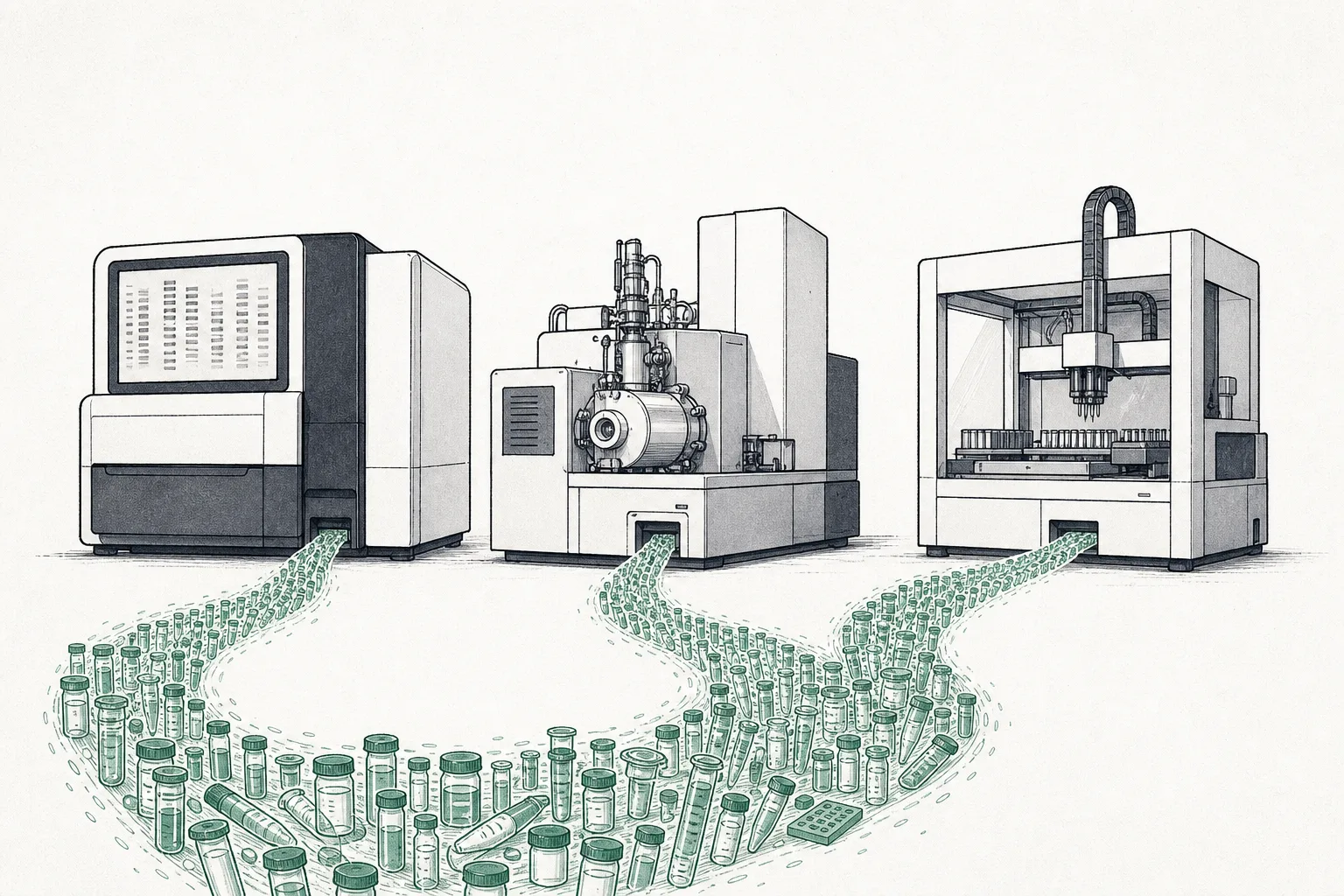
When we hear about a new cancer drug, a gene therapy, or an mRNA vaccine, we picture the pharma company. But behind every one of those discoveries, a set of machines is quietly at work — readers that decode DNA, scales that weigh molecules (mass spec), lab robots, and thousands of bottles of chemical reagents. These are the “picks and shovels” of the age of biology. And here's the key: they sell like a razor and blades — sell the machine once, then sell the reagents that get refilled every day for the machine's whole life. This market is worth nearly $200B a year, and it's one of the most stable, durable profit pools in all of medicine.
01What it is
Think of the gold rush. The people who actually got rich weren't the miners — they were the ones selling the picks, the shovels, and the jeans to the miners. Because whether or not anyone struck gold, the people selling the gear got paid every time. Life-Science Tools are the pick-and-shovel sellers of biology. No matter which company the race for a cancer drug, a gene therapy, or a new vaccine ends with, every lab has to buy its machines and reagents from this group first.
This node bundles three core families of tools that biology labs worldwide can't do without. (1) Gene readers (DNA sequencing / NGS) that read the A-T-C-G letters in a gene · (2) Molecular analyzers like mass spectrometry (weighing molecules one at a time to identify them) and chromatography (separating a mixture into its parts) · (3) Lab instruments and reagents — from liquid-handling robots to reagents, antibodies, and single-use test tubes.
On the megatrend map, this node is a branch under Tools, Diagnostics & CDMO within the bigger trend Biotech & Genomic Medicine. It sits in the “deepest layer of the supply chain” — the people who make the tools that pharma companies, universities, and hospitals then use. Its siblings next door are Diagnostics & Precision Testing (taking these tools to diagnose patients) and CDMO / Contract Manufacturing (making drugs under contract) — if this node is “the one who makes the picks,” the other two siblings are “the ones who take the picks and dig.”
NGS (Next-Generation Sequencing) = technology that reads millions of pieces of DNA at once, making it vastly faster and cheaper to read a whole genome · Mass Spectrometry = a machine that turns molecules into ions and weighs them, to identify what's in a sample (used to test drugs, proteins, contaminants) · Reagents / Consumables = the chemical reagents and disposables (flow cell, tubes, antibodies) that have to be refilled every time you run the machine — these are the “blades” that generate the real revenue.
02Why it matters — the high-margin razor-and-blades model
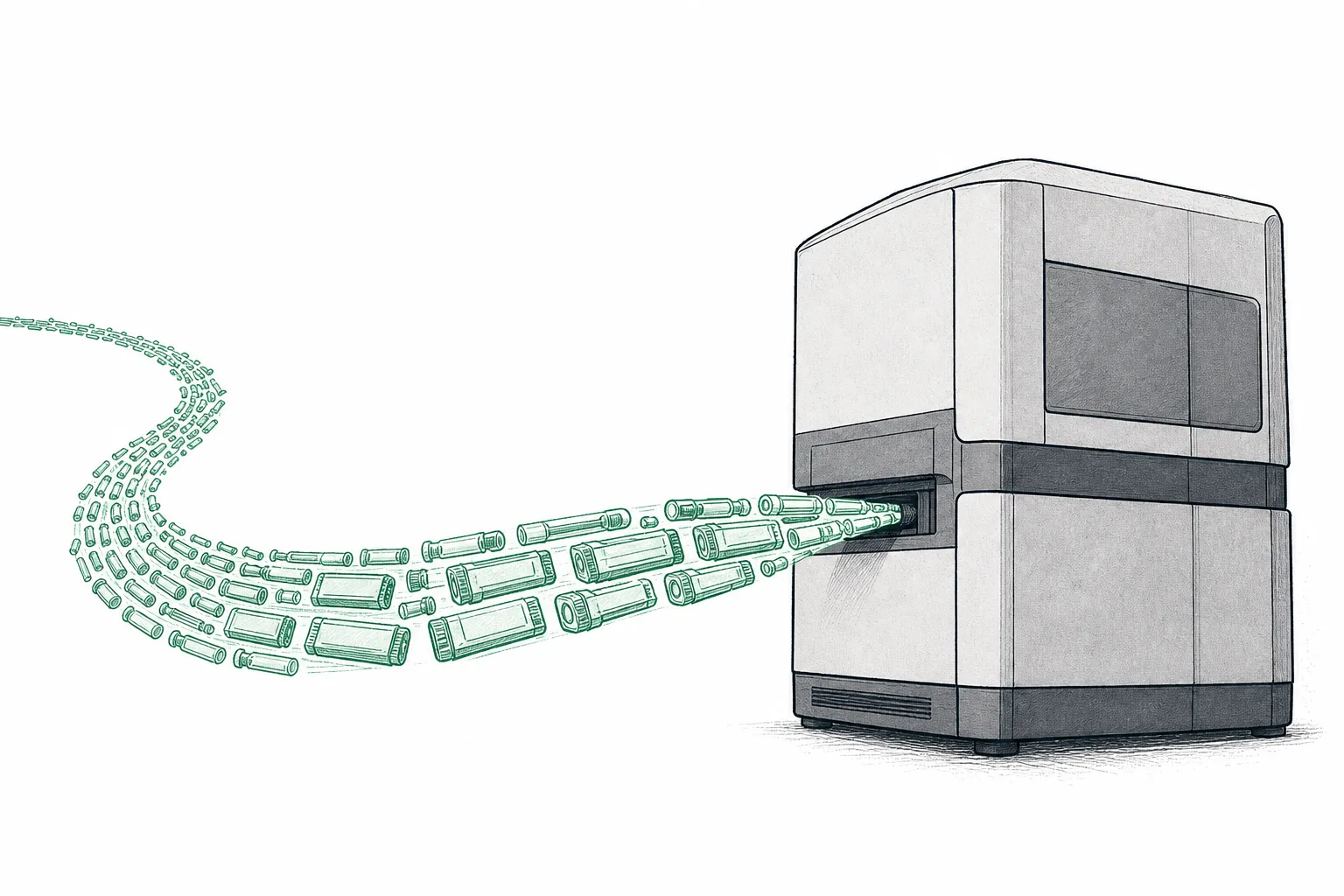
What makes this business special isn't the machine itself — it's the way it's sold. It's exactly the Gillette razor model: sell the machine (the razor) at a thin margin, but that machine then “infects” the customer into buying high-margin reagents (the blades) for the machine's whole ten-plus-year life.
The numbers from Illumina, the market leader in DNA readers, show the power of this model clearly. In 2024, 72% of the company's revenue came from reagents (consumables), not machines — and reagent gross margins run around 70–75%, versus about 40% on the machines. Put simply: every time a lab hits the button to read DNA once, Illumina earns money on reagents with a margin of nearly three-quarters.
Why does this matter economically? Because it builds a business that's predictable and steadily profitable in a way pharma can't be — a pharma company bets everything on whether one drug clears the FDA, but the toolmaker gets paid whether any given drug succeeds or fails. All it needs is for “people to keep doing research.” That's why companies like Thermo Fisher (market cap over $170B) and Danaher became giants that investors treat as the “defensive stocks” of healthcare.
03How it works (how DNA readers crashed the price)
The best example of this group's power is reading DNA. The first project to read a human genome (the Human Genome Project) cost around $1B and took years. But today Illumina's NovaSeq X reads a whole genome for under $200 — more than five million times cheaper in just over twenty years. Faster and steeper than Moore's Law in chips. So how did it do that?
The key is the phrase “massively parallel”. Instead of reading DNA one long strand at a time, an NGS machine chops the DNA into millions of tiny pieces, scatters them across a small glass plate called a flow cell, and reads “every spot at once,” one letter at a time, by shining light to make each base (A/C/G/T) glow a different color. A camera captures the whole plate, and a computer then stitches the pieces back into the full genome. The more spots you pack per plate (new models hit 16 terabases per round), the cheaper the cost per genome — and the flow cell and the glowing reagents are the “blades” you have to buy again every time.
Machines in the other families work on similar principles — mass spectrometry turns molecules into ions and flings them through an electric field, where heavier and lighter molecules reach the finish line at different times, revealing what's in a sample to a precision of one part in a trillion. All of it is about turning a “biological question” into a “signal you can measure in numbers” — and every measurement needs reagents.
04Where it sits in biomedicine
If you see the whole world of biomedicine as a knowledge factory, this group of tools is the “foundation” that every floor above rests on — no tools, no data; no data, no drugs. It's inseparably wired into the rest of the ecosystem.
- AI drug discovery feeds on it directly: AI models that predict protein structures or design drugs have to consume enormous amounts of biological data — and that data all comes from sequencing and mass spec machines. The hungrier AI gets for data, the more demand grows for this group of tools. It's a two-way, mutually dependent relationship
- It's the toolkit for Diagnostics & Precision Testing: finding cancer from blood (liquid biopsy), prenatal screening (NIPT), detecting pathogens — all of it takes these same sequencing machines and uses them on real patients. This sibling node is the “clinical end” of the same technology
- It's the infrastructure for CDMO and drug manufacturing: contract biologics factories use mass spec and chromatography to check the quality of every lot, and bioprocessing equipment to make the drug — which is exactly why Thermo Fisher and Danaher poured billions into bioprocessing acquisitions
- Driven by an aging society: it connects to the whole Biotech trend and gets a tailwind from longevity and aging populations — the older the world gets and the more it wants precision medicine, the more demand for reading genes and analyzing molecules spikes
05Where it stands now
The big picture right now has two slightly conflicting stories. On one hand, the market has passed through a slump — in 2023–2024 the industry hit a strong headwind as funding into biotech companies contracted (the biotech funding downturn), making labs slow to buy new machines, and China, a big market, cut its procurement budgets. On the other hand, the long-term structure is still strong because the “blades” (reagents) keep flowing in, and demand from AI and precision medicine is coming back.
The market structure is “all-in-one giants vs specialized specialists.” The giants are led by Thermo Fisher (the biggest in the business, market cap over $170B, a product in every category) and Danaher, known for buying companies and squeezing out efficiency. On the specialist side there's Illumina, which holds about 80% of the world's DNA-reading market (and over 90% in clinical work) · Agilent and Waters, strong in mass spec/chromatography · and Bruker, strong in high-end analytical instruments.
The hottest part is reading DNA. The price crashing below $200 per genome opens the door for gene reading to become routine in the clinic. The NGS market alone is expected to grow from about $11.8B in 2026 to $22.4B in 2031 (~14% a year). But Illumina's throne is starting to be challenged — there are new rivals like Ultima Genomics, which claims it can already do a “$100 genome,” and the Chinese player MGI, which is taking share in its home market.
06The road ahead — from reading the “average” to reading “one cell at a time”
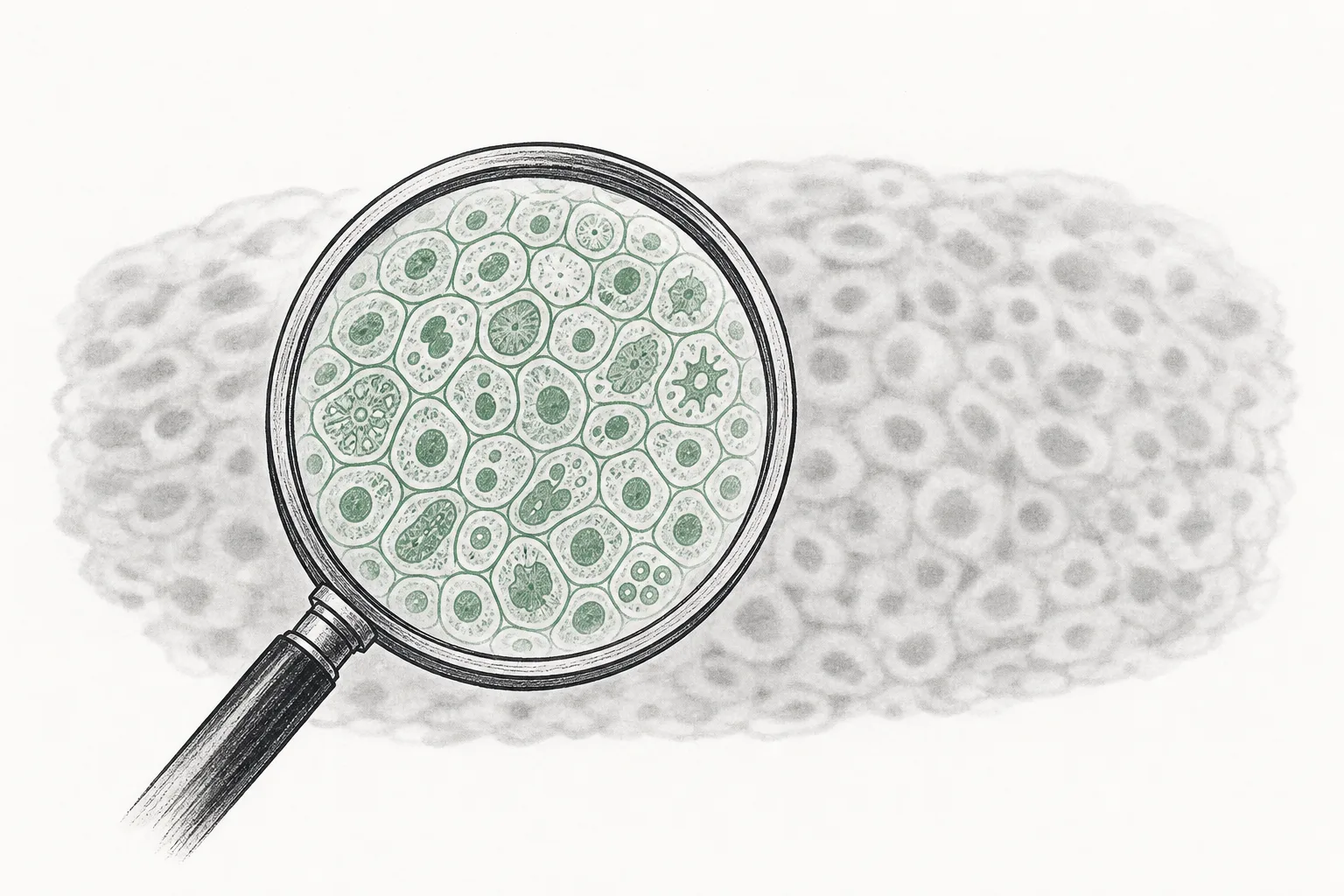
The first direction is ever-higher resolution. Older machines read DNA from a big chunk of tissue, getting only the “average” of millions of cells. But new technologies like single-cell sequencing (reading one cell at a time) and spatial biology (seeing where in the tissue a gene is active) open a new dimension where researchers can spot the difference between a cancer cell and a normal cell sitting right next to it. The single-cell market is expected to grow from ~$1.95B (2025) to ~$3.46B (2030) — and 10x Genomics is the pioneer of this field.
The second direction is “long-read” sequencing. The older machines read DNA in short pieces and stitch them back together, which can miss the repetitive regions. But the long-read technology of PacBio and Oxford Nanopore reads a long strand in one go, seeing structures that short-read machines overlook — a duopoly fighting over a fast-growing market (nanopore holds about 56% of the long-read market).
The third direction is the feedback loop with AI. The more biological data the tools produce, the better AI gets at predicting and designing drugs; and the more drugs AI designs, the more tools are needed to test and verify them — a loop that accelerates itself. So demand for tools doesn't just grow with the number of researchers, but with the progress of AI too.
07Challenges & risks
The first risk is the biotech funding cycle. Reagent revenue may be steady, but “machine” sales are tied to the capital flowing into the research world. When the biotech capital market goes cold (like 2023–2024) or the government cuts university research budgets, labs immediately slow their purchases of new machines — a business with a solid revenue base but a “growth” portion that swings with the mood of the capital market.
The second risk is geopolitics and the splitting into two worlds. China is both a big market and a fast-growing rival — BGI/MGI overtook Illumina in China's domestic share back in 2022, backed by the state. Meanwhile the US side passed the BioSecure Act (2024) to shut these Chinese companies out of the American market. The result is a supply chain splitting into two systems: Western players risk losing the China market, and Chinese players risk being unable to enter the West.
The third risk is concentration and patent wars. Nearly the entire DNA-reading market is in Illumina's hands, giving the company strong power to set high reagent prices — but that also draws in competitors and patent lawsuits (Illumina and BGI have sued each other in several countries). If a new rival can really deliver a cheaper price at scale, those gorgeous 70–75% reagent margins could be squeezed — and that is the very heart of the whole model's profit.
In short: this node is the tool layer beneath every medical advance — the gene readers, the molecule scales, and the reagents that flow in every day. It's one of the quietest yet most powerful businesses in the healthcare economy, and the more biology becomes a matter of “data,” the more important the role of “the people who sell the data readers” becomes.