Megatrend · Biotech & Genomic Medicine
The company that "thinks up" a drug and the one that "makes" it are usually not the same company
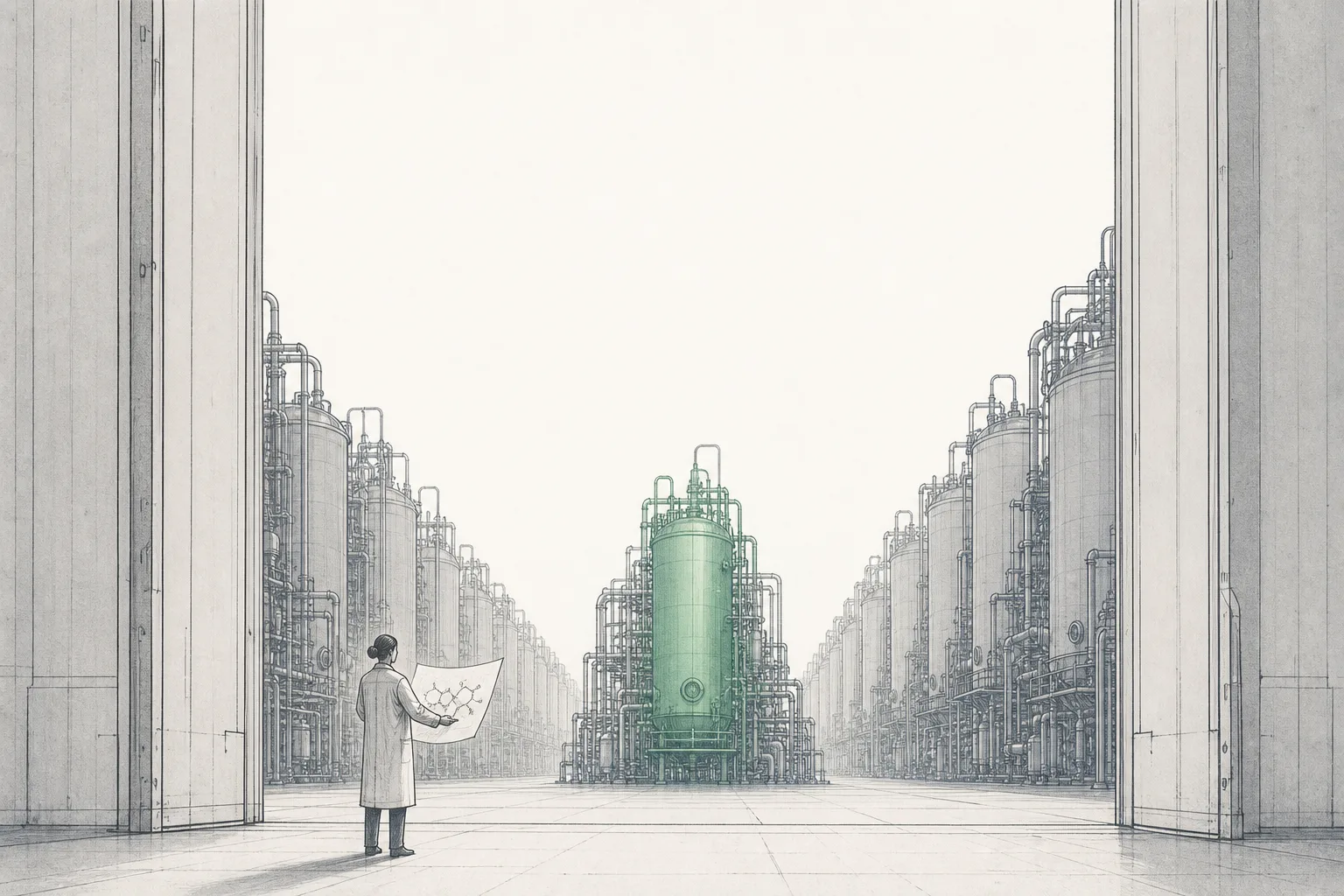
When we see a famous drug's name, we tend to assume the company that owns it makes it too — but the truth is, many modern biologic drugs are "built" in the factory of a company you've never heard of. The drug company designs the molecule; a CDMO (Contract Development & Manufacturing Organization) is the contract factory that takes that design, develops the process, and actually makes it. In plain terms, it's the "TSMC of pharma" — a foundry that anyone who designs a drug can hand the manufacturing to. And in an era when GLP-1 and biologics are exploding demand, having a spare fermentation tank is like holding gold.
01What it is
Picture the chip world. Companies like NVIDIA or Apple design chips but own no factory of their own — they send the design to TSMC to make. The biologics world has exactly the same structure. Many drug and biotech companies think up and design the drug molecule but don't build the factory themselves. They hire a contract factory called a CDMO to "develop the manufacturing process" and then "actually make" it for them.
CDMO stands for Contract Development & Manufacturing Organization — notice the word Development in there. That's the key difference. It's not just a factory that stamps out a drug from a finished recipe; it's the one that turns "a molecule that worked in a test tube" into "a process that can make it by the thousands of liters, consistently, to FDA standards" — a hard job, and an art in its own right.
On the megatrend map, this node is a leaf under Tools, Diagnostics & CDMO within the big trend Biotech & Genomic Medicine. It sits in the deepest layer of the chain — the "builder" behind every drug. Its neighbors are Life-Science Tools & Sequencing (who make the tools and materials the CDMO uses) and Diagnostics & Precision Testing (who make the diagnostic kits). To compare with the chip world once more — this node is the Foundry of drugs.
CDMO = a contract factory that both develops the process and makes drugs for other companies · biologic = a drug made from living things, like an antibody, produced by culturing cells — the opposite of a "small molecule" drug, synthesized purely by chemical reaction · fill-finish = the final step, filling the finished drug into vials/syringes under sterile conditions — a chronically short bottleneck
02Why it matters — capacity is the moat
Why CDMOs became a globally important business comes down to one sentence: building a biologics factory is enormously expensive and slow. One large cell-culture plant takes billions of dollars to build and 4–5 years to construct and get certified. A new biotech that's just thought up a drug has neither the money nor the time to build its own — so hiring a CDMO isn't a choice, it's the "only way" to get a drug to market in time.
As a result, outsourcing has become almost the default for the industry. A survey of biologics makers found that about 87% outsource at least some steps, and steps like fill-finish and analytical testing are outsourced at around 85% — numbers that show the whole drug industry today rests on someone else's manufacturing capacity.
But what makes now more special than any era before is the GLP-1 wave — weight-loss/diabetes drugs like the semaglutide class, where demand has exploded. The GLP-1 market earned about $53 billion in 2025 and is expected to surge to $157 billion in 2030, with prescription volume growing ~38% a year on average since 2022. Most of these drugs are peptides/biologics that have to be made in fermentation tanks and filled under sterile processes — meaning every extra dose sold is capacity demand flowing straight into CDMOs.
03How it works (from cell to vial)
Small-molecule drugs (like paracetamol) are made by chemical reaction in a mixing tank. But biologics are "cultured" up from living cells — like making beer or cheese, except the cleanliness and precision have to be at drug grade. Let's walk step by step through how a single vial of an antibody drug comes to be.
The hidden difficulty is that "the process is the product" — with biologics, changing the fermentation tank, changing the cell line, or even changing the factory can leave the resulting drug with slightly different properties, enough to require a whole new round of testing. This is why customers find it so hard to switch CDMOs once production has begun, and why a CDMO that has carried a "drug" successfully through certification can hold onto a customer for a decade or more — the knowledge of how to "make the process stable" is the real, un-copyable value, not just the fermentation tank itself.
04Where it sits in the drug world
The CDMO is the "foundry in the middle of the belt" of the drug industry — it takes designs from one party, uses materials from another, and hands the drug to the next. It works in concert with every layer of the ecosystem.
- Makes things for the drug and biotech companies that design the drugs: from biotech startups that have only a molecule, to big pharma that wants to add capacity fast without building its own plant — the CDMO is the one that turns a "drug on paper" into a real drug
- Relies on Life-Science Tools as raw materials: single-use fermentation tanks, cell-culture media, filtration resins, and analytical instruments are all bought from the Tools group — interestingly, a giant like Thermo Fisher sells both the "instruments" and the "CDMO service" at once
- Takes in new-generation drugs from Biosimilars and gene/cell therapy: when an originator drug's patent expires, the biosimilar makers need capacity, and especially hard-to-make drugs like ADCs and cell therapies push companies even harder to hire specialist CDMOs
- Starting to use AI to speed up and control the process: AI helps design cell lines and control fermentation-tank conditions for higher yields, faster — a new technology layer arriving to reinforce manufacturing that used to rely on pure experience
05Where it stands now
The biggest story in the industry right now is the "scramble for capacity" — demand for biologics, GLP-1 especially, is growing faster than factories can be built. In 2025 the industry announced about $24.9 billion in combined capacity investment, and what's notable is that 74% of that money (~$18.5 billion) flowed into the U.S. — reflecting both the overflowing demand and the "make it near home" trend.
The world's leader is Lonza of Switzerland. In 2025 it spent $1.2 billion to buy Genentech's plant in Vacaville, California, instantly adding a big block of U.S. capacity. The hottest challenger is Samsung Biologics of Korea, playing the "enormous scale" game — its fifth plant in Incheon is pushing total capacity toward about 784,000 liters, the most in the industry, vaulting it into the world's top 3. And there's Fujifilm of Japan, which pivoted from a photographic-film company into a world-class CDMO.
But the shadow over the whole industry is the fate of China's WuXi group. Both WuXi Biologics and WuXi AppTec were once leaders that U.S. customers leaned on heavily — it's estimated that about 1 in 4 drugs used in the U.S. pass through WuXi AppTec's hands. But the newly-in-force BIOSECURE Act is pressuring Western customers to move work out, bit by bit — and this enormous block of demand is flowing toward Lonza, Samsung, and players outside China.
06The road ahead — the scramble for capacity
The first direction is that the GLP-1 wave will keep driving demand for years. As this weight-loss/diabetes class expands into new indications (heart, kidney, brain) and makers race to make oral versions in place of injections, the volume of drug to be made grows so vast that the drug developers can't make it all themselves and must rely on CDMOs as a relief valve for capacity — the biggest structural tailwind for this node.
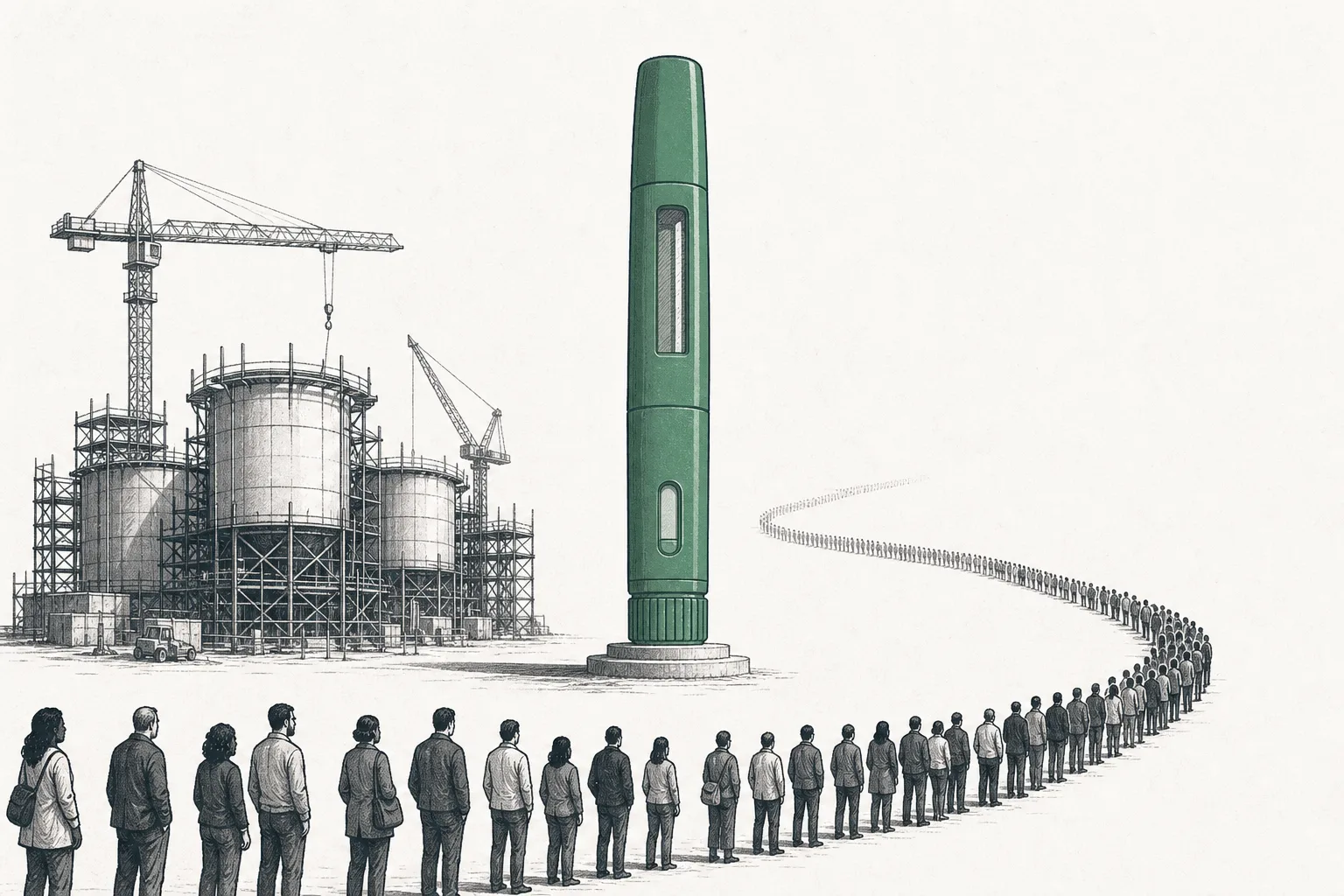
The second direction is moving production back home (onshoring). Both post-COVID health security and political pressure on China have the U.S. and Europe wanting key drugs made domestically — the 74% of money that flowed into the U.S. in 2025 is the first sign. CDMOs that already have factories in the West (like Lonza, Thermo Fisher, Fujifilm) gain an immediate edge.
The third direction is competing on "difficulty" rather than just "size". New-generation drugs like ADCs, gene therapy, and cell therapy are far harder to make than ordinary antibodies, opening room for specialist CDMOs (such as WuXi XDC, which focuses on ADCs) to grow even without the biggest fermentation tanks — future value moves to whoever can "make what others can't."
07Challenges & risks
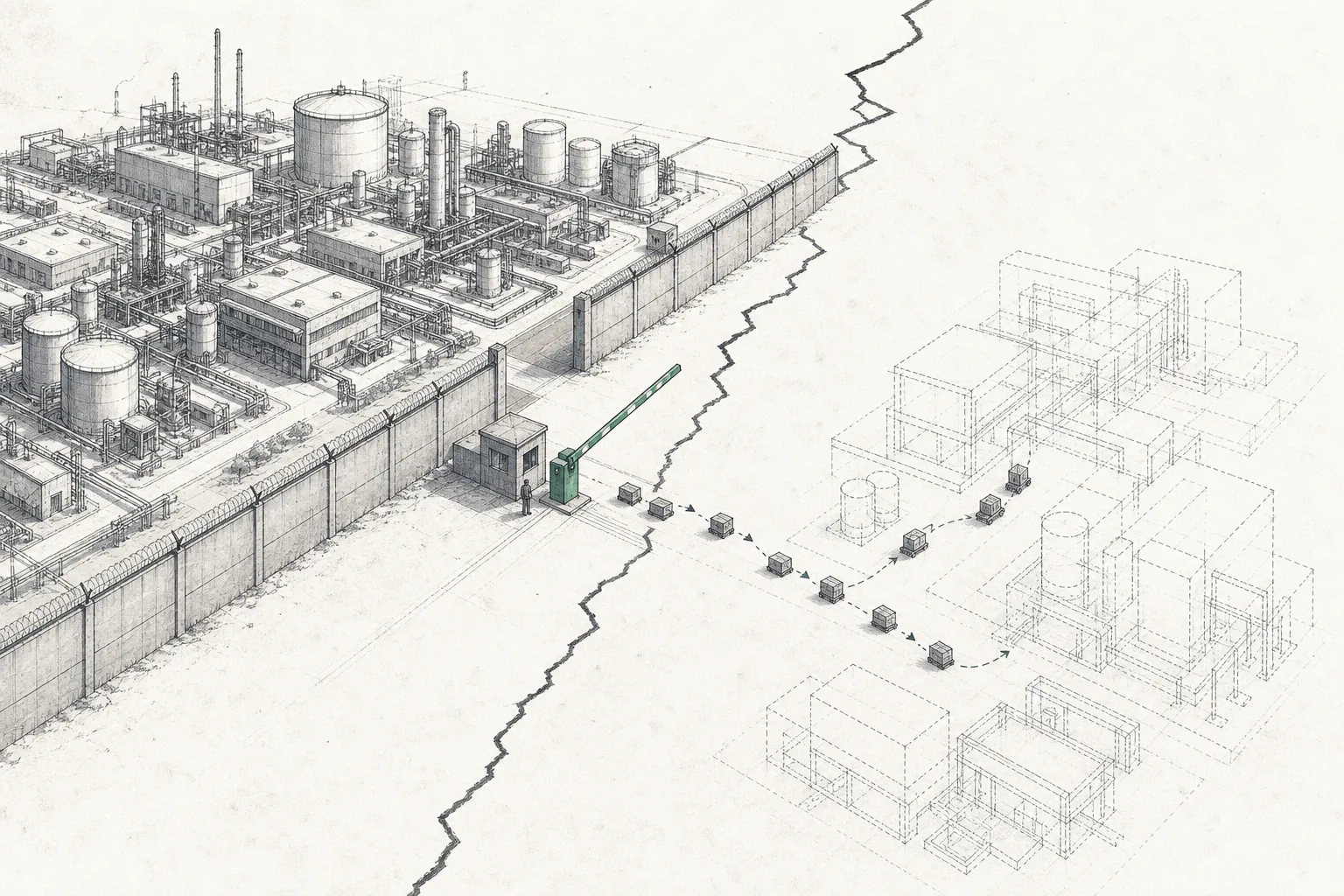
The first risk is the double-edged sword of geopolitics. The BIOSECURE Act, signed into law late in 2025 (via the NDAA defense bill), and the placing of WuXi AppTec on the Defense Department's 1260H list in June 2026, are shaking the industry. There's a grandfather period letting existing contracts run to roughly 2031–2032, but in the short-to-medium term it could tighten the industry's capacity and push prices up, as customers move work out of WuXi all at once while new factories aren't finished yet.
The second risk is heavy investment and the risk of overcapacity. A biologics factory is a bet of billions of dollars placed 4–5 years in advance. If everyone rushes to build at once to catch the GLP-1 wave and then demand slows or a key drug stumbles, there's a risk of overcapacity that pushes contract prices and profits down across the industry — it's a business where the "timing of investment" matters as much as the skill.
The third risk is dependence on a few customers and drugs. Many CDMOs tie a big chunk of their revenue to a few hit drugs or a few big-pharma customers. If that drug faces competition, gets withdrawn, or the customer decides to pull the work back in-house, revenue shakes immediately — and because the product is a "drug," a single quality failure or contamination damages trust far more heavily than in an ordinary business.
In short: this node is the behind-the-scenes factory that actually builds every drug other companies design — the "TSMC of pharma," where the more biologics and GLP-1 demand grows, the more powerful scarce capacity becomes. And in an era where politics is starting to split the supply chain, having fermentation tanks in the right place is like holding the most important card in the drug industry.