Megatrend · Longevity
The one corner of anti-aging you can "buy" today — for better or worse
Among all the dreams of living longer, there's one corner that's stranger than the rest — it isn't waiting on a lab, it isn't waiting on the FDA, it's already a real product on the shelf with real revenue. That's "NAD+ & Cellular Energetics": supplements that claim to refill the "cellular fuel" that declines with age. People buy them by the millions of bottles, and one company pulls in over $129 million a year — but here's the thing that has to be said plainly: the science is still running several steps "behind the market." These products really do raise NAD+ in your blood. But do they actually make you "age slower"? No one has proven that yet.
01What it is
Start with the lead character — a molecule called NAD+ (en-ay-dee-plus, short for nicotinamide adenine dinucleotide). The name sounds complicated, but its job is simple and very important: it's a "coenzyme" that every cell in your body has to use in order to (1) turn food into energy in the cell's tiny power plant (mitochondria) and (2) feed the cell's "repair crew" — repair enzymes like sirtuins and PARPs can't work at all without NAD+.
This node — NAD+ & Cellular Energetics — is a sub-branch under the megatrend Longevity & Life Extension, and one thing clearly sets it apart from its siblings: it already has a real consumer market. While the other branches (like cellular reprogramming or senolytics) are still circling around labs and clinical trials, this corner has become a "supplement" that actually sits on the shelf, with someone buying and taking it every day.
The whole idea rests on a single observation: NAD+ in our bodies "declines" steadily with age. Research has found that in many tissues of middle-aged people, NAD+ is down to only about half of what it was when they were young. So the hypothesis is straightforward — if this thing drops and the cells decay, why not try to "refill it"? But the body doesn't absorb NAD+ well when you take it directly, so the field turned to "precursors" that the body can convert into NAD+ on its own — the two lead actors are NMN and NR.
NR (nicotinamide riboside) and NMN (nicotinamide mononucleotide) are two "raw materials" the body can build up into NAD+. Think of them as the ready-made parts of NAD+ — take NR/NMN, and the body assembles them into NAD+ itself. The two work in similar ways, but they differ in their "legal status" in the U.S. — and that becomes the big drama of this lesson.
02Why it matters — anti-aging you can actually buy
What makes this node interesting isn't that its science is the most solid — quite the opposite, its evidence in humans is weaker than several other branches. What makes it special is that it's the one corner of Longevity with "real revenue" flowing in today. While other anti-aging drugs still have to wait 5–10 years for trial results, NAD+ supplements have become a product you can walk into a store and buy right now.
The market behind it is growing fast, too. The U.S. market for NAD+ precursor supplements is estimated at about $350 million in 2025, projected to grow to ~$779 million by 2035 (CAGR ~8.4%). The global NMN-only market is around $210–340 million, growing ~8–13% a year, while some research houses that count "NAD+ products" in the broadest sense (including raw materials, IV, cosmetics) think it could reach ~$12 billion by 2033 — figures swinging this wide tell you one thing: the "definition of the market" isn't settled yet, but the direction is clearly up.
But what gives this story its flavor is the phrase "consumer-revenue edge" — its advantage is that it can make money right away, without having to prove it actually extends life. Supplements in the U.S. can be sold without passing a drug-style efficacy proof; they just have to be safe and not overclaim. This is both the strength (money comes in fast) and the weakness (no pressure to seriously prove anything) of the whole field.
03How it works — the cell's "fuel + repair crew"
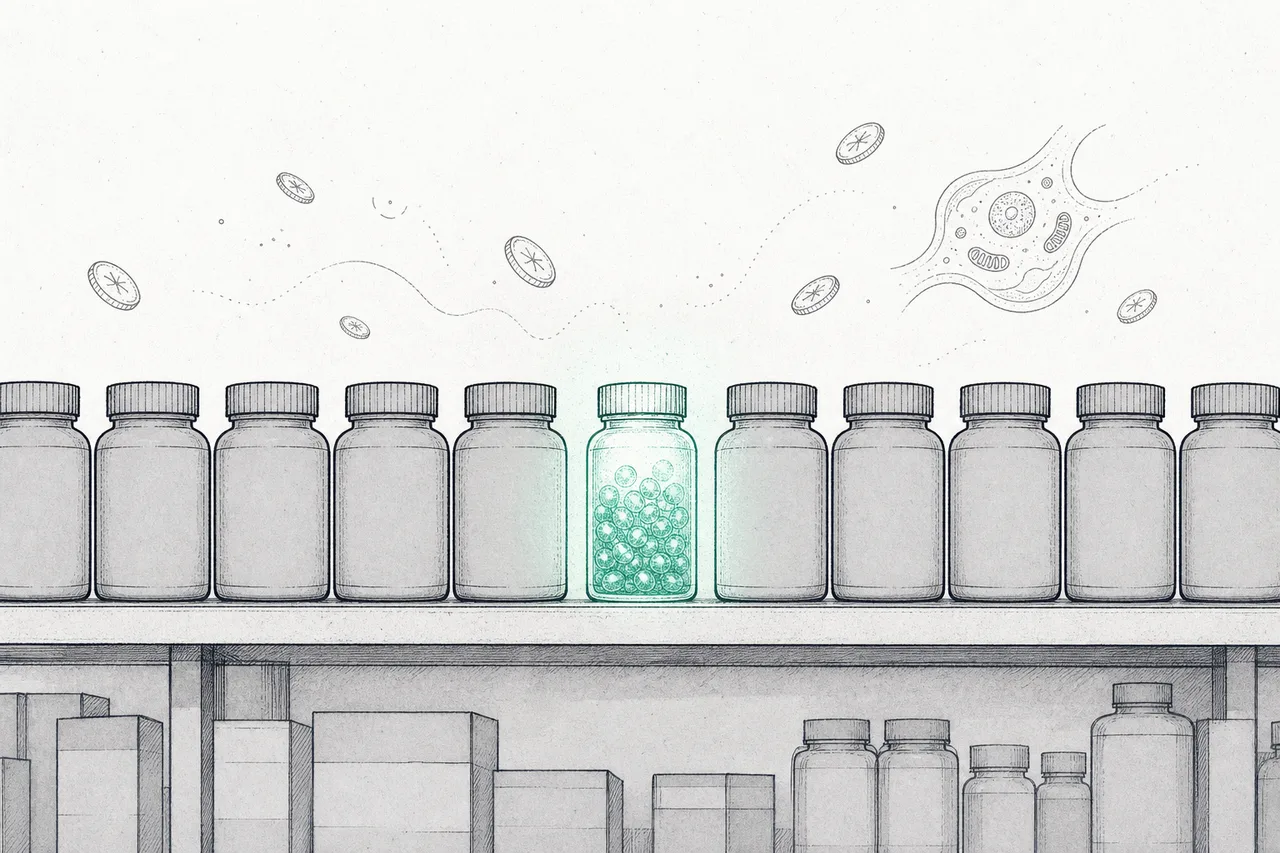
Think of NAD+ as an "energy coin" circulating in every cell, and this coin is spent on two main jobs. The first is making energy — it helps shuttle electrons through metabolism in the mitochondria (the cell's power plant). Without NAD+, a cell can't produce energy. The second is being the repair crew's "wages" — repair and maintenance enzymes like sirtuins (which look after / repair DNA and regulate inflammation) and PARPs (which fix damaged DNA) can only work when NAD+ is there to pay them.
Now here's the problem of aging — as you get older, this energy coin is both produced less and spent more wastefully at the same time. DNA damage piles up with age, forcing PARP to work overtime to repair it — and a hard-working PARP "sucks up" enormous amounts of NAD+ (research has found that fully active PARP1 can consume up to ~80% of the NAD+ in the nucleus). The result: less NAD+ is left to feed the sirtuins, repair and mitochondrial upkeep get worse, and the cell decays faster.
So the NMN/NR hypothesis is simple: add the raw materials and let the cell make enough energy coins to pay both the power plant and the repair crew. Let's walk through this picture step by step.
Here we have to be clear — this picture is a beautiful hypothesis, and the part where "NMN/NR really do raise NAD+" is proven in humans. But the final step — that "higher NAD+ makes you age slower" — is still a seam where the human evidence isn't complete. We'll come back to this in Chapter 5.
04Where it sits in Longevity
This node is one of 7 approaches under the megatrend Longevity & Life Extension, and its position is clear — it's the "commercial wing" of the field, the corner that already earns revenue from consumers, while most of its siblings are still cash-burning research.
- A close cousin of Metabolic Aging & Geroprotectors: both rest on the same idea — "aging is a matter of metabolism gone wrong, and we can tune it back with molecules." The difference is that the geroprotector side uses drugs (metformin, rapamycin), while this side uses supplements (NMN, NR) that can be sold without being drugs — which gets it to market much faster, but with looser evidence
- Leans on Longevity Diagnostics & Aging Clocks to prove itself: the headache of this whole field is "how do you know it's working?" Right now companies can only measure that blood NAD+ went up. But NAD+ rising ≠ aging slowing. If biological clocks get accurate enough, this field will finally have a tool to prove (or disprove) itself
- Feeds customers to Longevity Clinics & Healthspan Services: this is the junction where money flows hardest — NAD+ isn't sold only as a pill, but as a "NAD+ IV drip" infused into the veins at anti-aging clinics, at several times the price. The leader, Niagen, has its IV line sold through over 1,200 clinics in the U.S.
- Sits on the knowledge base of Biotech & Genomic Medicine: both the discovery of NR (by Dr. Charles Brenner at Dartmouth in 2004) and the production of these precursors via fermentation with engineered yeast are all fruits of the biochemistry and genetic engineering of the Biotech field
Notice that the value of this node isn't concentrated in the "molecule" alone — it's spread across the whole chain: the ingredient, the consumer brands, the IV line in clinics, and the patents that wall out competitors. That's why a player who "owns the patent + the brand" has the edge over someone who just sells generic NMN powder.
05Where it stands now
Let me set two truths side by side first, because this is the heart of the lesson. The commercial side: it's a real success — there's revenue, profit, and millions of customers. But the scientific side: it still can't prove that it makes people "age slower." Human trials confirm clearly that NMN and NR really do raise NAD+ in the blood, and safely (Elysium's study, for example, found NAD+ up ~40% from baseline; several trials found NAD+ doubling within 2 weeks) — but no trial has yet proven a tangible anti-aging / life-extending effect in healthy people. Anyone who says "take it and you'll definitely live longer" is selling you something.
The most dramatic story of this node is the FDA-vs-NMN saga. In November 2022, the FDA ruled that NMN cannot be sold as a supplement. The technical reason: a drug company (Metro International Biotech) had registered NMN as a "drug under investigation" before it was legally sold as a supplement — and under the U.S. "drug preclusion" rule, once something becomes a drug first, it can't be a supplement. The ruling shook the whole market and pushed the big players toward NR instead of NMN, because NR doesn't run into this problem.
On the public-market side, the clearest leader is Niagen Bioscience (formerly ChromaDex, renamed in March 2025) — and its numbers tell a good story of how Longevity's "commercial wing" really makes money:

06The road ahead
The first direction is "moving from pills to clinics." The margin on selling supplements as pills is squeezed by price wars (especially NMN powder from China). So the smart players are pushing their business toward NAD+ IV and in-clinic services, which charge much more per unit and are harder for rivals to copy — the big money in this field may end up in clinics rather than on the store shelf.
The second direction is "from supplement to real drug." Interestingly, NMN is already being studied by drug companies as a drug (that's exactly what sparked the FDA drama). If one day a drug-level trial proves that a NAD+ precursor really can treat some age-related disease, the value jumps another level — but in exchange for the costs and risks of a drug, no longer those of a supplement.
The third direction is "waiting for the tool to prove it." If the aging clocks field can measure biological age accurately enough, it will be the first time this industry can prove (or disprove) whether "higher NAD+ really translates into slower aging" — and that result will decide whether this corner of Longevity grows into an evidence-backed industry, or stays just a market of hope.
07Challenges & risks (straight talk)
This node is interesting because it has a real market — but you also have to look at it with a cold eye, because its risks are clearly different from the other branches of Longevity.
The first and most important risk is "selling something whose end-result still can't be proven." All we can prove is that blood NAD+ goes up, but that's a "surrogate marker," not evidence that aging has slowed. The history of medicine is full of cases where the numbers in the blood improved but the real health outcomes didn't. As long as there's no long-term human trial, the word "anti-aging" is still hope, not fact.
The second risk is "legal ground that can shift." The FDA-NMN saga (banned in 2022 → accepted in 2025) shows that a whole product category can be made legal or illegal by a single ruling. A company that relies on NMN as its mainstay carries a regulatory risk it can't control — which is exactly why a leader like Niagen chose to stand on NR, where the law is steadier.
The third risk is "price wars and commoditization." NAD+ precursors, especially NMN, can be made by many manufacturers (mostly in China), driving prices down and margins thin. Anyone not walled off by a patent or a strong brand gets squeezed until almost no margin is left — which is why Niagen's "ownership of the NR patent" is its single most important moat.
In short: the charm of this node is that you can touch it — you really can "buy" this corner of anti-aging today. But honesty demands you add that "buyable" is not the same as "proven." To understand this node is to understand the widest gap in Longevity — the gap between what the market has already sold and what the science can confirm.