Megatrend · Longevity
Same birthday, but your bodies aren't the same age
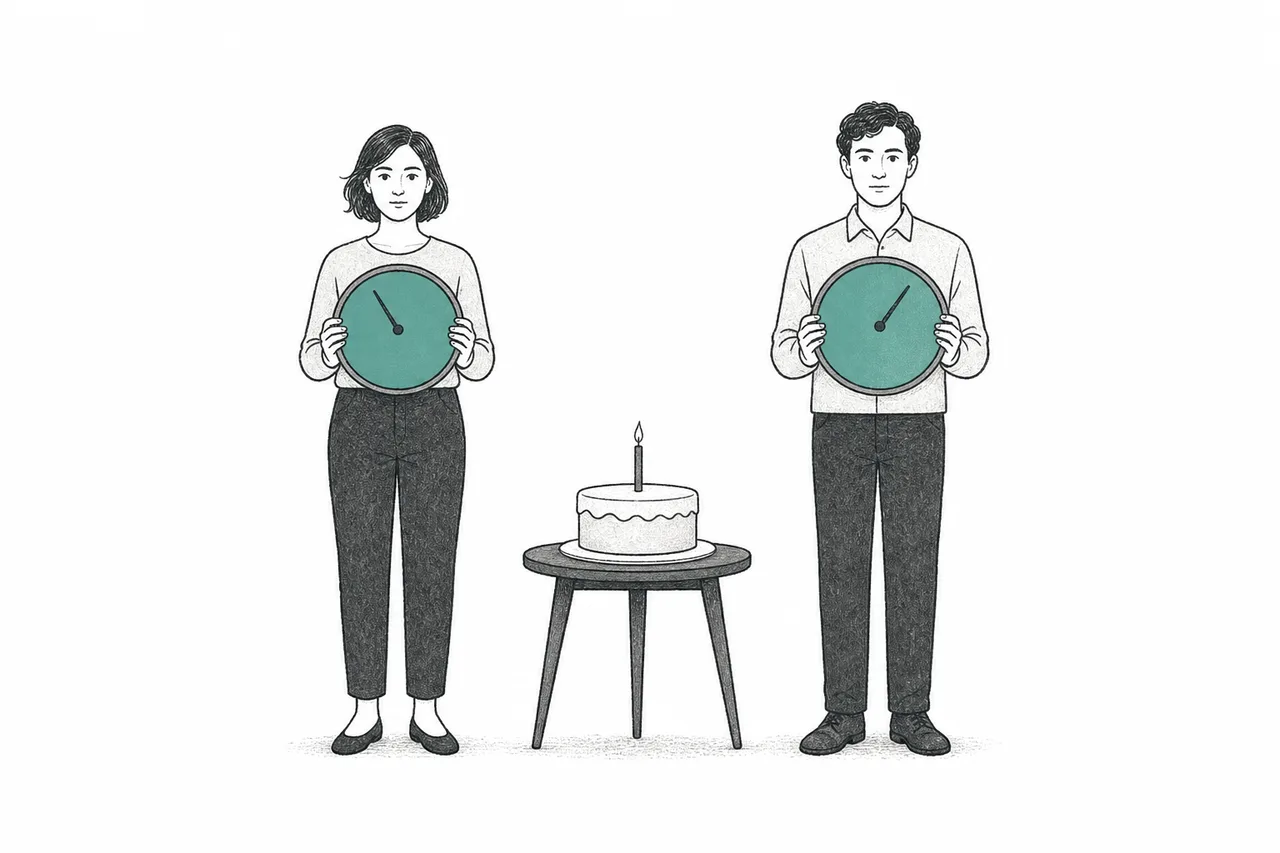
Picture two people born on the same day — their IDs both say 50. But inside, one body might be "aging" like a 45-year-old and the other like a 58-year-old. So how do you measure that difference as a number? This is the world of "aging clocks" — tools that try to read your body's real age from the chemical marks on your DNA. They're the "shovel and scale" of the entire anti-aging industry, because if you can't measure age, you can't prove which drug or method actually works. But the honest truth to state plainly: these clocks still disagree with each other, and none is yet approved for making medical decisions.
01What it is
There's one line the anti-aging field repeats until it sticks: "you can't manage what you can't measure." It sounds like a business cliché, but with "aging" it's a deadly serious problem — because aging has no unit. We measure weight in kilograms and blood pressure in numbers, but "how old is your body right now?" — we've never had a ruler for that.
This node — Longevity Diagnostics & Aging Clocks — is a sub-theme under the megatrend Longevity & Life Extension, and it's the attempt to build that "ruler for aging." At its heart is the idea that our bodies have a "biological age" that may not match the "chronological age" counted from our birthday — and if you can measure biological age, you can tell who ages fast, who ages slow, and what actually helps you age slower.
The field's most prominent tool is the "aging clock", which reads your age from tiny chemical marks on your DNA (we'll dig into that in Chapter 3). Let me draw an important line first: this node measures aging overall — not the blood test that detects multiple cancers (MCED), which is a different thing, a screening tool for specific diseases, not a measure of biological age.
Chronological age = your calendar age, counted from your birthday (everyone adds one year at the same rate) · Biological age = the age your cells and body's "real condition" signal — two people who are both 50 on the calendar can have biological ages 10 years apart, depending on genetics, lifestyle, stress, sleep, diet, and so on · this node's goal is to measure that biological age as a credible number.
02Why it matters — selling the shovels
There's an old line in investing: in a gold rush, the ones who get rich for sure aren't the miners, they're the shovel sellers — because a miner may or may not strike gold, but everyone has to buy a shovel. This is the heart of the thesis that makes this node especially interesting.
The whole anti-aging field — anti-aging drugs (geroprotectors), cellular reprogramming, longevity clinics — shares the same hardest question to answer: "So how do you know it worked?" People don't die fast enough to sit and wait for a real lifespan reading. If you have to wait 30–40 years to prove a drug extends life, you can barely test anything.
Aging clocks are the way out of that problem — they promise to tell you quickly which method makes the body "age slower," without waiting for anyone to actually grow old or die. Every drug company, every clinic, every trial needs this measuring device — this is the "shovel" everyone in the anti-aging gold rush has to buy.
The market behind it is growing fast, too. The "biological age testing" market was valued at about $1.8 billion in 2025 and could grow to ~$4.3 billion in 2034 (CAGR ~10%) — and zoom in on just the "aging clock / epigenetic clock" segment and some houses see it growing as fast as ~18% a year, faster than the average for the whole anti-aging field.
03How it works — reading age from marks on your DNA
The most famous aging clocks run on a phenomenon called DNA methylation — it sounds hard, but the idea is simple. Think of your DNA as one long book. Over a lifetime, tiny "chemical tags" (methyl groups) attach to or fall off various spots in that book — like someone sticking and peeling sticky notes on the pages. These tags control which genes are "on" or "off."
The amazing part is that the pattern of these tags changes systematically with age. Some spots gradually get more tags as you grow older; others gradually lose them. In 2013, a researcher named Steve Horvath found that if you look at just 353 spots that change predictably and run them through a math formula, you can predict a person's age with stunning accuracy — a correlation with real age above 0.9 and an average error under 5 years. This is the "Horvath clock" that sparked the whole field.
Methylation isn't the only kind of clock. There are clocks that read from proteins in the blood (proteomic clocks), from levels of inflammation (inflammatory clocks like iAge), from sugars attached to proteins (glycans), all the way to simple functional measures like walking speed or grip strength — which predict mortality risk surprisingly well. But the star and the best-seller right now is still the epigenetic clock that reads from DNA methylation.
Epigenetics = a layer of information "above" your DNA that controls which genes turn on/off, without changing the DNA code itself · DNA methylation = the most common epigenetic mechanism — attaching a tiny chemical group (methyl) to a specific spot on the DNA (called a CpG site) · an aging clock picks a set of CpGs that change systematically with age and reads out an "age" — the device that reads millions of spots at once is the methylation array chip from biotechnology companies.
04There isn't just one clock — and they disagree
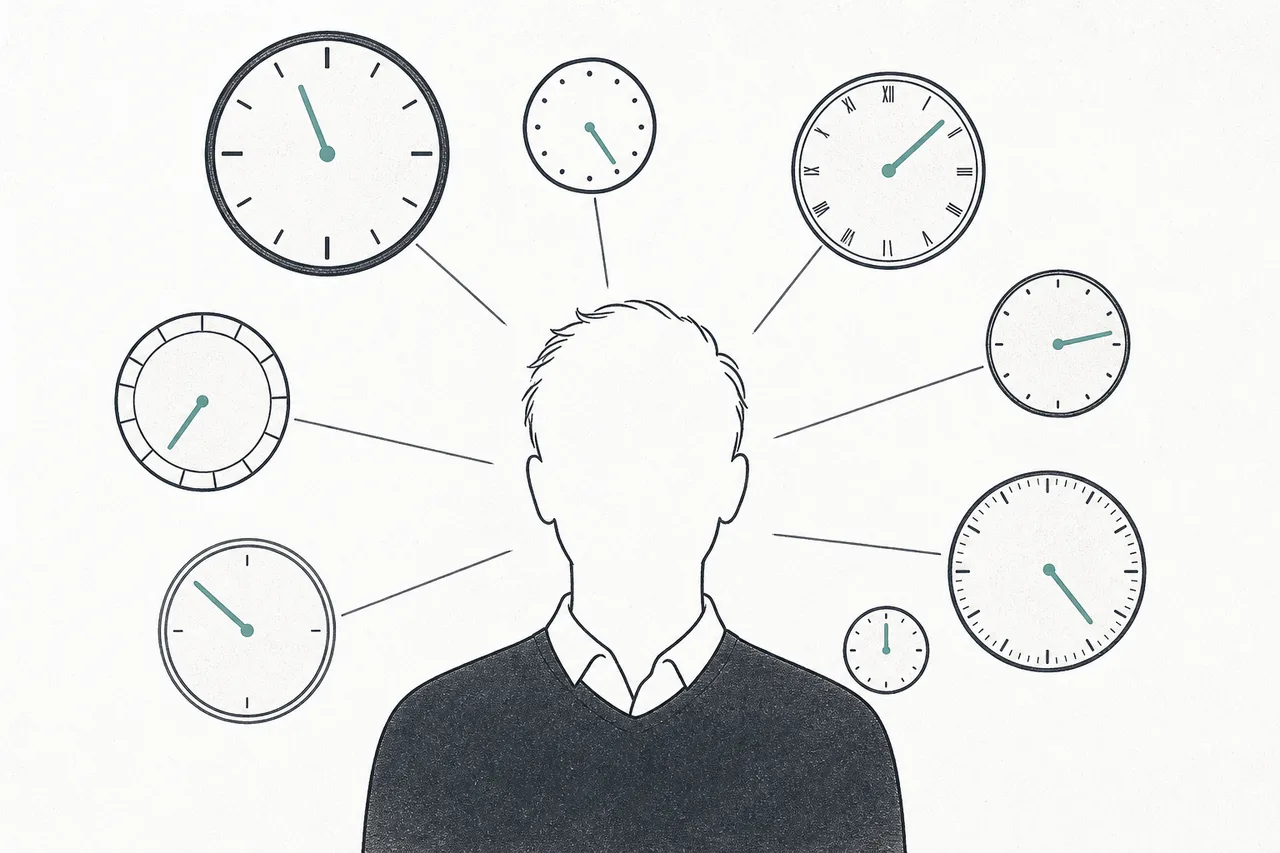
If the story ended at "the Horvath clock is 90% accurate," it would be tidy. But the truth is more complex and more candid — there are dozens of aging clocks, and they don't give matching answers. This is the biggest and most honest problem in the field.
Each "generation" of clock was trained with a different goal, so each measures something different:
- Gen 1 — Horvath / Hannum (2013): trained to predict chronological age as accurately as possible. Great at telling your age, but not designed to tell you about "health"
- Gen 2 — GrimAge / PhenoAge: trained to predict illness and mortality risk directly — GrimAge is reputed to be the most accurate mortality-risk predictor of all the clocks
- Gen 3 — DunedinPACE: doesn't tell you an "age" but a pace of aging — like an engine's rev counter, how fast you're aging per year right now. It comes from the Dunedin study that has followed 1,037 people born in 1972–73
Because they're trained differently, the results don't match — and not by a little. Research found that the "pace of aging" measured by DunedinPACE and the one measured by the Horvath clock correlate only ~0.13 (1.0 is a perfect match, 0 is no relationship at all). In plain terms, these two clocks measure almost different things. The result: the same person sends in a sample and can get a "biological age" that differs by years depending on which clock is used.
The good news is the field is getting serious about "tidying the house." A 2025 study in Nature Communications compared 14 clocks at once against the onset of 174 diseases, to find which generation actually predicts what. It found that Gen 2–3 (GrimAge, DunedinPACE) predict disease and death clearly better than the first generation — an important step in sorting out "which clock is truly reliable."
05What it connects to in the Longevity world
This node is one of 7 approaches under the megatrend Longevity & Life Extension, but its role is special — it doesn't try to "slow aging" directly; it's the shared tool every approach has to use:
- The "referee" for Metabolic Aging & Geroprotectors: how do you know a drug like metformin/rapamycin really slows aging? You have to measure whether it makes the "clock run slower" — the two are inseparably dependent. Without a reliable clock, anti-aging drugs can't prove themselves
- The core service of Longevity Clinics & Healthspan Services: longevity clinics worldwide use biological-age results as a "sales opener" — a client pays for the test, sees they're "older than their years," and buys the care program that follows. Much of this node's value flows through clinics
- Measuring the effect of Cellular Reprogramming and other cutting-edge approaches: cellular reprogramming aims to "reset" a cell's age — and the epigenetic clock is the only ruler that can tell whether the reset truly succeeded
- Sitting on the foundation of Biotech & Genomic Medicine: the technical core is the methylation array chip and DNA sequencing, the base infrastructure of the biotech field — how good a clock is depends on how finely and correctly you can read DNA
- Leaning ever more on AI: finding the "right set" out of millions of CpGs and building new generations of clock are all machine-learning problems — companies like Deep Longevity specialize in using deep learning to build clocks from multiple layers of data (blood, imaging, behavior)
Notice how this node differs from its siblings — it benefits no matter who wins the anti-aging game, because every side has to use its measuring device. This is the "shovel seller" quality we talked about from the start.
06Where it stands now
Let me say it straight: you can buy a biological-age test kit today — but no clock is yet FDA-approved for making medical decisions. It sits in an odd state: "sellable in the consumer market, but not an approved medical device." So interpreting the results takes care.
On the consumer side, the market is genuinely busy. A top kit like TruDiagnostic's TruAge reads over 900,000 CpGs on an Illumina EPIC chip (the same technology universities use for research), priced at about $499 per test for the full version and ~$229 for the PACE version that measures "pace of aging" for periodic retesting — a sign the business model is shifting from "one-time test" to "subscription retesting" to track the trend.
The field is "consolidating" fast — in April 2026, TruDiagnostic's parent company (Infinite Epigenetics) acquired Tally Health, co-founded by the famous scientist Dr. David Sinclair of Harvard — a deal called the merging of the world's largest private DNA methylation database, reflecting that "whoever has the most data" is the one who'll build the most accurate clock.
On the science/regulatory side, what everyone is watching is turning "biological age" into a surrogate endpoint the FDA accepts in drug trials — because if the FDA accepts that "the clock running slower = the drug works," anti-aging drug trials become vastly faster and cheaper. Platforms like TranslAGE (2025) are trying to set a common standard for which clock is "responsive, accurate, and stable on repeat" enough to actually serve as an endpoint — this is the key that would "unlock" aging as something treatable.
07The road ahead
The first and most important direction is a "pass from the FDA." If regulators accept that some biological-age biomarker can serve as a surrogate endpoint — that's the turning point for the whole Longevity field, because it would turn "aging," for the first time, from something untreatable (in the eyes of the law) into an indication you can develop drugs to treat. Work like TranslAGE is the first step on that path.
The second direction is "consolidating the clocks" and making them more stable. Instead of dozens of clocks that disagree, the field is moving toward a standard clock that's responsive, stable on repeat, and genuinely predicts disease (as the 14-clock comparison in 2025 began to sort out) — reliability is what separates the real winners from the hype.
The third direction is cheaper, more frequent testing. The technology is trying to make clocks that use fewer CpGs (like research using just ~10 spots from saliva) to drive cost down so you can retest often — because the real value isn't a single value, it's the trend of whether your body is aging faster or slower. The cheaper and more often you test, the more the data means.
08Challenges & risks (straight talk)
This field is exciting, but you have to view it with a cold eye, because the gaps still unclosed are bigger than the ads admit.
The first and biggest risk is "not yet clinically validated." The clocks predict mortality risk well across large populations, but that doesn't mean they're accurate enough to tell you, one person, what to do. And there's still no clear evidence that "making the clock run slower" actually makes people live longer — that link is exactly what the whole field still has to prove.
The second risk is "the clocks disagree with each other," as we saw in Chapter 4 — different generations of clock give the same person different biological ages, and the value from a single test still swings with fiddly factors (poor sleep, a cold, a hard workout the day before). If consumers take a single value too seriously, they may panic or grow complacent for no good reason.
The third risk is "hype and overselling (consumer-test hype)." Once there's a consumer market paying thousands of baht per test, there's an incentive to sell the fear of aging and tack "anti-aging methods" with no evidence onto the results — the line between "scientific tool" and "lifestyle product" blurs, and consumers have to be wary of overblown promises.
In short: the charm of this node is that it's the infrastructure of the long-life dream — if you can't measure aging, you can't prove anything, and whoever builds the most reliable ruler becomes the one the whole field depends on. But the truth to accept is that this ruler isn't done being calibrated. It points well in the broad picture, but isn't yet accurate enough to judge any one person's life — understanding this node means understanding why "measuring" is both the key and the bottleneck of the entire anti-aging field.