Megatrend · Longevity
The front door to anti-aging is a cash register
Most anti-aging science is still stuck in the lab. But one layer is already "selling today" — premium clinics that take cash straight from your wallet, hundreds of thousands to millions of baht a year, to examine your body far more deeply than a regular doctor does (whole-body scans, a hundred-plus blood markers, a clock that measures your biological age) and then design a personalized "aggressive prevention" program. This is the layer that turns "longevity science" into "revenue that recurs every year" — a high-margin, exciting business, and at the same time the one most argued over in the whole megatrend for whether it's "actually worth it."

01What it is
Picture it this way first — most of the other branches under the megatrend Longevity & Life Extension are still trying to invent something: drugs that rejuvenate cells, compounds that sweep out aged cells, more accurate age clocks — and all of it is still in the lab, not yet for sale. But this node — Longevity Clinics & Healthspan Services — is the one branch that answers the question, "So what's actually for sale right now?"
It is a network of membership clinics and health services selling "aggressive prevention" to people who are still healthy. The model: you pay an annual membership, and the clinic examines your body far more deeply than a regular doctor — a whole-body MRI scan, blood draws measuring hundreds of values, and a reading of your "biological age" with an aging clock — then uses all that data to design a personalized program (drugs, hormones, diet, exercise, follow-up). The goal isn't to "treat disease" but to "catch the signals before you get sick and stretch out the years you stay strong."
The word to separate out from the start is healthspan (the stretch of life you stay healthy), not lifespan (total years lived) — this industry doesn't promise to get you to 120, it promises that the late years of your life will still be ones where you "can run, can think, and aren't bedridden." And the most important thing for understanding this business: almost all of it is cash-pay, not through insurance, because regular health insurance won't pay to examine someone who isn't "sick" yet.
Healthspan = the stretch of life you stay healthy (the opposite of a late stage spent chronically ill) — different from lifespan, which only counts "how long you live" · Cash-pay = the customer pays 100% out of pocket, not through insurance, because insurance doesn't see examining a healthy person as "medically necessary" — that's what pushes prices high and limits the market to those who can afford it, but it's also what makes the margins fat.
02Why it matters — the gate that turns science into revenue
The reason this node matters to the economy of the whole megatrend isn't the science — it's that it's the "layer that can make money." A branch like Metabolic Aging has a big problem: its best drugs are cheap generics that no one "owns," so they're hard to monetize. Anti-aging clinics solve this simply: they don't sell the drug, they sell the "service" wrapped around it — membership, interpreting the results, follow-up — and those can be charged for in full, recurring every year.
The numbers bring it into focus. The longevity-clinic market was valued at about $5.35 billion in 2025 and is projected to grow to ~$9.55 billion in 2030, a growth rate (CAGR) of about 12.2% a year — several times faster than the average for the general healthcare industry.
But the clinic figures alone are still small next to the "pool" they draw from — the global health and wellness economy hit $6.8 trillion in 2024 and is expected to grow to ~$9.8 trillion by 2029. The piece that connects directly is "personalized medicine," worth about $147 billion and growing ~9.3% a year, because people who want to live longer are flocking to personalized diagnostic and health-tuning services.
Behind it are three forces converging at just the right moment: (1) a population aging worldwide (see Aging Population) (2) a wealthy group worried about their health and ready to pay cash, and (3) diagnostic technology getting cheaper and easier to access — when these three meet, a certain group of people is ready to "pay out of pocket to buy health" without waiting for insurance.
03How it works — the "membership cycle" that recurs every year
To understand this business, you have to see it as a four-step cycle that recurs every year, not a one-and-done trip to the doctor. And that "recurrence" is the heart of the revenue model — the customer isn't buying "a checkup," they're buying a "long-term relationship" that renews every year.
- Become a member: the customer pays an annual membership (cash-pay) — this is where the cash register rings
- Measure deeply: a whole-body MRI, blood tests for hundreds of markers (biomarkers), a biological-age reading with an aging clock — turning a healthy person's body into a "thick set of data"
- Design a personalized program: interpret the data, then prescribe a program — drugs/hormones, diet and exercise adjustments, ongoing follow-up
- Loop back to measure again: a few months to a year later, the customer comes back to measure again to see if "the clock has slowed," then renews — and the cycle turns once more
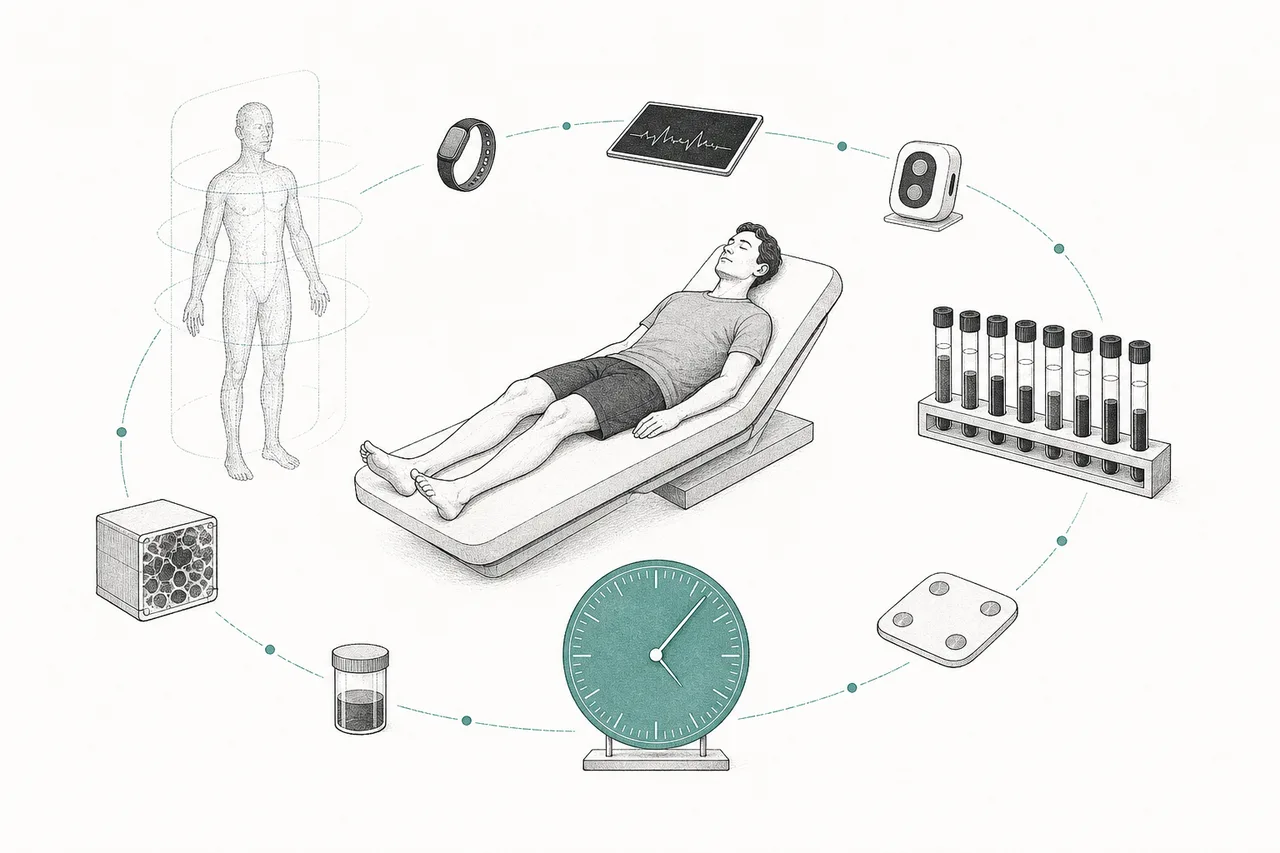
Whole-body MRI = a magnetic scan of the whole body to find abnormalities (like early-stage tumors) in people who don't yet have symptoms. Services like Prenuvo/Ezra charge about $2,500 per scan · Biomarker panel = a set of tests measuring many values in the blood (cholesterol, inflammation, hormones, glucose, etc.) — Function Health sells a 160+ value testing package on a membership model. Both are the tools for "measuring deeply" in step 2 of the cycle.
04What it connects to in the Longevity world
This node is one of 7 branches under the megatrend Longevity & Life Extension, and what makes it special is that it's the "service / monetization layer" that sits downstream of every branch. The other branches invent the science; this node is where that science gets converted into money:
- Depends indispensably on Longevity Diagnostics & Aging Clocks: without "age clocks" and diagnostic tools, a clinic has no "product" to sell in the measurement step — diagnostics are the raw material, the clinic is the storefront that wraps and sells it
- A distribution channel for Metabolic Aging: many clinics prescribe metformin/rapamycin off-label to customers — interesting that the money from these drugs that "can't monetize on their own" shows up here, in the form of clinic fees
- Upsells on top of NAD+ & Cellular Energetics: NAD+ given by IV drip and supplements in this group are popular menu items at anti-aging clinics and spas — a tangible service that can be charged for immediately, even though the human evidence is still limited
- Sits on the foundation of Biotech & Genomic Medicine: the genetic testing and biochemistry knowledge behind interpreting results comes from Biotech — but seen another way, the clinic is also a rival/substitute for expensive biologic drugs, by offering "prevention" instead of "treatment"
- Driven by Aging Population and increasingly reliant on AI: an aging, wealthy population is the customer, and AI is the tool that turns a flood of test data into "personalized advice" — Function Health even launched an AI model to interpret test results in late 2025
In short: if you draw Longevity as a river, the other branches are upstream (research and invention), and this node is the river mouth — where everything flows together and gets exchanged for money out of the consumer's wallet.
05Where it stands now
Let me say it straight: the most famous real players in this industry are mostly still private companies that aren't on the stock market — whether Fountain Life (Tony Robbins and Peter Diamandis's clinic), Human Longevity, Function Health, Hone Health, or Superpower. This isn't a weakness of the industry but a feature of a still-young industry, where private capital pours in faster than companies go public.
And the money flowing in isn't small. Function Health raised a $298 million Series B in November 2025 at a $2.5 billion valuation — a company selling a 160+ blood-marker package on a membership model that has run over 50 million tests since 2023. Fountain Life just raised another $18 million in mid-2025. Its membership prices tell the market's story well:
In the stock market, "investing directly" in this node is still hard to find. So the entry tends to be indirect — through the infrastructure the clinics rely on: giant blood-testing labs, imaging-scan services, and companies that sell hormone-optimization services through clinic networks. For example, biote (BTMD) posted about $197 million in revenue in 2024 through a network of 5,300 clinics, with gross margins reaching ~70% — a mirror reflecting that the "anti-aging service" model can genuinely turn a profit.

06The road ahead
The first direction is "prices fall, the customer base widens." Right now the full-service version belongs to people who can pay hundreds of thousands in cash, but companies like Function Health are pulling prices down with a membership blood-testing model — and the cheaper the measuring tools get (scans, age clocks), the more the service gradually shifts from "for the rich" to "the upper middle class."
The second direction is AI becoming the interpreter. The problem with "measuring a lot" is that you get so much data that humans can't keep up interpreting it — that's where AI comes in. Function launching an AI model to interpret test results in late 2025 is a sign the industry is moving from "selling the test" to "selling interpretation and advice," which scales better and walls off rivals with data.
The third direction is connecting to "drugs that actually work." If one day a branch like Metabolic Aging or GLP-1 Healthspan Proxies produces a drug proven to slow aging in real humans, these clinics become a "drug distribution channel" that's already in place — with customers, data, and relationships. So they might be the biggest winners when a real anti-aging drug arrives.
07Challenges & risks (straight up)
It's true this industry "actually sells." But you have to look at it with cold eyes, because the biggest question still has no clear answer: is it "actually worth it"?
The first and biggest risk is that "the evidence on ROI is still debated." The clearest example is the whole-body MRI — the American College of Radiology (ACR) does not endorse this kind of scan in people without symptoms, because literature reviews found "incidental findings" as high as ~32%, most of which aren't dangerous but lead to unnecessary follow-up tests or biopsies. This is the overdiagnosis problem, which for healthy people may create more worry and cost than benefit.
Incidental finding = an abnormality found by chance on a scan, even though no one was looking for it; most aren't dangerous · Overdiagnosis = finding an "abnormality" that would never actually have made you sick, but once found you have to keep testing/treating, creating unnecessary risk, stress, and cost — supporters counter that "not finding it early" (underdiagnosis) is the bigger problem. The debate isn't settled.
The second risk is "the line with wellness that sells dreams." Because it's a cash-pay market that doesn't have to pass drug-style proof, there are many services (IV drips, supplements, hormone optimization) with thin human evidence sold in high-priced packages. The risk is that consumers can't tell "evidence-based prevention" from "wellness that sells hope" — and the whole industry could lose credibility because of the ones who oversell.
The third risk is "access and overlap." Prices in the hundreds of thousands make this a service for a small wealthy group (an ethical question of whether healthspan should be something you can "buy"), and on the other side, many services overlap with existing mainstream preventive medicine and concierge medicine — which blurs the line on "what is really an anti-aging clinic," so market-size estimates swing widely.
In short: the appeal of this node is that it's the only branch in Longevity that already sells today and genuinely turns a profit — but the truth you have to admit is that it stands on a thin line between "serious preventive medicine" and "a hope service for people with money." Understanding this node is understanding why the "layer that can make money" in a trend can arrive before the science finishes proving itself.