Megatrend · Artificial Intelligence
The day top-tier AI became something you can "download for free"
While closed labs like OpenAI lock their best models behind an API wall and rent them out by the token, another camp does the opposite — they train a powerful model and then "release the blueprint" (the weights) for anyone to download, run on their own machine, and tune themselves, with no per-token fee. This is Meta (Llama), France's Mistral, and China's DeepSeek and Qwen. Their bet: if you turn "intelligence" into a commodity anyone can have, whoever controls the world's developer base becomes the real winner — and in early 2025, DeepSeek proved that bet really can shake the market.
01What it is
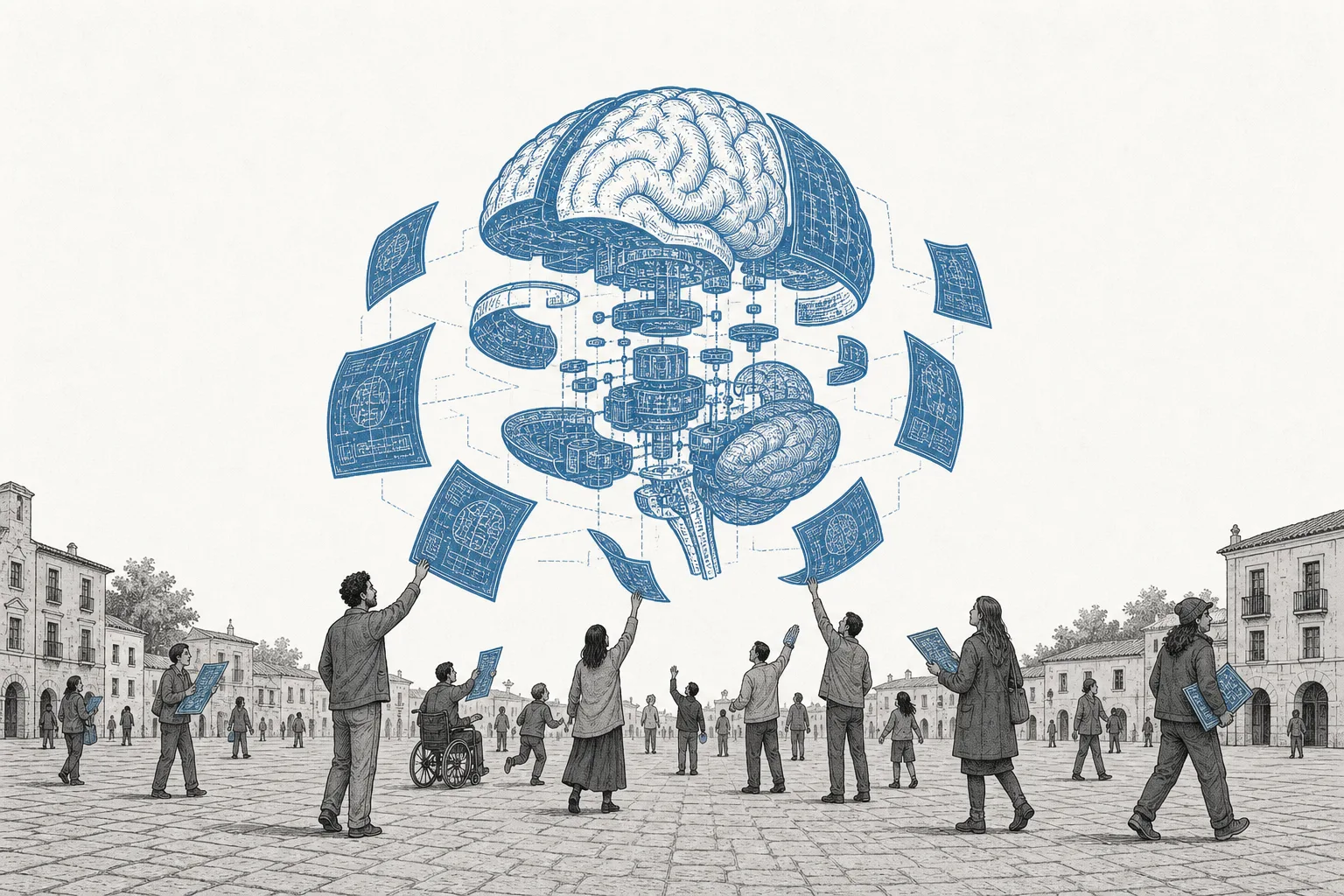
Think of an AI model as a "recipe that's already been cooked" — trained on enormous data until billions of numbers (called the weights) are set, holding all of its knowledge and abilities. The question is, once the training is done, what does the owner do with that recipe? This node is about the camp that chose one answer that sounds counterintuitive — give the recipe away for the whole world to download free.
open-weight (an open-weights model) means a model whose makers release the weights file for download, so anyone can run it on their own server, fine-tune it for a specialized task, or embed it in a product — without paying per token and without sending data outside the house. The opposite is the closed / frontier labs (Closed / Frontier Labs) that keep their best model to themselves and let you reach it only through an API or app — you can rent the intelligence, but you never get to hold the model itself.
On the megatrend map, this node is one of two species of Foundation Models & Research Labs under the big trend Artificial Intelligence — its sibling on the other side being the closed labs. Both do the same thing, training foundation models, but their philosophy of "release or lock up" is at opposite extremes, and that difference is exactly what sets each camp's business model, customer base, and geopolitical role.
Open-weight = releasing the "already-trained numbers" (weights) so they can be downloaded, run, and tuned — but usually not disclosing the training data or the full recipe, which is why it differs from open-source software that opens everything. · Fine-tune = taking the downloaded base model and training it a bit further on your own data to make it strong at a specialized task (say, Thai legal language) without retraining the whole thing — the main reason many organizations choose open models.
02Why it matters — turning intelligence into a commodity
The open camp's big bet is one word: commoditization. If a "good-enough" model is given away free for anyone to run, the intelligence per token keeps getting cheaper until it becomes a commodity — and at that point, the value no longer sits with "who has the smartest model," but with "who controls the developer base and ecosystem." So releasing a model for free isn't charity, it's a strategic weapon: undercutting the price wall of rivals who sell expensive APIs, while pulling the world's developers in to build on your standard.
The clearest proof of that power came on January 27, 2025 — the day Wall Street calls "DeepSeek Monday." A Chinese startup called DeepSeek released an open model nearly as good as America's top tier, but claimed to have trained it on a tiny fraction of the budget. The market panicked: "if this level can be built this cheaply, will demand for expensive chips really keep growing?" — and Nvidia stock fell nearly 18% in a single day, wiping out about $600 billion at once, the largest single-day loss of value for any company in stock-market history.
More important than the shocking one-day number is what it changed permanently — DeepSeek convinced the whole industry that a "cheap but capable open model" is genuinely possible, not just a toy trailing the expensive stuff. Since then, the open side's weight in the industry has kept climbing, and a once-academic question — "will intelligence become a commodity?" — has turned into a business risk that every closed lab has to answer.
03How it works (from releasing weights to building on top)
The heart of open models is "the point where it changes hands" — where the whole world can pick it up and keep using it without paying the owner. Let's walk step by step through how one model travels from the lab to a single developer.
What makes this model look anti-business is that the training cost stays just as high, but the revenue per use is zero — open labs pay tens to hundreds of millions to train, same as anyone, but once they release it free, no API fees flow back. So revenue has to come indirectly: selling a managed hosting service (like Mistral), selling ads / tying it to a core business (like Meta), or strategic / geopolitical goals (like the Chinese camp). This is the "free lunch problem" every open camp has to answer.
Another reason the open side can keep costs low is an architectural trick like Mixture-of-Experts (MoE) — DeepSeek's model has a total of 671 billion parameters, but when it actually answers it only "fires" about 37 billion per query. It's like having hundreds of experts in one room but only calling on the ones relevant to that question — making both training and running much cheaper, while staying nearly as capable as a giant model that uses every parameter every time.
04How it connects in the ecosystem
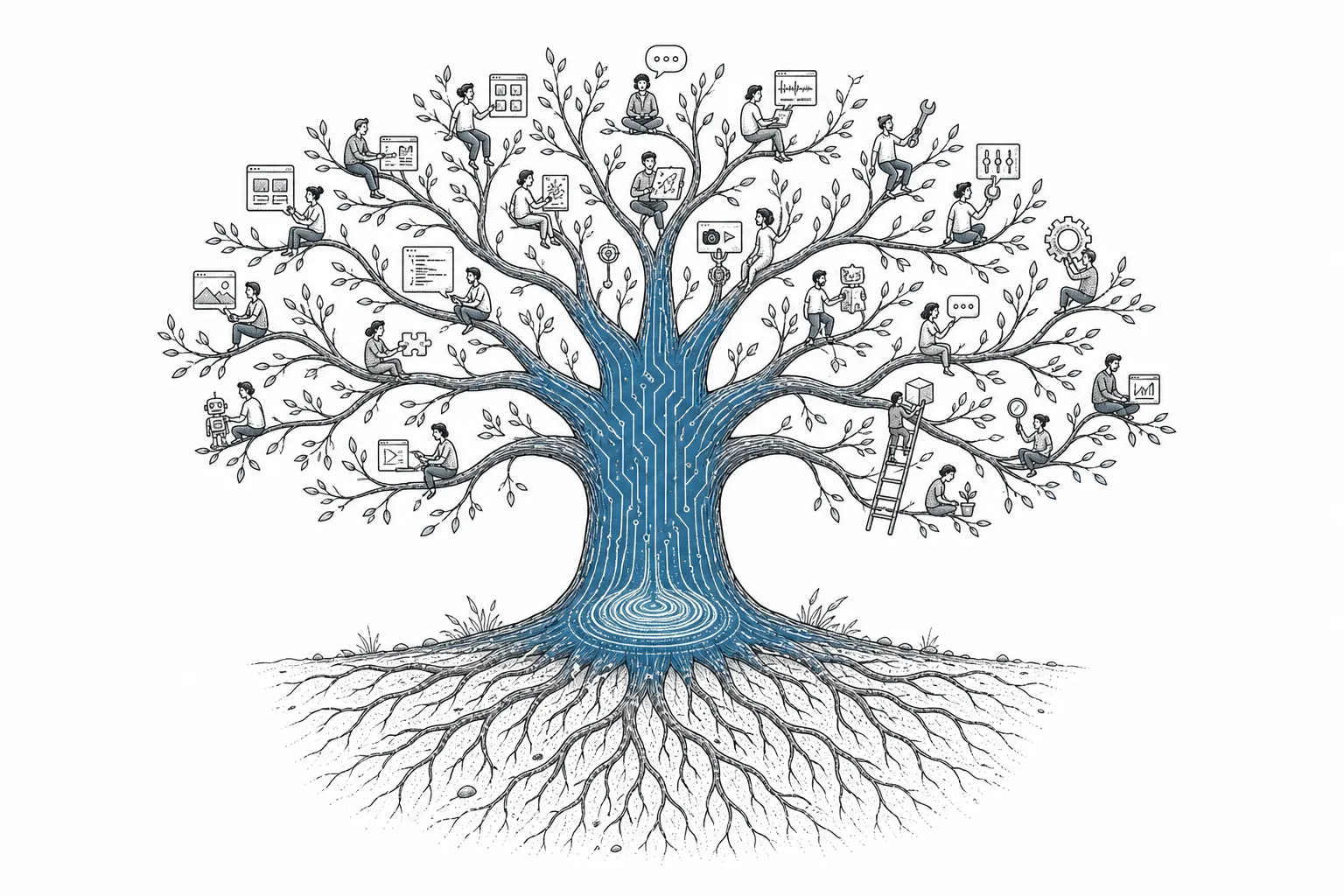
Open models don't float on their own — they're the "free raw material" that sets the whole AI ecosystem around them in motion, and the clearest relationship is with these three neighbors.
- Always paired with AI Tooling & MLOps: an open model only has value once "tools" wrap around it — platforms like Hugging Face that act as the hub for storing and distributing models, fine-tuning tools, tools for running models on your own server. The more open models spread, the more demand grows for this tooling layer, because "running a free model well" turns out to be a job that takes high expertise
- Feeding raw material to AI Applications & Copilots: many startups and organizations choose to build apps on open models because they can control cost (no per-token fee), control data (nothing leaves the house), and tune deeply — so open models are the "floor" beneath a whole wave of budget-friendly AI apps
- The polar opposite of closed labs (Closed Labs): the closed side sells the best intelligence by the token through a wall, earning premium margins but leaving customers without control of the model · the open side gives it away free to control, but has to earn revenue indirectly — the two compete on a "highest quality vs control/cost" axis, and the dividing line shifts every month
05Where it stands now
The biggest story on the open side right now is China taking the lead. In early 2025, open models were still a game Meta (Llama) even dominated. But by early 2026 the picture had flipped entirely — measured by download volume on Hugging Face in February 2026, Alibaba's Qwen alone did about 153.6 million downloads a month, more than double the combined total (71.2 million) of the next 8 major open-model makers put together. Meanwhile Meta's Llama share slid gradually from 25% (late 2023) to about 11%.
Another angle that reflects the flip is actual usage (tokens) on model-aggregator platforms like OpenRouter — Meta's open-model token share, which once peaked at 37.4% (Jan 2025), fell to almost zero by early 2026, replaced by DeepSeek (~31%) and other Chinese players — within a single year, the "majority" of open-model usage shifted from America to China.
The West still has strong main players — Meta keeps pushing the Llama family as the pillar of America's open side, while France's Mistral has become Europe's "AI sovereignty" hope, raising funds until its valuation touched about €20 billion in 2026 and winning a $1.5 billion investment from ASML for about an 11% stake to back building its own data centers. Meanwhile several of the real players (Mistral, DeepSeek) are still private companies you can't buy shares in directly — the way ordinary investors can ride this trend is through listed giants like Meta and Alibaba.
06The road ahead — the open-closed gap narrowing
The first direction is the quality gap between open and closed closing. In 2024, open models still trailed closed ones in quality by nearly a year, but by 2025–2026 the gap had shrunk to a few months, and in some arenas — especially coding and reasoning — some open models have actually pulled "ahead" of closed ones. If this trend continues until the gap is nearly zero, the big question is: how long can closed labs hold on to premium pricing power when the "good-enough" stuff is given away free to run yourself?
The second direction is value moving from "the model itself" to "the services around the model". When raw intelligence becomes free, the money piles up at the layer that makes that free model "actually usable" — managed hosting services, fine-tuning to make it strong at a specific task, secure embedding into enterprise systems. This is why Mistral chose to sell services, and why the AI tooling layer tends to benefit directly from the spread of open models.
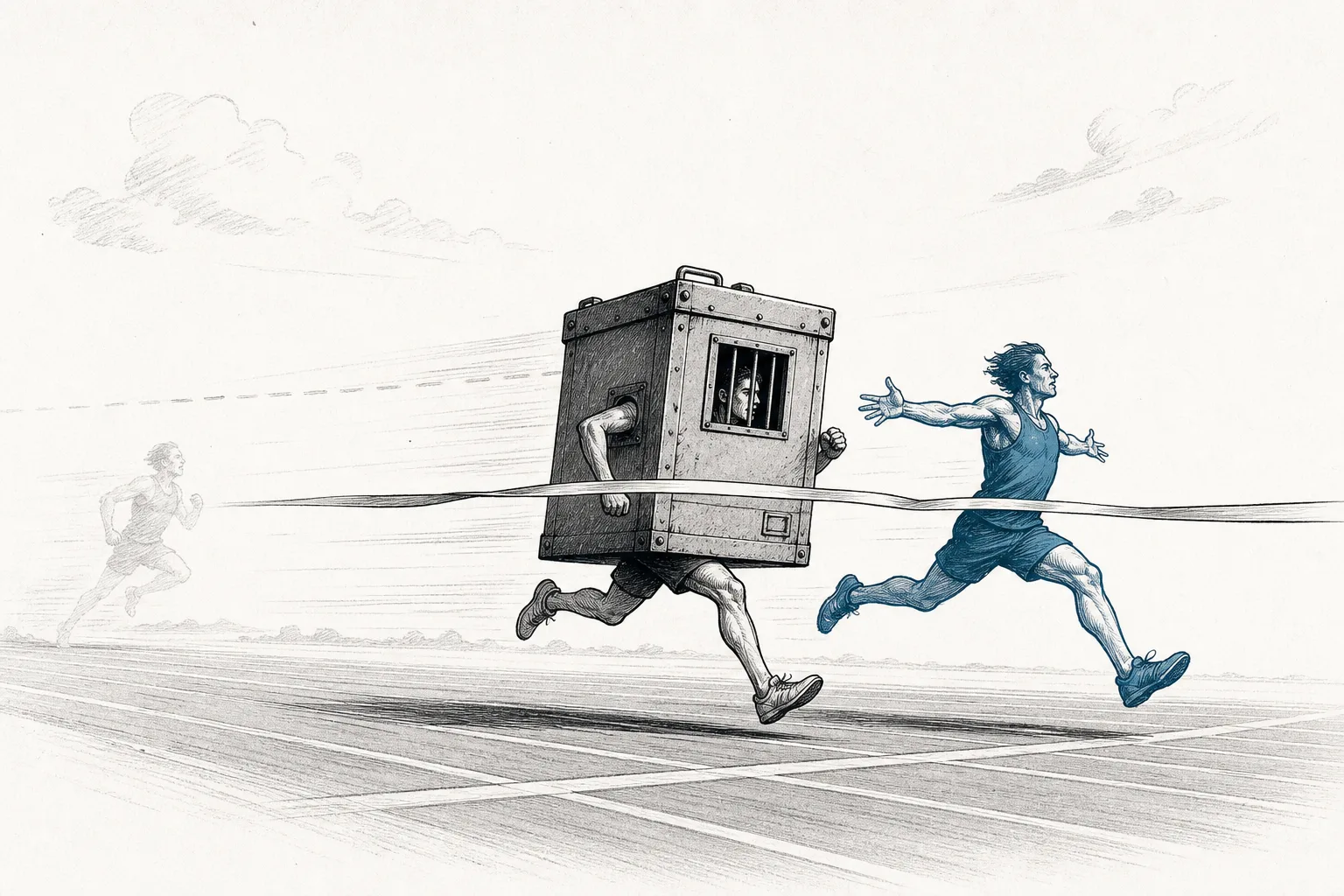
The third direction is open models becoming a geopolitical tool. For China, giving away capable models free is a way to "convert achievement into power" — expanding technological influence, reducing dependence on American infrastructure, and setting standards in emerging markets, all without expecting direct profit from the models themselves. This makes the "open vs closed" competition not just a business matter, but inseparably entangled with the national rivalry between the U.S. and China.
07Challenges & risks
The first risk is a business model that isn't clear yet. Giving away something expensive for free sounds great for users, but the question no one can fully answer is: "then who pays for the next round of training?" Training costs keep climbing with every generation, while direct revenue is zero — open labs have to lean on other businesses to carry it (Meta's ads), sell add-on services (Mistral), or rely on strategic capital. If one day the wallet doing the carrying starts questioning the returns, investment in training the next-generation model could stumble.
The second risk is safety and misuse. Once weights are released, they can't be taken back — anyone can download and tune them to do dangerous things (generate disinformation, malware code, illegal content) without the safety wall a closed lab can enforce through its API. The "openness" that's the selling point is, at the same time, a governance weakness — an issue regulators worldwide are watching.
The third risk is geopolitics and splitting into two worlds. With many of the open-side leaders being Chinese companies, Western organizations or governments running a Chinese model in critical systems inevitably raises questions of trust and security. The possible result is the open-model world splitting into two camps that won't use each other's products — eroding the "universality" that was open's appeal in the first place.
In short: this node is the camp that chose to "give away" rather than "lock up" — training powerful models and then releasing the weights for the whole world to download and build on, free and with no per-token fee. Their bet is to turn intelligence into a commodity, to seize the developer base and standards of the future — and in early 2025, DeepSeek proved that bet really can shake the most expensive giant in the industry.