Megatrend · Artificial Intelligence
In a gold rush, the ones who really got rich were selling shovels
Everyone is watching which AI model will win — GPT, Gemini, Claude, or Llama. But beneath those models sits a much quieter 'software layer' that preps the data, trains the models, runs them in production, and watches to see if they go off the rails. This is the 'picks and shovels' of the AI gold rush — a business that gets paid no matter which model wins, and where companies like Databricks and Scale AI have become tens-of-billions-of-dollars giants that most people have never even heard of.
01What it is (AI's 'shovel' layer)
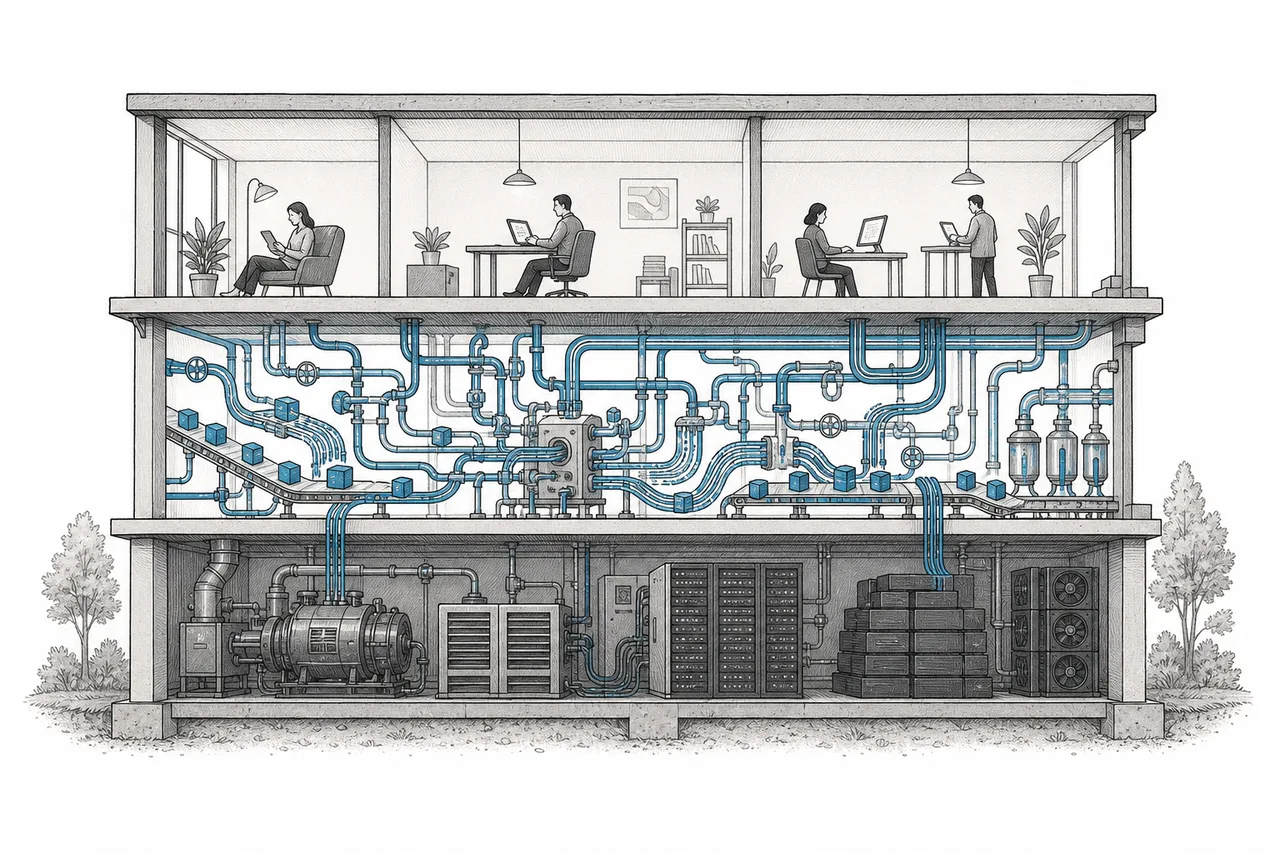
When we talk about AI, we usually picture the 'model' — a lump of brainpower like GPT or Gemini. But a bare model is like an engine sitting on a factory floor: it still can't drive a car. It takes an enormous amount of machinery around it to make it actually work in a business — and that 'surrounding machinery' is exactly what this node is.
This node is a sub-theme under the Artificial Intelligence megatrend. Its definition is short but sharp: 'the data and operations layer used to train, run, control, and monitor AI — the picks-and-shovels kind of software.' Put another way, it's everything that sits beneath the model, not the model itself. It breaks into four big chunks:
- Data: preparing, cleaning, and 'labeling' data so the model can learn from it — companies like Scale AI do this, alongside large data platforms like Databricks and Snowflake
- Retrieval: a new kind of database called a vector database (e.g. Pinecone) that lets AI 'search its memory' and find the information that's actually relevant — the heart of a hugely popular technique called RAG
- Deploy & Serve: taking a trained model and 'running it for real' so millions of users can call it at once, fast and cheap
- Observability & Eval: keeping an eye on whether the model is answering correctly, costing too much, or starting to drift — companies like Datadog are pushing hard here
MLOps (Machine Learning Operations) = the mindset and tools that take the software industry's playbook (automated, repeatable, auditable) and apply it to 'building and maintaining AI models' as a system, not by hand · LLMOps is the version tailored to large language models (LLMs), which have their own quirks — like making things up (hallucination) and expensive token costs
The simple version: if Foundation Models are the 'engine,' this node is the 'assembly line, fuel system, and control room' that lets that engine actually drive on real roads.
02Why 'selling shovels' beats 'digging for gold'
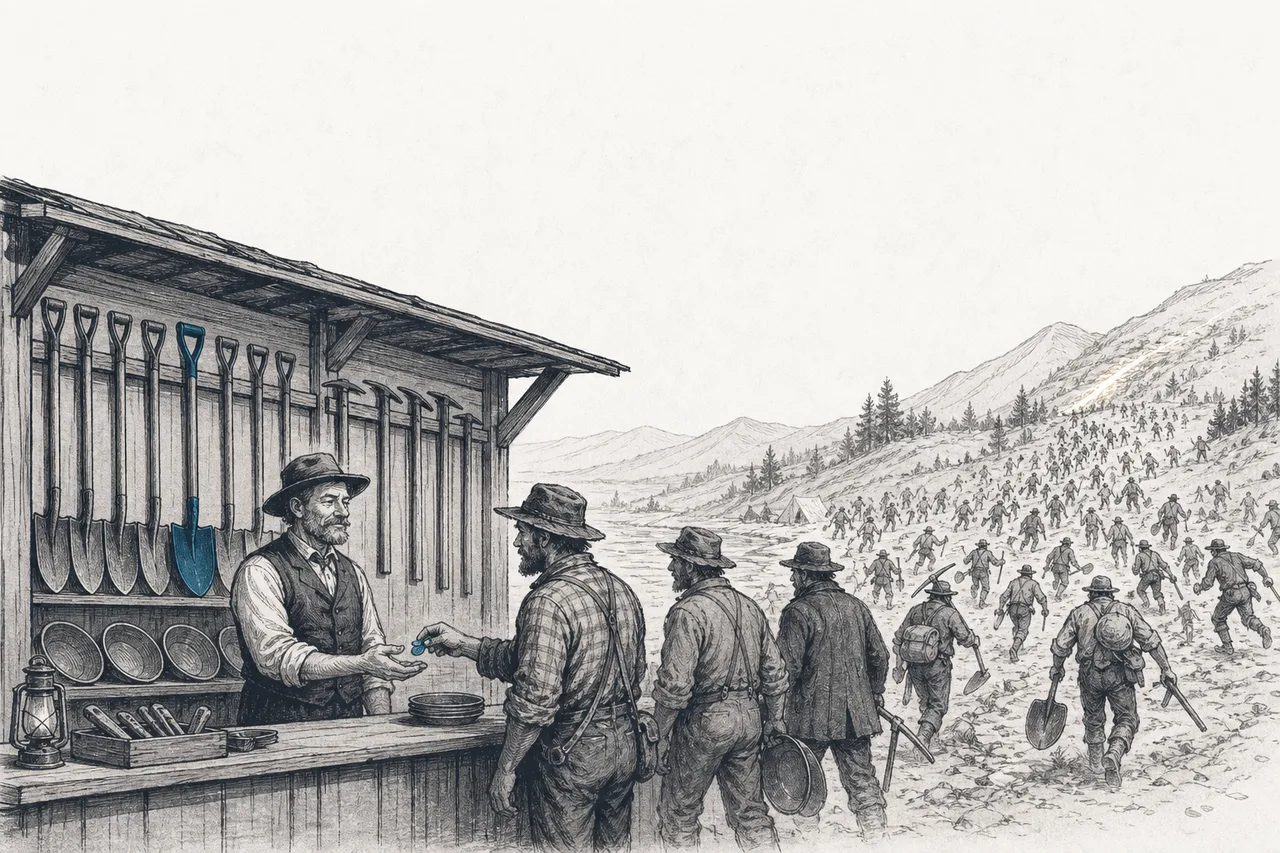
There's an old saying from the California gold rush: 'In a gold rush, the richest person isn't the digger — it's the one selling shovels.' Most diggers went home empty-handed, but everyone had to buy a shovel — and that's the entire investment thesis of this node.
In today's AI model wars, nobody knows whether GPT, Gemini, Claude, or an open-source model will win in the end. Betting on any one model is risky. But no matter which model wins, they all need well-labeled data, they all have to run somewhere, and they all need someone watching them. So this shovel layer gets paid by the 'whole field,' not just the winner.
This shovel layer is growing faster than almost any market. The MLOps market specifically is projected to grow from around $2.2 billion in 2024 to ~$16.6 billion by 2030 — over 40% a year on average. Meanwhile the overall AI infrastructure market (hardware + software) had already crossed the hundreds-of-billions mark by 2026.
The reason this market is exploding comes down to one fact companies learned the hard way: building a slick AI demo in a meeting room is easy, but running it for real — stable, secure, and without burning money — is very hard. The gap between 'a demo that works' and 'a system you can actually use' is exactly where this shovel layer makes its money.
03How it works — the MLOps cycle
The heart of this node is something called the 'MLOps cycle' — it's not a straight line you do once and finish, but a circle that never stops turning. Unlike ordinary software, an AI model decays over time (the world changes, new data arrives), so it has to loop back and be retrained again and again.
Step by step: (1) Data is the starting point — how good the model gets depends on the data you feed it. This stage is about collecting, cleaning, and 'labeling' (this image is a cat, this sentence is polite, and so on) — the kind of work Scale AI does over millions of person-hours · (2) Train the model means using the data to teach or 'tune' the model, while logging every experiment to see which settings work best · (3) Run in production means serving the model so users can call it, including the RAG technique that pulls in real data to support an answer · (4) Monitor means catching whether the model is getting slower, more expensive, or starting to make things up.
The key is the bold arrow in the diagram — what the 'monitor' stage sees feeds back as data for the next round, keeping the whole loop turning. This is what makes AI in real production different from a one-and-done project. It's a 'living thing' you have to keep feeding — and every stage in this loop is a product the shovel-layer companies can sell.
RAG (Retrieval-Augmented Generation) = a technique where, before letting the AI answer, you 'search' for the relevant real documents and paste them in first — to cut down on made-up answers and let it cite a company's latest data · Vector database = a new kind of database (e.g. Pinecone) that stores data as 'coordinates of meaning,' so it can find things that are close in meaning, not just an exact word match — the core tool that makes RAG work
04How it connects in the AI ecosystem
This node sits in the 'middle layer' of the AI stack — it receives from the layers below and hands off to the layers above:
- Feeds and draws from Foundation Models: this toolset is what the model labs (OpenAI, Anthropic, Google) use to train and tune their models. At the same time, the models that come out have to run on this tool layer to reach users — the two layers are tightly bound
- The foundation for AI Applications & Copilots: every AI app a company builds (a customer-support assistant, a copilot inside software) sits on top of this data-plus-tools layer. Without a vector database and MLOps, those apps can't be built
- The backbone of Agentic AI: AI that runs many steps on its own (an agent) needs even heavier monitoring and eval, because it makes its own decisions — so its mistakes ripple further
- Depends on Cloud & Digital Infrastructure: these tools mostly run on the cloud, and the cloud giants are themselves swallowing this layer into their own services — both partner and rival
- Ignites demand for energy and power + critical materials: training and running models devours enormous power and chips, so this layer is the origin point that drives energy demand all along the chain
An easy way to remember it: trace the AI stack from bottom to top — chips and cloud at the very bottom, models in the middle, apps at the top — and this node is the 'mortar and plumbing' that ties every layer together, making the data flow and the models actually run. That's why it's one of the nodes that connects to the most other trends in the entire map.
05Where it stands now
2026 is the year this shovel layer proved itself with 'real money,' not just promises. Look at the two leaders in the data layer: Databricks (a private company; a data + AI platform) hit revenue of $5.4 billion a year, up 65%, with AI-product revenue alone reaching $1.4 billion (~26% of the total). Its latest funding valued it as high as $134 billion, with reports of a new round being discussed at $165–175 billion.
On the public side, Snowflake (SNOW) posted full-year FY2026 product revenue of $4.72 billion, with over 9,100 customers starting to use its AI features (Cortex) — a sign that organizations are moving AI to work right next to their own data, not just playing with a chatbot.
What's worth noting is that many of the real stars in this layer are still private companies that aren't on the stock market — Databricks, Scale AI, and Pinecone are all high-valuation private companies, making it hard for ordinary people to invest directly. So we've arranged the players below by their role in the MLOps cycle and their share of leadership, rather than by raw market cap — to show who actually controls which part of this shovel layer.
06The road ahead
The first direction is RAG and vector databases becoming the standard. Companies don't want their AI making things up, and they want it to be able to cite their own internal data. The RAG market is projected to grow from around $2.3 billion in 2025 to tens of billions over the next decade, at over 40% a year — one of the fastest-growing categories in the shovel layer.
The second direction is the weight shifting from 'training' to 'running and monitoring'. Early on, the money poured into training big models, but as AI starts getting used at scale, the weight shifts to the 'run for real' (inference) and 'monitor' stages — which happen every single day, all the time. This is why an observability company like Datadog is so excited about AI: every single model call is something that has to be measured and watched.
The third direction is tooling for Agentic AI. As AI starts running many steps on its own (booking a ticket, writing code, coordinating), 'tracking what it did' and 'testing how trustworthy it is' becomes a whole new tool layer — with no clear winner yet. It's an open field that's still up for grabs.
07Challenges & risks
The appeal of 'selling shovels' comes with its own particular risks — and the biggest is consolidation.
The problem is that this shovel layer is full of small tool startups. But enterprise customers don't want to buy 20 tools from 20 companies — they want 'one platform that does it all.' The result is that the giants — especially clouds like AWS, Azure, and Google, and the AI-cloud providers — are buying up or copying the features of the small tools and folding them into their own services.
The second risk is a thin moat. Some tools in this layer are easy to copy once you understand what they do. The vector database is an example — at first it was seen as cutting-edge tech, but before long the existing databases (PostgreSQL, MongoDB, Oracle) added the capability. As a result, the pioneers now have to compete with a free feature that 'comes bundled with the database the customer already has.'
The third risk is dependence on the AI boom. This layer's explosive growth is tied to the whole world pouring money into AI. If the AI investment cycle slows — or if the returns on AI inside companies disappoint — demand for these tools will slow too. The case of Scale AI, where some customers backed off after the Meta deal, is a warning that even the leaders have their own fragile spots (here, dependence on a few customers and data-confidentiality concerns).
In short: in the gold-rush legend, the shovel sellers were the ones who got rich quietly and most reliably. AI's data + tools + MLOps layer plays the same role — it's not as flashy as the model itself, but it's where the 'real money' flows through every day, no matter who strikes gold or how this gold rush ends.