Megatrend · Artificial Intelligence
When copper can't carry the data far enough, AI clusters start talking in "light"
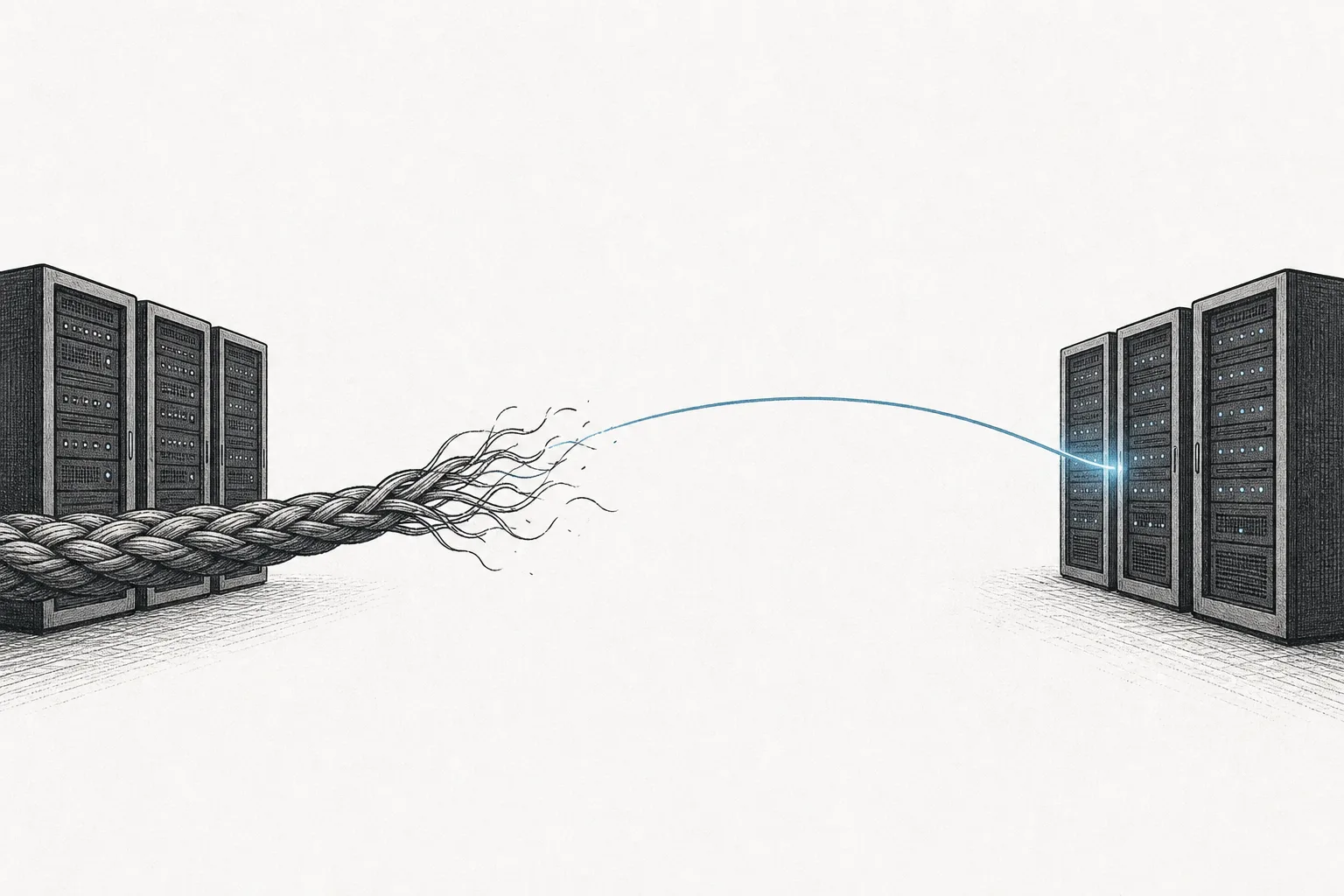
At 200 gigabits per channel, a copper cable runs out of steam before it even reaches one meter — the signal fades and it gets too hot. But the GPUs in an AI cluster sit tens of meters apart, in different racks, different buildings, even different cities. The only way to keep scaling is to turn electrons into light, shoot them through glass fiber, and convert them back on the other side. That converter is the optical transceiver — a tiny part whose market blew past $23 billion in a single year, and is now both a bottleneck and a new treasure trove of the AI era.
01What it is (connecting with light)
In a giant AI cluster, tens of thousands of GPUs have to talk constantly — and they aren't sitting side by side. In a different rack they're several meters apart, in a different row tens of meters, in a different building kilometers apart. The question is how to move enormous amounts of data across these distances fast and power-efficiently. The answer is to stop sending it as electric current through copper, and switch to sending it as light through glass fiber.
This node is the layer that does exactly that — the group of devices that convert digital data (electrons) into light signals (photons), shoot them through fiber, and convert them back to electricity at the far end. There are three main pieces to know: (1) Optical transceiver — a plug-in module that does the conversion back and forth (with a laser inside) · (2) Co-packaged optics (CPO) — the newer approach that moves the optical conversion onto the same "package" as the switch chip, to shorten the distance electricity has to travel · (3) Data-center interconnect (DCI) — linking data centers across buildings or cities with long-distance light.
On the megatrend map, this node is a leaf under AI Networking & Interconnect within the big trend Artificial Intelligence. It stands alongside its sibling, Switching & Networking Silicon (the switch chips that decide where data goes) — if the switch is the "brain that directs traffic," this node is the "blood vessel that actually carries the blood, at the speed of light."
Transceiver = a transmit-receive unit (transmitter + receiver) that converts electricity↔light in one device · CPO (co-packaged optics) = moving the optical conversion right next to the switch chip on the same package, instead of plugging it in as a separate front-panel module · DCI (data-center interconnect) = linking data centers in different buildings/cities with long-distance light (tens to thousands of kilometers), using a technique called coherent optics.
02Why it matters — copper can't reach
It starts with an unavoidable wall of physics. Copper carries data well over short distances, but once the speed per channel climbs to 200 gigabits per second per lane (200G/lane), the electric signal in copper fades fast — at this speed, a copper cable is nearly useless before it reaches even one meter. Push it faster and farther and it gets hotter and burns more power until it's no longer worth it.
But the GPUs in an AI cluster aren't just one meter apart — they have to talk across racks, across rows, across buildings. So whenever distance or speed crosses the line copper can handle, light is the only way to keep scaling, because light in glass fiber travels much farther, loses less energy, and isn't disrupted as easily as an electric signal. That's why the industry calls this phase the "copper-to-optical transition."
The economic impact exploded right away. The total optical transceiver market hit over $23 billion in 2025, growing ~50% in a single year, driven mainly by AI demand. The datacom side (inside data centers) alone passed $16 billion (+60%), and is expected to climb to around $29 billion by 2029.
More important than size is the repetition of demand — a single GPU needs several transceivers to connect out in every direction. The bigger the cluster and the higher the speed per channel, the more pieces per GPU — which makes this node's demand grow even faster than GPU unit sales. It shows clearly in the unit numbers: transceivers faster than 800G shipped about 24 million units in 2025, and are expected to leap to nearly 63 million units in 2026 — 2.6× more in a single year.
03How it works (electrons → light)
The heart of this node is "transforming" data twice in one trip — from electricity to light on the way out, and from light back to electricity on arrival. Let's trace step by step how one chunk of data travels from a GPU on one side to the other.
What makes these things "hard" lies at the heart of the transceiver — the signal-converting laser, called an EML (externally modulated laser). This laser has to blink on and off 100 billion times a second to encode 200G of data into a single beam of light. It's made from a special material called Indium Phosphide that demands extremely high precision — only a handful of companies in the world can make this laser at this quality and volume. This is the "bottleneck inside the bottleneck" that gives upstream laser makers especially strong bargaining power.
EML = a laser with a built-in modulator, used to encode high-speed data into light (200G per lane is this generation's standard) · Silicon photonics = a technique that builds "optical circuits" onto a silicon chip like electronic circuits, letting you pack multiple wavelengths into a single fiber and shrink the optical-conversion set — the core technology that opens the door to CPO.
04Where it sits in the industry
Optical interconnect doesn't work alone. It's a layer that meshes inseparably with the other layers of the AI network.
- Always paired with the switch chip (Switching Silicon): the switch decides where data goes, and optical actually carries it — every port on a high-speed switch has a transceiver plugged in. The faster the switch chip gets (say, 102.4 Tbps class), the more — and faster — transceivers it needs. These two layers run together; if one falls behind, the other becomes the bottleneck
- Connecting pods and buildings in building AI data centers: cables, fiber, and transceivers are what gets installed while building a cluster. And when a cluster grows too big for one building's power to handle, you use DCI to link multiple buildings and cities — this node is the blood vessel that threads it all together
- Depends on Interconnect & Passive (semiconductors): EML lasers, silicon photonics chips, optical connectors, and advanced substrates are all physical parts that must be manufactured and assembled to micron precision
- Eases the power burden: because light sends far with far less energy than copper, and CPO cuts power per link by several times more. In an era where data centers fight over electricity, "watts per bit" becomes a crucial deciding factor
05Where it stands now
The picture right now is this — every side of the value chain is booming at once. But the money doesn't flow evenly — the side that makes "lasers and upstream parts" is clearly split from the side that "assembles modules at high volume."
The upstream (lasers/parts) is held by the West. Coherent and Lumentum are the two big makers of the EML laser — the heart of the transceiver that everyone else has to buy. Lumentum says revenue from AI and cloud now makes up over 60% of revenue, and it's the only company shipping 200G-per-lane lasers in volume. Its latest quarter (Q2 FY2026) hit $665 million in revenue, with guidance for over 85% growth year over year.
The high-volume module side, by contrast, is dominated by China — InnoLight and Eoptolink together captured about 60% of Nvidia's additional 800G orders, and the three big Chinese makers combined held over 55% of the world in 2025. InnoLight did about ¥38 billion in revenue (+60%), while Eoptolink surged +187%. This is where geopolitics starts to heat up, because the customers and upstream chips are on the U.S. side, but the cost-effective module assembly plants are in China.
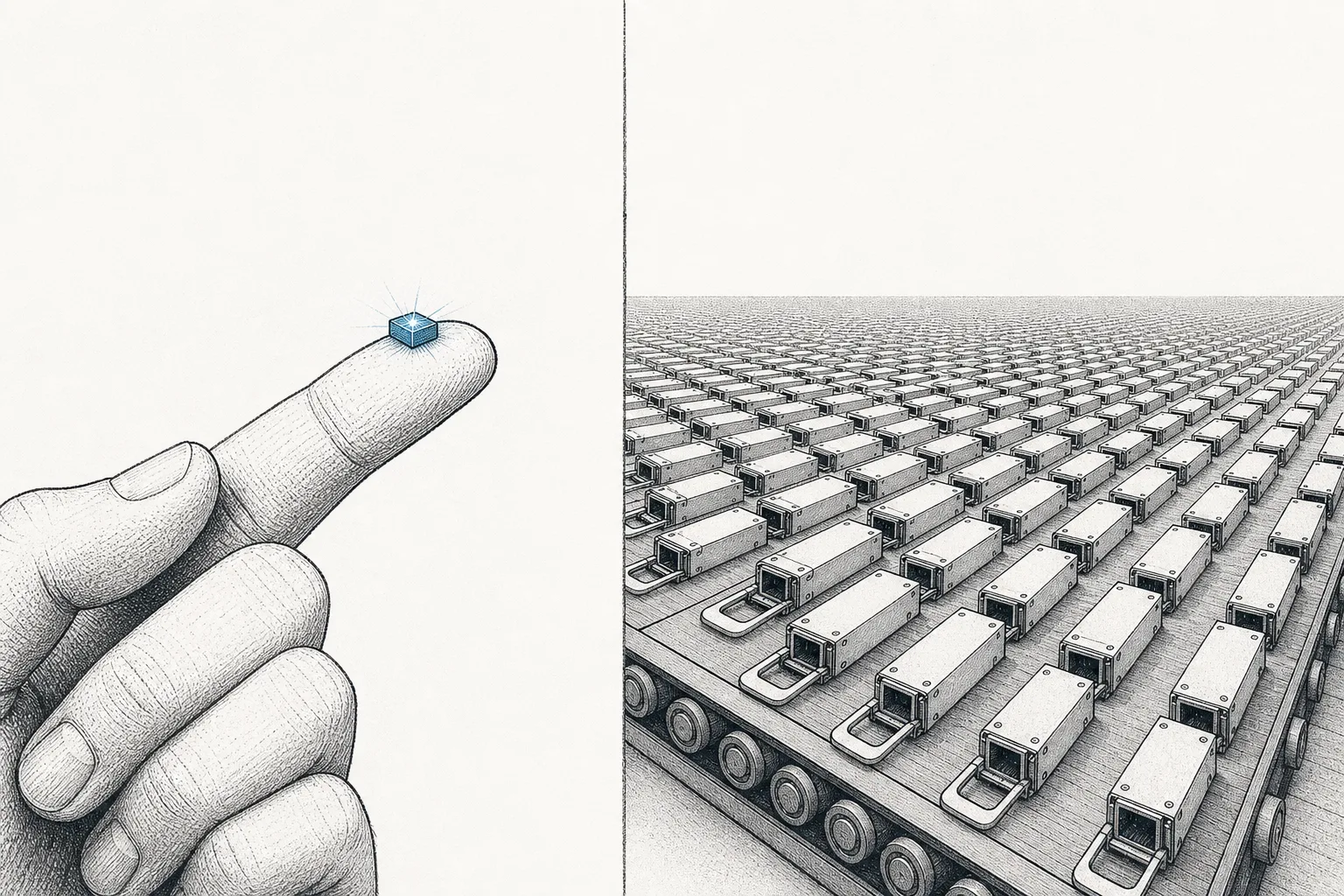
Another name not to forget is Fabrinet — a contract manufacturer that assembles optical modules for Coherent, Lumentum, and others, the "invisible hand" behind the actual production. On the DSP-chip side, which processes the signal inside the module, Marvell and Broadcom are the two big players, and there's also Credo, which stands out in smart copper cables (AEC) that extend copper's life over short distances before the point where you have to switch to light.
The DCI side (linking across buildings/cities) is becoming the new wave, because AI training clusters have grown too big for one building's power — large training runs now eat over 100 megawatts and are expected to reach gigawatt scale by 2030, forcing training to spread across multiple data centers. That drives up demand for long-distance coherent optics (like 800G ZR modules that reach up to 2,000 km).
06The road ahead — 1.6T, CPO, LPO
The first direction is the steady climb in speed 800G → 1.6T → 3.2T. Every time speed rises, copper runs out at shorter distances, bringing light closer and closer to the GPU. The 1.6T generation is accelerating into real production, with demand expected at around 7 million units in 2026, and modules faster than 800G overall leaping from ~24 million to nearly 63 million units in a single year.
The second direction is co-packaged optics (CPO) — instead of plugging transceivers in as separate front-panel modules, you move the optical-conversion set onto the same package as the switch chip, cutting the distance electricity travels to nearly zero. The result is huge power savings: in Nvidia's numbers for a 1.6T link, signal loss drops from about 22 dB to ~4 dB, and power per link from ~30 watts to ~9 watts. Broadcom's CPO switch saves about 65% in power versus plug-in modules. 2026 is seen as the first year production-grade CPO starts shipping, led by Broadcom (the Tomahawk family) and Nvidia (Quantum-X / Spectrum-X).
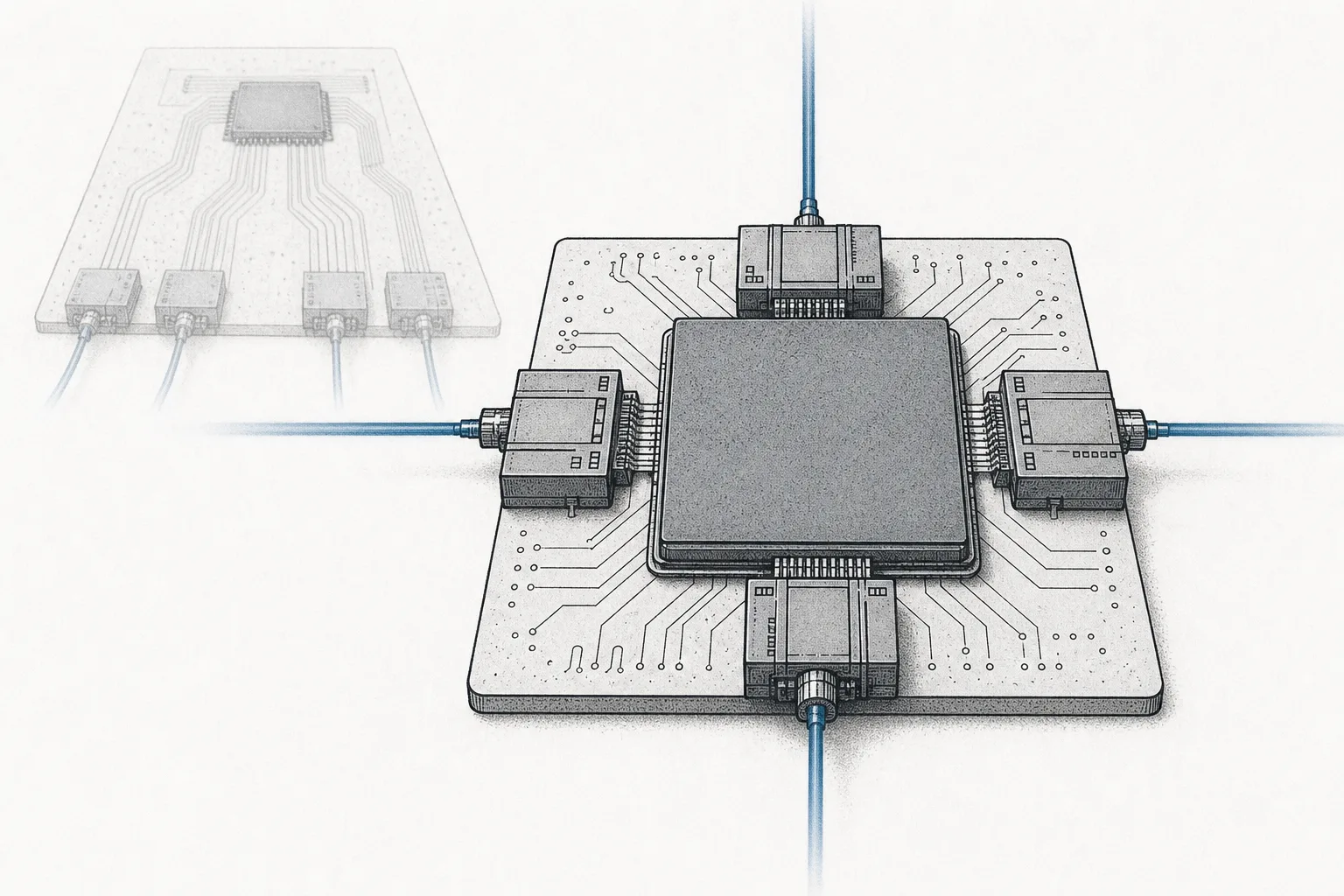
The third direction is LPO (linear-drive optics) — a "middle path" that strips the power-hungry DSP chip out of the module and drives the signal linearly instead, to cut both power and cost while still plugging in the usual way. It's a debated option — how long it'll sit on the way to CPO. The overall picture is the whole industry running toward "more light, less power per bit" — whoever controls the most power-efficient technology first comes out ahead.
07Challenges & risks
The first risk is competition from Chinese makers attacking the market on volume. Most cost-effective optical modules are made in China (InnoLight, Eoptolink), which are growing very fast and taking over half the world's share. For Western makers, that means price pressure in the downstream module segment — so value flows toward the harder-to-copy "upstream" (lasers/chips) rather than the module itself.
The second risk is fast technology shifts and betting on the wrong path. The route from plug-in modules → LPO → CPO is still unclear in how fast it moves and who wins. Whoever invests heavily in one generation of technology can be overtaken by another. The climb of 800G → 1.6T → 3.2T also forces constant new development — what sells well today can be obsolete in two years.
The third risk is being tied to the AI investment cycle and a few customers. Almost all demand comes from cluster-building by a handful of hyperscalers. If AI investment slows or there's an "over-investment" stretch, transceiver orders stall instantly — a business that grows hard on the upswing but is sensitive to the spending timing of its biggest customers.
In short: this node is the point where AI clusters "switch languages" from electricity to light, because copper can't carry the data far enough — in either distance or speed. Every time AI pushes up the speed ceiling, the boundary of light creeps closer to the chip — making optical interconnect one of the most powerful and fastest-growing bottlenecks of the AI era.