Megatrend · Artificial Intelligence
When cables and switches are what turn ten thousand GPUs into a single brain
Everyone talks about expensive GPUs. But here's the part people miss — training one AI takes tens of thousands of GPUs running at the same time, and every fraction of a second they have to "talk to each other" with enormous amounts of data. If the link between them is even a little slow, the most expensive GPUs in the world just sit there waiting. This lesson walks through the layer of cables and switches that ties a whole cluster of GPUs into one machine — and the hundred-billion-dollar fight between Nvidia and Broadcom that's heating up on top of it.
01What it is (the network is the computer)
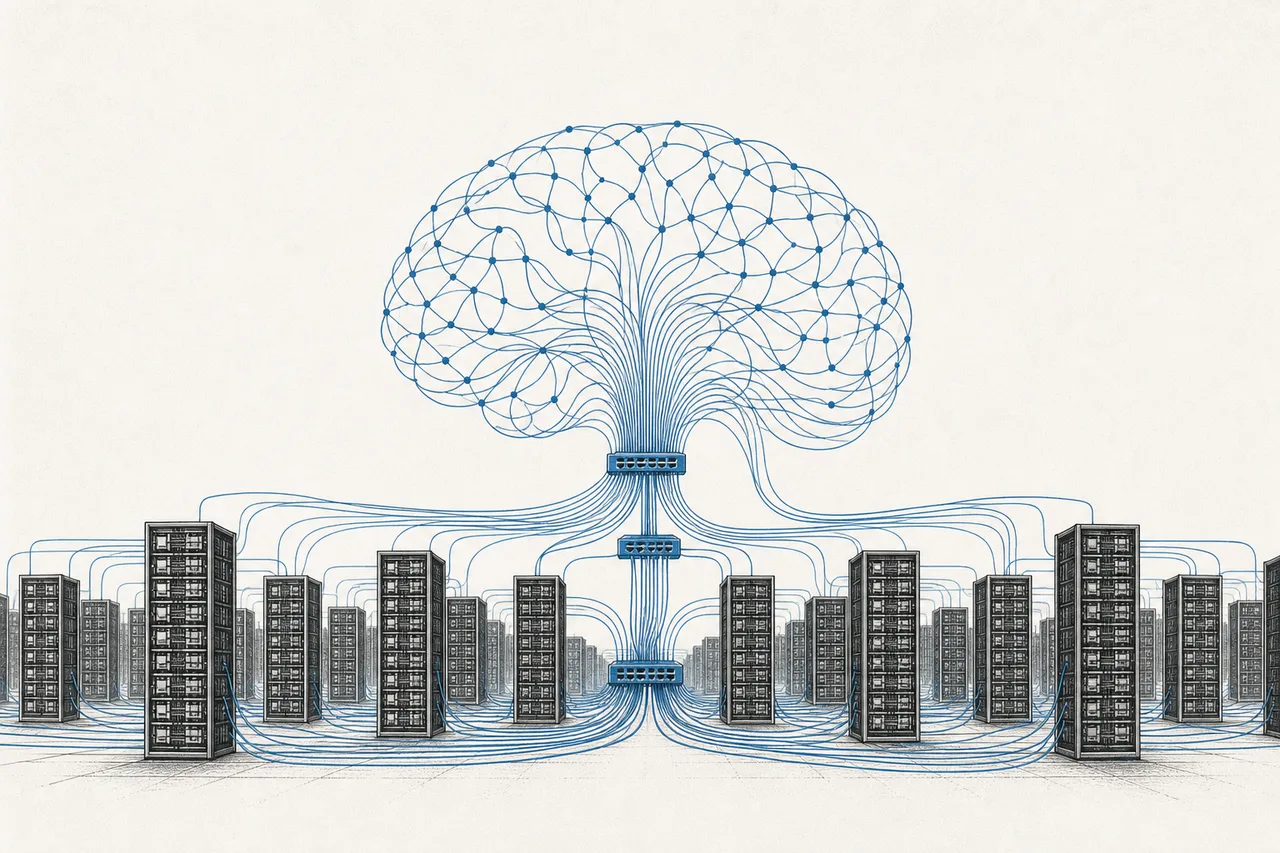
When we hear "train an AI model," we usually picture one extremely powerful computer. It's nothing like that — big models like GPT or Gemini are trained on tens of thousands of GPUs running at once. The catch is that each GPU only sees a sliver of the data, so it constantly has to "pool" its results with its neighbors. That's where AI Networking & Interconnect comes in.
This node is about the cables and switches that bind a whole cluster of GPUs into a single computer — both the switches that route data (switching) and the optical fiber that carries it at the speed of light (optical). There's a phrase the industry loves: "the network is the computer" — and for today's AI it's no longer a metaphor, it's an engineering fact.
Interconnect = the wiring that lets many chips talk to each other · Fabric = the whole web of cables + switches that weaves the GPUs together like a sheet of cloth. The bigger the model, the wider and more seamless that cloth has to be — because a single GPU stuck "waiting for data" drags the whole cluster down with it.
On the megatrend map, this node is a sub-theme under Artificial Intelligence, sitting in the "infrastructure layer" alongside siblings like AI compute chips and power and cooling. If the chip is the "brain," the network is the "nervous system" that lets many brains think as one.
02Why the network became the bottleneck
To see why the network matters this much, you first have to understand how AI gets trained. Training a model means repeating "one step" millions of times, and in every step each GPU computes its own correction (gradient), then averages it together with every other GPU in the cluster before moving to the next step. That pooling step is called all-reduce, and it happens every step — which means if the network is slow, all the GPUs have to stop and wait together.
This is why the industry calls AI clusters "network-bound" — the speed ceiling isn't how fast the chips can compute, it's how fast they can "exchange data." On large training jobs, waiting on the network can eat up to ~40% of each step. That means GPUs costing tens of thousands of dollars each can sit idle nearly half the time if the network isn't good enough.
The economic fallout follows immediately. The network used to be a "small add-on" in a data center. But in an AI cluster it becomes a major expense, estimated at around 10–20% of total cluster cost — and one of the fastest-growing pieces. On the narrow definition (just "AI data center switch systems," per ResearchAndMarkets), this market is projected to grow from $4B in 2024 to $19B in 2030 (about 30% a year). But if you count all AI back-end switch spending, the number is far bigger, potentially reaching around $100B by 2030 (Dell'Oro — see the switch layer). And that still doesn't include the optical and cable side.
03How it works — scale-up vs scale-out
An AI network isn't one layer — it's two layers doing different jobs, and understanding the difference between them is understanding the whole trend.
The first layer is called scale-up: linking GPUs that sit "in the same rack" so fast they behave like a single chip. The hero technology is Nvidia's NVLink — one Blackwell GPU has 18 NVLink lines, for 1.8 TB/s of total bandwidth (about 14× a regular PCIe slot). A new system like the GB200 NVL72 binds 72 GPUs in a single rack into "one domain" with 130 TB/s of total bandwidth — like cramming 72 GPUs into one giant chip.
The second layer is called scale-out: connecting "across racks" to tie hundreds or thousands of racks into a cluster of tens of thousands of GPUs. This layer uses a different kind of technology — InfiniBand or Ethernet — and it's the fiercest battleground of this whole trend (we'll come back to that fight).
Why split it into two layers? Because scale-up is much faster — NVLink inside the rack is about 18× faster than the scale-out network across racks. So engineers try to "cram" as many GPUs as possible into the same scale-up domain (from 8 per node, to 72 per rack, heading toward 576). Because every time data has to leave for the scale-out layer, that's a kind of "wasted time."
It's "combine and average" the values from every GPU, then send the result back to all of them equally — and it happens on every training step. The more GPUs, the heavier the all-reduce. That's why a network's "bandwidth" (how wide it can send) and "latency" (how much delay) directly set how fast you can train an AI.
04The two layers of this trend (switching + optics)
Seen as a business, this trend splits into two interdependent halves — and both are booming at the same time.
The first half is switches and switch chips (Switching & Networking Silicon/Systems) — the "traffic junction" for data. A switch takes data from hundreds of cables and sends it the right way. The heart of it is the switch chip (switch ASIC), which sets how much data a single switch can move. The latest switch chips double in speed every generation. This is the arena where Broadcom and Arista are clashing (more on the players and specs at → the switch layer).
The second half is connecting with light (Optical Interconnect & DCI) — when you have to send data farther and faster, copper (cable) starts to break down: the faster it goes, the hotter it gets and the shorter the distance it can reach. So the world is switching to light — turning data into optical signals fired down glass fiber. That converter is called an optical transceiver, and demand for it is exploding. The total transceiver market topped $23B in 2025 (up about 50% in a single year). The core of it is a wall of physics — at 200G per lane, copper can't reach even 1 meter, so light is the only way left to keep scaling. And the value clusters in the western-held "upstream lasers" more than in the modules China dominates (see → the optical layer).
So this node is really "the same story, two sides" — the switch is the brain deciding where data goes, and the optics are the blood vessels actually carrying it. Both have to get faster together, or the other one becomes the bottleneck.
05How it connects in the ecosystem
AI Networking doesn't float on its own. It's the layer that "threads" the other trends together:
- Binds AI compute chips into one machine: this is the deepest relationship. However good a GPU is, it's meaningless if they can't talk to each other — so this node's demand is tied directly to GPU sales. The more GPUs you buy, the more cables and switches you have to buy with them
- Part of building AI data centers: switches, cables, and transceivers are the parts installed while building a giant cluster
- Draws enormous power: a high-speed network eats a lot of electricity — which is why co-packaged optics (putting the light right on the chip) matters, since it can cut tens of megawatts per cluster
- Depends on semiconductors and Interconnect & passive: a switch chip is still a chip that has to be made in a foundry, and the cables, connectors, and advanced substrates are the physical parts that have to be assembled together
- Depends on critical raw materials: from high-quality copper to the materials for glass fiber and the lasers inside the transceiver
06The battle right now (2025–2026)
This is the most dramatic part — a war over the AI network between two big camps, with hundreds of billions of dollars on the line.
On one side is Nvidia, which doesn't just sell GPUs but sells "the whole system" — including its own networking, both InfiniBand (from buying Mellanox) and NVLink for scale-up. InfiniBand once held around 80% of the AI cluster back-end because it's stable and low-latency, so Nvidia tries to "lock in" customers to buy chip and network as a single package.
On the other side is the Ethernet alliance, led by Broadcom (switch chips) and Arista (switch systems), pushing an open standard called Ultra Ethernet (spec 1.0 shipped mid-2025) to make Ethernet — an open-standard technology — fast and stable enough to take on InfiniBand. The pitch: "no single-vendor lock-in, and cheaper."
And in 2025 the tide turned — Ethernet overtook InfiniBand to become AI's main scale-out network for the first time, with reports that Ethernet's market for scale-out that year was more than 2× the size of InfiniBand's — a flip from when InfiniBand held ~80%.
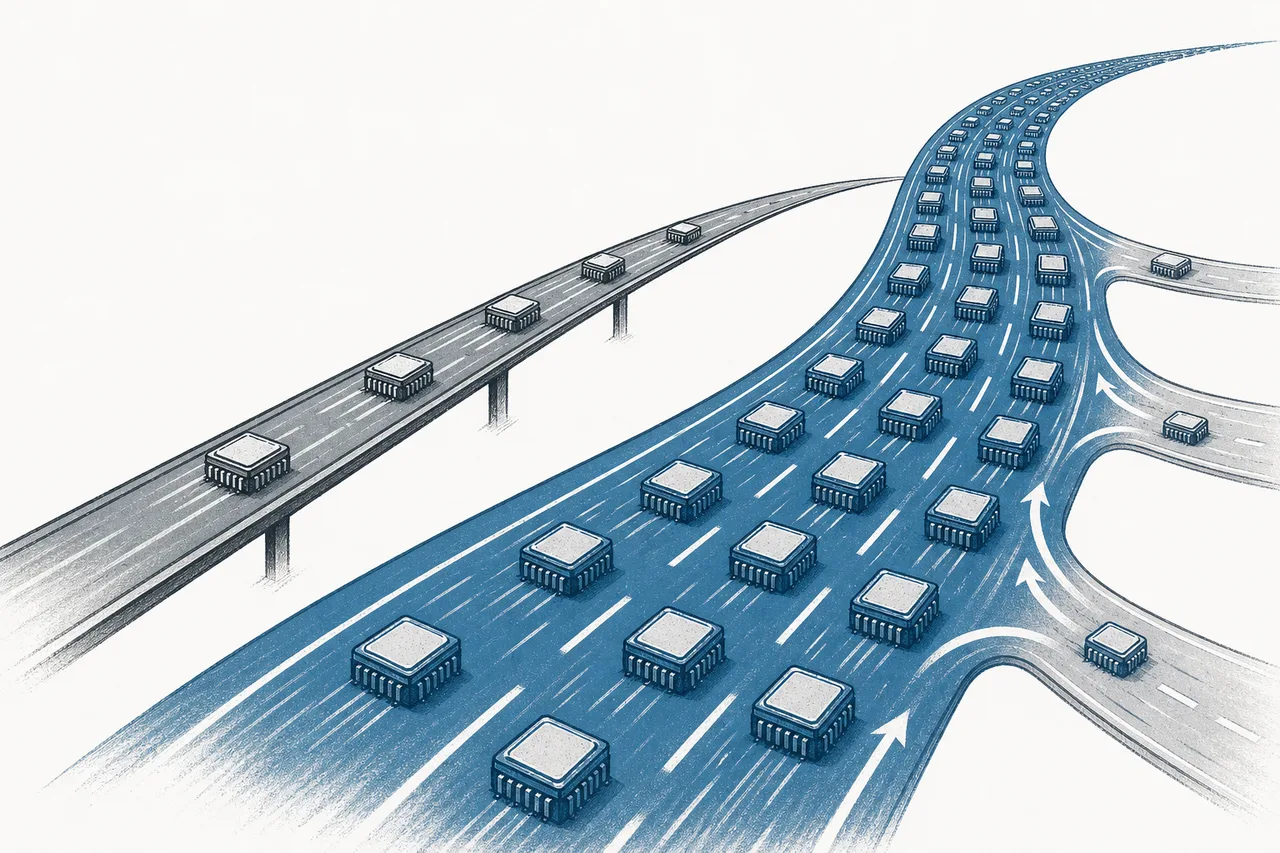
The players' numbers tell the story clearly. Broadcom has become the quiet winner of this era — in fiscal Q4 2025 its AI-chip revenue grew 74% to a record, and the networking side grew 170%, making up about 40% of all AI revenue. Meanwhile Arista raised its 2026 AI revenue target to $2.75B (from a $1.5B target in 2025), with a backlog of over $6.8B waiting to ship.
The optical side is just as hot. 800G demand pushed Chinese makers like Innolight and Eoptolink to grab a combined ~60% of Nvidia's added orders, while western players like Coherent and Lumentum hold the lasers and upstream parts. And Nvidia itself jumped into the optical arena with co-packaged optics switches — Quantum-X (late 2025) and Spectrum-X (2026).
07The road ahead
The first direction is a "copper-to-light super-cycle". The higher the speed per channel (800G → 1.6T → 3.2T), the more copper runs out of road, so light takes over at shorter and shorter distances. The endpoint is co-packaged optics (CPO) — putting the laser right next to the switch chip to cut power and add speed. 2025–2026 is seen as the first year of real production CPO, with Google, Meta, Amazon, and Nvidia leading the way — pluggable transceivers aren't going away, but the path is clearly toward more light.
The second direction is Ethernet keeps taking share, with a maturing Ultra Ethernet standard and a broader ecosystem. Ethernet revenue for AI scale-out is forecast to top $100B a year by 2030. But InfiniBand won't disappear — it still owns the jobs that demand the very lowest latency and highest certainty (frontier-scale training clusters, national research).
The third direction is scale-up opens up. Today NVLink belongs to Nvidia alone, but there are efforts to build an open scale-up standard (for instance, pushing Ethernet down into the scale-up layer too). If it works, it opens the field for other players to compete in a layer Nvidia once monopolized — a new round of the battle now taking shape.
08Challenges & risks
AI networking is a hot trend, but it comes with risks you have to see clearly.
The first risk is being tied to the AI investment cycle. This node's demand is tied directly to building GPU clusters. If hyperscaler AI investment slows (or if there's a period of "over-building"), orders for switches and transceivers stall right away — this is a business that grows very fast on the way up, but is sensitive to the spending rhythm of just a few customers.
The second risk is an unsettled standards war. The InfiniBand vs Ethernet fight and the opening of scale-up mean today's leader could be disrupted by a new technology or standard. Betting on the wrong standard in a business that changes this fast is expensive.
The third risk is geopolitics and the optical supply chain. Most cost-effective optical modules are made in China (Innolight, Eoptolink), while the main customers and upstream chips sit on the US side. Trade tensions or export controls could hit both the price and the delivery of a layer that's already in short supply.
In short: AI Networking is the layer that was dismissed as just "wiring" but suddenly became one of the most important bottlenecks — and battlegrounds — of the AI era. Because the most expensive GPU in the world is worthless the moment there's no network fast enough to tie them together. Understanding that "the network is the computer" is understanding why hundreds of billions of dollars are flowing into the cables and switches we never even see.