Megatrend · Brain-Computer Interface
Treat the brain without touching the brain — just send a pulse to a nerve in the "neck"
Deep-brain stimulators have to drill through the skull, carry real risk, and grow slowly. But there's a smarter side — instead of going all the way into the brain, it taps the nervous system's "cables" as they pass through the neck, under the tongue, or in the pelvis. Easier to operate, lower risk, and it opens the door to diseases that millions of people have. The rising star is the hypoglossal-nerve stimulator that treats sleep apnea — already over $900 million a year in revenue. And in 2025, a single vagus nerve was approved by the FDA to treat rheumatoid arthritis for the first time, opening the era of "bioelectronic medicine."
01What it is
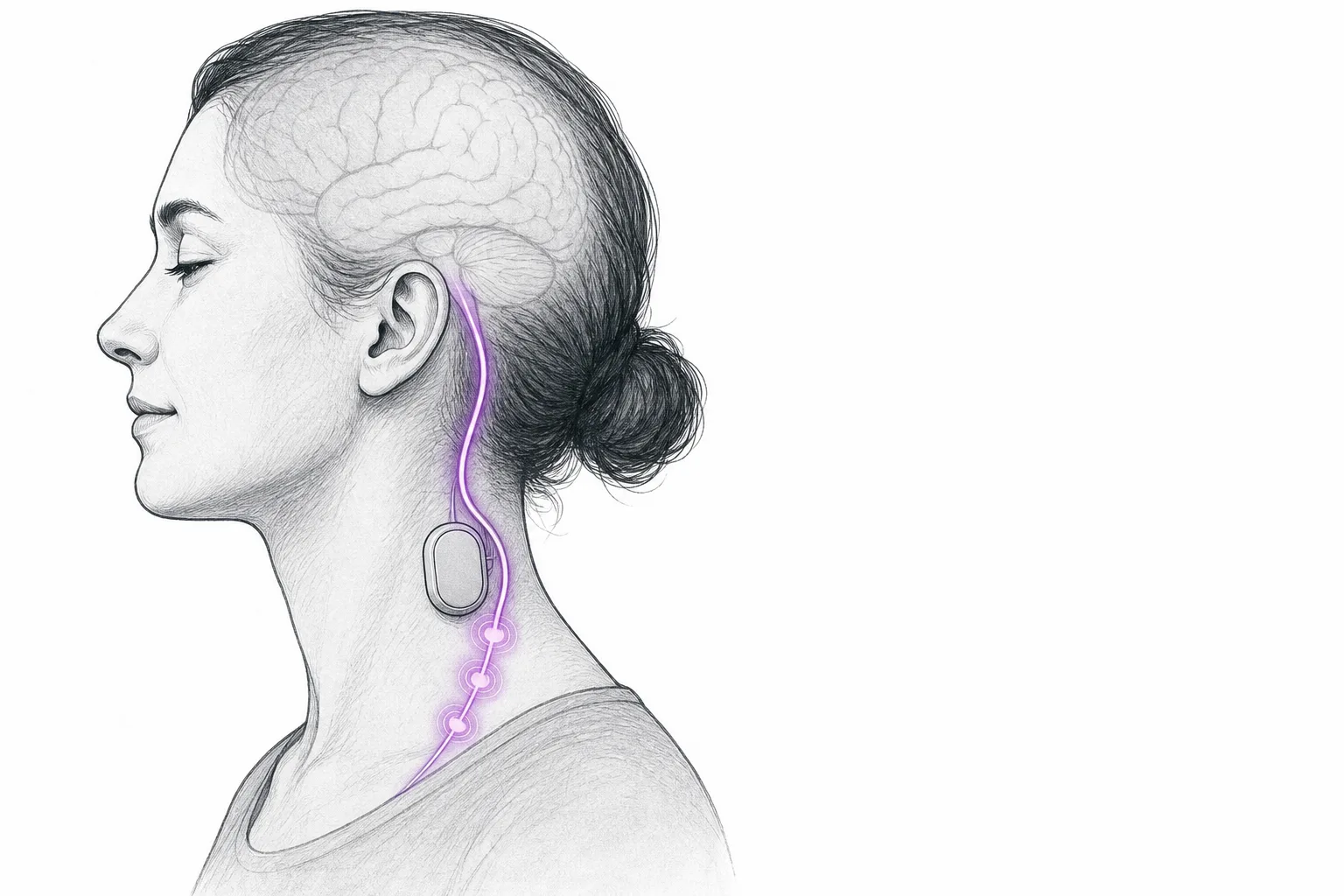
Picture the nervous system as a network of wiring through the whole body. The brain is the "central control room," and the nerves are the cables that branch out everywhere. If you want to fix a garbled signal, you have two choices — reach straight into the center (drilling through the skull into the brain), or tap the "cable" along the way, somewhere far easier to reach. This node is the second choice.
At its heart are a few nerves that run through spots a surgeon can reach without touching the brain. The three standouts are: (1) the vagus nerve, a long nerve that runs from the brainstem down through the neck to the internal organs — stimulated at the neck to treat epilepsy and depression · (2) the hypoglossal nerve, which controls the tongue muscle — stimulated to keep the tongue from falling back and blocking the airway during sleep, treating sleep apnea · (3) the sacral nerve in the pelvis, which controls the bladder, treating urinary incontinence.
On the megatrend map, this node is a branch under Neuromodulation within the larger trend Brain-Computer Interface. What sets it apart from its siblings is that it avoids the brain and spinal cord — the two siblings are DBS & SCS (deep-brain and spinal-cord stimulation), which drill deep, and closed-loop devices at the technological frontier. This node instead picks the "easiest place to reach" in exchange for a bigger market and lower risk.
The idea that "an electrical pulse can be a drug too" — instead of swallowing a chemical drug that works on the whole body (with side effects all over the body), you send an electrical signal straight to the single nerve that controls that organ or symptom. The word electroceutical = electro (electricity) + pharmaceutical (drug). The vagus nerve is the hero of this idea, because it connects directly to the immune system and many internal organs.
02Why it matters — a market that's easier to operate and grows faster
There's an iron rule in the implantable-device world: the easier the surgery, the bigger the market. Drilling through the skull to implant a DBS device in the brain is high-risk, needs a specialist surgeon, and many patients decide it's "not worth the risk." But implanting a small device in the neck or under the chin — operating outside the most dangerous part of the body — opens the door to a much larger group of patients. That's why the peripheral-nerve side has become the growth engine of the neuromodulation industry.
The number that tells the story best is sleep apnea (obstructive sleep apnea — OSA). Worldwide, about 936 million people have it, but 65–80% have never been diagnosed. And among those who know, only 40–60% actually keep using CPAP (the air-blowing mask), the standard treatment — because many can't stand sleeping with a mask on. That enormous gap is the arena for the hypoglossal-nerve stimulator.
The result: the hypoglossal stimulator from Inspire Medical Systems grew faster than any category in the industry — 2025 revenue topped about $900 million (Q3 alone did $224.5 million), and over 100,000 people have already been implanted. And it's a one-product company. That's the power of picking a disease where the "market is big and the surgery is easy."

Zoom out and the idea of bioelectronic medicine — using electricity instead of drugs — is being valued as a far bigger market. Several research houses put the combined electroceutical/bioelectronic market at about $25 billion in 2025, growing to around $36 billion by 2030. Because if a single nerve can treat several diseases (like the vagus nerve expanding from epilepsy to depression and arthritis), the market is no longer limited to brain diseases.
03How it works (tapping the cable)
The device's structure is the same as any neuromodulation device: a pulse-generator box with a battery, implanted under the skin · a lead running to the target · and an electrode at the end of the lead that wraps around the nerve. But the key difference is that the target isn't in the brain — it's at a peripheral nerve that's far easier to reach surgically, with each nerve treating a different disease.
The clearest example is the hypoglossal-nerve stimulator. When we sleep, the tongue muscle relaxes; in some people the tongue falls back and blocks the airway until breathing stops in spurts. Inspire's device detects the breathing rhythm and fires a pulse to the hypoglossal nerve to "tense the tongue forward," clearing the airway right as you inhale — working quietly all night with no mask. In one study, the new generation (Inspire V) cut the AHI (apnea events per hour) from 34.4 to 8.3 events per hour.
The vagus nerve, meanwhile, is the one that "does the most," because it connects directly to the brain, the internal organs, and the immune system. That's why the same vagus-stimulating device is being developed to treat everything from epilepsy to depression and, most recently, rheumatoid arthritis — an immune disease, not even a brain disease.
04Where it sits in the industry
The easiest way to remember it is to see the whole neuromodulation industry as a "depth spectrum" — the deeper you go, the higher the risk but the heavier the disease treated; the shallower, the safer but the bigger the market. This node sits at the "shallow and safe" end of the spectrum, and it works in clear connection with its neighbors.
- A different arena from DBS & SCS: those two big brothers drill deep into the brain (DBS) and spinal cord (SCS) to treat Parkinson's and chronic pain — the biggest money in the industry, but hard to operate and fiercely competitive. This node instead "avoids the danger zone" and taps peripheral nerves, so it can expand its market much further
- Borrowing technology from closed-loop devices: Inspire's hypoglossal device has to "listen to the breathing rhythm" before firing a pulse at the right moment — that's its own version of the closed-loop idea. Future peripheral-nerve devices will keep getting smarter on the same principle
- Competing with and complementing Biotech & Genomic Medicine directly: this is the tensest spot. The bioelectronic-medicine idea is deliberately about "replacing drugs" — SetPoint uses the vagus nerve to treat rheumatoid arthritis, competing with expensive biologics. At the same time, the GLP-1 drug (Zepbound) has just stormed into Inspire's sleep-apnea market — a rival and a complementary alternative at once
- Riding the whole Brain-Computer Interface trend: among the various sides of BCI, this node is the one that "actually makes money and is easiest to operate" — a way for investors to reach the brain-machine theme without waiting for brain-implant technology that's still experimental
05Where it stands now
2025 brought several big milestones for the peripheral-nerve side. The most important: on August 25, 2025, the FDA approved SetPoint Medical's "SetPoint System" — the world's first implantable vagus-nerve stimulator to treat rheumatoid arthritis (RA) in people whose existing drugs (both biologics and JAK inhibitors) couldn't control it. This is a major step for bioelectronic medicine — the first time an "electrical pulse" has been approved to treat an immune disease, through the RESET-RA trial with 242 patients.
On the business side, the rising star is still Inspire Medical Systems, with 2025 revenue around $900 million, driven by faster surgery in the Inspire V generation (12 cases per surgical day on average, versus 9 in the old one). On the bladder side, Boston Scientific closed its deal to buy Axonics, the leader in sacral-nerve stimulators, for about $3.7 billion — a market where roughly 30 million Americans aged 40+ have incontinence symptoms, making the giant willing to pay up.
The player landscape splits clearly into three tiers — medical-device giants that buy up specialist leaders (Boston Scientific buying Axonics) · fast-growing single-disease specialists (Inspire with sleep apnea, LivaNova with epilepsy/depression) · and new challengers opening the bioelectronic-medicine era (SetPoint, electroCore), proving that a single nerve can treat several diseases.
06The road ahead
The first direction is the vagus nerve = a platform for new diseases. Once SetPoint proved in 2025 that the vagus nerve can treat rheumatoid arthritis, it opened the door to a whole group of other immune and inflammatory diseases (such as inflammatory bowel disease, IBD). This is the biggest bet in bioelectronic medicine — if it works, it goes after the hundred-billion-dollar biologics market, because a one-time implant may cost less than a lifetime of expensive injections.
The second direction is devices that are even less invasive. The whole trend runs toward "easier surgery, longer-lasting batteries, smaller devices." There are even versions that need no major surgery at all — electroCore makes a no-surgery vagus stimulator (non-invasive nVNS — just touch it to the neck) for migraine and is testing it in other diseases. The easier the surgery, the more the market expands to patients who once found it "not worth the surgical risk."
The third direction is continued consolidation. After Boston Scientific bought Axonics and Globus bought Nevro on the SCS side, the trend is clear: the giants will buy up specialist leaders that have proven their markets — because building a sales channel and a surgeon team from scratch is harder and slower than buying a company that already has the goods. That makes small players with standout technology acquisition targets.
07Challenges & risks
The first and biggest-news risk in the industry is GLP-1 drugs. In December 2024, the FDA approved tirzepatide (Zepbound) as the world's first drug to treat sleep apnea, because losing weight reduces airway blockage. This is a direct rival to the hypoglossal stimulator — patients who once needed an implant may choose an injection instead. The market still has to watch whether the two will "compete" or "complement" each other (people who lose weight on the drug but still stop breathing will still need the device).
The second risk is reimbursement. These devices cost tens of thousands of dollars, and almost all of them depend on whether Medicare or insurance agrees to pay. A clear example is the depression side — LivaNova had to work with CMS for years to win VNS coverage for treatment-resistant depression. The moment the authorities tighten the criteria, demand stalls.
The third risk is clinical evidence that still hasn't "won decisively" in some diseases, especially the new diseases that are the growth bet — LivaNova's RECOVER trial for depression came back mixed, and bioelectronic medicine for immune diseases is still very new. Expanding from proven diseases (epilepsy, sleep apnea) to bigger-market ones (depression, arthritis) isn't always guaranteed to succeed.
In short: this node is the art of "avoiding the most dangerous spot" — instead of drilling into the brain, it taps a single, easy-to-reach nerve and turns an electrical pulse into a drug. From treating the snoring and sleep apnea of millions, to immune diseases that were once the exclusive territory of biologics. And that's why it's the side that "makes money today" in the whole brain-machine trend.