Megatrend · Whole-trend overview
When a thought can run a machine — no finger required
Paralyzed patients moving a cursor on a screen, controlling a robotic arm, typing out text — with pure "thought." This isn't science fiction anymore; it's happening right now in clinical trials around the world. Brain-Computer Interface (BCI) means wiring the brain directly to a machine. This lesson is the map that ties the field's five categories together — sorted by "does it need surgery to implant?" and who supplies whom — and, crucially: the real thing closest to market is medicine, not the "telepathy by chip" people love to talk about (each category has its own deep-dive lesson coming).
01The big picture: wiring the brain straight to a machine
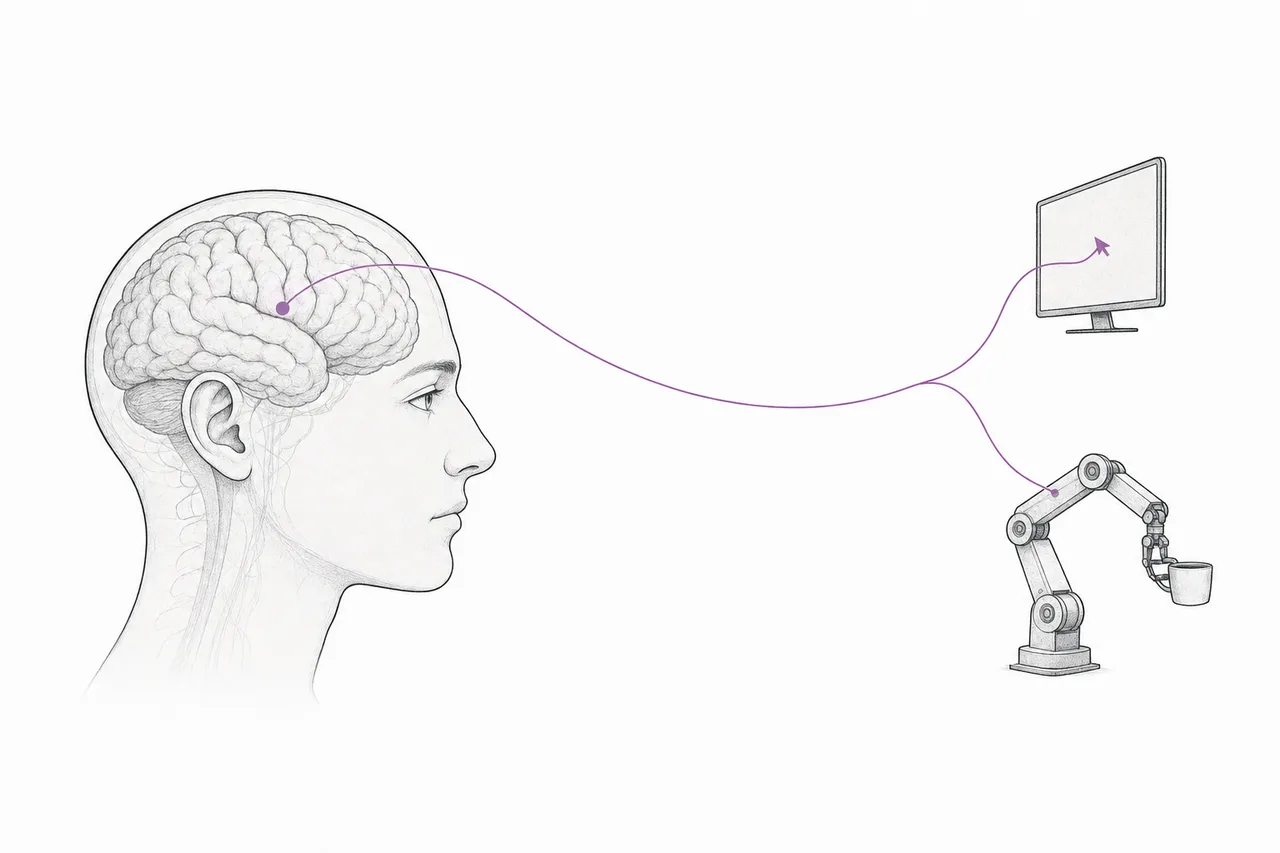
When we move a hand, the brain sends tiny electrical signals through nerves to the muscles. But if that path is cut — say, in someone paralyzed by a spinal cord injury, or a patient with ALS — the brain still "commands" exactly as before; the command just never reaches the end. A Brain-Computer Interface (BCI) eavesdrops on that command straight from the brain and uses it to drive a machine instead — a cursor, a robotic arm, a wheelchair, even synthesized speech.
A system that reads (and sometimes writes to / stimulates) neural signals directly, then converts them into digital commands — skipping muscle and voice entirely. It covers both the implant-in-the-brain kind and the wear-on-your-head kind (we don't count drugs that treat the brain — those sit in the Biotech & Genomic Medicine megatrend).
This is a trend that's genuinely still "emerging" — unlike semiconductors or AI, which are fully grown industries. Most of the star players are still private companies with no revenue, and human trials only began a few years ago. But the momentum is real: venture capital flowing into BCI broke $1.2 billion in 2024 alone, up about 45% from the year before.
The market size researchers forecast is growing fast too — from around $3–4.5 billion in 2024–2025 to $16–20 billion by 2034, roughly 17% a year. But read that number carefully: it "folds in" the medical market that already exists (neurostimulation devices). Full-blown "read-your-thoughts" BCI is still a small slice inside it.
02The map: what are the five sub-categories
The best way to understand this field is to ask a single question: "Does it need surgery to open the skull?" — because that splits the world into two poles (invasive vs non-invasive). Then there are three more categories that "supply" both poles. Each category has its own deep-dive lesson (tap to read):
The platform side — two poles of reading the brain
- Invasive BCI Systems: systems that actually get implanted inside the brain (or threaded through a blood vessel to sit against it) — the sharpest signal, fine enough to read single neurons. This is the home of Neuralink, Synchron, and Precision Neuroscience (the leading players are all private)
- Non-invasive BCI & Neurotech: the wear-it-from-outside kind — EEG headsets, fNIRS, ultrasound. No surgery; the signal is coarser (like hearing voices in a room through a wall) but it's safe, cheap, and sellable to the general public — the biggest share by volume, though the platform players are still almost all private
The supply side — materials & tools (picks-and-shovels)
- Implantable Neural Electrodes & Sensing Components: thin-film electrodes, signal-receiving chips, front-end circuits — the "hardware" every implantable BCI is built from. This is the slice with some publicly listed players you can actually get a hold of
- Neural Signal Processing & Brain-Mapping Tools: the software layer — processing power, decoding algorithms, and brain-mapping tools that turn "messy electrical waves" into usable commands (BCI is only a small part of this category; most of it is general brain research)
The bridge category — medicine that already sells for real
- Neuromodulation & Closed-Loop Neurostimulation: FDA-approved neurostimulation devices that are already on the market — deep brain stimulation (DBS) for Parkinson's, spinal cord stimulation (SCS) for chronic pain, responsive stimulation (RNS) to stop seizures. This is the closest the public market gets to touching BCI — both the foundation for, and the bridge to, full BCI
03How it all connects: the invasive spectrum
The heart of this map isn't a straight-line chain like semiconductors — it's a "spectrum". The horizontal axis is "how invasive," from deep inside the brain (left) all the way to just worn on the head (right). The deeper you implant, the sharper the signal — but the risk and regulatory wall climb too. And beneath the entire spectrum sit two layers that supply every type alike: electrodes/chips (hardware) and decoding software.
The thing to grasp is that there's no "single winner" across the whole spectrum — implants suit hard cases that need high precision (full-body paralysis, ALS), while wearables suit the broad market that tolerates some coarseness (gaming, wellness, focus). And both sides lean on the same decoding software — which is getting smarter fast thanks to AI.
04Where the value is: medicine first
This is the single most important lesson of the whole trend, and the point people most often get wrong: today's real money isn't in "reading thoughts" — it's in "giving patients back movement and speech".
The category with real revenue, real profit, FDA approval, and listed companies you can actually touch is Neuromodulation — the neurostimulation device market is around $5.8 billion in 2024 and is forecast to grow to ~$23 billion by 2034, several times bigger and more "real" than the implantable-BCI market. Three giants — Medtronic, Abbott, Boston Scientific — hold about 65% combined.
The "picks-and-shovels" side — electrodes, chips, and tools — is also lower-risk than betting on a single platform. Because whether Neuralink or Synchron wins, everyone still has to buy electrodes and use decoding software. That's why the components category is structurally interesting — even if pure-play companies are still small and hard to find.
The lesson for looking at this trend: don't just ask "does this company do BCI?" — ask "does it have medical revenue today, or is it burning cash waiting on a dream 10 years out?"
05The forces that move the whole trend
Even though each category differs, there are four big forces moving the whole field at once:
1. AI makes decoding smarter, fast — BCI's real wall isn't just "can you read the signal" but "can you translate a messy signal into the right command?" Modern AI models decode intent from brain waves far more accurately and quickly, so even coarse signals from outside the head are becoming usable — that's why BCI depends_on AI directly.

2. Tangible medical demand — there are millions of people who are paralyzed, have ALS, have lost speech, or have Parkinson's. This isn't a "nice-to-have" market; it's a "must-have" one. That demand is what keeps pulling capital and FDA approval to the medical side first — and it's why BCI complements the aging-society trend.
3. The invasive vs non-invasive contest — this is a philosophical race. One side believes "you have to implant to be sharp" (Neuralink); the other believes "just thread it through a blood vessel, no need to open the skull" (Synchron), or "no surgery at all" (EEG) — and who's right depends on the use case, not the technology alone.
4. Ethics and regulation — this is a force BCI carries heavier than any other trend. Reading (and maybe writing) the data inside a brain opens questions of "neural privacy," consent, and ownership of brain data. Some states (like Colorado and California) have already started passing laws to protect "neural data" — and this wall will set how fast the trend grows.
06Where things stand now + each category's champion
2025–2026 is the field's "first-in-human" phase — human implant trials are expanding, and the front-runners are getting close to filing for real commercial approval. But to be clear: almost all the star players on the invasive side are still private, with no revenue, and not listed on any stock market. What you can actually invest in on the public side is mostly the medical and components categories.
07The future, the risks, and the ethics
Looking ahead, BCI has both a real tailwind and risks worth stating plainly.
On the opportunity side: the number of "channels" that can read the brain at once is jumping — from the Utah Array's ~100 channels, to Precision's 1,024 points, all the way to Neuralace's target of 10,000+. More channels means a sharper signal and more complex abilities (from moving a cursor to fluent speech and limb movement). Combine that with smarter AI decoding, and the path to an approved medical product keeps getting clearer.
On the risk side, there are several layers to watch:
- Still early and burning cash: the main platform players are private, with no revenue, and human trials can still be counted by the patient — the path to profit is a decade out, and there may be clinical stumbles
- The regulatory wall is high and slow: brain-implant devices must pass the FDA's strictest review, taking years per step, and a single safety failure could set the whole field back
- Technical risk: implanted electrodes can degrade over time or scar brain tissue, and the signal may fade — long-term durability is still an unsolved problem
- Overblown expectations (hype): the media loves to talk about "uploading memories" or "telepathy," which are still science fiction — the real thing in our generation is giving patients back movement and speech, not superpowers for everyone
So the ethical questions are anything but distant: who owns the data inside your brain? How far can a company use it? If a device can "write" back into the brain, who's responsible when it changes behavior? That's why some U.S. states have begun passing laws to protect "neural data" — and that wall will set the pace of the whole trend's growth as much as the technology itself.