Megatrend · Brain-Computer Interface
The side of "brain meets machine" that's actually made money for 20 years
Most BCI news is still about experimental brain implants. But there's another side of this field — quieter, yet already inside more than a million people — that treats real diseases, gets reimbursed by insurance, and brings in billions of dollars a year. That's "neuromodulation": devices that send gentle electrical currents to retune neural circuits firing out of sync. And in 2025 it crossed a major line: the first device that "listens" to the brain and adjusts its own treatment was approved, a world first.
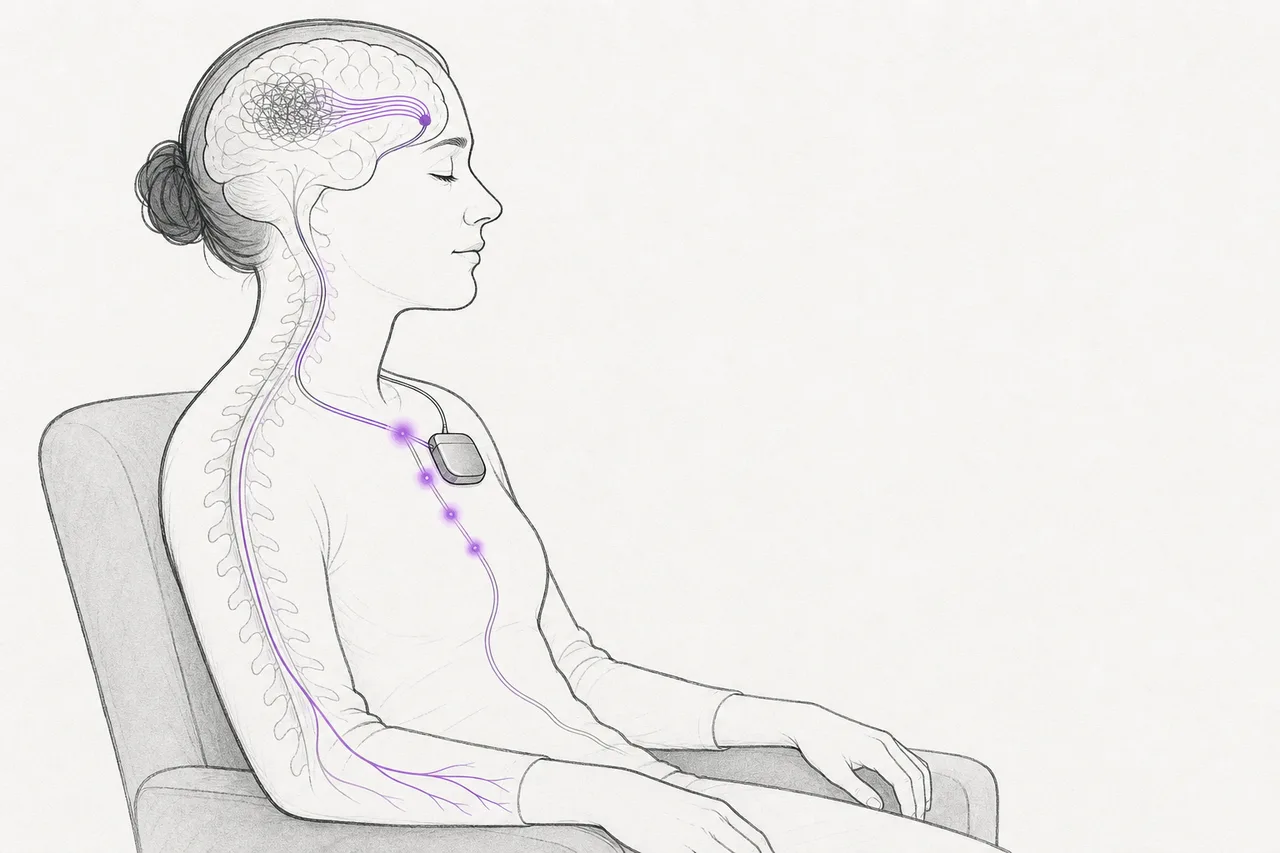
01What it is
Think of the familiar heart pacemaker — a small box implanted under the skin, with a wire running to the heart, sending electrical rhythm so the heart beats in order. Neuromodulation is the same idea, but the target is the "nervous system" instead of the heart.
The principle is very simple: many brain and nerve diseases come from neural circuits that "fire out of rhythm" — the tremor in Parkinson's is the movement part of the brain firing too fast, chronic pain is nerves sending pain signals nonstop, and a seizure is neurons all firing together until they can't be controlled. If you send a gentle, controllable electrical current right to that spot, you can "override" or "retune" the faulty circuit to settle down — without cutting out brain tissue, and without relying on drugs alone.
This node sits under the megatrend Brain-Computer Interface (BCI) — but it's a completely different world from the BCI image we see in the news. The famous side is the invasive brain implant (Invasive BCI), like Neuralink, that reads thoughts to control a computer — still in trials with a handful of people. Neuromodulation is the side that's "all grown up" — FDA-approved, already implanted in hundreds of thousands to millions of real people, and the main way investors can "buy the stock" of the BCI trend right now.
Neuromodulation = sending electricity in to adjust/treat (one-way, treats disease) · mind-reading BCI = pulling signals out to control a device (decodes intent) — the line is blurring, because newer devices do both: they "listen" to the brain and "adjust" it in one device.
02Why it matters — the BCI that actually makes money
When people talk about "brain-machine theme stocks," the problem is that most of the most famous players still aren't on the stock market, or don't yet have real sales revenue. Neuromodulation is the exception — it's the part of this trend with a large market, steady growth, and most importantly, already profitable.
The global neuromodulation market is around $6.6 billion in 2025 and is expected to grow to about $10.5 billion by 2030, at roughly 9% a year. The number isn't flashy like AI, but it's "solid and durable" growth, because the driver is something you can't stop — an aging population. Parkinson's, chronic pain, and other neurological diseases all rise as the world's population ages.
Another reason this market is "stable and high-margin" is that it's a market with few players and high walls. These devices have to pass years of clinical trials, get FDA approval, have insurance reimbursement codes, and rely on specially trained surgeons — all of which make it very hard for new companies to enter. So most of the market leaders are a handful of medical-device giants, most of them public and paying dividends.
03How it works (open-loop vs. closed-loop)
Every neuromodulation device has three main parts: (1) a pulse generator, a small box with a battery implanted under the skin (usually in the chest or buttock) · (2) a lead that runs from the box to the target · and (3) an electrode at the end of the lead that touches the nerve point you want to stimulate. The device sends rhythmic electrical pulses according to the doctor's settings.
But the biggest advance in the field is in one word — "loop." Here's where the old devices and the new ones differ:
- Open-loop (the original type): the device sends its preset pulses at the same level all the time, no matter how the patient is doing — like leaving the air conditioner on one setting all day. To adjust it, the patient has to visit the doctor to reset it. The downside: at some times it stimulates more than needed (wasting battery + side effects), and at others too little
- Closed-loop / adaptive (the new type): the device "listens" to the brain's signals through the same electrode, detects when symptoms are flaring, and turns the pulse strength up or down automatically — like an air conditioner with a temperature sensor that adjusts itself: stronger when needed, gentler when not
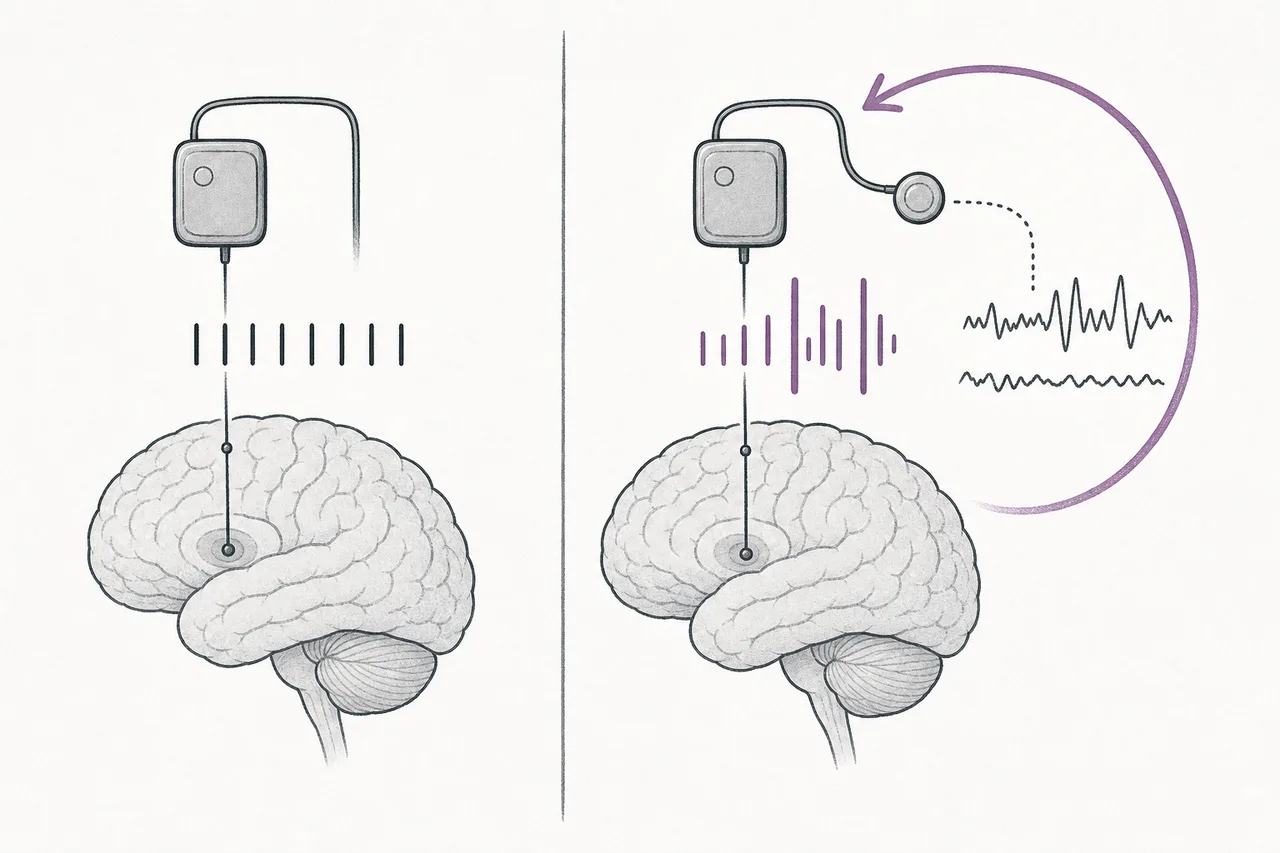
The key point investors should grasp is that closed-loop isn't just an add-on feature — it's the upgrade path for the whole industry, and the bridge that connects neuromodulation to the real "brain-reading" BCI.
04The three branches of this trend
The same principle (sending electricity to retune neural circuits) is applied to different "target points" in the body, each treating a different disease. And on the megatrend map, this node splits into three branches that tell the same story from different angles.
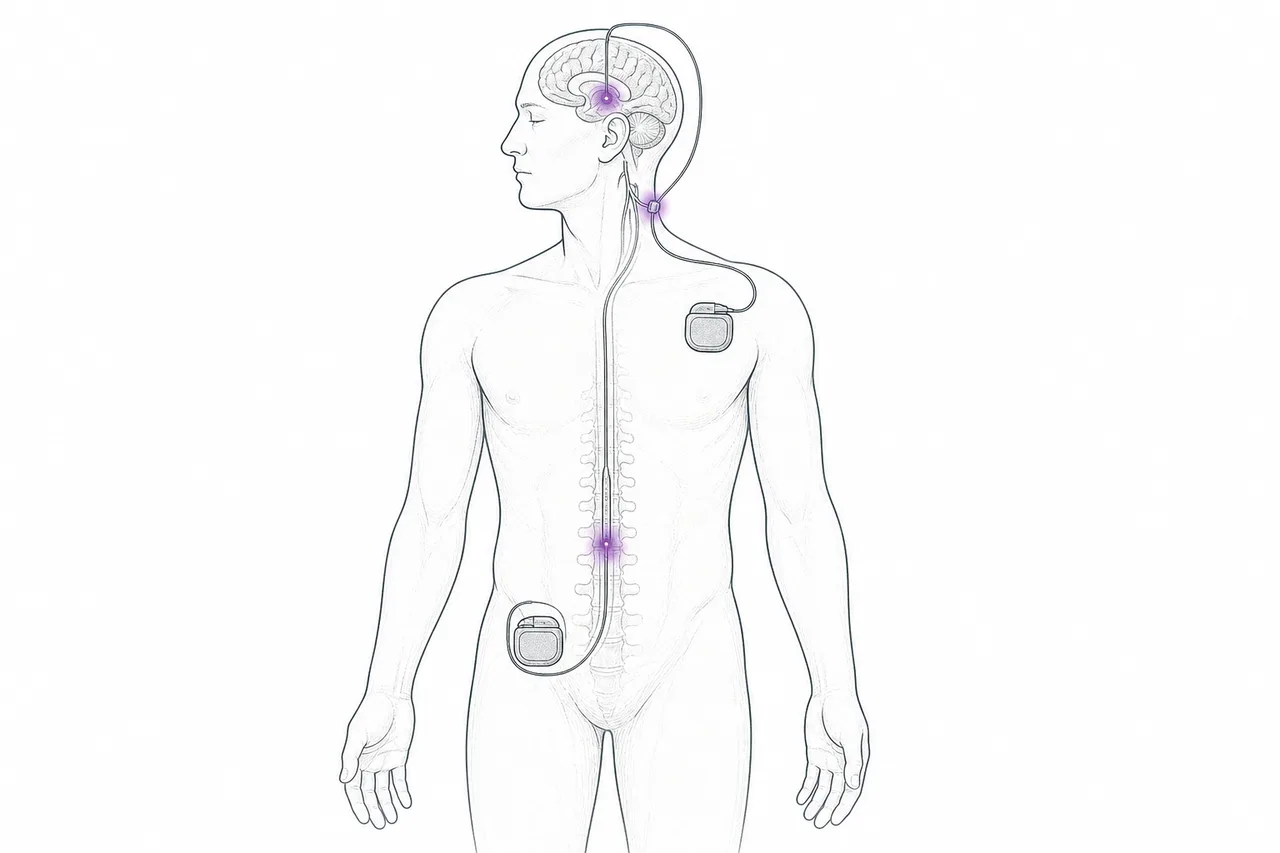
Branch 1 — deep brain & spinal cord stimulation (DBS & SCS — the established leaders) This is the revenue heart of the field, split into two main parts: DBS (Deep Brain Stimulation) implants electrodes deep in the brain to treat tremor and movement disorders in Parkinson's — a standard treatment for over 30 years, implanted in more than 244,000 people. And SCS (Spinal Cord Stimulation) implants electrodes at the spinal cord to "override" chronic pain signals (back pain, leg pain). The SCS market alone is large, around $3.3–3.5 billion, and it's the fiercest battlefield — because it's the biggest pool of money and every rival is in it.
Branch 2 — responsive / closed-loop neural devices This is the frontier of the field — devices that listen to the brain and adjust on their own. The classic example is NeuroPace's RNS, implanted in the brain of people with epilepsy, detecting the "pre-seizure" signal and firing a pulse to head it off before symptoms appear. And in 2025 this branch hit a major milestone: the FDA approved the world's first adaptive DBS (Medtronic), turning traditional DBS into closed-loop. The SCS side is the same — Saluda Medical makes Evoke, which measures the nerve's response (ECAP) and adjusts the stimulation on every pulse. This branch is the fastest-growing market in the group (CAGR ~16% versus ~9% for neuromodulation overall), even off a small base — NeuroPace (RNS, drug-resistant epilepsy) is the pure-play pioneer, and Saluda (Evoke SCS) proved that closed-loop really can beat open-loop (see → closed-loop devices).
Closed-loop devices use the electrical "echo" the nerve sends back (ECAP) as a biomarker to fine-tune the dose on every pulse — the ECAP/biomarker details are in the child chapter → closed-loop devices
Branch 3 — peripheral & cranial nerve stimulation Instead of touching the brain directly, this branch stimulates peripheral nerves, which is easier to operate on and lower-risk. The two fastest-growing examples are: VNS (Vagus Nerve Stimulation), which stimulates the vagus nerve in the neck to treat epilepsy and is now in trials for treatment-resistant depression (the leader is LivaNova); and Inspire Medical's hypoglossal nerve stimulator that treats sleep apnea — this is the rising star, bringing in around $900 million a year, the fastest in the group. There's also sacral nerve stimulation for urinary incontinence.
Looking at the big picture, the three branches run from "deepest and riskiest" (deep brain) to "shallowest and safest" (peripheral nerves) — the shallower it is, the easier the surgery and the faster the market expands, but the deeper it goes, the heavier the diseases it treats, with no other option.
05What it connects to
This node sits at the junction of several big trends:
- A sibling of BCI's other three branches: under the same Brain-Computer Interface there's the mind-reading invasive brain implant (Invasive BCI), the neural electrodes and sensors that are the basic parts of every device, and non-surgical brain-reading devices — neuromodulation is the side that "makes money today" while the others are still investing for the future
- Relies on AI to step up to closed-loop: to "listen" to the brain and decide how to adjust the pulse in real time, you need algorithms that separate the signal of a flare-up from noise — the smarter the AI, the more accurate the adaptive device
- Complements and competes with biologics and genomic medicine (Biotech): many of the diseases neuromodulation treats (Parkinson's, depression, epilepsy) also have drug options — so the device both "complements" (used alongside drugs) and "competes" (used instead when drugs don't work) with the drug side
- Rides the aging population (Aging Population) wave: this is the real long-term tailwind — the diseases that need these devices all rise with age
06Where things stand now + the players
2025 is the year this field crossed a major line. The most talked-about turning point was when the FDA approved the world's first adaptive DBS on February 24, 2025 — Medtronic's BrainSense system, which lets the DBS device treating Parkinson's "listen" to brain waves (beta oscillation) and adjust the stimulation on its own. More than 40,000 patients worldwide who already have a Percept device are eligible to upgrade to this mode — a prime example of a "software feature" unlocking value from an already-implanted base.
The business side moved hard too — in February 2025, Globus Medical announced it would buy Nevro (the pioneer of high-frequency SCS) for around $250 million, showing that even though the SCS market is fiercely competitive, it's still a prize. And Abbott announced an investment to expand its U.S. neuromodulation research center in late 2025.
The player landscape splits clearly into two groups — the "three giants" that dominate the main DBS/SCS market (Medtronic, Abbott, Boston Scientific) and the "specialists" that focus on one disease but grow fast (Inspire, LivaNova, NeuroPace).
07The road ahead
The first and clearest direction is "everything becomes closed-loop." With adaptive DBS through the FDA in 2025 and closed-loop SCS (Saluda) starting to hit the market, the whole industry is heading toward upgrading from devices that "send the same current" to devices that "listen and adjust themselves" — and this isn't just better performance, it extends battery life, reduces side effects, and, crucially for the business, creates new value from the existing patient base.
The second direction is expansion into new diseases, especially psychiatric disorders — treatment-resistant depression, OCD. If it works, it opens a market many times larger than the traditional neurological diseases, but it's also the hardest gate (see the mixed results of LivaNova's RECOVER study as an example). And there are rivals from the drug side, as well as new kinds of psychiatric medicine.
The third direction is less invasive devices — smaller electrodes, easier surgery, longer-lasting batteries, and versions that don't need major surgery. The easier and lower-risk the surgery, the more the market expands to patients for whom it was once "not worth the risk" to operate. The fastest-growing region will be Asia-Pacific (CAGR ~10%), while North America is still the largest market (~45% of world demand).
08Challenges & risks
Even though it's a business that really makes money, neuromodulation has its own particular risks that investors need to understand.
The first risk is reimbursement. These devices are expensive (tens of thousands of dollars each), and almost all of them depend on insurance/Medicare agreeing to pay. If an agency like CMS cuts coverage or tightens the criteria, demand could stumble instantly — this is a variable outside the company's control, and the reason these stocks move with insurance-policy news.
The second risk is that it's surgery, especially DBS, which requires drilling into the skull to implant electrodes deep in the brain — there's a risk of infection and bleeding, and it needs specialized surgeons. That limits market expansion to the number of centers and doctors who can do it. The more invasive the device, the slower the market grows (compare Inspire, which is easier to operate and so grows faster).
The third risk is competition and clinical results. The SCS market in particular is a battlefield where every giant clashes, putting strong pressure on prices. And some of neuromodulation's treatment results still aren't a "clear win" — some studies (like RECOVER for depression) failed their primary endpoint, a warning that expanding into new diseases is no guarantee of success.
In short: while the world is buzzing over mind-reading brain implants, neuromodulation is the "brain-machine" technology already inside hundreds of thousands of people, that's made money for 20 years, and in 2025 has just begun to "listen to the brain" — the point where the side that makes money today and the side that's the future are slowly coming together.