Megatrend · Brain-Computer Interface
The small device in your chest that stops a hand from shaking and quiets the pain — a multi-billion-dollar business that's been profitable for 20 years
Long before the headlines about brain chips that read your thoughts, there was another group of devices already implanted in hundreds of thousands of people, sending a faint electric current in to "mask" the tremor of Parkinson's and "cut" the chronic pain that drugs can't reach. This is the side of the brain-machine world that actually makes money, actually gets reimbursed, and has made people rich for a long time — a market where just 4 companies split nearly all of it, and one that's now entering a big upgrade cycle: from machines that "send the same current" to machines that "listen and adjust themselves."
01What it is
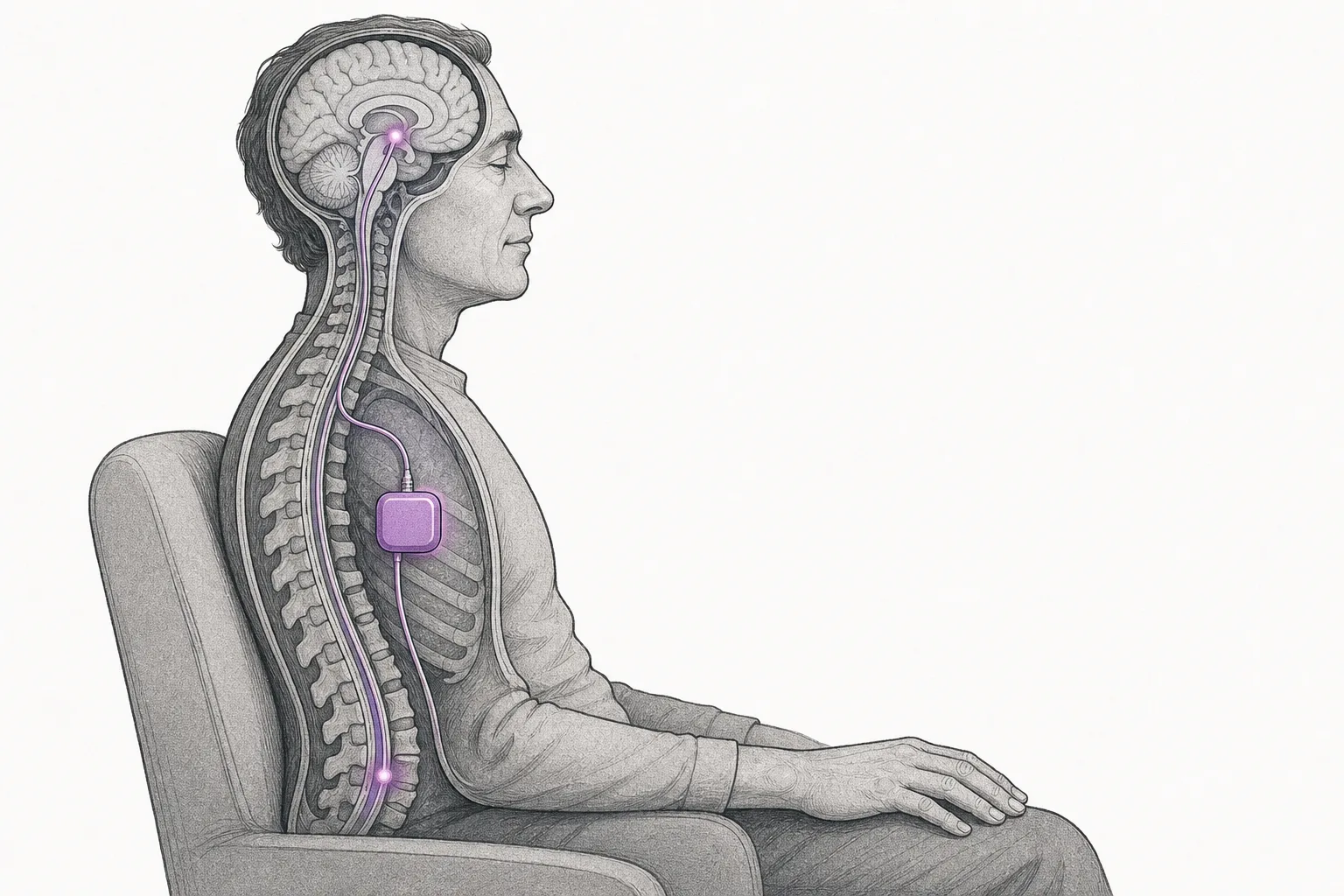
Think of a heart pacemaker — a small box implanted under the skin with a lead running to the heart, sending electric beats to keep it in rhythm. This node is the same idea, except the lead's tip doesn't go to the heart — it goes to the deep brain or the spinal cord instead.
These are the two pillars of the neuromodulation world — and the two that "make money" most:
- DBS (Deep Brain Stimulation): electrodes implanted deep in the part of the brain that controls movement, sending pulses to "mask" the over-firing signals that cause the hand tremor in Parkinson's (including essential tremor and dystonia) — flip the switch on, and a hand that shook too badly to eat goes still in an instant. It looks like magic, but it's pure electricity
- SCS (Spinal Cord Stimulation): electrodes placed in the space above the spinal cord, sending pulses to "cut/mask" the chronic pain signal before it can run up to the brain. Used for people with chronic back and leg pain that surgery, injections, and medication couldn't fix
The word "incumbents" in the node's name matters a lot — it means this is the side of the industry that has already been through the battle. Not lab technology, but a standard treatment that's been around for over 30 years, long past FDA, with reimbursement codes, and a handful of big medical-device giants who have profitably held this market the whole time.
On the megatrend map, this node is a branch under Neuromodulation & Closed-Loop Neurostimulation within the larger trend Brain-Computer Interface. It's the industry's "revenue trunk." The other two sibling branches — next-gen closed-loop / responsive devices and peripheral nerve stimulation — are the "newer / faster-growing" side, but still much smaller than this node.
DBS = deep brain stimulation (treats movement symptoms, like Parkinson's) · SCS = spinal cord stimulation (treats chronic pain) · IPG (Implantable Pulse Generator) = the pulse-generator box with a battery, implanted under the skin — the shared "heart" of both systems, differing only in where the lead's tip goes.
02Why it matters — a big market that's also profitable
When people talk about "brain-machine theme stocks," most of the best-known names don't even have real revenue yet. But DBS and SCS are the clearest exception — they're the side that sells product, gets reimbursed, and has been profitable for a long time.
The numbers tell the story well: the SCS market in 2025 is around $3.3–3.5 billion, expected to grow to about $6.5 billion in 2030. The DBS market in 2025 is around $1.4 billion, growing to about $2.5–2.85 billion in 2030. Both grow at a CAGR of roughly 10% a year — not flashy like AI, but "solid and durable" growth.
Why is SCS nearly twice the pile of money that DBS is? Because there are vastly more people with chronic pain than with Parkinson's. Chronic back and leg pain is a population-scale problem, while Parkinson's is a disease of a specific group. That's why SCS has become the "main battlefield" where every giant clashes hardest.
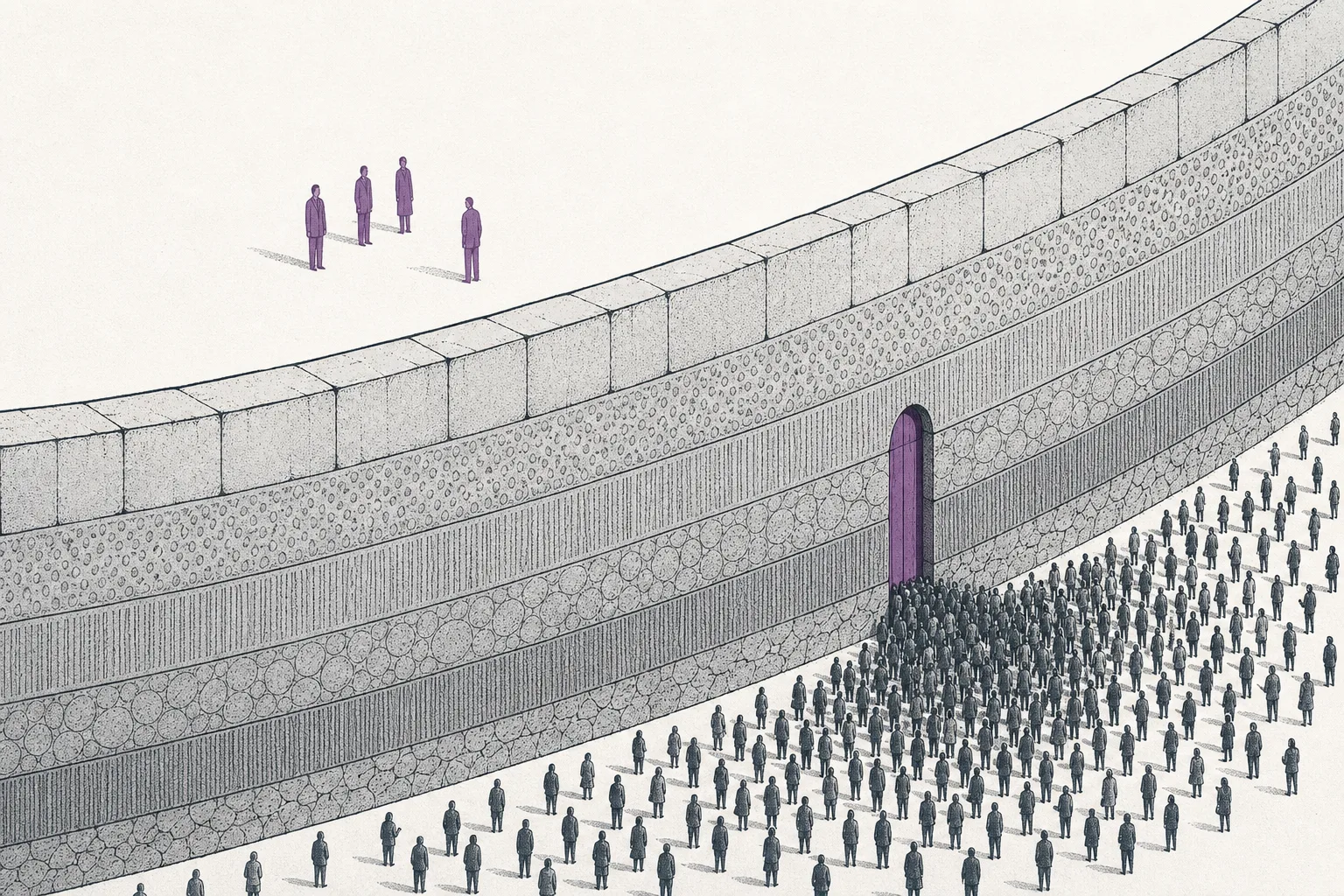
But more important than the size of the market is its structure — this is a few-player market with very high walls. To get in, a new company has to get through years of clinical trials, win FDA approval, hold reimbursement codes, and rely on specially trained surgeons. The result: just 4 companies — Medtronic, Abbott, Boston Scientific, and Nevro — together control about 75% of global neurostimulation sales.
03How it works (IPG → lead → electrode)
The principle is simpler than you'd think. Every device has the same three parts; the only difference is "where the lead's tip lands."
The depth of the target is what separates the "difficulty" of these two. DBS requires drilling the skull and threading a lead deep into the brain to a target within millimeters — a major operation that needs a neurosurgeon and image guidance. SCS surgery is much shallower, because you just place the electrode in the space above the spinal cord — in some cases through a needle, without major surgery. And the nice part is, the patient can try it first — implant a temporary electrode to test for about a week, and if it works, then implant the permanent device.
The thing changing the whole industry comes down to one word: "loop." Old-style devices are open-loop — they send the same pre-set pulse all the time, no matter how the patient is doing, like leaving the AC on one setting all day. Newer models are starting to go closed-loop / sensing, which is the same device, but it also "listens" to the signal coming back, then adjusts the pulse strength itself based on real symptoms — this is the upgrade path we'll cover in the future chapter.
04Where it sits in the ecosystem
This node is the "foundation" that the other branches of neuromodulation build on top of. You can see the relationships as three lines:
- The foundation for next-gen closed-loop / responsive devices: closed-loop isn't a different kind of device — it's the same DBS/SCS with the ability to "listen to the brain" added on. Patients who already have an IPG are the first group to upgrade. So the incumbent side is the "ground the new thing has to stand on," not a rival to be replaced
- Different from peripheral nerve stimulation: that branch doesn't touch the brain or spinal cord directly, but stimulates peripheral nerves (like the hypoglossal nerve to treat snoring, or the vagus nerve in the neck) — easier to implant, lower risk, faster-growing, but still a much smaller market than DBS and SCS combined
- A tangible "BCI stock" under Brain-Computer Interface: while brain chips that read thoughts are still in the experimental stage, DBS/SCS are implanted in hundreds of thousands of real people and generating real revenue — the entry into the BCI trend that investors can actually buy today
Beyond the neuromodulation circle, this node is also entangled with several other big trends:
- Both complements and competes with Biotech & Genomic Medicine: the diseases DBS/SCS treat — Parkinson's, chronic pain — also have drugs as an option. So the devices both "complement" the drug side (used alongside drugs when drugs can't hold the symptoms) and "compete" with it (replacing drugs when they don't work or have too many side effects)
- Relies on AI to reach closed-loop: to "listen" to brainwaves and decide to adjust pulses in real time, you need algorithms that separate the signal of a flare-up from noise — the smarter the AI, the more accurate the adaptive device
- Rides the wave of Aging Population: this is the real long-term tailwind. Parkinson's and chronic pain both rise as the world's population ages — so this node's demand grows with population structure, not just hype
05Where it stands now
2025 was a year the whole industry moved hard — on both the technology and the deal side. The loudest turning point was when the FDA approved the world's first adaptive DBS on February 24, 2025 — Medtronic's BrainSense system, which lets a DBS device treating Parkinson's "listen" to brainwaves (beta oscillation) and adjust the stimulation itself. The more than 40,000 patients worldwide already using a Percept device are eligible to upgrade to this mode — Medtronic called it "the largest commercial BCI launch ever," and it's true, because this is a base of devices already implanted in real people.
The business-deal side was just as hot. On February 6, 2025, Globus Medical announced it would buy Nevro — the pioneer of high-frequency SCS (HF10 / 10 kHz) — for about $250 million ($5.85 per share, all cash), closing mid-2025. What's striking is that this price was far below the value Nevro once reached in its heyday — reflecting how fiercely the SCS battlefield competes, enough to exhaust even the technology's own pioneer.
So who controls what? This is an oligopoly where each player has its own "signature":
Medtronic is the true market leader and the DBS frontrunner — the Percept and BrainSense adaptive system put it ahead on "sensing the brain's signals" (closed-loop sensing). Abbott stands out with the Infinity-generation DBS and burst-type SCS plus ganglion stimulation (DRG). Boston Scientific's selling point is waveform flexibility (multi-waveform), in both its Vercise DBS and WaveWriter SCS — and it's the one whose neuromodulation generates billions of dollars a year. As for Nevro, it's the pioneer of 10 kHz high-frequency SCS (HF10) that once flipped the market, but after running into competition it sold itself to Globus in 2025.
06The future — the closed-loop upgrade cycle
The clearest direction for this node is "the upgrade cycle from open-loop to closed-loop." Now that adaptive DBS has passed the FDA in 2025, the whole industry is moving from machines that "send the same current" to machines that "listen and adjust themselves" — and this is as much a business story as a medical one, because it unlocks value from the existing base of patients who already have a device implanted.
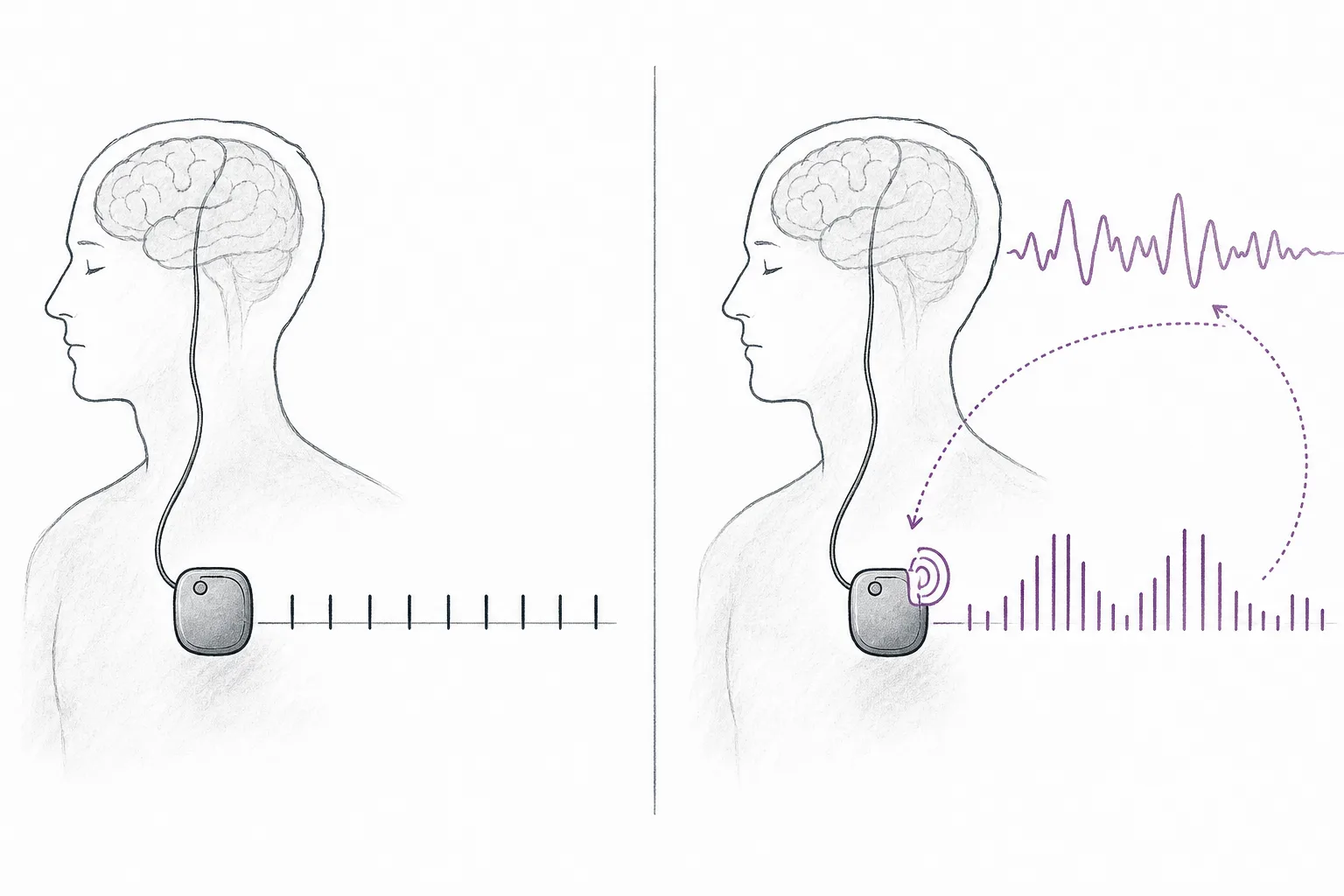
Why does this matter for profit? Because selling a new device requires "finding a new patient + a new surgery," which is slow and capped by the number of surgical centers. But upgrading the existing base to adaptive — like Medtronic's 40,000-plus Percepts — creates added value from something already inside people. It reduces side effects, extends battery life, and binds patients to your own system more tightly. That's why all 4 giants are racing to compete on "sensing/adaptive" features more than on the hardware itself.
The second direction is spreading to new diseases and less invasive surgery — electrodes are getting smaller, batteries last longer (rechargeable versions cut down on battery-replacement surgery), and implanting is getting easier. The easier and lower-risk the surgery, the more the market expands to patients for whom it was previously "not worth the risk." Regionally, Asia-Pacific is the fastest-growing market, while North America is still the largest.
But let's be clear: this node is the "incumbent" side — it won't grow in leaps. What it gives you is quiet, predictable growth with a tailwind from an aging population, plus a closed-loop upgrade cycle that gradually adds value per patient. The "flashy" part lives more in the responsive and peripheral sibling branches.
07Challenges & risks
Even though it's a business that genuinely makes money with high walls, this node has its own particular risks to understand.
The first risk is a price war in the SCS market. This is the battlefield where every giant clashes over the biggest pile of money, which means high price pressure and fierce competition — visible in the fact that Nevro, the pioneer of HF10 technology itself, still had to sell to Globus for only ~$250 million, far below its heyday value. Some of SCS's clinical results still don't "clearly beat" the competition, so fighting for share comes down to price and service, not just technology.
The second risk is that it's implant surgery, especially DBS, which requires drilling the skull and implanting electrodes deep in the brain — there's a risk of infection, bleeding, and lead migration, and it needs a specialist surgeon. So market expansion is limited by the number of centers and doctors who can do it (this is why DBS grows more slowly than easier-to-implant branches like snoring devices). Even SCS, which is shallower surgery, still has issues of lead migration and revision surgery.
The third risk is reimbursement. These devices are expensive — the DBS device alone runs about $15,000–20,000, and the total surgical cost in the U.S. can climb to $35,000–100,000 per case. Almost all of it depends on insurance/Medicare agreeing to pay. If an agency like CMS cuts coverage or tightens criteria, demand could stall instantly — an out-of-control variable for the companies that makes this group of stocks sway with insurance-policy news.
In short: this is a small device that stops a Parkinson's hand from shaking and quiets chronic pain. It's already implanted in hundreds of thousands of people, has been profitable for 20 years, and is now entering a big upgrade cycle — from a machine that "sends the same current" to one that "listens to the brain and adjusts itself," which will decide who keeps the incumbent crown over the next decade.