Megatrend · Brain-Computer Interface
The device that "listens" to the brain all day, then stimulates only when needed
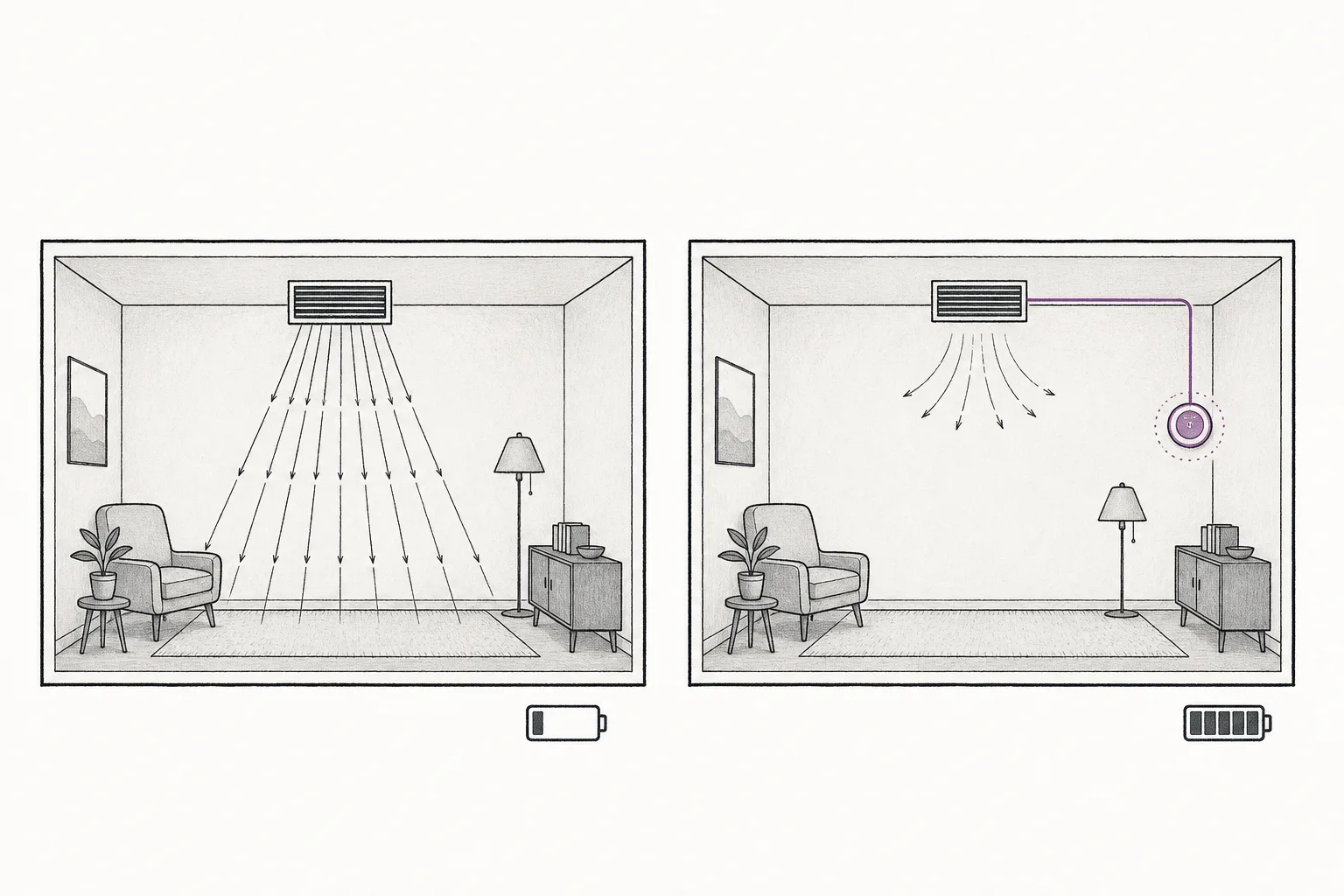
Old-school neurostimulators send the same electricity 24 hours a day — like running the AC at full blast all day whether the room is hot or cold. A new generation of devices called "responsive" or "closed-loop" flips that logic entirely: they listen to the brain's signals all the time, detect when a symptom is about to flare, and fire a pulse to head it off only when needed. The result is less wasted power, fewer side effects, and far more precise targeting. This is the frontier of neurostimulation — and a bridge that's slowly connecting today's world of treatment with tomorrow's world of brain-reading BCI.
01What it is
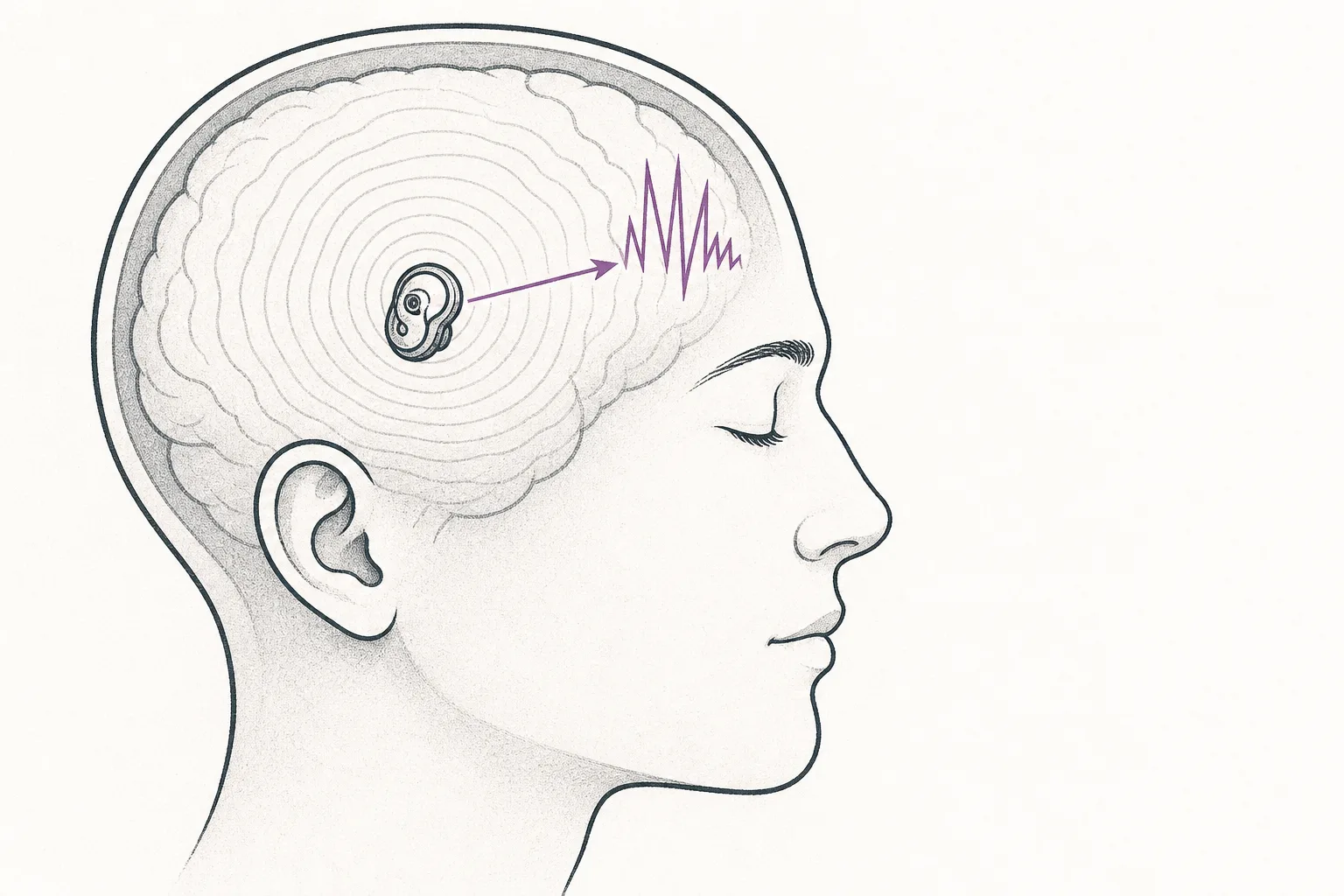
Picture an automatic sprinkler on the ceiling. It doesn't spray water all the time — it has a sensor watching for heat, and the moment it finds fire, it sprays water right on that spot — only when needed, exactly where it's happening. A responsive / closed-loop neural device works with this same logic on the brain. Implanted in the patient, it "listens" to the brain's electrical signals all the time, and only sends an electrical pulse when it detects that a symptom is about to flare.
The term closed-loop comes from a simple engineering idea: a system that measures its own output and feeds it back to adjust how it works. The opposite is open-loop, which just keeps doing the same thing regardless of the result. Old-school neurostimulators are open-loop — the doctor sets the strength, and the device sends pulses at that level all day and night, whether the patient is sleeping, walking, or perfectly calm. A responsive device is closed-loop: it has "ears" that hear the brain and a "little brain" on a chip that decides when to stimulate.
This node is one of the deepest branches (a leaf) under Neuromodulation & Closed-Loop Neurostimulation within the big megatrend Brain-Computer Interface. It's the technical frontier of neurostimulation — its siblings next door are traditional DBS & SCS (the incumbent leaders), the open-loop devices that sell well and earn the industry's main money, and peripheral nerve stimulation, which touches nerves outside the brain. If the old-school devices are "leaving the lights on," this node is "lights with a motion sensor."
Open-loop = sends a constant pulse all the time, listening to nothing (like leaving the AC on) · Closed-loop / responsive / adaptive = listens to brain signals and adjusts / fires pulses to match reality (like an AC with a thermostat) · Biomarker = the "telltale signal" the device uses to decide — for example a brainwave pattern that comes before a seizure (epileptiform) or the beta band that correlates with rigidity in Parkinson's — the device stimulates when this biomarker shows up.
02Why it matters — precise, efficient, fewer side effects
The big problem with old-school neurostimulators isn't that they "don't work" — they do. But they over-stimulate, because they send the same electricity 24 hours a day even though the patient's symptoms only flare in bursts. That has three consequences: (1) wasted battery, meaning more frequent replacement surgeries · (2) side effects from over-stimulation, like slurred speech, off-balance, mood changes · and (3) bad timing — too strong at some moments, too weak at others. Closed-loop solves all three at once, because it stimulates only when and only as much as needed.
The clearest evidence comes from the spinal side: in Saluda Medical's Evoke trial, which compared closed-loop against open-loop head-to-head, responders in the closed-loop group (pain down ≥50%) were about 79% at 24 months, versus 54% in the open-loop group — a huge gap for the same treatment, just from teaching the device to "listen."
The economic value of this is growing fast. The global market for closed-loop neurostimulation devices was around $2.4 billion in 2025, and is expected to grow at an accelerating pace of about 16% a year, reaching several billion dollars by the early 2030s — many times faster than the overall neuromodulation market. That's because it's the "upgrade layer" steadily taking share from the older devices.
03How it works (listen → detect → stimulate → adjust)
The heart of a responsive device is a feedback loop that spins constantly inside the patient. Let's walk through, step by step, how it goes from "listening" all the way to "stimulating and then adapting."
The key that makes these devices "hard" lies in one electrode having to do two jobs — to listen (record) and stimulate (stimulate) at nearly the same time. It's like trying to hear a whisper in a room where you yourself are shouting. The device has to separate the real brain signal from the "noise" created by its own stimulation, and it has to decide within a fraction of a second on a chip low-power enough to stay implanted in a person for years. That's why closed-loop relies on algorithms and AI to tell the biomarker apart from the noise, accurately and fast enough.
04Where it sits in the ecosystem
This node doesn't float on its own — it builds on existing technology, leans on other trends, and is clearly different from its siblings in the same family.
- Builds on traditional DBS & SCS: closed-loop didn't throw out the old devices, it "upgraded" them — most of the basic hardware (the pulse generator, leads, electrodes) comes from the same base as open-loop, sold for decades. The difference is the sensing ability plus the algorithm. That means some patients who already have a device can upgrade to adaptive mode without new surgery
- Leans on AI as its heart: to "listen" to the brain and decide at the right moment, you need algorithms that separate the symptom-signaling pattern from noise — accurately, at real-time speed, on a low-power chip. The smarter the AI, the smarter and more trustworthy the responsive device. This is what makes this node fundamentally different from the old devices
- Different from peripheral nerve stimulation: that sibling branch touches nerves outside the brain (like the hypoglossal nerve to fix snoring), which is easier to operate on and the market expands fast. This node focuses on listening-and-responding directly in the brain and spinal cord — deeper, technically harder, but where the closed-loop ability is worth the most
- Complements biologics and genomic medicine and rides the aging population wave: the diseases these devices treat (drug-resistant epilepsy, Parkinson's, chronic pain) all have drugs as an alternative too, and all rise as the world's population ages — both a rival and a long-term tailwind
05Where it stands now
2025 is the year closed-loop crossed the line from "a niche thing" to "mainstream." The loudest turning point came on February 24, 2025, when the FDA approved the world's first adaptive DBS — Medtronic's BrainSense system. It lets a DBS device treating Parkinson's "listen" to brainwaves (the beta wave linked to rigidity) and adjust the stimulation by itself. What matters for the business is that the over 40,000 patients worldwide who already have a Percept implant are eligible to upgrade to this mode — a beautiful example of a "software feature" unlocking new value from an already-implanted base. Medtronic calls it the largest commercial launch of BCI technology ever.
But the true pioneer of closed-loop is NeuroPace, which made responsive devices before anyone else. Its RNS System is implanted in the brains of people with drug-resistant epilepsy, detecting the "pre-seizure" signal and firing a pulse to head it off before the symptom hits — and the long-term data is striking: at 9 years, patients' seizures dropped by a median of 75% (up from 55% at year 3), showing that the more the device "learns" the patient, the better it gets. On the business side, NeuroPace had 2025 revenue of about $100 million, growing ~25%, and is targeting ~20% growth in 2026.
The spinal side is moving too — Saluda Medical makes Evoke, which measures the nerve's "echo" (ECAP) and adjusts the stimulation on every pulse, and beat open-loop clearly in a head-to-head trial. Meanwhile giants like Abbott and Boston Scientific are racing to add sensing into their own new devices — so the closed-loop game isn't a one-player race, but a competition across the whole industry.
06The road ahead — from adaptive to BCI
The first and clearest direction is "everything becomes closed-loop." With adaptive DBS through the FDA in 2025 and closed-loop SCS starting to reach the market, the whole industry's direction is upgrading from devices that "send the same electricity" to devices that "listen and adjust by themselves" — and it will spread step by step to every indication: epilepsy, Parkinson's, chronic pain, and even aiming at psychiatric conditions like treatment-resistant depression, which, if it succeeds, opens a market many times larger.
The second direction is devices that get smarter with on-device AI — algorithms that detect biomarkers more accurately, learn each patient's specific patterns, and may adjust themselves without needing the doctor to tune them often. The better and lower-power the processing chip inside, the longer the device can do complex work on a single surgery.

The third direction is the line with true BCI slowly blurring. A responsive device that can already read brain signals is just one step away from a full mind-reading BCI — at the far end are companies like Synchron (already implanted in 12 people, raised $200 million in late 2025 to enter a pivotal trial) and Neuralink (expanding to dozens of participants) aiming at full read-write of the brain. Both are still private companies in the trial stage. But they're the direction sense-and-respond technology is heading — and this node is the middle of that journey, the part that "already makes real money" today.
07Challenges & risks
The first risk is algorithms and data. The heart of closed-loop is the ability to "detect at the right moment" — if the algorithm misreads the signal (firing a pulse when it isn't needed, or missing when it should fire), the whole benefit disappears. Proving a device is "truly smart" takes large amounts of patient data and years of trials. On top of that, a device that records brain signals all the time opens a new question of brain-data privacy that regulation hasn't caught up with.
The second risk is a specialized market and surgery. Especially devices implanted directly in the brain (like RNS) require drilling into the skull to implant electrodes — with infection risk, and a need for specialized centers and trained surgeons. That caps market expansion at the number of centers that can do it. Drug-resistant epilepsy itself is a niche market compared with diseases that are easier to operate on — which is why a pure-play company like NeuroPace has main revenue in the "hundreds of millions," not the "billions" of the giants.
The third risk is funding and competing with the giants. Many of the closed-loop pioneers are still small or private companies (Saluda, Synchron, Neuralink) that have to burn a lot of research money before turning a profit — so they depend on continued fundraising and are exposed to swings in the capital markets. At the same time, when giants like Medtronic, Abbott, and Boston Scientific add closed-loop ability into their own devices, the small companies have to compete with rivals who have far greater sales channels, patient bases, and capital.
In short: this node is the device that stopped scattering electricity all day and turned to "listen to the brain first, then stimulate only when needed" — a technical frontier that makes treatment more on-target, and a quiet bridge that's steadily bringing the world of neurostimulation closer, step by step, to the real world of Brain-Computer Interface.