Megatrend · Cybersecurity & Digital Trust
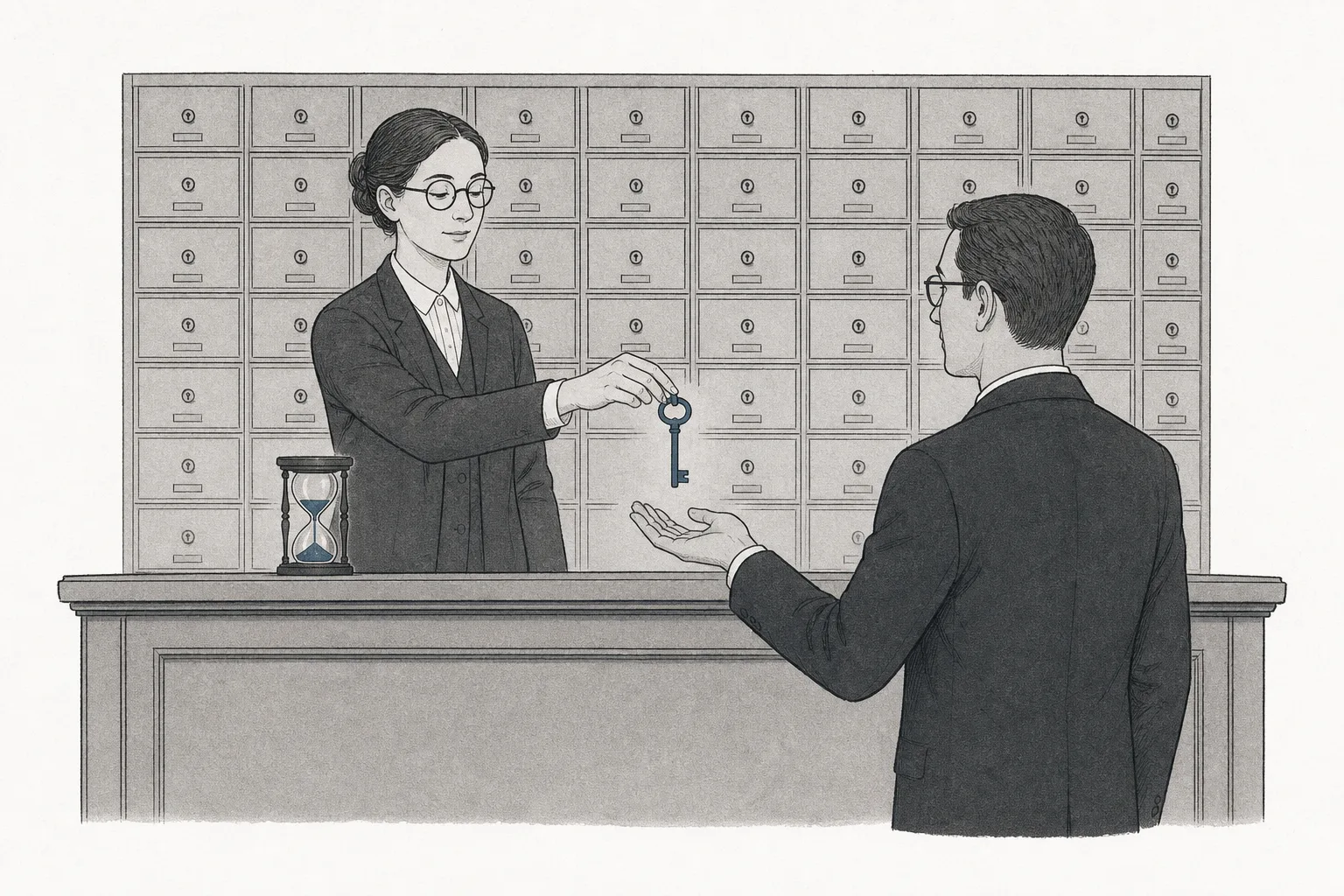
The key that opens every room in the building — whoever holds it is the company's owner, for a while
Every organization has a small group of wildly powerful special accounts — the admin, root, and superuser accounts that can shut down servers, wipe databases, move money, and create new users. These are the “keys to the kingdom.” Steal just one of these keys and the game is over — the hacker becomes the system administrator. Privileged Access Management, or PAM, is the discipline of keeping these keys in a vault, lending them out one use at a time, and filming every time someone uses one. This is the innermost layer of the modern security fortress.

01What it is — the keys to the kingdom
Picture a whole office building. Each ordinary employee has a keycard that opens only their own floor — they can get into the meeting rooms, use the copier, and that's it. But a small group holds a master key that opens every room, from the server room to the finance office to the vault holding all the customer data. In the IT world, this group is the system administrators (admin / root / superuser), and their accounts are what we call “privileged accounts.”
These accounts can do almost anything — shut down a server, delete an entire database, create or remove users, change security settings. In a bank, they're the accounts that can order big money transfers. Put simply, whoever controls these accounts is, technically, the company's owner for a while. That's why the industry casually calls them the “keys to the kingdom” — the keys to the realm.
Privileged Access Management (PAM) is the discipline and the tools built specifically to look after this set of keys. Its heart is three short steps: (1) keep the passwords and keys in a central vault — so no one even knows the real password · (2) lend out access one use at a time, only as needed, then take it back (just-in-time) · (3) film and log every action in a privileged session, so anything unusual can be traced. On the megatrend map, PAM is a sub-branch under Identity & Access Management (IAM) within the larger trend Cybersecurity & Digital Trust, with siblings alongside it: Workforce & Customer IAM (SSO/MFA), which handles “ordinary people,” and Identity Governance (IGA), which handles “who should have which rights.” PAM focuses on the smallest but most dangerous group — the accounts with the highest power.
Privileged account = an account with power over the system (admin/root) that can do what a normal account can't · Vault = a digital safe that stores passwords/keys encrypted and rotates them automatically · Just-in-time (JIT) = granting rights “only when you need them” and pulling them back immediately, never leaving access standing · Least privilege = the principle of granting the minimum rights a task requires, no more.
02Why it matters — one leaked admin = the whole company falls
Look at the numbers that make this anything but a small problem. The Verizon Data Breach Investigations Report 2025, which analyzed over 12,000 breaches, found that stolen credentials are still the #1 way in — showing up in roughly 22–32% of all incidents, and in web application attacks, a full 88% started from a stolen account. Here's the key point: if the stolen account is just an ordinary employee, the damage is limited. But if it's an admin account, the hacker can walk straight through the entire organization.
This is the core of the idea the industry calls “assume breach” — assume from the start that someday someone will break through the outer wall (because they always do). So the more important question isn't “how do we keep people out,” but “once they're in, can they grab the master key?” If the answer is no — the keys are locked in a vault, used one at a time, with everything filmed — the damage stays contained. That's why PAM is counted among the best-value security investments there is: it protects the spot that's most expensive when it breaks.
Economically, this matters because every organization on earth has privileged accounts — banks, hospitals, power plants, online stores. And the more an organization moves to the cloud and uses more apps, the more its number of privileged accounts explodes. So PAM isn't an optional product; it has become mandatory infrastructure that laws and standards (cyber insurance, ISO 27001, financial regulators) are starting to require — which is why demand grows largely independent of the economic cycle.
03How it works (vault → lend one at a time → film it)
The heart of PAM is changing how people access privileged accounts. Instead of the old way — the admin knows the password and logs straight into the server (dangerous, because the password lives in someone's head and can leak out) — it routes everything through a “middleman” (broker) that controls every step. Let's walk through it.
What makes this mechanism so powerful is that it removes all the weakest points — the password isn't in someone's head or a notes file; it's in a vault that rotates it automatically (so the admin can't sell or leak it, because they never knew the real one) · rights don't stand around all the time; they're handed out only when needed and taken back (shrinking the “attack surface” enormously) · and every action is filmed, making it traceable and accountable if anything goes wrong. All of this turns “permanent trust” into “one-time, verifiable permission.”
Beyond managing the passwords of “people,” modern PAM also has to manage the passwords of “machines” — programs, bots, and APIs use secret keys (called secrets, like API keys, tokens, certificates) to talk to each other. Secrets management is the vault for this kind of key, and it's the fastest-growing part, because the number of “machine identities” is racing far past the number of people (see the next chapter).
04Where it sits in the security world
PAM is the innermost layer of the identity system. If you picture all of IAM as a house, Workforce IAM (SSO/MFA) is the front door every employee passes through, and PAM is the safe in the master bedroom that holds the most valuable things. It works inseparably alongside the other branches.
- Builds on top of Workforce/Customer IAM: SSO/MFA proves “who you are,” and PAM decides “then when, and for how long, do you get to hold the master key” — these two layers join into a complete access gate
- Pairs with Identity Governance (IGA): IGA answers “who should have which rights” and reviews it periodically, while PAM makes sure those rights are actually used safely — which is why the big players try to merge all three layers (IAM + PAM + IGA) into one identity platform
- Opens the way for Cloud & Digital Infrastructure: the more work moves to the cloud, the more privileged accounts and secrets explode — PAM is what lets the move to cloud happen without scattering the master keys everywhere
- Accelerated and challenged by AI: an AI agent is a “digital employee” that needs its own identity and the right to access systems on its own; each one is a privileged account to control — so AI is both an accelerant for PAM demand and a harder new problem
- Prepares for Quantum Computing: a future quantum machine might crack the encryption used today, so the vaults and keys PAM guards are among the first gates that must switch to post-quantum encryption
05Where it stands now
The biggest event in the PAM world this round was a deal that shook the whole industry — in July 2025, Palo Alto Networks announced it would buy CyberArk, the PAM market leader, for about $25 billion, and closed the deal in February 2026. This is one of the largest security giants placing a “big bet” that the future of security will revolve around identity — and that the keys to the kingdom are an indispensable piece of its platform.
Why is CyberArk worth that much? Because it's the true PAM market leader — its annual recurring revenue (ARR) hit $1.44 billion at the end of 2025, up ~23%, with the subscription portion growing ~30% and making up 88% of total revenue, reflecting a stable, predictable business. In the 2025 Gartner Magic Quadrant for PAM, the three long-standing leaders were CyberArk, Delinea, and BeyondTrust.
The other two leaders play from the private-equity-owner side — Delinea (born from merging Thycotic with Centrify under the TPG fund) has held the leader spot in Gartner for 7 straight years, strong on ease of use and fast deployment, while BeyondTrust is strong on endpoint privilege control and remote access. Neither is on the public market, which reflects an important truth about this field: many of the real players are private companies or have been absorbed into giants — leaving not many options you can invest in directly on the stock market.
On the related, investable side, Okta is the identity giant moving deeper into the privileged-access game from the largest SSO/MFA base. And Asia has its own ecosystem — China is led by Venustech, while South Korea and Japan have several specialists in PAM/secrets, reflecting how the security of the “master key” has become a matter of digital sovereignty that each country wants its own home players for.
06The road ahead
PAM's biggest direction is captured in the phrase “non-human / machine identities.” In a modern organization today, the number of “machine identities” — bots, scripts, containers, microservices, and most recently AI agents — is many dozens of times larger than the number of people. Various reports estimate the ratio anywhere from around 45-to-1 up to 80–100-to-1 in cloud environments, and it keeps climbing — in a single year, the number of NHI grew about 44%.

Every machine identity is an account that needs a secret to reach other systems, and these secrets are often embedded insecurely in code or config files — in 2025, more than 24 million secrets were found leaked in public. That's why secrets management has become the fastest-growing new battlefield in PAM, and AI agents accelerate it further, because they're “digital employees” that decide to access systems on their own — they need a vault and rules to control them just like people.
The second direction is cloud-native PAM. Many of the older tools were designed for servers in the office, but the world has moved entirely to AWS/Azure/Google Cloud. So a new generation of players offers PAM that's lightweight, fast to install, and able to control cloud rights in real time (called CIEM — managing entitlements in cloud infrastructure). The third direction is fusion into the whole of identity — the lines between IAM, PAM, and governance are blurring, and customers want a single platform that controls all of identity. That's the direct reason behind the Palo Alto–CyberArk deal.
07Challenges & risks
The first risk is the wave of consolidation. The Palo Alto–CyberArk deal is a signal that PAM is being absorbed into being “one feature” inside a giant security platform. The upside is customers get everything in one place. But the downside is that small specialists get squeezed — they have to find a niche or get acquired, and the options you can invest in directly on the stock market shrink, because CyberArk became part of a bigger company while Delinea/BeyondTrust belong to private equity.
The second risk is that cloud-native PAM could eat the incumbents' market. Leaders that were strong in the old server world have to adapt fast to the cloud world; if they're slow, players born on the cloud from the start could overtake them — just like what happened in the network security market (see Network Security & SASE, where the “true cloud” players overtook the box-sellers). It's the classic risk for a leader carrying old legacy on its back.
The third risk is complexity and trust. PAM is famously hard to install and run. Get it wrong — a vault goes down, or a misconfiguration leaks rights — and the impact is far more severe than with an ordinary product, because this is the whole set of “master keys.” And because AI agents and machine identities are growing faster than the old tools can keep up, the gap between “the number of keys to control” and “the actual ability to control them” may widen temporarily — which is both a risk and an opportunity for this field at the same time.
In short: PAM is about the keys to the kingdom — the handful of accounts that control everything, and the discipline of locking them in a vault, lending them out one at a time, and filming every use. In a world where every organization has to “assume it's already been breached,” and the number of keys is exploding because of AI and the cloud, keeping the master keys firmly under control becomes one of the most important and indispensable gates in digital security.