Megatrend · Climate Adaptation & Water
The building you live in was made for a world that no longer exists
Buildings everywhere were designed for the climate of 30–50 years ago — back when heat waves, storms, and floods weren't this severe. Today they're too hot to live in, flood too easily, and 'leak' energy so badly that they're behind nearly 40% of the world's carbon emissions. This node is the business of 'upgrading' the buildings the world already has — making them tough enough for a harsher climate while using less energy. It's engineering, it's materials, and it's an investment wave with the law as its trigger.
01What it is
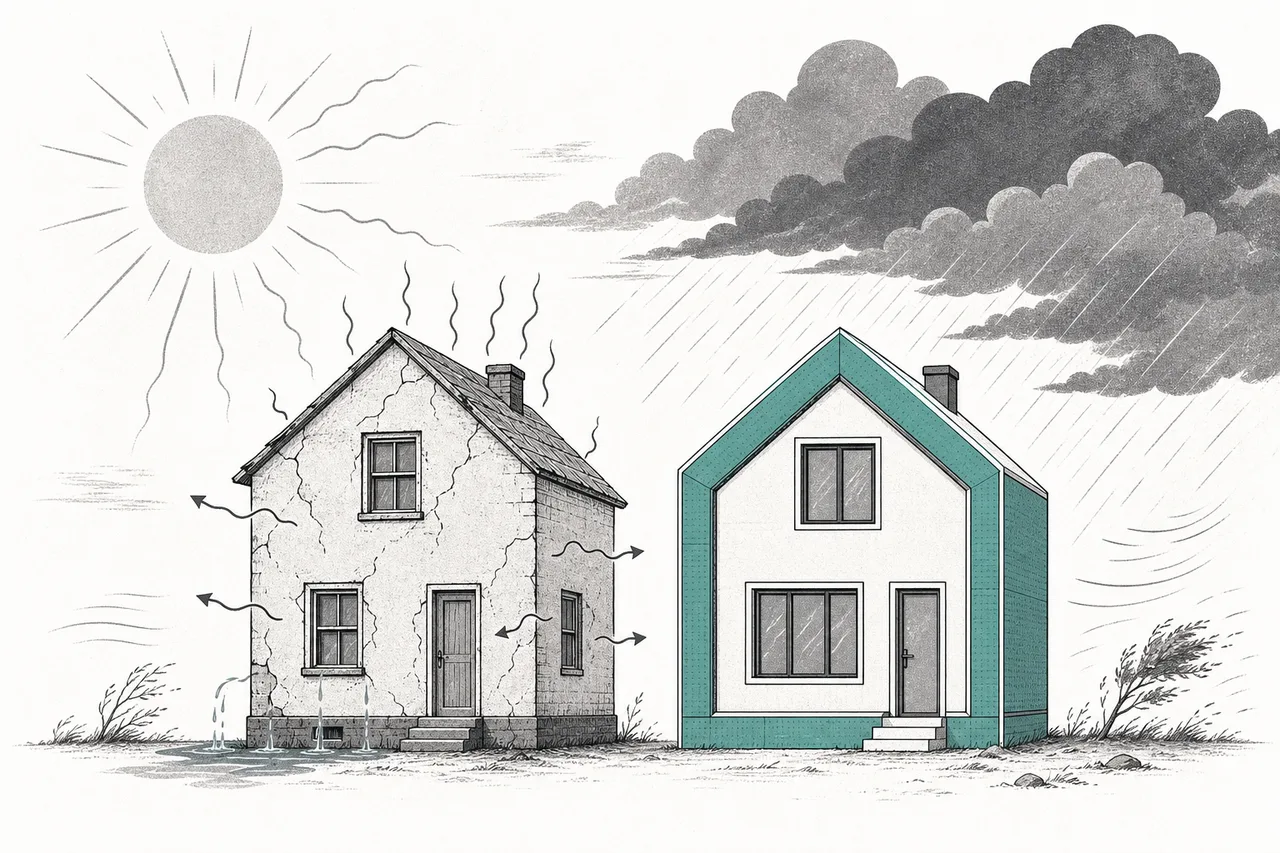
Picture the home or office you're in right now. If it was built before 2000, it was designed for the climate of 'that era' — summers that rarely hit 40°C for long, storms that came less often, rain that didn't pour this hard. But buildings last for decades, and the climate is changing far faster than that. The result: a world full of buildings that are 'climate-obsolete' even though they're still standing perfectly fine.
Resilient Buildings & Retrofit is the business of fixing this — not by knocking things down and rebuilding, but by 'upgrading the buildings that already exist' (the word retrofit means improving something old without tearing it down) to do two things at once: (1) withstand a harsher climate — heat, storms, floods, wildfire — and (2) use less energy. The work spans everything from insulating walls, swapping in impact-resistant windows, and painting reflective coatings on roofs, to replacing heating/cooling with efficient electric systems and installing a 'brain' to run the building.
On the megatrend map, this node is a sub-theme under Climate Adaptation & Water — the group focused on 'adapting to a warming world,' which differs from 'cutting carbon.' It accepts that the climate will get worse for sure, then asks how do we live with it. And of all the things we need to adapt, 'the buildings we live our daily lives in' are the very first frontline.
Retrofit = upgrading an existing building without demolishing it · Mitigation = cutting carbon emissions themselves to slow warming · Adaptation = making what we already have survive in a world that's already hotter. What makes this node special is that it does both in a single job — a good retrofit makes a building tougher (adaptation) and uses less power (mitigation) at the same time.
02Why it matters — buildings have to survive, and use less energy
Start with a number a lot of people don't know: buildings consume about 30% of the world's final energy and emit roughly 26% of the energy sector's carbon. And once you add in the energy used to make construction materials, that figure jumps to nearly 40% of all energy-related carbon emissions (IEA, 2025). Which means if you're serious about fixing climate change, you simply cannot skip 'buildings.'
But why 'retrofit the old' rather than 'build new and build it well'? The answer lies in one harsh truth — most of the buildings that will still be standing in 2050 have already been built today. New construction adds only about 1% to the total stock each year. So if you wait for new buildings alone to drive the transition, it'll take a century. The real job is steadily upgrading the billions of 'existing' buildings around the world.
That's why the EU rolled out a new rule (the revised EPBD, 2024) that aims to double the building renovation rate from today's roughly 1% a year, and will require renovating the worst-performing 16% of buildings by 2030 and 26% by 2033 — this law is exactly what turns an environmental problem into a massive 'construction order.' Meeting the target is estimated to require investment of €297 billion a year across 2024–2030.
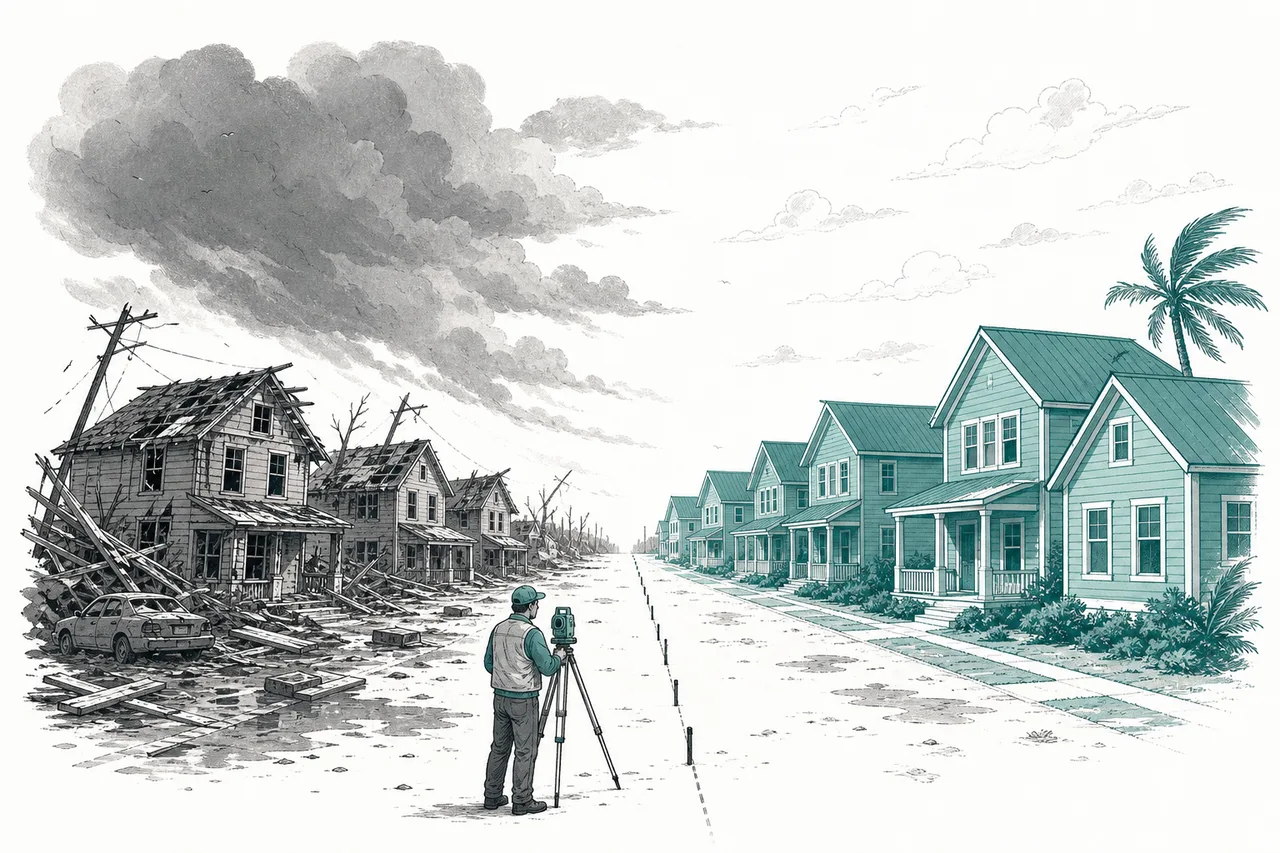
And the second reason — 'survival' — is accelerating demand from the other side. As the climate gets harsher, damage costs and insurance premiums climb with it, making investment to 'toughen' a building a matter of money saved, not just ideals. The clearest example is Florida, where the building code mandates impact-resistant windows (impact windows) in coastal zones — and demand for impact windows in new coastal construction is expected to grow more than 20%.
03How it works — the mechanics of a retrofit
The heart of this is captured in a single image. Picture an old building that 'leaks' — heat pours in through an uninsulated roof, cool air escapes through gaps around the windows, water seeps in at the foundation, and the old air conditioner burns huge amounts of power fighting a heat load that flows in nonstop. A building like this is both 'not tough' and 'energy-wasteful' in the very same body.
A retrofit means fixing it one layer at a time, from the outside in — starting with what tradespeople call the 'building envelope', because it's the first line that separates outside from inside:
This order matters a lot, because it's why the 'building envelope' is the biggest segment — roughly 52% of the energy retrofit market (Grand View). The logic is simple: if a building is still 'leaking,' putting in a new air conditioner is like pouring water into a bucket with a hole in the bottom. You have to seal the envelope first; then everything else gets smaller, cheaper, and more efficient.
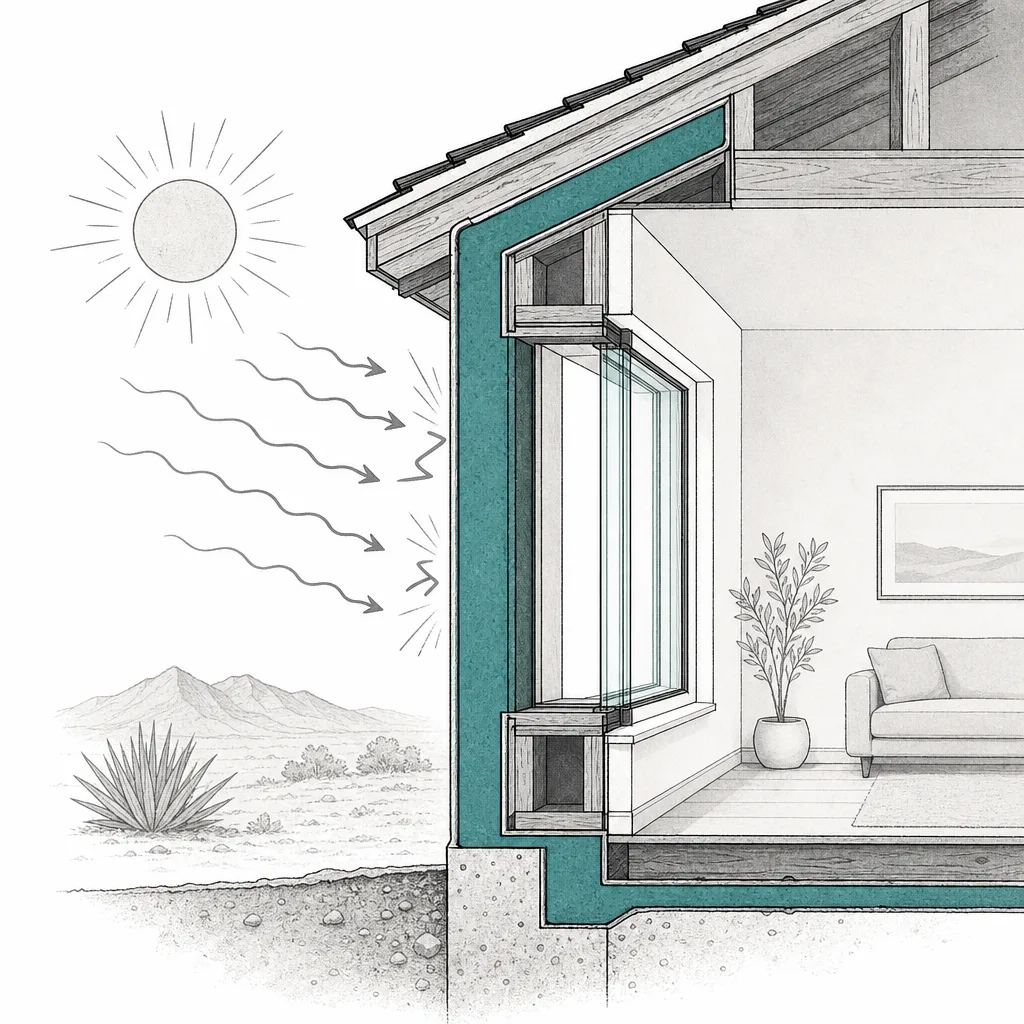
Each layer delivers a measurable, real result — a reflective 'cool roof' alone can cut the power needed to run the AC by about 5–20% in hot regions, and pay for itself in 4–7 years. New impact-resistant windows not only survive storms, they cut the AC load by 25–35% versus plain clear glass. And a deep retrofit that does every layer can cut a building's energy use by as much as 80%.
Building Envelope = everything that separates inside from outside — walls, roof, windows, insulation, joints · BMS (Building Management System) = the 'brain' that automatically controls the AC, lights, and the building's various systems, running them only as much as needed — a layer that takes little investment but saves quickly, because you're just 'making what's already there smarter' without swapping much hardware.
04The ecosystem — what it connects to
This node doesn't stand alone. It sits at the seam of several big trends, and you understand it better by seeing how it 'shares the work' with its neighbors:
- The closest sibling — Cooling & Heat Resilience: both sit under Climate Adaptation, and the line between them is razor-thin. An envelope retrofit = reducing 'the heat that flows in'; Cooling = handling 'the heat that's left' with efficient AC / heat pumps. Seen together, they're one story — keeping people livable inside a building in a hotter world without burning power
- Complements — Energy Transition & Power Demand: a more efficient building is the cheapest way to 'cut power demand' — the cheapest unit of energy is the one you never have to generate. And heat pumps move buildings off burning gas/oil and onto electricity that gets cleaner by the day
- Depends on — Critical Materials & Supply Chain: insulation, special glass, steel, aluminum, coatings — a retrofit is a job that 'eats' materials in enormous quantities. So material prices and the supply chain hit costs directly
- Converges with — AI / Smart Infrastructure: modern BMS uses AI to learn how a building is used and then auto-tunes how the systems run, making an existing building 'smarter' with barely any hardware change
What's interesting is that this node is both an 'adapter' and a 'decarbonizer' at the same time — which isn't normal. Most adaptation trends (a flood barrier, say) help you survive but don't cut carbon, while most decarbonization trends (solar, say) don't make a building survive a storm. A good retrofit does both on a single budget — and that's why capital from both the climate side and the energy-efficiency side flows here.
05Where it stands now + the players
2025–2026 is when 'the law starts to bite.' Europe's EPBD has to be transposed into national law in member states by May 2026. And in the US, the post-disaster rebuilding wave (hurricanes, California wildfires) plus tougher building codes in Florida/California are driving real demand for 'tougher materials.'
Another force on the way is electrification, heat pumps especially — the global heat pump market sits at around $83–93 billion in 2025 and is expected to reach $135–163 billion by 2030. The IEA estimates that for the world to hit its stated targets, it needs to install around 600 million heat pumps, covering 20% of building heating demand by 2030 (up from about 10% today).
So who benefits? There are no 'flashy startups' here. This is the arena of global building-materials and building-systems companies riding the renovation wave + tougher rules — mostly old-line firms that suddenly find themselves at the center of a climate trend. We arrange the players by their role in the chain (envelope · systems/heat pumps · distribution) rather than by raw market cap, to make it clear who actually controls which part of the retrofit job.
06The road ahead
The first direction is 'the law pulling demand'. This is a trend that doesn't lean on consumer fashion, but on laws that are already passed and have clear deadlines — the EPBD mandates renovating the worst 16% of buildings by 2030 and 26% by 2033, and building codes in US disaster zones tighten every time something happens. Demand like this is predictable and long, because it's 'mandated,' not 'chosen.'
The second direction is the consolidation of envelope + systems + data. Envelope work (Owens Corning, Kingspan) and systems work (Carrier, JCI) used to be separate, but in the future they'll increasingly sell as an 'all-in-one retrofit package,' with BMS/AI as the thread tying it all together — whoever controls both the 'hardware + brain' will have more pricing power than someone selling a single material.
The third direction is 'asset value' starting to split between buildings that are tough/efficient and those that aren't — as premiums in high-risk zones soar and tenants/buyers begin paying a premium for buildings with low energy bills and storm resistance, buildings that refuse to retrofit will gradually become 'stranded assets' that are hard to sell and expensive to insure. This pressure will push retrofits from the financial side, not just the legal side.
07Challenges & risks
This trend sounds like a sure thing, but it carries several risks baked into its very nature.
The first is the construction cycle and interest rates — this is a group that's very sensitive to the economy. When rates are high or growth slows, people defer renovation work immediately (it can be deferred, unlike medicine). Owens Corning itself warns that demand for insulation/roofing can shrink fast when the housing market cools. A building that should be retrofitted doesn't mean it will be retrofitted this year.
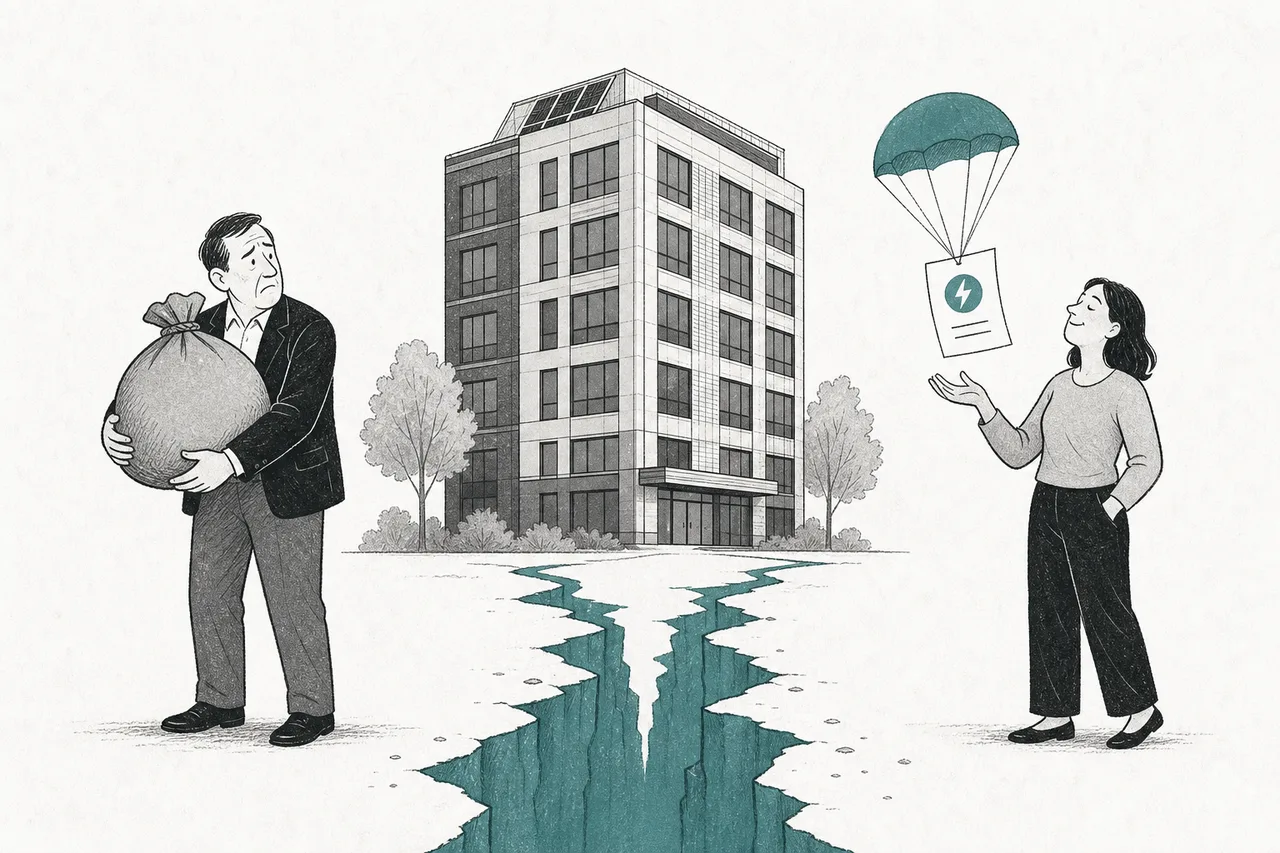
The second is the 'split incentive' problem — in a rented building, the person who has to pay for the retrofit (the owner) is often not the person who gets to save on the energy bill (the tenant). So owners don't want to invest, and tenants can't invest in a building that isn't theirs. This gap is a big reason the global renovation rate is still stuck at ~1% a year, even though everyone knows it should be done.
The third is code dependence. The single biggest chunk of demand is driven by rules — which is a double-edged sword. If a government flips, eases the targets, or pushes back the deadlines (cost-of-living backlash in Europe, say, or a climate-policy retreat in the US), the wave of orders the market was counting on can slow instantly. A trend the law lit can be put out by the law too.
The fourth is high upfront cost. A deep retrofit that cuts energy by 80% sounds great, but payback can take 10–20 years, while many owners think in 3–5-year cycles. New financing models (loans tied to the energy savings, for example) still have to grow a lot more before this market's full potential is unlocked.
In short: this is a trend that starts from a single, simple truth — we have a world full of buildings made for a climate that no longer exists, and demolishing and rebuilding all of them is impossible. The only way out is to 'upgrade what's there,' making it tougher and less power-hungry one building at a time. Multiply that by billions of buildings, multiply it again by laws that mandate it — and it becomes one of the largest and most tangible adaptation jobs there is, even though it's hidden inside a business as boring-sounding as 'insulation, windows, and air conditioners.'