Megatrend · Robotics & Physical AI
The one robot that's already proven it makes real money — and why challengers are showing up now
In a world where most robots are still burning cash to prove themselves, surgical robots have long been the corner that 'actually makes money, and a lot of it.' A surgeon sits at a console and drives robotic arms to operate through tiny incisions — but the secret that makes this business rich isn't the machine. It's the 'blade' you buy fresh for every case. And for 20 years, one company held almost the entire market — until 2025–2026, when the real competitors finally arrived at the door together.
01What it is
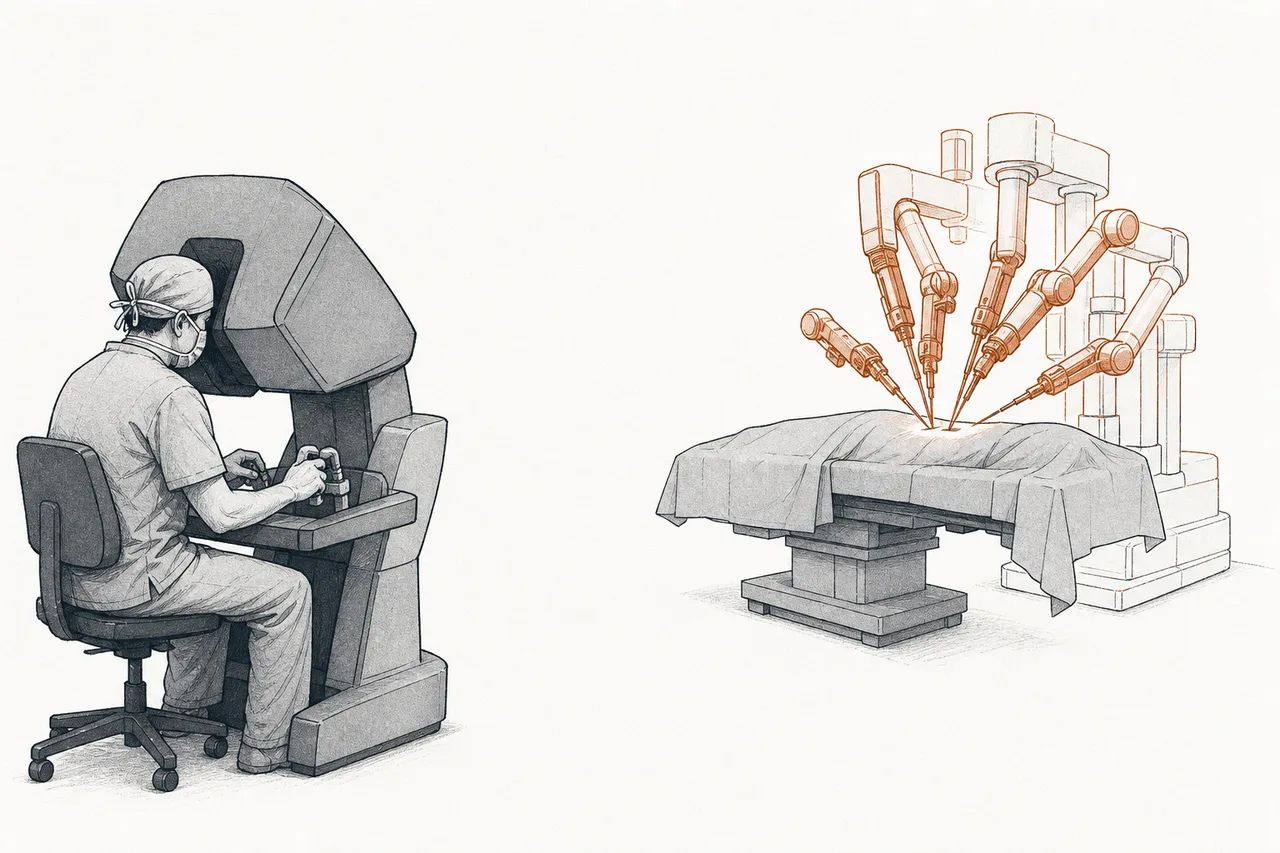
Picture the surgery we all know: the doctor stands over the patient and opens an incision wide enough for hands to work inside. Now swap the image — the doctor sits in another corner of the room, leaning into a 3D screen, both hands on joystick-like controls. And every time the doctor's fingers move, the slender robotic arms poised over the patient follow precisely, holding tiny instruments that work through incisions just a few millimeters across.
That's a surgical robot — and the word 'robot' here needs care. It doesn't operate on its own, and there's no AI deciding for the doctor. It's an 'extension of the surgeon's hand' that makes a human hand steadier, more precise, and able to reach angles a real hand can't — with the doctor controlling 100% of every motion.
On the megatrend map, this node is a sub-theme of Robotics & Physical AI and the 'grown-up' corner of the field — while humanoids and self-driving cars are still proving themselves, surgical robots have been making real money for over a decade. Its definition says it plainly: a surgical system with recurring revenue from instruments and services — and that recurring revenue is the heart of the whole story.
'Small-incision' surgery — instead of opening a wide cut, the doctor inserts a camera and slim instruments through a few small holes. The upside: less pain, less blood loss, faster recovery, and smaller scars. A surgical robot 'upgrades' MIS with the steadiness and precision of robotic arms, plus zoomable 3D imaging.
02Why it matters — a robot that actually makes money
In the stock market, the word 'robot' usually comes paired with a dream that isn't paying yet — self-driving cars are still losing money, humanoids are still in the lab. But surgical robots are completely different: they've been hugely profitable for over a decade. That's why they matter as 'proof' that a robot can build a sustainable business — if the model is right.
The market isn't as big as chips or AI, but it grows fast and steadily. The global surgical-robot market sat at roughly $13–14 billion in 2025, and many research houses expect it to reach ~$27 billion by 2030, growing about 12–17% a year (median across MarketsandMarkets, Grand View, and P&S).
But a more powerful number than 'market size' is 'how much room is left to grow.' In the US there are as many as ~44.5 million soft-tissue surgeries a year, but only ~900,000 are done with a robot — meaning robots have penetrated just the single digits of all surgery. That's the enormous 'open space' both the incumbent and the challengers are fighting over.
03How it works — from console to instrument tip
The 'multiport' surgical robot (the kind that dominates the market) has three main parts that work in sequence. First is the console where the doctor sits — it shows 3D imaging from a camera inside the patient and has controls for the doctor's hands. Second is the arm cart poised over the patient, with 3–4 robotic arms, each holding a slim instrument inserted through a small incision. Third is the processing and imaging system that links the two together.
The magic is in the 'motion translation' between the doctor's hands and the instrument tips. The system does three things at once: (1) it filters out hand tremor for perfect steadiness · (2) it scales the motion down — the doctor moves a hand 1 cm and the instrument tip might move just 2–3 mm, enabling work finer than bare hands can manage · and (3) it adds joints at the instrument tip (wristed instruments) so it can bend and rotate in every direction, like a human wrist, in tight spaces.
The result is what bare hands can't do: suturing deep in tight spaces, joining millimeter-thin blood vessels, working at angles a human wrist can't reach — all through small incisions that let patients recover fast. And the newest generation, da Vinci 5, adds 'force feedback' so the doctor can feel how hard they're pulling on tissue — in testing, it cut the force applied to tissue by up to 43%.
04The 'razor-and-blades' model — the heart of the profit
Now for the most important part, and the reason surgical robots are such a dream business. Think razor and blades: the company sells the machine (the razor) at a high price — da Vinci 5 goes for an average of ~$1.5 million per unit — but that's not where the big profit comes from. The real profit is in the 'blades': every operation needs a fresh set of instruments and consumables (instruments & accessories) with limited lifespans, plus annual service and maintenance.
This is a revenue machine that compounds over time. Every machine sold in the past keeps generating revenue every year, as long as it's still used to operate. The more machines installed and the more often they're used, the more the recurring revenue stacks up. The result, for the incumbent: ~84% of revenue is recurring (instruments + services), not from selling machines.
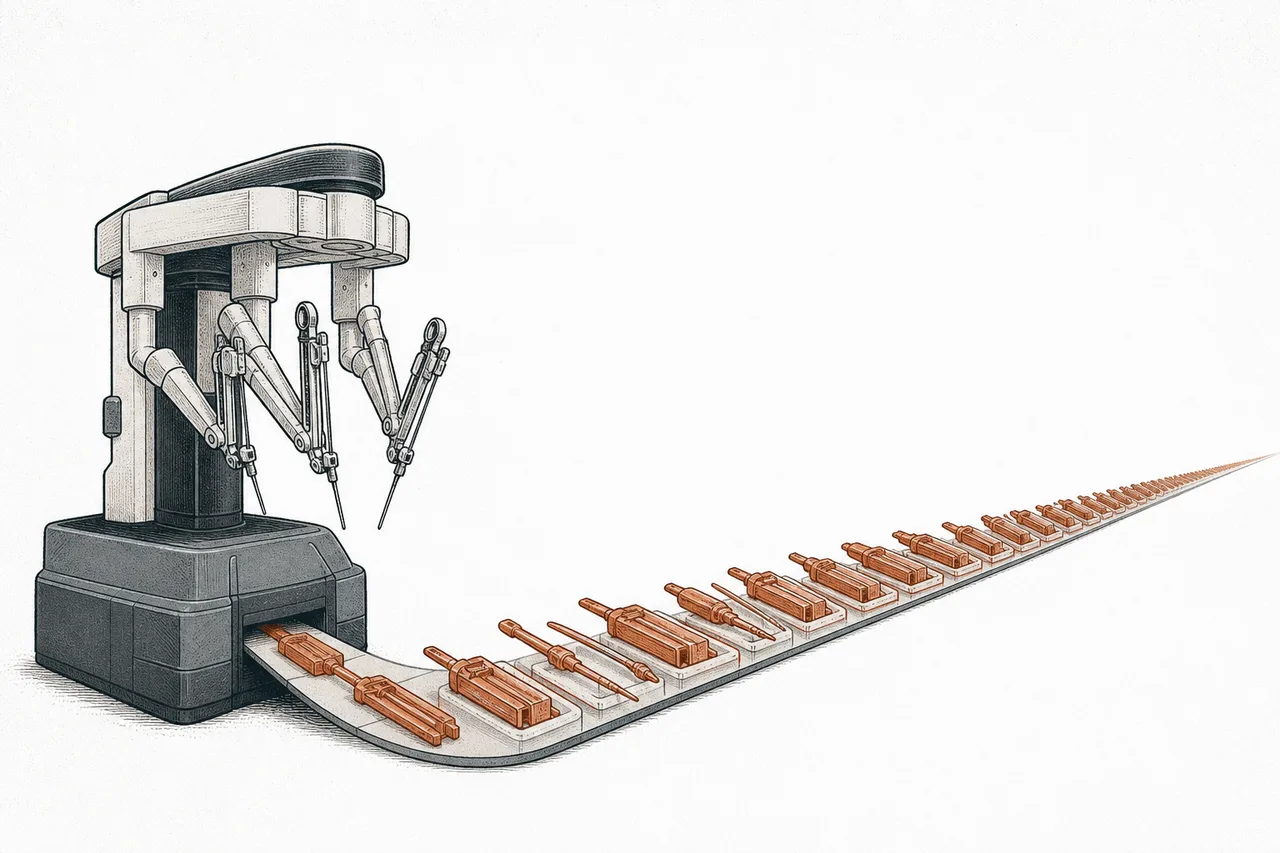
Why is this model so powerful as a business? Because it builds a two-layer moat. First layer: once a hospital invests in a machine worth millions, trains its whole team, and makes it the standard in the operating room, switching to another brand carries a very high cost. Second layer: predictable recurring revenue keeps cash flow steady and gross margins high — a quality of earnings investors will pay a premium for.
Installed base = the total number of machines installed and in use across the market. More is better, because each one 'pumps' recurring revenue in every year · Recurring revenue = revenue that repeats steadily (per-case instruments + service fees), not the one-time revenue from selling a machine — the main reason the market values this business so highly.
05Where it sits in the robotics universe
Surgical robots are one of the 'application' areas of Robotics & Physical AI — the same group as factory robots, warehouse robots, self-driving cars, and humanoids. The difference is that surgical robots sit at the far end of the 'high-precision, high-risk, high-value-per-unit' spectrum, while warehouse robots focus on volume and low cost.
It connects to other nodes in ways that tell a clear story:
- It sits on top of robotic components and actuators: the steadiness and precision of the arms come from high-quality motors, gears, and force sensors — the mechanical heart of a surgical robot is this group of parts (companies like Renishaw and Hiwin are in this chain)
- It's driven by an aging society: more elderly people = more surgery (cancer, prostate, knee/hip replacement), so demand for surgical robots is tied directly to demographics
- It overlaps with Biotech & Genomic Medicine: both are 'technologies that make treatment better' — surgical robots are the hardware side of precision medicine
- It's leaning more on AI: today AI doesn't operate in place of the doctor, but it's used to analyze surgical video, give guidance during cases, and it's the future direction of 'smarter robots'
Worth emphasizing: among all the robotics siblings, surgical robots are the node that's most successfully 'proven the business model.' It's the template showing that a robot selling expensive hardware plus collecting recurring revenue from usage is the formula that builds durable profit.
06Where it stands now — the incumbent and the challengers who just arrived
The story of 2025–2026 has two lines running side by side. First line: the incumbent is still growing hard and pulling away. Intuitive Surgical (maker of da Vinci) has an installed base of over 10,700 machines worldwide (+13% a year). In 2025 there were about 3.15 million da Vinci procedures (+18%), total revenue hit ~$10 billion (+21%), and it holds over 60% of the soft-tissue surgical-robot market — a near-monopoly for 20 years.
The second line, and the biggest drama in the field: after almost no real competition for 20 years, two giants just arrived at the door together. In December 2025, Medtronic won FDA approval for its Hugo robot in urology surgery — the first time da Vinci has faced a real competitor in the US soft-tissue market. And in January 2026, Johnson & Johnson filed its Ottava robot for FDA approval right behind it.

Meanwhile, another arena is orthopedics (bones and joints), played by a different group — here Stryker dominates with its Mako robot (over 2,000 installed; two out of three knee replacements in the US are done with Mako), and Zimmer Biomet competes with Rosa. Orthopedic robots work differently from soft-tissue ones: they help the doctor 'cut bone precisely and place the implant in the right spot' more than driving the arms through the whole operation.
07The road ahead
The first direction is competition returning for the first time in 20 years. The arrival of Hugo and Ottava will test just how strong Intuitive's moat really is. The upside for the field: more options usually makes hospitals braver about investing, and pushes market penetration (still in the single digits) to move faster — 'the pie may be sliced more ways, but the pie itself grows faster too.'
The second direction is expansion into new procedures. Surgical robots started with prostate and gynecology, then gradually expanded into general surgery — now the main growth engine. Next comes harder, more complex procedures, plus more merging of the orthopedic and soft-tissue arenas.
The third direction is AI and data — not letting the robot operate in place of the doctor, but using data from millions of surgeries to analyze, give guidance during cases, measure quality, and train new doctors. Whoever holds the largest installed base holds the most data — which becomes a new layer of moat that newer rivals find hard to match.
08Challenges & risks
The appeal of surgical robots comes with clear risks.
The first risk is competition that has genuinely arrived. For 20 years Intuitive had almost no rival in soft tissue. Now Medtronic and J&J — two giants with capital, sales teams, and relationships with hospitals worldwide — have come at once. The question is how much they can bite into share and push down prices (especially the price of the 'blades,' the source of profit). This is a risk to margins, not just share.
The second risk is cost and reimbursement. A ~$1.5 million machine, plus expensive per-case instruments, makes robotic surgery cost more than the old methods. If insurers or governments don't pay enough extra to make it worthwhile, hospitals hesitate to invest. This is the ceiling that caps penetration in many countries, especially markets with limited public-health budgets.
The third risk is clinical evidence and safety. Surgical robots have to keep proving that outcomes are 'better than, or at least equal to' the old methods, at a higher price. Any safety event or product recall can hit confidence hard. And in some procedures, the benefit of a robot versus ordinary laparoscopic surgery is still debated.
In short: in a robotics megatrend full of promises, surgical robots are the corner that's 'already making real money' — with the formula of selling an expensive machine once and collecting recurring revenue every case. The story ahead isn't whether it can make money — it already does — but how well this fortress, after holding the market for 20 years almost unopposed, can stand up to the giants who just arrived at the door.