Megatrend · Robotics & Physical AI
Anyone can win the robot race — but you still have to buy the gears in the joints from Japan
Every company is racing to build humanoid robots — Tesla, China, American startups. But go deep into each joint of every robot and you'll find one group of 'parts' eating more than half the cost, with its core gears made by just two Japanese companies. This is the story of the 'pick-and-shovel sellers' in the robot gold rush — the ones who get paid whether or not anyone strikes gold.
01What it is (the robot's picks and shovels)
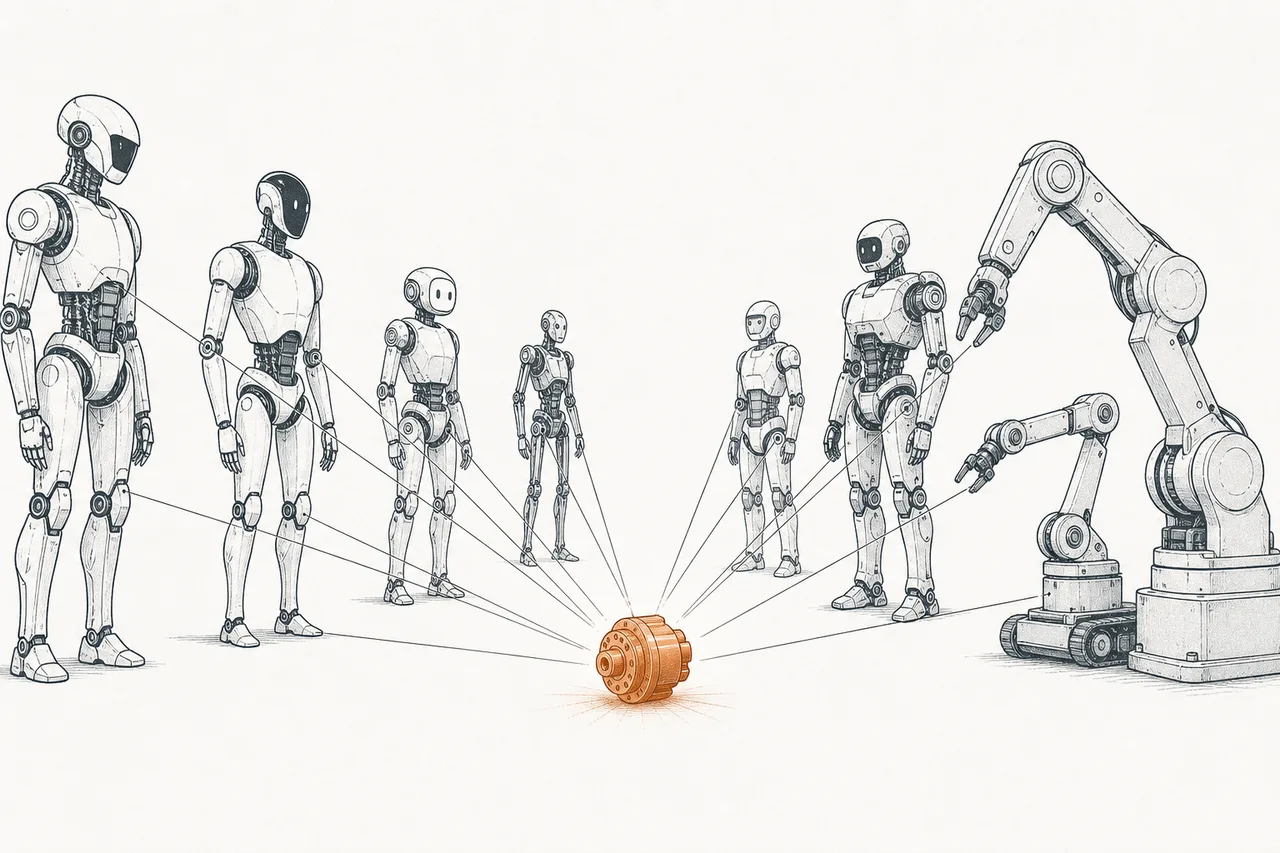
There's an old saying in investing: 'In a gold rush, the people who really get rich aren't the miners — they're the ones selling picks and shovels.' Most miners never strike gold, but every one of them has to buy a shovel. Robotics Components & Actuation is the pick-and-shovel seller of the robot era.
Right now the whole world is racing to build robots — Tesla makes Optimus, China has dozens of humanoid startups, factories everywhere are buying robotic arms and mobile robots. Nobody knows for sure which brand will win. But one thing is certain: every robot has to move, and moving always takes the same group of parts. That's what this node is about.
The definition is simple: this is the 'supplier layer' of the robotics industry — precision motors, gear reducers (reducer), and sensors that combine into every 'joint.' On the megatrend map it's a sub-theme under Robotics & Physical AI, sitting in the deepest 'upstream' (supply chain) layer — because no matter how smart a robot's AI software is, in the end it still has to tell real motors and gears to move the arms and legs.
If the computer is a robot's 'brain,' the actuator is its 'muscle' — the unit that turns electricity into actual movement. One typical actuator has 3 parts: a motor (creates rotation) + a reducer / gearbox (slows the rotation down but makes it stronger) + an encoder (a sensor that measures position for precise control). A single humanoid robot has around 25–40 actuators — one per joint.
02Why it eats more than half a robot's cost
What makes this layer so interesting as a business is that most of a robot's money flows here. Take a humanoid robot apart and look at its bill of materials (BOM), and you'll find that the actuation system eats roughly 40–60% of the whole robot's cost. On simpler models that number can push past 50%. The 'brain' parts — chips and cameras — take only ~10–20%.
And within that actuation chunk, the part that eats the most money and is the hardest to make is the 'reducer' — the high-precision gear reducer. This single piece accounts for about 35% of the whole robot's cost. That's why whoever controls this gear effectively controls the tap for the entire industry.
Why has this become a 'megatrend' now? Because demand is about to explode. Traditional industrial robots sell only a few hundred thousand units a year, but the new wave is humanoids. Goldman Sachs estimates the humanoid market will reach $38 billion by 2035, at ~1.4 million units a year. Morgan Stanley looks all the way to 2050 at nearly 1 billion units. Each one needs 25–40 actuators — meaning demand for motors, gears, and precision sensors could grow tenfold.
03How a robot joint works inside
The engineering problem of a robot joint sounds easy but is brutal: an electric motor spins very fast but has little 'torque' — like a fan that spins fast but you can stop with your hand. A robot joint needs the opposite: turn slowly but with enormous force, enough to lift things or hold up its own weight — and stay accurate to a fraction of a degree.
The answer is to chain 3 parts together — and the real star is the reducer in the middle:
The mechanism in the middle — the reducer — is the hardest part. Say a motor puts out 2 newton-meters of torque; run it through a 1:100 gear reducer and the force coming out becomes ~200 newton-meters. That's the power that lets a robotic arm lift heavy loads. But the real challenge isn't just 'multiplying force' — it's multiplying force with zero 'play' (backlash). If the gears have even the tiniest gap, the tip of a meter-long robot arm swings off by several millimeters — useless in practice.
There are two main families of gear · harmonic is light and precise, good for small joints / humanoids · RV is rugged and strong, good for the base of industrial robot arms — the deep mechanics of both are in the child lesson Precision Drives & Reducers.
04The 4 core parts + what it connects to
This supplier layer breaks into 4 sub-categories — the 4 parts that combine into every robot's ability to 'move and sense':
- Precision Drives & Reducers (reducers): the most expensive, hardest-to-make heart — the strain-wave gear and RV reducer we just covered. Fewer than 5 top-tier makers exist worldwide; this is the real bottleneck
- Servo Motors & Magnets (motors): precision servo motors and the NdFeB permanent magnets inside them — the source of the rotation, depending directly on critical raw materials like rare earths
- Machine Vision & Force/Tactile Sensing (eyes + touch): smart cameras and force/tactile sensors that let a robot 'feel' how hard it's gripping something — a segment dominated by the likes of Keyence and Hikvision
- LiDAR & 3D Perception Sensors (3D spatial vision): sensors that measure distance and build 3D maps, letting mobile robots and self-driving cars see the world around them
The first two (motors + gears) are the 'muscles and joints'; the last two (vision + LiDAR) are the 'eyes and senses' — together they're everything that turns a metal box into a robot that moves and perceives the world.
So how does this layer connect to other trends? It's the 'hard floor' that the whole robotics industry stands on:
- Feeds Humanoid Robots and Industrial Automation: these are the real customers. Every robot arm in a factory and every humanoid being built has to order its actuators from this layer
- Depends on Critical Materials & Supply Chain: high-power motors need rare-earth magnets (neodymium), whose production China controls almost worldwide — a geopolitical weak point baked into every actuator
- Driven by AI: a smarter AI brain is what makes robots actually useful. The smarter the AI, the more actuator demand surges — but AI can only command if there's a 'muscle' precise enough to obey
- Uses chips from Semiconductors: every encoder and motor controller needs a chip — which makes robotics a fast-growing new customer for the semiconductor industry
05Where it stands now
The most exciting thing about this layer right now is that it's a real 'Japan bottleneck'. In the premium high-precision reducer market, two Japanese companies — Harmonic Drive Systems (maker of the strain-wave gear) and Nabtesco (maker of the RV reducer) — lead the field, and the top five (Harmonic Drive Systems, Nabtesco, Sumitomo Heavy, Wittenstein, Nidec-Shimpo) together hold roughly ~61% of the global market by value. Nabtesco alone holds about ~60% of the gear market for the big joints of medium-to-large industrial robots. With both leaders in Japan, if production there stumbles, the robot production lines of nearly every OEM in the world stumble with it.
And a fresh wave of demand really is arriving. Harmonic Drive Systems reported that humanoid-related orders rose from ~¥1.3 billion in a single quarter, and are expected to reach ¥2.5 billion in the fiscal year ending March 2026 — a sign the humanoid wave is starting to convert into real orders, not just hype.
The precision reducer market isn't huge yet, but it's accelerating on humanoid momentum. The harmonic drive (strain-wave) segment alone is expected to grow from ~$2.8 billion (2025) to ~$6.1 billion (2034) at a ~9% CAGR — and that doesn't even count the scenario where humanoids are made by the millions.
Equally hot on the other side: China is rushing to make its own gears to crush costs. Because the reducer eats ~35% of the cost and has to be imported from Japan, making it themselves is the key to making Chinese robots cheap enough to compete. China is catching up fast, led by Leaderdrive, steadily climbing in harmonic-reducer share (the detailed share numbers are in the child lesson Precision Drives & Reducers), while Shuanghuan leads the state program (MIIT) to localize both RV and harmonic reducers.
And don't overlook the other two layers — the 'eyes and senses' — running just as hot as the gears · the eyes + touch group is a fat-margin business — Keyence/Cognex dominate at ~50% margins, and force/tactile sensors are growing with humanoid hands (see → Machine Vision & Force/Tactile Sensing) · the LiDAR group is the fiercest — prices have crashed from ~$75,000 to under $500, and four Chinese players led by Hesai hold nearly 90% of the market (see → LiDAR & 3D Perception Sensors)
06The road ahead
The first direction is the clearest: the humanoid wave will turn this layer from a niche market into a mass market. One industrial robot uses about 4–6 reducers, but one humanoid uses 25–40 actuators. If humanoid shipments grow from tens of thousands to millions a year as Goldman/Morgan Stanley expect, demand for gears, motors, and sensors will grow many times over — which is why this group of stocks is watched as 'a way to play the robotics theme without guessing which brand wins.'
The second direction is new actuator designs to cut cost. Engineers are debating two paths: 'high-power motor + less reduction (planetary)' versus the classic 'fast motor + harmonic reducer.' Which one wins decides whether the money flows more to motor makers or gear makers — an architectural fight that isn't over yet.
The third direction is China catching up. Beijing sees the reducer as a strategic bottleneck and is pouring in capital to localize it. If China can really make gears that match Japan's quality at a lower price, the cost equation for robots worldwide changes — and the pricing power of the two Japanese leaders gets challenged for the first time in decades.
07Challenges & risks
The 'pick-and-shovel' layer sounds like a safe investment, but it carries its own specific risks you need to understand.
The first risk is China catching up and eating margins. The core of this layer's value is 'gears so hard to make that few companies can.' If Chinese players (Leaderdrive, Shuanghuan, etc.) can make good gears far cheaper, what used to be a high-margin premium product could turn into a price-competed commodity — just like what happened with other parts China moved into.
The second risk is cyclicality and being a 'bet placed ahead of time'. Robot demand is tied to factory capital spending and humanoid momentum, both of which rise and fall in cycles. When the economy is good, orders flood in; when it slows, orders vanish. This group of stocks usually trades on expectations of future humanoids — so if humanoids arrive later than hoped (and robotics tech is almost always 'slower than promised'), share prices that ran ahead can face a sharp correction.
The third risk sits even further upstream: dependence on Chinese rare earths. Every high-power motor uses NdFeB magnets made from neodymium, whose refining China controls almost worldwide. If China uses rare earths as a trade bargaining chip (as it has before), the cost and security of the whole industry's motor supply could wobble — details in Critical Materials & Supply Chain.
In short: in an era when everyone's excited about the AI brain of robots, the overlooked story is the 'muscle' — the motors, gears, and sensors that eat more than half the cost and are controlled by just a few players. Understand this layer cold, and you understand why the stock of a small, unknown Japanese gearmaker became one of the most-watched 'ways to play the robotics theme' for investors worldwide.