Megatrend · Synthetic Biology
Planes really can fly on used cooking oil — but it's still too expensive
Cars have an electric option, ships are starting to test batteries, but an intercontinental plane that has to lift hundreds of tons into the sky and stay up for more than ten hours can't just "plug in." The only realistic answer left is to change the fuel itself — turning used cooking oil, waste fats, even CO₂ from the air, into a fuel that looks so much like jet fuel you can pour it straight into the same tank. What makes this interesting is that it's a way to cut aviation's carbon that actually works today — but it's full of traps around cost and feedstock.

01What it is
When we say "electric car," everyone gets it instantly. But picture a single Boeing flying from Bangkok to London — it has to lift its own heavy body into the air and keep flying for 11–12 hours straight. All that energy has to be packed into a liquid light enough to carry itself up too. A battery storing the same energy would be so heavy the plane couldn't take off. That's why aviation is one of the hardest industries in the world to "decarbonize".
If you can't change the aircraft, you have to change the fuel instead — and that's what this lesson is about.
Jet fuel made from renewable feedstocks — used cooking oil, waste animal fats, biomass, even CO₂ from the air — instead of refining crude from underground. The heart of it is one word, "drop-in" — its chemical structure is nearly identical to ordinary jet fuel (Jet A-1), so you can pour it into the same tank, run it in the same engine, and push it through the same airport pipes, with no modifications at all. Its sibling is renewable diesel (renewable diesel for trucks), made from the same feedstock in the same refinery.
"Drop-in" is the whole story. Compare it to an EV, where you have to replace the whole car and rebuild the charging station. SAF is the opposite — airlines don't have to buy new planes or build new airports. They just swap the "liquid in the tank" for a fuel that emits up to ~80% less carbon over its life cycle than fossil fuel (depending on feedstock and process). That makes it a decarbonization tool you can use right now on the existing global fleet.
On the megatrend map, this node sits under Synthetic Biology (non-pharma) — it's about using biological feedstocks and processes to make "energy" rather than food or materials. And it overlaps deeply with Energy Transition too.
02Why it matters — the only way to make aviation clean right now
Aviation emits roughly 2–3% of the world's greenhouse gases. That sounds small, but the problem is it's the hardest part to fix, and it's growing against the grain of other sectors that have already started cutting carbon. The industry is targeting net-zero by 2050, and in that plan SAF is cast as the lead.
The reason SAF takes such a big share is that the other options are still far off — electric planes can only fly tiny short routes, hydrogen planes are still prototypes that need a whole new aircraft design, and reforestation offsets are questioned on credibility. That leaves SAF, which "works with what already exists today," as the most tangible answer.
But here's the thing to say plainly — what drives this market isn't a normal market mechanism, it's "the law". If airlines got to choose, no one would willingly pay for fuel that's 2–5× more expensive. So almost all the demand comes from governments that issue rules mandating that SAF be blended into jet fuel.
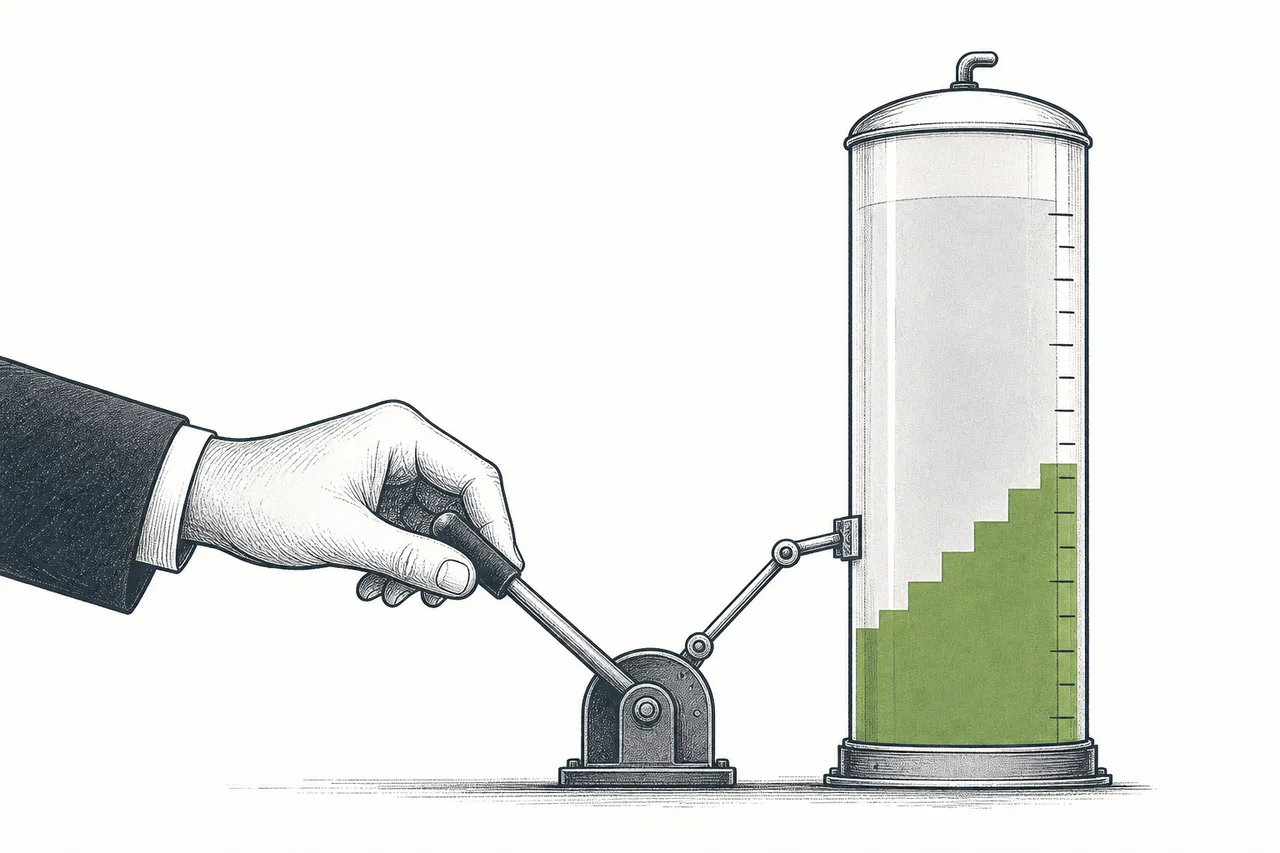
The loudest rule is Europe's ReFuelEU Aviation, which began enforcement in 2025, requiring fuel suppliers at EU airports to include at least 2% SAF, then climbing to 6% in 2030, 20% in 2035, and 70% in 2050. The UK has its own SAF mandate, while the U.S. takes a softer hand — using IRA tax credits to encourage rather than mandate. Different paths, same direction: forcing more SAF every year.
03How it works
The core that makes SAF a "drop-in" is that every process shares the same goal — building hydrocarbon molecules that look almost identical to fossil jet fuel, just starting from a different feedstock. The difference is in the "starting material" and the "way it's converted," and there are three main routes.
Expanding on the three routes:
- HEFA (adding hydrogen to fats): run used cooking oil, animal fats, or vegetable oil through hydrogen to strip out the oxygen and rearrange the structure into jet-fuel-like hydrocarbons — mature and the cheapest route, accounting for about 70% of SAF produced in 2025. Almost the entire market today is this route
- Alcohol-to-Jet (ATJ): start from alcohol (ethanol from corn/sugarcane/agricultural residue), then link the molecules longer until they become jet fuel — opening the door to a far wider feedstock than fats, but still small in scale
- Power-to-Liquid (e-fuel / e-SAF): the most advanced and "cleanest in theory" route — combine green hydrogen (from splitting water with renewable electricity) with captured CO₂ to synthesize fuel, relying on no biological feedstock at all. But it's still enormously expensive and barely produced outside pilot projects
04How it connects in the ecosystem
SAF is a node sitting at the crossroads of several megatrends — and these connections are what decide whether it thrives or sinks:
- A sibling of Bio-Based Materials & Industrial Chemicals: the same bio-refinery that makes SAF can also make renewable diesel and other bio-chemicals — it's the "refinery of the future" that branches into many products from one set of feedstocks
- A piece of Energy Transition & Power Demand: SAF is the answer for the part of energy that "can't be electrified" (aviation, shipping, heavy trucks), so it fills in the clean-energy trend where batteries can't reach
- e-fuel relies directly on green hydrogen: 66–83% of power-to-liquid's cost is the hydrogen — if green hydrogen doesn't get cheaper, e-SAF can't happen. The fates of these two trends are tightly bound
- Competing with agriculture and land: the fats and vegetable oils used for SAF are the same resources used for food and animal feed. The more you pull into fuel, the more you pressure food prices — a tension the law has to keep watching
- A "rival/complement" to AI: finding enzymes and microbes that convert biomass into fuel better relies more and more on computational biology and AI
05Where it stands now
The first truth to state up front: SAF is still very small. In 2025 the world produced about 1.9 million tons of SAF (roughly 2.4 billion liters), which sounds like a lot — until you realize it's only ~0.6% of all the jet fuel the world uses. And more worrying, the growth is slowing — at the end of 2025 IATA warned that 2026 would grow to only ~2.4 million tons, well below earlier expectations, because costs are high and policies are inconsistent.
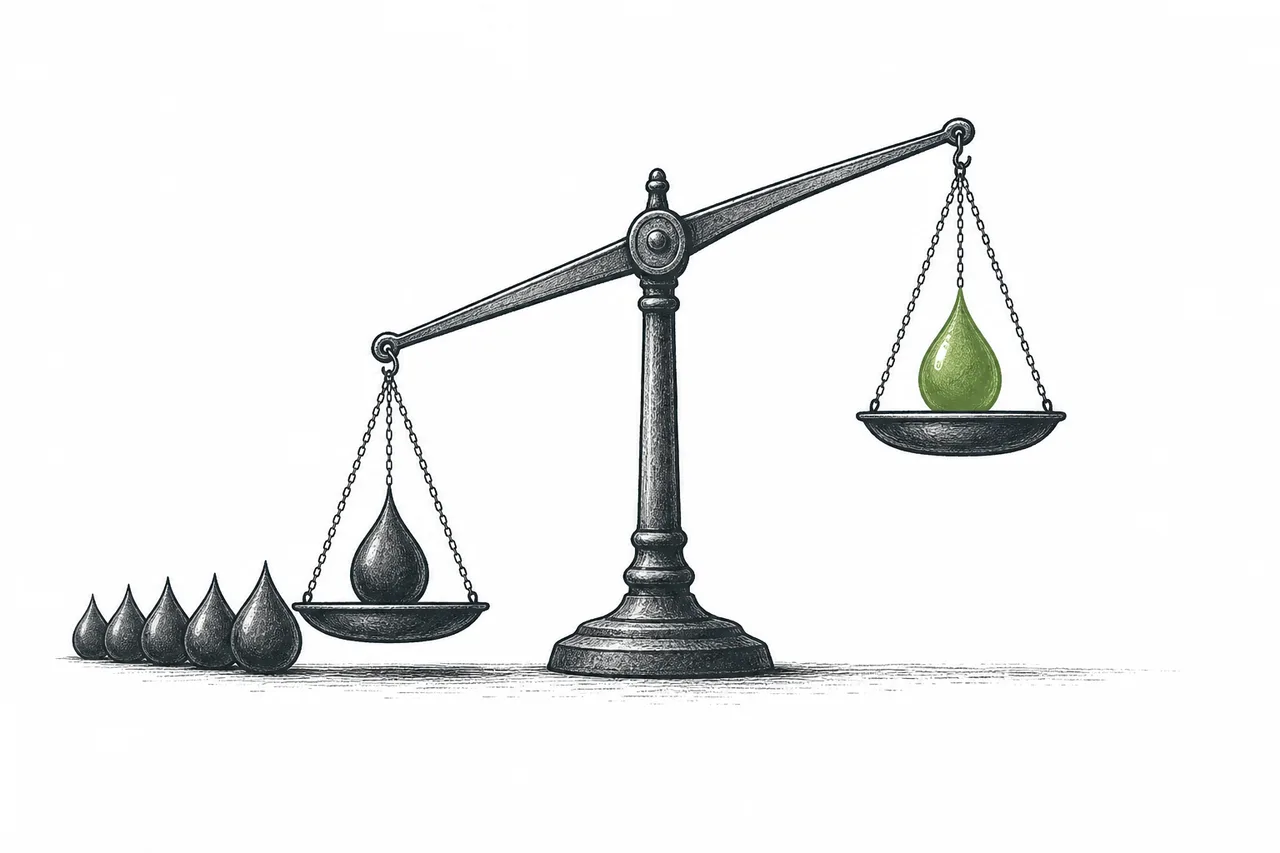
And the second thing to say plainly is price. SAF is 2× more expensive on average, and up to 5× in markets where there's a mandate but not enough supply. In 2025, airlines worldwide had to pay about $3.6 billion in extra "price difference" just to blend in 1.9 million tons of SAF — a cost that ends up on the ticket price.
Now let's see who the real players are. The key to understand is that SAF is a business of "refineries" more than startups — it takes heavy investment, big plants, and petrochemical expertise. So the real leaders are both specialized renewable-energy companies and giant refineries adding a SAF line.
06The road ahead
The biggest direction is a market "ordered" to grow — because ReFuelEU and other rules ratchet up every five years, SAF demand is already locked into law no matter how expensive it gets. So many analysts expect the SAF market to grow from around ~$2–3 billion in 2025 to about $40 billion by the mid-2030s (a CAGR of roughly 30%+) — but let me stress these numbers vary a lot between research houses, so treat them as direction rather than precision.
The second direction is shifting from HEFA toward routes with unlimited feedstock. Because used cooking oil and waste fats have a ceiling (more on that in the next chapter), the future has to rely more on alcohol-to-jet and e-fuel. ReFuelEU even issued a separate sub-mandate just for e-fuel — 1.2% in 2030 climbing to 35% in 2050 — to force this still-expensive route into existence.
The third direction is Asia becoming the new arena. Singapore, Japan, and Thailand are starting to issue their own SAF blending targets. A company like Bangchak, which moved early to make SAF from domestic used cooking oil, is in an advantageous position at the feedstock end — because this region has both fast-growing aviation demand and large amounts of fat/palm-oil feedstock.
07Challenges & risks
This trend has the "right direction" but is full of traps you need to understand fully. There are four big ones:
One — cost that won't come down. As long as SAF stays 2–5× more expensive than fossil fuel, every liter used is a cost that squeezes airline profits and pushes up ticket prices. Without a mandate, this market has almost no economic reason to exist.
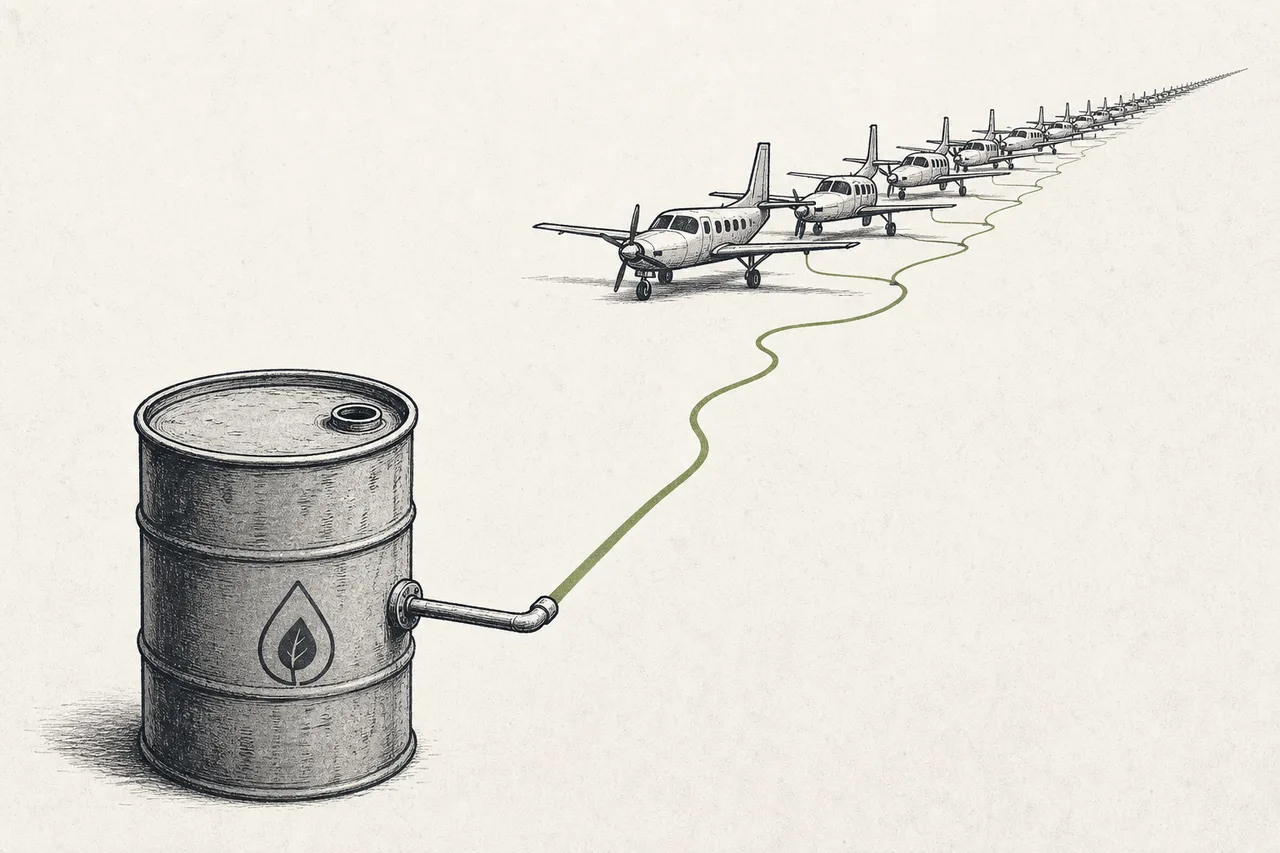
Two — the feedstock ceiling. This is the deepest structural problem. The HEFA that dominates the market today relies on used cooking oil and waste fats, which are very limited. It's estimated that the used cooking oil actually collectable worldwide could meet only 3–8% of 2030 SAF demand — it's impossible to scale the world's SAF on this feedstock alone.
Three — too dependent on policy. Almost all demand comes from mandates. If politics shift, governments soften targets, or tax credits expire, the market could stumble at once. At the end of 2025, IATA itself warned that inconsistent policy is slowing production growth and pushing prices up — this risk is real.
Four — e-fuel hasn't grown enough. The route that was supposed to solve the feedstock ceiling (power-to-liquid) is instead so expensive it's barely produced outside pilot projects, because 66–83% of its cost is still-expensive green hydrogen. If green hydrogen doesn't get cheaper fast enough, the 35% e-fuel target for 2050 risks being just a number on paper.
In short: SAF is the best answer we have for cutting aviation's carbon today — it actually works, really cuts carbon by up to 80%, and has clear legal backing. But it's still expensive, small, and stuck at the feedstock ceiling. Understanding these three words is understanding why a trend that "everyone knows must happen" still moves slower than anyone hoped.