Megatrend · Quantum Computing
Trap an atom in mid-air, then fire a laser to tell it to think
In the battle of quantum computers, there's one camp that doesn't build its qubits from human-made electrical circuits — it uses "real atoms" directly. A charged atom (an ion) is trapped, floating still in mid-air by an electromagnetic field, then controlled with a laser beam. The advantage: every atom in the universe is exactly identical, which makes this camp's qubits the "cleanest" and most accurate in the world — IonQ just set a record at 99.99% accuracy, and Quantinuum succeeded in building a machine with 48 error-corrected logical qubits. But the trade-off is being slower and harder to scale than anyone else. This is the story of betting on "quality" instead of "speed."
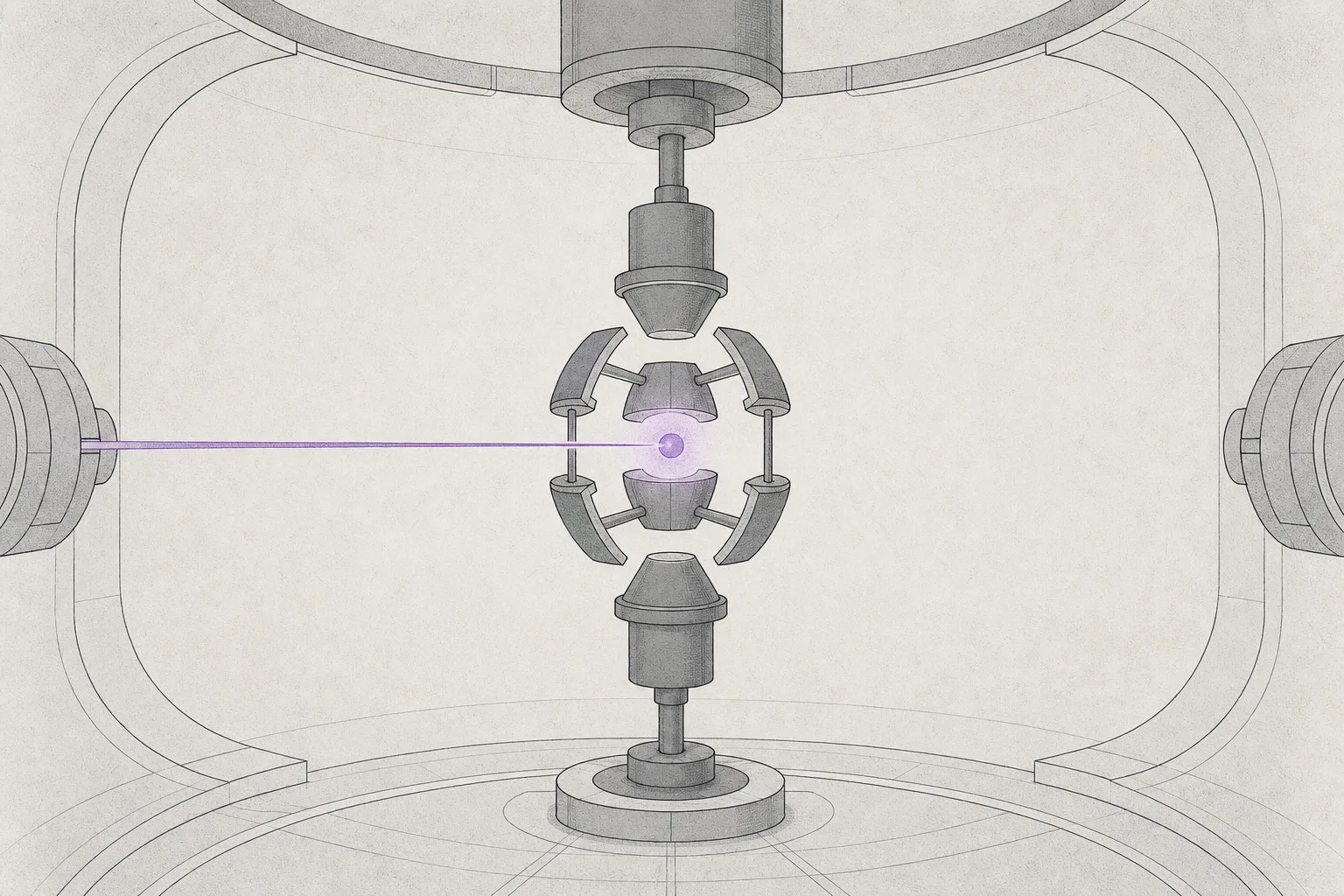
01What it is (qubits from real atoms)
Every quantum computer needs the same thing — a qubit, a unit of information that can be 0 and 1 at the same time. But the question the field still argues about is, "what should you make a qubit out of?" One camp builds it from tiny, deeply chilled electrical circuits (superconducting); another uses particles of light (photonic). But the camp this lesson is about — Trapped-Ion — chose the most science-fiction path of all: it uses real atoms as qubits directly.
The idea: take an atom of an element like ytterbium or barium and pull one electron off it to make an "ion" (an electrically charged atom). Then use an electromagnetic field to trap it floating still in a vacuum, like hanging a bead in mid-air with nothing touching it, and fire a laser beam at it to "write" information into each atom. The two energy states of the electron in the atom are exactly the 0 and 1 of the qubit.
What makes this camp special — and the reason it exists as a modality of its own — is that every atom in the universe is exactly identical. One ytterbium ion and another can't differ in even the slightest way — the opposite of human-made electrical circuits, which always carry small variations from the production line. This "exactly identical" quality is what makes this camp's qubits the cleanest and most accurate in the world.
On the megatrend map, this node is one of the "technology camps" under Quantum Hardware — Pure-plays within the larger trend Quantum Computing. Its siblings next door are Superconducting (the fast camp that can make the most qubits) and Photonic & others (the camp that uses light). For an easy way to remember it: trapped-ion is the "slow but sure" camp, while superconducting is the "fast but messy" camp.
Ion = an electrically charged atom (with an electron pulled off or added) — because it has a charge, it can be "caught" by an electric field · Paul trap = a device that uses a radio-frequency (RF) electric field oscillating very fast to create a "well" that traps the ion floating still in mid-air · Gate fidelity = the accuracy of "operating" a qubit once. The closer to 100%, the better — this is the field where trapped-ion holds the world title.
02Why it matters — the cleanest qubit
In the quantum world, what investors like to count is the "number of qubits," but the figure physicists care about more is the accuracy of each qubit. Because many qubits that fail often are like a team of a hundred people who make a mistake every three minutes — the work falls apart in the end anyway. This is where trapped-ion shines.
In mid-2025, IonQ set a world record with two-qubit gate fidelity of 99.99% — meaning out of every 10,000 operations, only one fails. Quantinuum, in its newer machine (Helios), achieved 99.921% for two-qubit gates and 99.9975% for single-qubit gates. These numbers are significantly better than the superconducting camp, and that's why the world hasn't abandoned this camp, even though it's slower.
Why is accuracy worth real money? Because it directly affects the "cost of error correction." The heart of a usable quantum computer is bundling many error-prone qubits into one stable qubit (a logical qubit). The more accurate each qubit is from the start, the fewer qubits you need to bundle — meaning you can build a powerful machine with less hardware. In late 2025, Quantinuum showed the real thing by building 48 error-corrected logical qubits on a machine with only 98 physical qubits — a 2-to-1 ratio that people previously thought was impossible.
There's a bonus investors often overlook: trapped-ion doesn't need to be deeply chilled. The superconducting camp needs a dilution fridge that reaches near absolute zero — colder than space — expensive and hard to maintain. But an ion trap works at room temperature in a vacuum — which is why newer machines like IonQ Forte/Tempo are starting to "rack-mount like a server," something that matters a great deal when you have to place them in a real data center.
03How it works (trap → fire → connect → read)
Let's walk through, step by step, how a single atom becomes a computer. The process has four main steps: trap → fire → connect → read.
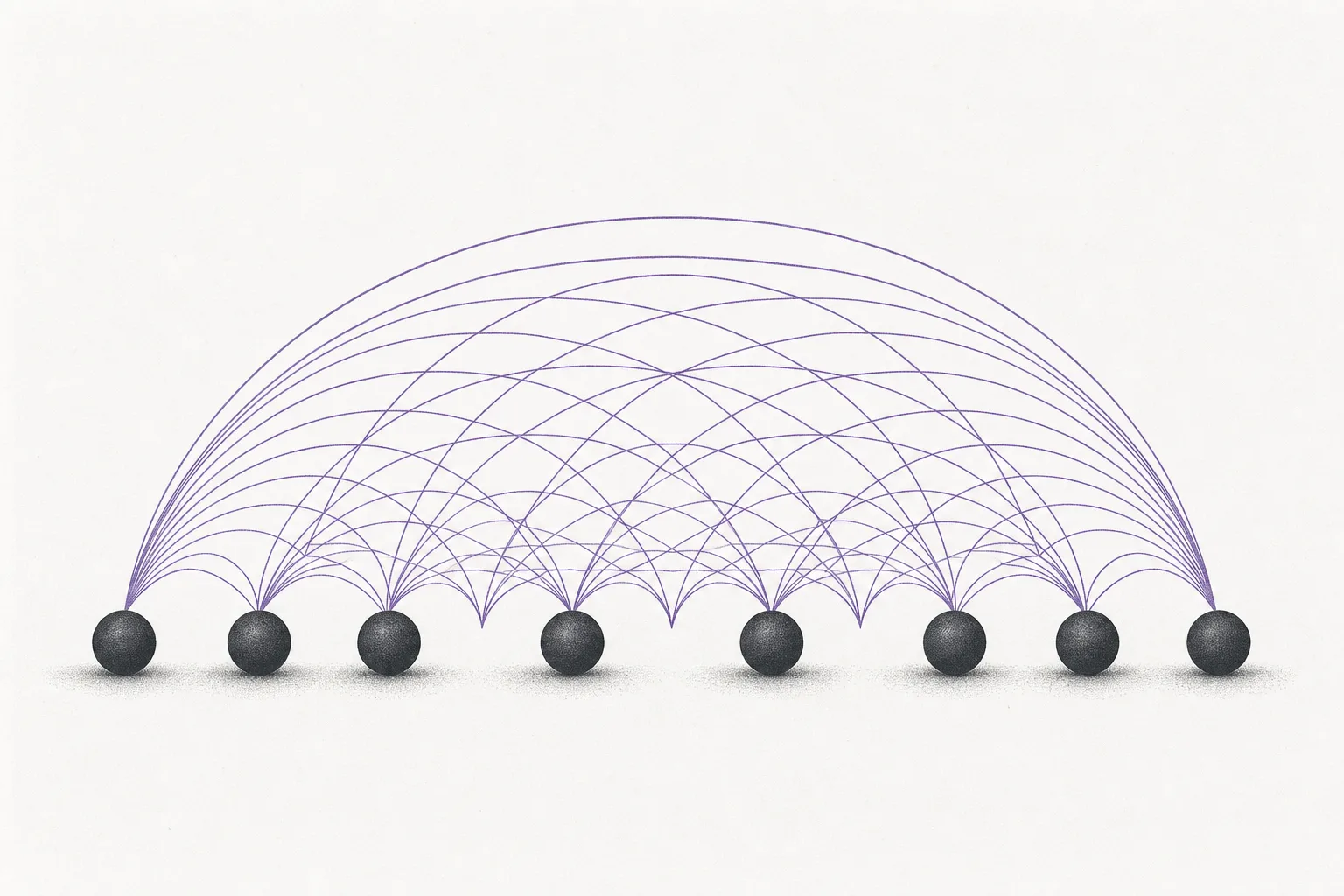
The connect-everyone step (all-to-all connectivity) is the hero that sets this camp apart. Because all the ions are in the same trap and vibrate together, qubit number 1 can "talk" directly to qubit number 50. In the superconducting camp, each qubit can only connect with its immediate neighbors on the chip — to make two distant ones talk, you have to relay through several intermediaries, which accumulates errors along the way. So all-to-all is an architectural advantage that greatly reduces the complexity of a quantum program.
And reading the result (step 4) is beautiful in its simplicity: fire another set of lasers in, and the ions in the "1" state will glow brightly while those in the "0" state stay completely dark. Just photograph which ones are bright and which are dark, and you can read off the computer's answer.
04Where it stands in the quantum universe
trapped-ion isn't fighting alone. It's one "camp" in a larger battle, with clear rivalries against its neighbors:
- The main rival — Superconducting: this is a duel between two philosophies. Superconducting is faster (gates operate in nanoseconds) and can make more qubits — the path Google and IBM chose. Trapped-ion is more accurate and connects everyone to everyone, but its gates are slower (microseconds — about a thousand times slower). In short: superconducting bets that "speed + numbers" wins, while trapped-ion bets that "cleanness" will reach a usable machine first
- Another sibling — Photonic & others: the camp that uses light, and the neutral-atom camp (neutral atoms, no charge), which is actually very close to trapped-ion — the only difference is using light to catch the atoms instead of an electric field, making it easier to scale up the numbers. A rival worth watching
- A big future customer — AI: a common misconception is that "quantum will replace the GPU" — it won't. In the near term, quantum solves a different kind of problem than AI (like simulating molecules, finding the best solution). The real relationship is complementary: AI helps tune and control the lasers in ion machines to make them more accurate, while in the future quantum may help speed up certain science that AI does slowly
- The backbone of — Quantum Hardware — Pure-plays: both IonQ and Quantinuum are pillars of the pure-play group — companies whose "entire business" is building quantum machines, with no other business propping them up. That makes their stocks a "pure bet" on whether trapped-ion wins
05Where things stand now + who the real players are
The state of this camp in 2026, put plainly, is that two giants are pulling ahead — and both just hit big milestones in the past half year.
IonQ is the most prominent listed pure-play in this camp. In 2025 its revenue reached ~$110M, growing 222% year-over-year — the first listed quantum company to cross $100M in revenue. And it's playing offense with acquisitions — in mid-2025 it poured $1,075M into Oxford Ionics, a British ion startup with technology to control ions on a chip, then followed with Lightsynq (a Harvard startup focused on connecting multiple quantum machines together through light) — both deals are about buying the "missing pieces" to solve scaling. Its newer machines, Forte (36 qubits) and Tempo (targeting 100 qubits), are designed to rack-mount in a data center.
Quantinuum is the real technology leader — a company majority-owned by Honeywell. In late 2025 it unveiled its machine Helios: 98 qubits, switched to barium ions (controlled with visible light, cheaper and tougher than the ytterbium that needs UV light), achieving two-qubit gate fidelity of 99.921% and successfully building 48 error-corrected logical qubits. Then in mid-2026 it went public under the ticker QNT with an IPO that raised $1,680M — the largest IPO in the history of a quantum pure-play company.
But the truth that has to be said clearly is that both are still deeply in the red. Quantinuum posted a net loss of $192.6M in 2025 on revenue of just $30.9M, and a machine that's "fully commercially usable" is still years away. Milestones like 48 logical qubits are real and important — but they "prove it can be done in principle," not "a product ready to sell widely." The distance between those two is the heart of what investors have to read.
Beyond the two giants, there are players worth watching, such as Universal Quantum (a British private company taking a different path, using a microwave field instead of lasers to make scaling easier) — reflecting that this field still has several sub-approaches competing within it.
06The future — a race on scale and IPOs
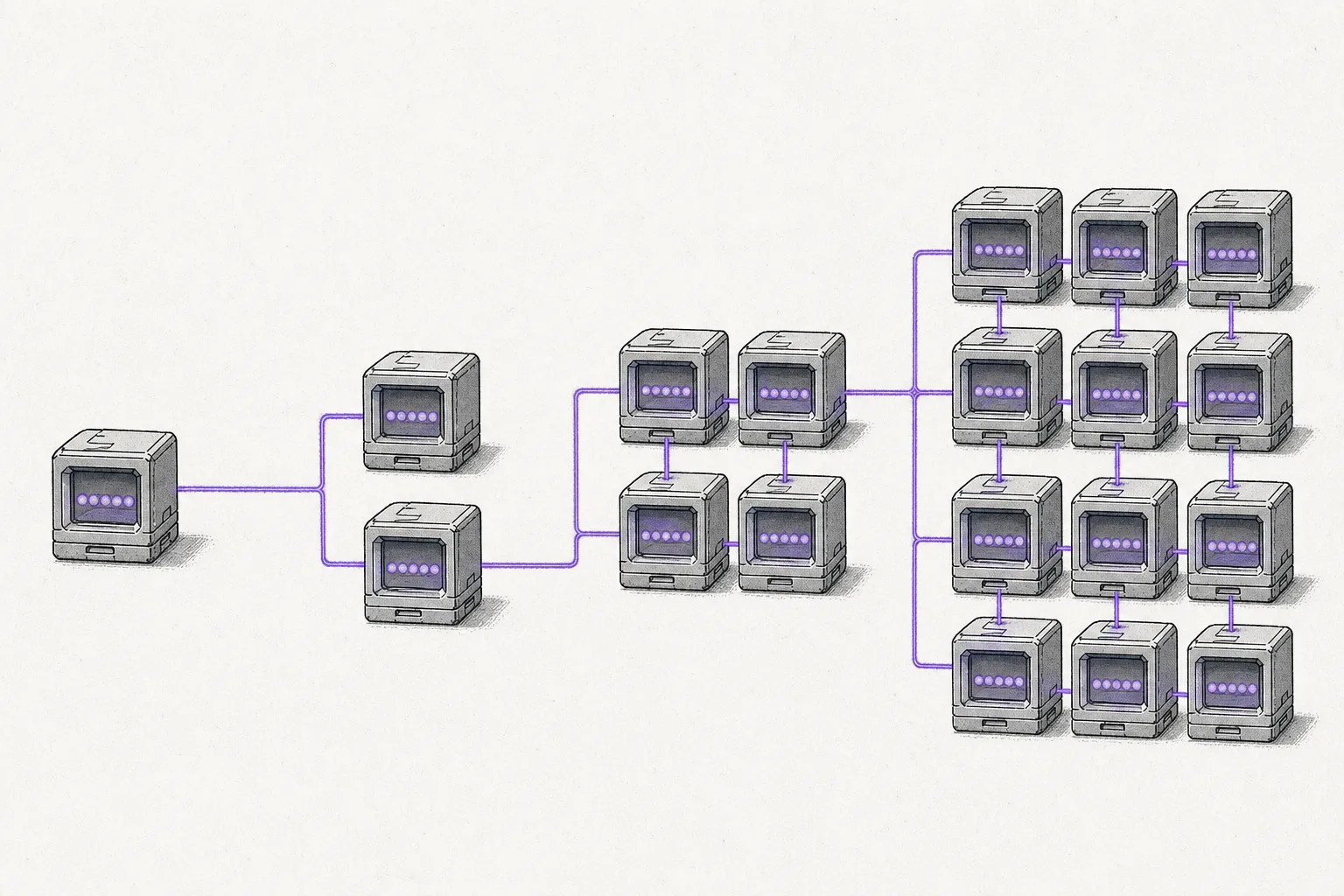
The first and most important direction is scaling. The classic problem of trapped-ion is that the more ions you line up in a single trap, the longer the row gets and the more easily it "bends," making control harder. The solution the field is betting on is the QCCD (quantum charge-coupled device) architecture — instead of trapping all the ions in a single row, you split them into many small zones and "shuttle" ions back and forth between zones, like a railway switching tracks. Quantinuum's Helios uses this idea with a rotating ion-storage ring, and the company is targeting a fully fault-tolerant machine by 2030.
The second direction is entering the capital markets. Quantinuum's IPO in mid-2026 opened a door for retail investors to reach this camp's real technology leader for the first time. Before this, people who wanted to bet on trapped-ion mainly had only IonQ (or holding Honeywell indirectly). With both giants on the stock market at the same time, this camp has become the most "actually investable" modality of all the quantum camps.
The third direction is the merging of technologies. IonQ's Oxford Ionics and Lightsynq deals hint that the game ahead isn't just "who makes the most accurate qubits," but "who can connect several small machines into one big one first" — because trapping a million ions in a single trap is impossible, the future has to connect multiple modules through light (optical interconnect). Whoever controls this technology controls the path to a usable machine.
07Challenges & risks
The first risk is slow gates and hard scaling — a physical weakness. The slowness of the gates (microseconds, about a thousand times slower than superconducting) means that in the same amount of time, trapped-ion can run fewer steps of computation. And the more ions you add per trap, the harder control becomes, exponentially. If the QCCD architecture and connecting modules through light don't work as planned, this camp could stall at hundreds of qubits while rivals push on — a technical bet with no answer yet.
The second risk is betting on the wrong camp. Like every quantum pure-play, holding IonQ or Quantinuum is a bet that trapped-ion will be the winning camp. If the world ultimately chooses superconducting or neutral-atom because they scale faster, then even if trapped-ion is the most accurate, these two stocks may not move forward — accuracy is an advantage, but not a guarantee of victory.
The third risk is a sky-high valuation, far from profit. Quantinuum went public at a valuation of about $14,000M on 2025 revenue of just ~$31M — a price-to-revenue ratio of over 450x, compared with around 10–20x for a typical fast-growing tech company. This group's stock prices are driven by story and expectation more than by results. A single milestone headline can push a stock up tens of percent in a day — and it can fall just as hard when the mood shifts.
In short: this is the camp that catches "nature's real atoms" and turns them into a computer, getting the most accurate qubits in the world in exchange for speed and ease of scaling. IonQ and Quantinuum are the two favorites leading on both revenue and technology, but both are still burning cash and their stock prices are running far ahead of the fundamentals. Understanding that trapped-ion is strong on "cleanness" and still has to prove "scale" is the most important thing for seeing this group of stocks for what they really are.