Megatrend · Quantum Computing
A tiny circuit colder than space — and the front-runner of the quantum race
In a quantum race where no one yet knows which kind of qubit will win, one line is out front — qubits made from superconducting electrical circuits, chilled to ~15 millikelvin (colder than deep space) and driven by microwave pulses. It's the path IBM and Google chose to bet on, because it has the "fastest gates" and can be made on a chip production line. This lesson digs into how it works, why it's ahead, and what price it pays.
01What it is
Picture quantum stocks as a horse race. Several horses run toward the same finish line — a machine that can "actually compute without going haywire" — but each is built from a different technology. This lesson zooms in on the horse that's out front on qubit count and speed: Superconducting Qubits.
Its heart is something startlingly simple: a tiny electrical circuit on a chip, made of superconducting metal (cool it enough and electricity flows with zero resistance). The circuit is designed to behave like an "artificial atom" with energy levels in steps; we pick the two lowest levels to stand for 0 and 1 — that's one qubit. The most popular type is called a transmon.
Transmon = the most widely used type of superconducting qubit (IBM, Google, and Rigetti all use it) · its heart is the Josephson junction — a razor-thin junction between two superconductors that acts as a "nonlinear inductor." That makes the circuit's energy levels unevenly spaced — so we can separate the "0→1 step" from the others and drive it with a specific microwave frequency (around 3–6 GHz) without exciting the steps we don't want.
On the megatrend map, this node is a sub-branch of Quantum Hardware — Pure-plays under the big trend Quantum Computing. It's the "deepest infrastructure layer" — the people who build the machine itself that every quantum algorithm has to run on. Its siblings next door are the rival technology lines: Trapped-Ion (using charged atoms held still), Quantum Annealing (special-purpose machines), and Photonic & others (using particles of light) — if all four are contestants, this node is the one running out front on the track right now.
02Why it's the front-runner
With several lines to choose from, why did giants like IBM and Google pour their bets into superconducting? There are two main answers, and both are advantages you can actually touch.
The first is speed. A gate (one operation on a qubit) runs in nanoseconds on a superconducting circuit, while trapped-ion runs in microseconds — a difference of about 1,000×. In practice, a superconducting machine can run an error-correction cycle every ~1 microsecond, versus ~100 microseconds for trapped-ion. The more work you do per second, the better your odds of reaching the answer first.
The second is it can be made like a chip. A transmon is printed onto a wafer with the same technique as an ordinary chip fab (lithography), which means this field stands on the shoulders of decades of semiconductor industry. Adding qubits just means adding area on the chip — no need to build a whole new manufacturing technology from scratch. That's why this line makes the most qubits today.
Together, these two add up to superconducting becoming the most dominant and fastest-growing modality among quantum technologies. Many analysts see the superconducting segment growing fastest (around 36% a year) within a total quantum market expected to expand from ~$3.5 billion in 2025 to ~$20 billion in 2030 — driven mainly by the money behind IBM, Google, and Rigetti.

03How it works (circuit → fridge → microwave)
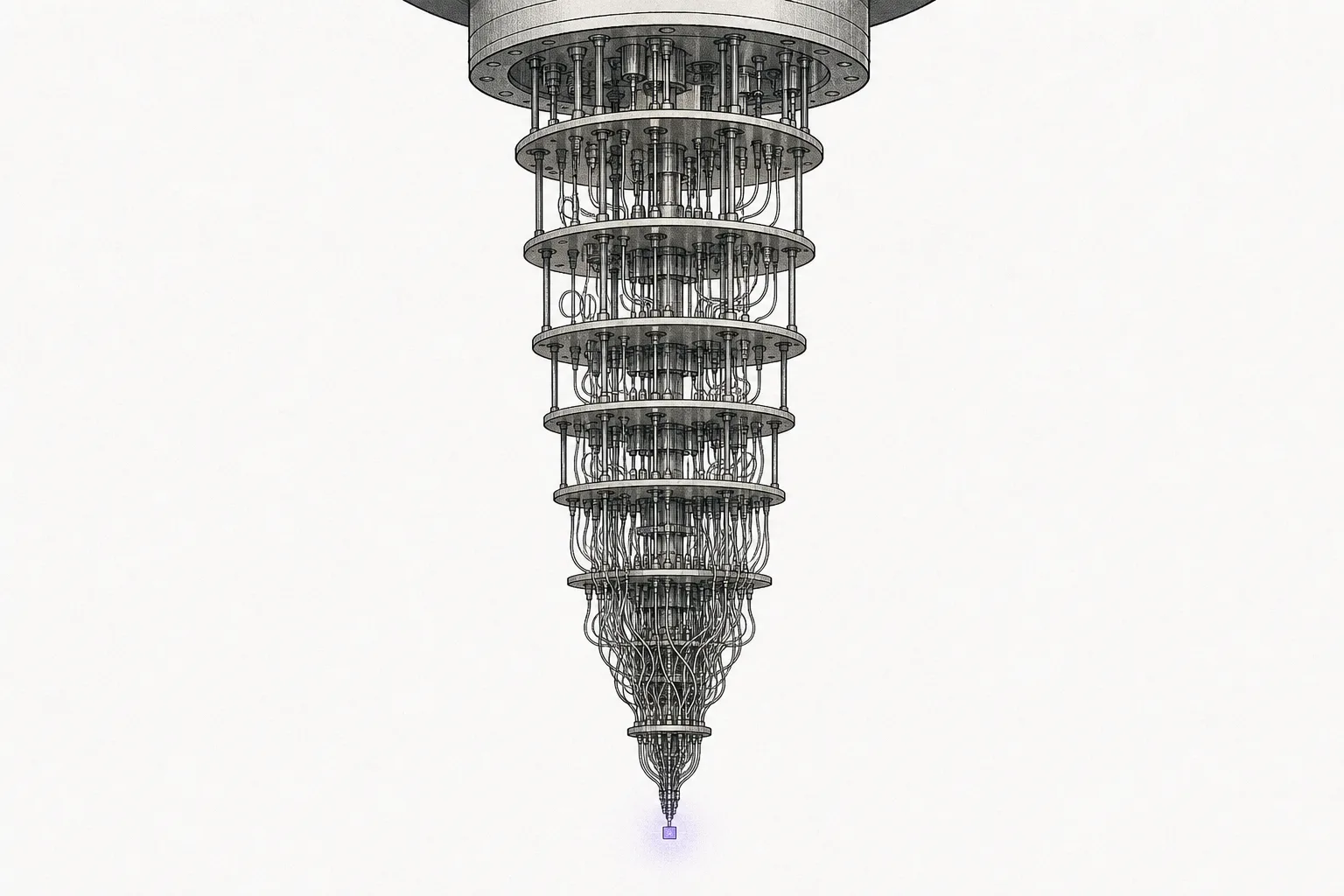
What confuses most people is what a real qubit actually looks like. The answer: it's a tiny chip at the bottom of a giant fridge. Let's walk step by step through what happens, from a "blank circuit" to "reading the answer."
Why so cold? Because quantum states are extremely fragile. A little heat, vibration, or stray noise makes a qubit "forget" the information it holds in a split second — a phenomenon called decoherence. The superconducting line's answer is to chill it in a dilution refrigerator down to ~15 millikelvin, about 0.015 degrees above absolute zero — colder than deep space — to stretch the time the qubit stays still long enough to compute. Recent progress pushed Google's coherence time (T1) up to ~100 microseconds — it sounds short, but in the quantum world that's long enough to run thousands of gates.
04Where it sits in the quantum universe
Superconducting qubits aren't competing alone. They're one of the "lines" running toward the same finish, and they connect to the rest of the quantum ecosystem in several ways.
- Direct rival — Trapped-Ion: uses charged atoms held still as qubits. Its strength is being the most accurate (highest fidelity) and holding its state far longer, because every atom is exactly identical — no manufacturing variation like a circuit — at the cost of being slower and harder to scale up. In short: superconducting is fast and many, trapped-ion is accurate and steady
- A less-cold rival — Photonic & others: uses particles of light (photons). Its big advantage is no deep chilling needed — cutting out the complexity and cost of the dilution refrigerator entirely. This category also includes neutral-atom, which scales easily and is gaining steam
- Depends on — Semiconductors and Critical Materials & Supply Chain: because a transmon is made with chip-fab techniques, it depends directly on the semiconductor supply chain, including the rare helium-3 for dilution refrigerators and high-purity superconducting materials
- Threatens encryption — Post-Quantum Cryptography: the day superconducting machines grow big enough (thousands of logical qubits), they'll be able to break the encryption protecting banks and the internet worldwide — which is why the cybersecurity world is rushing to develop post-quantum cryptography to prepare ahead, before the machines can actually break anything
- Future customers — Biotech and AI: what quantum will be good at is simulating molecules to design drugs and materials. With AI it's a different kind of "colleague" — quantum does not yet compete with the GPU; it solves a different kind of problem
05Where things stand now + the real players (2025–2026)
The milestone that shook the field most was late 2024, when Google unveiled the Willow (105 qubit) chip and did what no one had done before — as it scaled up the tile of error-correcting qubits (from 3×3 to 5×5 to 7×7), the error rate halved each time instead of rising. It hit "below threshold" for the first time. This was a key piece of evidence that scalable error correction is genuinely possible — and Willow also finished a benchmark problem (RCS) in 5 minutes, a task the fastest supercomputer would take an unimaginable amount of time to do.
On the other side, IBM played the "count and architecture" game — after building the Condor at 1,121 qubits (with over a mile of cryogenic wiring packed into a single fridge), IBM changed direction to focus on the higher-quality Heron (156 qubit) chip, having found that a smaller chip with fewer errors is more useful than a giant chip with many qubits that noise each other out — the key lesson that "qubit count" matters less than "qubit quality".
In the stock market, there are only a handful of pure-play superconducting players you can invest in directly. The most prominent is Rigetti Computing, whose 84-qubit Ankaa-3 chip reached 99%+ fidelity. The fact you have to state plainly: Rigetti's full-year 2025 revenue was only about $7 million (and even shrinking ~34%), while its stock value shot up to the tens-of-billions range — the company's strength right now is the "cash on hand," over $570 million it raised, which buys time to survive until the technology matures.
But the big reality of this line is that most of the strongest players are divisions inside giant companies, not standalone stocks — IBM and Alphabet (Google) are the real technology leaders. So investing in this line through these two companies is "holding quantum inside a portfolio fed by other businesses," unlike Rigetti, which is a pure bet. Newcomers like Amazon (the cat-qubit Ocelot chip), Microsoft, and Finland's IQM are also racing to build their own superconducting machines.
06The future — the road to a real working machine
The milestone the whole field is watching is IBM's path, laid out as a clear calendar — the goal is Starling, the first "large-scale fault-tolerant" superconducting machine in 2029, which will run 100 million gates on 200 logical qubits, with annual milestones along the way (Kookaburra 2026, Cockatoo 2027, magic-state injection 2028). If it goes to plan, this will be the first time quantum steps from "proven in the lab" to "a machine that actually works, stably."
The second important direction is cutting the "tax" of error correction. Today, one truly usable logical qubit can require hundreds to thousands of physical qubits. So the superconducting line is competing to lower that ratio — Amazon designed the Ocelot chip using "cat qubits" that suppress certain errors at the hardware level, so fewer spare qubits are needed. Whoever cuts this tax the most will reach a real working machine with fewer qubits.

The big picture: the superconducting line leads every other line in momentum and funding, and it's the only line with a calendar to fault-tolerance that big companies dare to put their own names on. But the key is no longer "who has the most qubits" — it's "who can first make qubits good enough to correct errors at a count that's worth it."
07Challenges & risks
The first risk is baked into the technology itself: fragility and the need for deep chilling. A superconducting qubit holds its state only on the order of microseconds, much shorter than trapped-ion, and has to stay in a ~15 mK dilution refrigerator at all times — this fridge is expensive, big, complex, and limited in "how many signal wires" you can pack in. The more qubits you add, the more wires you need, until the wiring becomes the real bottleneck for scaling (Condor needed over a mile of wiring in a single fridge).
The second risk is the still-brutal "error-correction tax". The work investors are waiting for — like breaking encryption — may need thousands of logical qubits = millions of physical qubits, while the best chips today have physical qubits only in the hundreds. That gap is very wide, and no one can guarantee the superconducting line can scale to a million qubits without hitting an engineering wall.
The third risk is betting on the wrong line (modality risk). For a pure-play like Rigetti — if one day the world finds that trapped-ion or photonic scales better, the bet placed on superconducting may not pay off. Unlike giants like IBM/Google, which have enough runway to try several paths, and even if quantum doesn't work out, still have a core business feeding the company.
The fourth risk — specific to investing — is the distance from technology to profit. Most pure-play players are still losing money and burning cash every quarter. Real revenue is tiny compared to the stock value, and the price moves on milestone news and market mood more than on results — it can go up hard, and down just as hard. In this group, "cash tough enough to last to the finish" matters as much as how advanced the technology is.
In short: this node is the quantum-technology line that's most out front today — a tiny circuit colder than space, driven by microwaves, made like a chip, and backed by both IBM and Google. But "being ahead" and "sure to win" are different things. The fragility that needs deep chilling, and the still-brutal error-correction tax, are the walls that will decide whether this horse really runs all the way to the finish.