Megatrend · Quantum Computing
The dark horses that could overtake the leaders — when qubits are made from light, atoms, and physics that erases its own errors
The two front-runners in quantum — superconducting and trapped-ion — each carry a weakness they can't shake: one has to be chilled to extreme cold, the other is hard to scale up. What's interesting is that there's still a whole set of "alternative paths," each betting a different way: make qubits from photons (particles of light) that work at room temperature and travel down fiber · from neutral atoms held by laser beams and easily scaled to tens of thousands · from spin in silicon built on existing chip production lines · and from topological states designed so physics erases the errors from the start. Each is a bet on "leapfrogging" the leaders — and most are still private companies that the stock market can only touch indirectly.
01What it is (the alternative paths)
In the quantum world, no one yet knows which way of building a qubit will win — unlike ordinary chips, where the whole world has agreed on silicon transistors. The two "front-running" siblings are Superconducting (tiny electrical circuits chilled to extreme cold — the Google/IBM camp) and Trapped-Ion (ions held still in an electromagnetic field — the IonQ/Quantinuum camp). They've gone the furthest so far, but each has a weakness it can't shake.
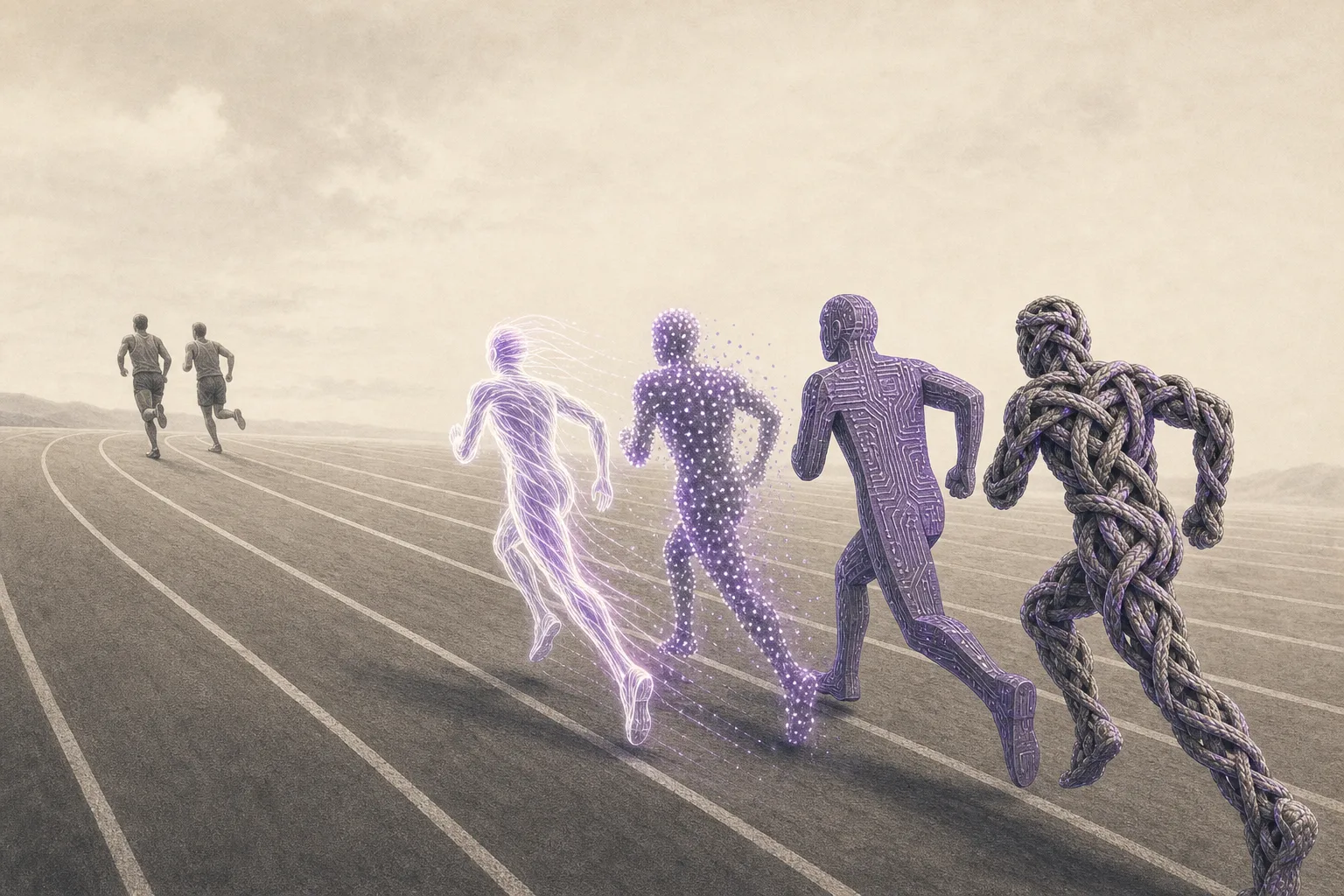
This node is "everything else" — the cluster of alternative approaches betting a different way to "leapfrog" those two leaders. It isn't one technology, but at least four completely different methods:
- Photonic (photons / particles of light): make qubits from "particles of light." The big advantage is they work at room temperature (no expensive dilution fridge), can send data down fiber, and can be built on silicon chip production lines
- Neutral-Atom: hold single atoms still with laser beams called "optical tweezers." The standout is they scale very easily — add more beams and you add qubits, into the thousands and tens of thousands
- Silicon-Spin: use the "spin" of a single electron in silicon as a qubit. The standout is they're built on existing CMOS chip lines the world already uses for chips — the most ready-made infrastructure
- Topological: the boldest bet — design the qubit from a special state of physics that's error-resistant at the hardware level. If it really works, it slashes the error-correction burden — but it's also the hardest to prove
On the megatrend map, this node is a leaf under Quantum Hardware — Pure-plays within the big trend Quantum Computing. Its siblings alongside it are superconducting, trapped-ion, and Quantum Annealing — this node is "all the other paths" that aren't those three.
Modality = a "technology lineage," each way of building a qubit (photons, atoms, spin, etc.) · Optical tweezers = a tightly focused laser beam that can hold a single atom still, as if pinching it with tweezers · Topological = encoding a qubit's information in the "shape" of a quantum state that small disturbances can't destroy — like a knot in a rope that doesn't come loose if you nudge the rope a little
02Why it matters — each one is aiming to overtake the leaders
The reason these alternative paths are worth watching is that the two leaders have walls they may not get past. Superconducting makes the most qubits and the fastest, but every machine has to be chilled near absolute zero in a dilution fridge costing millions of dollars. Trapped-ion is the most precise, but slower and hard to scale up in qubit count. So each alternative path takes direct aim at those weaknesses.
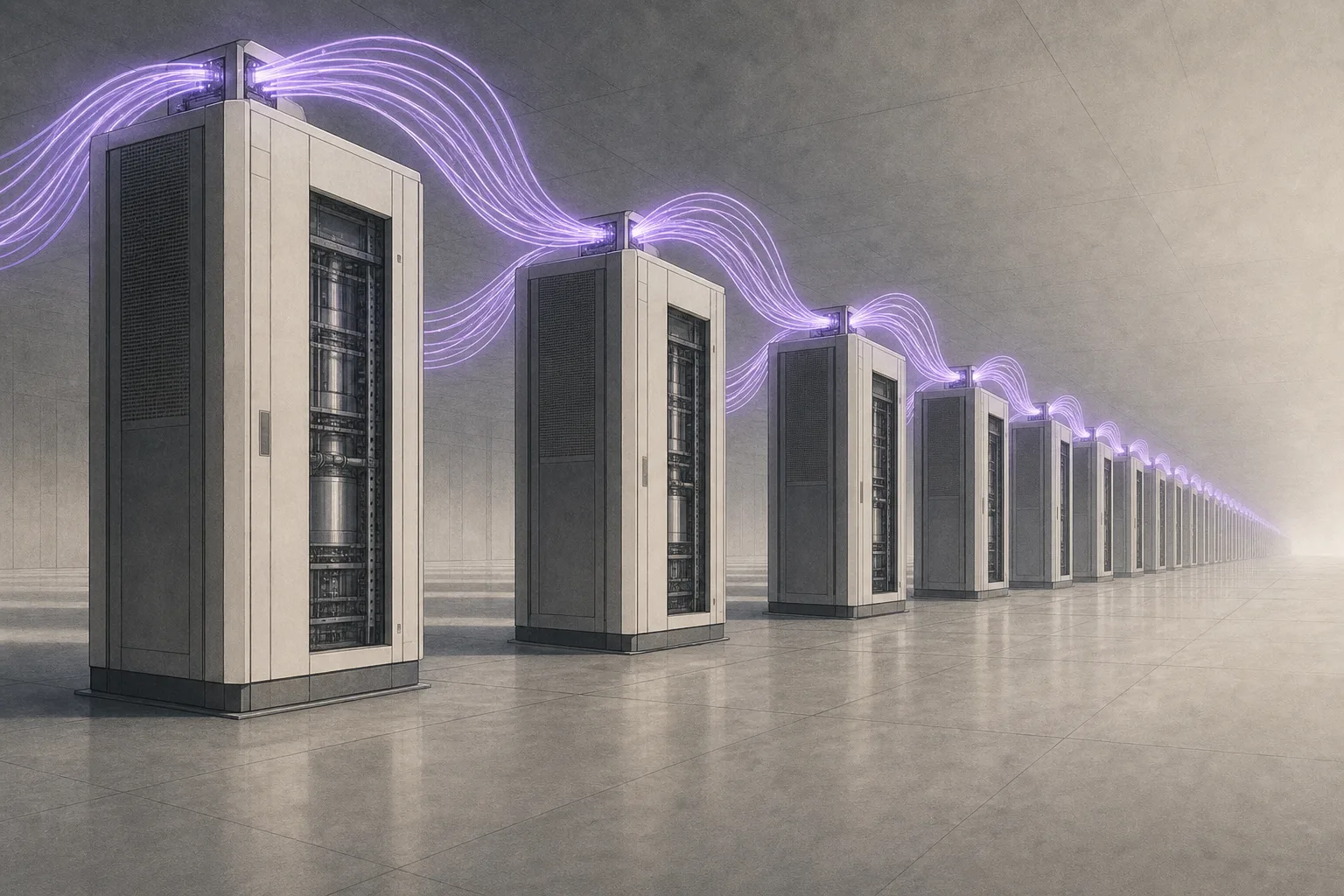
The brightest flag is planted at photons — qubits made from light don't need extreme cooling and can run on ordinary server-style cooling. And more importantly, they're "networkable", because light already travels down fiber. In early 2025, Xanadu unveiled a machine called Aurora, built from four server racks linked by 13 kilometers of fiber in total and using 35 photonic chips — all running at room temperature, proving that many small processors can work as one bigger machine.
Another force is scaling up. Neutral-atom adds qubits just by adding laser beams, so today's systems already reach 1,000–10,000 atoms — compared with superconducting's best, still in the hundreds. And in 2025, QuEra, working with Harvard/MIT, showed 96 logical qubits on 448 atoms in Nature-grade research. Silicon-spin bets on "the most ready-made infrastructure" (built on existing chip lines), and topological bets on "solving the error problem at the root" instead of bundling thousands of qubits together.
The money is growing fast, too. The overall quantum market is projected to go from ~$3.5 billion in 2025 to ~$20 billion in 2030 (averaging over 40% growth a year). The quantum photonics market alone is expected to grow from ~$850 million (2025) at a CAGR of about 35%, and neutral-atom grows at a similar rate. So these alternative paths aren't fringe — they're one of the parts pulling in the most investment in the whole field.
03How it works (comparing the 4 paths)
The best way to understand this node is to look at what each path "makes qubits from" and "what it trades for what," because no path is good at everything — each is strong in one place and weak in another.
Notice that every path bets on a different weakness of the leaders: photons solve "has to be cooled" · neutral-atom solves "hard to scale" · silicon-spin solves "infrastructure not ready" · topological solves "qubits so fragile you have to bundle thousands into one" (read more about logical vs physical qubits in the pure-plays lesson).
But every approach has a price to pay: photons still struggle to make single photons "exactly on time" · neutral-atom gets complex to control one by one once there are tens of thousands · silicon-spin is still at the level of a few qubits · and topological is a bet that's still not clearly proven even at the level of science.
04Where it sits in the quantum universe
These alternative paths don't just compete with each other — all of them are running toward the same "finish line" as the leaders: a machine that's truly fault-tolerant. It connects to the rest of the quantum ecosystem and the technology around it in several ways:
- Head-to-head with the two leaders — Superconducting and Trapped-Ion: this is the main rivalry. Every alternative path is a bet that "the leaders' approach hits a dead end before the finish line" — if those two front-runners fix their own weaknesses, the dark horses lose their edge instantly
- Deeply tied to Semiconductors (Photonics & Silicon): this is the clearest overlap — photon-type qubits are built on silicon-photonics chip lines, and silicon-spin is built right on existing CMOS lines, which turns the "chip factory" into a direct ally of quantum (PsiQuantum builds at GlobalFoundries' fab · Quobly builds on STMicroelectronics' line)
- Connected to AI through Artificial Intelligence: today's quantum machines have to run alongside GPU supercomputers for control and joint computation (hybrid quantum-classical) — Nvidia set up its NVAQC research center in Boston in 2026 to link quantum hardware directly to GPUs
- Future end customers — Cybersecurity and Biotech: the day the machines grow big enough, they'll crack the encryption that protects the internet (the reason the world is racing to build post-quantum cryptography) and simulate molecules to design drugs — these two arenas are why governments pour in enormous money
05Where things stand now + who the players are (2025–2026)
The first truth to say plainly is that most of the real players in the alternative paths are still private companies that haven't gone public — this is a market fact, and not a small one. For investors, it means "playing" this theme is mostly done through the big tech companies investing in these paths rather than buying a pure-play directly.
On the photon side, the standout is PsiQuantum (private, valued at around $7 billion after a Series E raise in mid-2025), which has partnered with GlobalFoundries to build Omega chips on a real production line and aims to stand up a data-center-scale quantum computing center by 2027. Xanadu (XNDU) is one of the first photon pure-plays to reach the stock market, unveiling Aurora, which runs at room temperature and is networked with 13 km of fiber.
The neutral-atom side is buzzing: QuEra (private) raised over $230 million in 2025 with Google and Nvidia among the investors, targeting 100 logical qubits by 2026 · Atom Computing (private, partnered with Microsoft) has a Phoenix machine packing 1,180 qubits — the largest in neutral-atom · and Pasqal (France) announced it would go public via SPAC in 2026 at a valuation of about $2 billion.
The silicon-spin side is led by Intel (INTC), which has a Tunnel Falls 12-qubit chip built on the same commercial 300mm production line as its logic chips, and Quobly (France, private), which just raised a Series A of around $133 million in mid-2026 to build on STMicroelectronics' line. On the topological side, the most famous lone horse is Microsoft (MSFT), which unveiled the Majorana 1 chip in early 2025 — claiming the world's first topological QPU, though many physicists still question the evidence.
And don't forget Nvidia (NVDA), which doesn't build qubits itself but is the field's "glue" — the CUDA-Q platform and the NVAQC center in Boston mean quantum hardware of every path has to work alongside Nvidia's GPUs, so the company benefits no matter which path wins.
06The road ahead — scale, room temperature, error-resistance
The first direction is chasing scale. Neutral-atom plans to go from thousands of atoms today to tens to hundreds of thousands of atoms over 2027–2028, with higher fidelity — Atom Computing targets a Magne machine doing 50 logical qubits from 1,225 physical qubits by late 2026. And Xanadu's photon side claims the Aurora architecture can "in principle" scale to millions of qubits by adding more server racks.
The second direction is playing photons' strength of "room temperature + networking". If qubits can be sent down fiber, the future picture is a "quantum data center" that links many small processors together instead of building one giant chip — a scaling path completely different from the leaders', and the reason PsiQuantum is pouring money into a data-center-scale center.
The third direction is proving the big bets of topological and silicon-spin. If Microsoft really proves the topological qubit and can scale it, it would "shortcut" the error-correction problem dragging on the whole field — but this is the biggest "if" of all. As for silicon-spin, if it can make large numbers of qubits on CMOS lines, it gains a mass-production edge instantly (in late 2025, teams showed two-qubit fidelity around 99.99% and qubits that work at 1 kelvin).
07Challenges & risks
The first risk is it's still unproven which path (or whether this path) will win. Each alternative path still has unresolved scientific problems — photons still struggle to make single photons "on time," neutral-atom still has to prove it can control huge numbers of qubits with error correction, and Microsoft's topological is still questioned by many physicists as not having solid enough evidence. The most "cutting-edge" bet is also the riskiest.
The second risk is most of the real players are still private companies. PsiQuantum, QuEra, Atom Computing, and Quobly are all still off the stock market — a market fact that limits how retail investors can reach this path. You have to play it indirectly through giants like Microsoft, Intel, and Nvidia, where quantum is just a tiny slice of the business — or through SPAC mergers with high volatility and uncertainty.
The third risk is it's still far from commercial. However exciting the qubit numbers look, a "fully fault-tolerant" machine from any path is still years away — some observers think a truly usable machine may even be beyond 2030. So today's players' real revenue is still tiny compared with the valuations and investment flowing in, which is why the share prices of the listed group move on news and expectations more than on earnings.
In short: this node is the "most diverse" corner of quantum hardware — gathering every approach that isn't the two leaders into one basket. Each is a clever idea that could really change the game, especially photons running at room temperature and networkable. Understanding "what each path is betting" and "who can play it through which door" is what lets you see this group for what it really is.