Megatrend · Critical Materials
The West's nuclear fuel is dug out of "two countries that aren't friends"
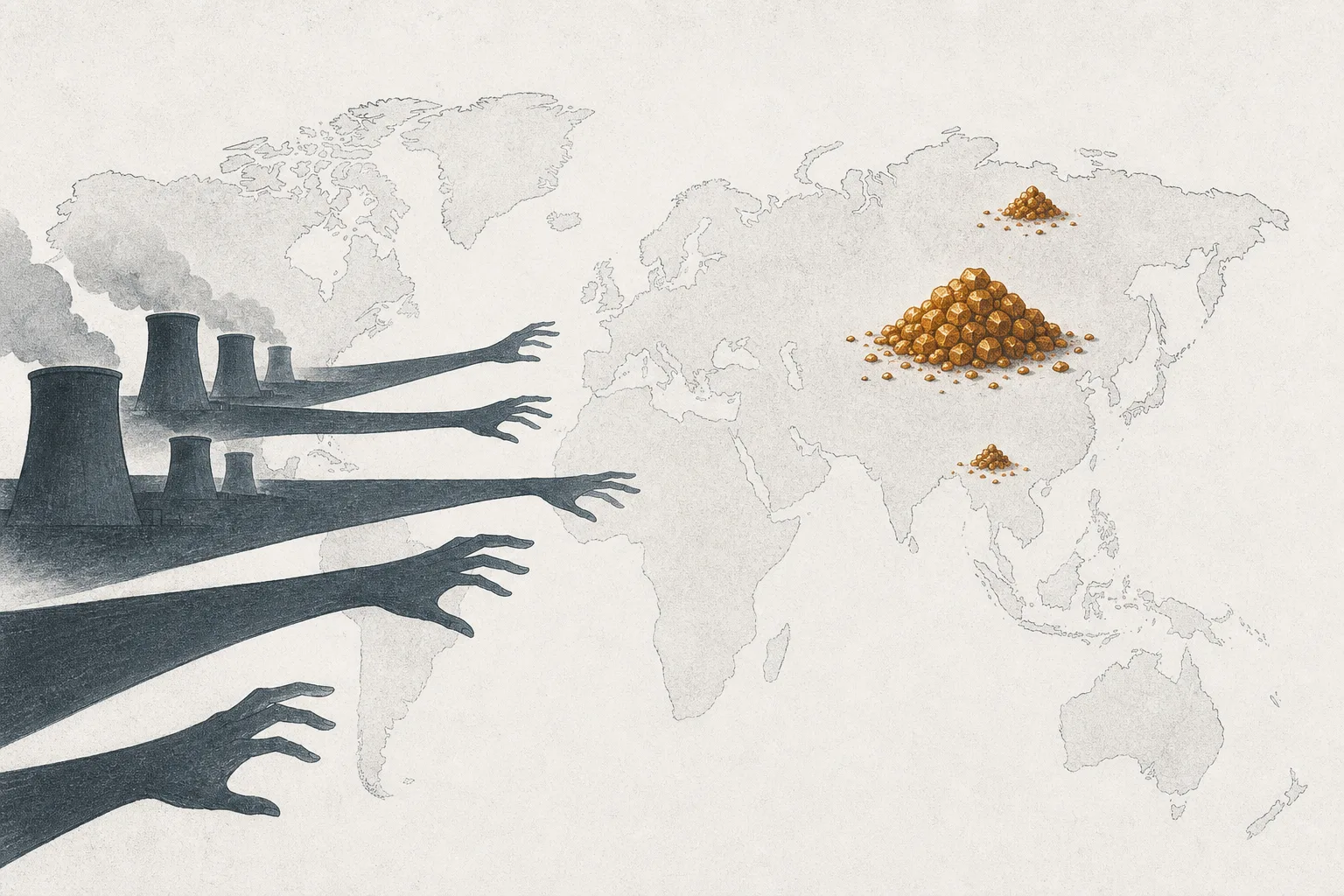
The sister lesson already told the "uranium is soaring because of AI" story — this one tells the scarier story: who actually digs it up. Nearly 40% of the world's uranium comes from Kazakhstan alone, and most of the shipping routes and enrichment are tied to Russia. When the war in Ukraine broke out, the US went so far as to pass a law banning Russian uranium and poured billions into building its own supply chain. This is a story about a strategic mineral where "security" matters as much as "price" — and the West is racing to find places to mine inside its own alliance before it's too late.
01What it is — a strategic mineral, not just a commodity
This node is the very top of the whole nuclear-energy chain — digging uranium ore out of the ground and turning it into a concentrated yellow powder called yellowcake (U₃O₈), before it's sent on to be enriched and shaped into reactor fuel. It's a sub-branch of Uranium & Nuclear Fuel Cycle inside the Critical Materials & Supply Chain megatrend — sitting right next to copper, lithium and rare earths as one of the "raw materials the world fights over."
But there are two angles you have to keep separate, because they tell completely different stories:
- The "price & demand" angle — why uranium jumped from $20 to over $100 a pound, and how AI and the nuclear revival are driving demand. That story is told in full in the uranium-from-the-energy-side lesson (Energy)
- The "security & supply chain" angle — this lesson. The angle that asks where this stuff is dug, who controls the tap, and why the West can't sleep. This is the angle that makes uranium not just an ordinary commodity but a "strategic mineral", on the same level as chips or rare earths
This distinction matters a lot, because with an ordinary mineral like copper, no matter how expensive it gets, you can still buy it from anyone in the world. But uranium has an extra layer of trouble — both mining and enrichment are concentrated in a handful of countries, some of which are direct geopolitical rivals. When relations between countries get tense, "who owns the mine" instantly becomes a national-security question.
A raw material that is (1) essential to the economy or security, and (2) at high risk of having its supply cut off — usually because it's concentrated in just a few countries. Uranium fits perfectly: it's the only fuel that makes a nuclear reactor run, yet it can only be mined in a few places, and it's the same mineral used to make weapons — which is why governments worldwide watch it especially closely.
02Why it matters — supply is concentrated in rivals' hands
Start with the number that gives Western energy planners chills: in 2024, Kazakhstan alone mined about 39% of the world's uranium, followed by Canada at 24% and Namibia at 12%. And counting just six countries (Kazakhstan, Canada, Namibia, Australia, Uzbekistan, Russia), you already get about 90% of all production. This is a commodity with extreme supply concentration.
This concentration is scary, but the second dimension is scarier — enrichment, the step that takes yellowcake and "refines" it until it's concentrated enough to sustain a reaction in the reactor. Russia alone controls about 44% of the world's enrichment capacity, and before the Ukraine war, Russia supplied US nuclear plants with enriched uranium worth about 27% of American reactors' fuel needs (2023 figure). Put simply, America's reactors were running partly on Russian fuel.
This is why the issue caught fire in Washington. In May 2024 the US passed the Prohibiting Russian Uranium Imports Act — banning imports of enriched uranium from Russia, taking effect August 13, 2024 (with temporary waivers through early 2028). In the same move, it freed up $2.7 billion to speed up America's own enrichment capacity. The fact that the government had to pass a law and spend on this scale tells us — for uranium, "who owns the chain" is a matter of national life and death, not just something for speculators.
03How it works — from underground ore to yellowcake powder
Before you can understand the "supply map," you need to picture how uranium is actually mined — because the way it's mined is what decides who can dig it cheapest, and that's the reason supply clusters where it does. There are three main methods, but they all end at the same place: yellowcake (U₃O₈) powder going to market.
The core thing to remember is that ISR (in-situ recovery) is the cheapest method — instead of digging a pit or boring a tunnel, you just drill wells, pump a mild solution down to "dissolve" the uranium out of the rock bit by bit, then suck the mineral-rich liquid back up and separate it into yellowcake. Almost all of it happens in a closed system — no blasting rock, no hauling enormous amounts of earth.
And this is exactly the answer to why supply clustered in Kazakhstan — Kazakhstan's deposits are sandstone layers that happen to be perfect for ISR. Kazatomprom mines almost 100% by ISR, so its costs are so low that rivals worldwide struggle to compete. Whoever can dig cheapest takes the share. The opposite is Canada, where the deposits in the Athabasca Basin are extremely concentrated (some spots grade hundreds of times above the global average) and require underground mining — more expensive, but yielding high-quality ore that sits in an allied country. That's why the West is turning to Canada as its hope.
04The global supply map — who mines, who controls the tap
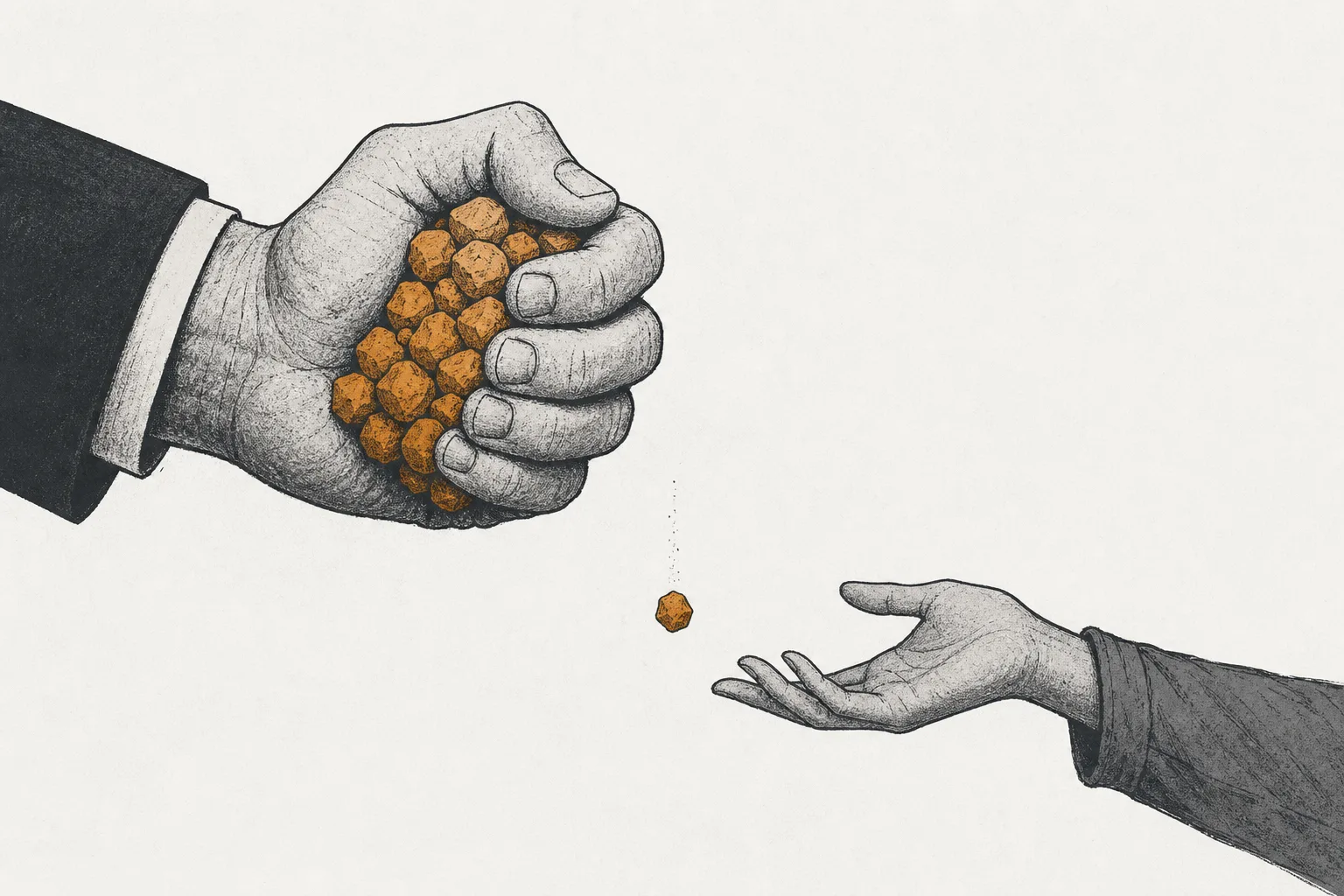
If you draw the uranium chain as a single line, you can see two clear "weak points" — the first is mining (clustered in Kazakhstan), the second is enrichment (clustered in Russia). Both sit in countries that aren't Western allies, while the destination — most of the reactors — are in the US, Europe and East Asia. This is truly a "mineral in the wrong place."
Let's go through it side by side.
The "non-ally" side (controls supply today) — Kazakhstan is the world's number one in mining. Kazakhstan itself isn't an enemy of the West, but the problem is the shipping routes: most Kazakh uranium has to pass through Russia to reach the sea, and Kazatomprom has big sales deals with China and Russia. Meanwhile Russia, though it doesn't mine much itself, controls about 44% of the world's "enrichment tap" and keeps expanding its influence into new deposits — in 2025, Russia negotiated to buy uranium from Niger (about 1,000 tons, ~$170 million) after a coup pushed France out, underscoring that Moscow keeps stacking up supply leverage.
The "ally" side (the West's hope) — Canada, the world's number two, has both the highest-grade ore and a world-class company in Cameco · Australia has the world's largest reserves but mines little because of political constraints · the US itself has ISR deposits in Wyoming, Texas and Utah being woken back into production · and Africa (Namibia), where the West is trying to hold onto the relationship before Russia and China grab it. So the West's task is clear: "move supply back inside the alliance" (friend-shoring) as fast as possible.
The idea that a country chooses to buy critical raw materials or goods from "trusted / allied countries" rather than just the cheapest source, to reduce the risk of supply being cut off in a crisis. For uranium, it means the West is willing to pay more to mine in Canada, Australia or the US instead of relying on cheaper Kazakhstan, which is tied to Russia.
05How it connects in the ecosystem
Uranium mining is the "very first step" of the chain, so it feeds upward and links sideways in several directions:
- Feeds on to conversion · enrichment & fuel fabrication: the yellowcake you mine is useless until it passes through this step — and this step is exactly where Russia controls the tap. So this sister node is the "second weak point" of the same security chain
- For price/demand, see the uranium-from-the-energy-side lesson: why AI and the nuclear revival are pushing U₃O₈ prices up and what the structural deficit looks like — that lesson tells the "demand" side, this one tells the "who mines / who controls" side
- A case study in strategic minerals in state hands (Sovereign Minerals): uranium is the classic example of a mineral where "security matters more than price" — governments step in, subsidize and stockpile, just as they do with rare earths and lithium
- A sibling in Critical Materials: sitting next to copper, lithium and rare earths — but different in that uranium is a "fuel," not a building material, and is tied to national security far more deeply than ordinary minerals
06Where it stands now — the real players
The 2025–2026 picture is "the West revving up to build its own supply chain." After the Russia ban took effect, the US freed up $2.7 billion for enrichers like Centrus, Orano and General Matter (~$900 million each), while rushing to refill the state's strategic uranium reserve — in 2024 the amount the government bought from American producers nearly doubled from 2023.
But there's a wall you can't rush past: opening a new mine takes a very long time. High prices today wake old projects up, but exploration, permitting, building and actual production eat up 10–15 years. The clearest example is NexGen, the Rook I project in Canada (potential of nearly 30 million pounds a year, the largest in North America), which only got its construction permit in early 2026 — the first Canadian uranium mine to get a green light since 2004. Meanwhile Cameco is ramping up Cigar Lake (~18 million pounds) to make up for delays at McArthur River — underscoring that even the allied-side giants can only add capacity a little at a time.
So the players split into three tiers: giant allied-side producers (Cameco, Kazatomprom — the market leaders actually mining today) · new-generation projects (NexGen, Denison) that are a bet on future supply · and US mine revivers (Uranium Energy, Energy Fuels, enCore) waking domestic ISR mines back up in line with the "mine it at home" policy.
07The road ahead & risks
There are three main directions ahead.
The first is that friend-shoring will accelerate. Instead of chasing the cheapest stuff, the West will pay more to lock in supply from Canada, Australia and the US. Long-term contracts that lay dead for a decade will come roaring back, because plants want to lock in both "price" and "a trusted source" at once — and that's a direct tailwind for allied-side producers.
The second is that strategic reserves will become normal. Just as countries hold oil reserves, governments are starting to see uranium the same way — the US is rushing to refill its reserve, while private players like the Sprott Physical Uranium Trust are sucking real ore out of the market and sitting on it (buying several million pounds in 2025). This stockpiling, by both states and private players, tightens the supply circulating in the market even more, and turns "security" into a new kind of permanent buying pressure that didn't exist in earlier cycles.
But the risks are just as heavy — the first risk is the concentration that still isn't solved. Even with a rush to build new mines and enrichment plants, actually cutting dependence on Kazakhstan and Russia will take a decade or more. In the meantime the West stays fragile — if Kazakhstan cuts its production target (as it announced for 2026) or Russia retaliates by shutting the enrichment tap first, prices will spike and fuel will tighten instantly.
The second risk is the brutal price cycle. Uranium has a long history of "sharp up, sharp down." If mines worldwide all reopen at once because prices are good, supply could flood and prices dive fast — as happened after Fukushima. And don't forget that a single nuclear accident can change the whole game: both demand and confidence would vanish overnight.
The third risk is that mines are slow and expensive to open. New projects have to clear lengthy permitting, costs balloon easily, and they need huge capital up front. So new-generation companies like NexGen, or the US mine revivers, are "bets" whose returns hinge on whether they can get into production in time, before the cycle flips.
In short — if the sister lesson says "uranium got more expensive because AI is starved for power," this lesson tells the next part: that more-expensive stuff is dug from places the West can't control, and that makes uranium mining not just a mining business but one of the hottest national-security games of the era.