Megatrend · Energy Transition & Power Demand
The miner at the very top of every light in the AI era
Before uranium can become fuel in a reactor, it has to be dug out of the ground first — and this is the story of the people who work at the very top of the chain: uranium mining. The world is rushing back to build nuclear plants to power the AI data centers that crave enormous amounts of energy, but mines worldwide have failed to keep up with demand for years. The result is a "shortage" that pushed uranium from $30 past $100 a pound. This lesson walks through how a lump of ore becomes "yellowcake," who the real market leaders are, and why "prices rising" doesn't mean "the supply comes fast."
01What it is — the raw fuel of nuclear power
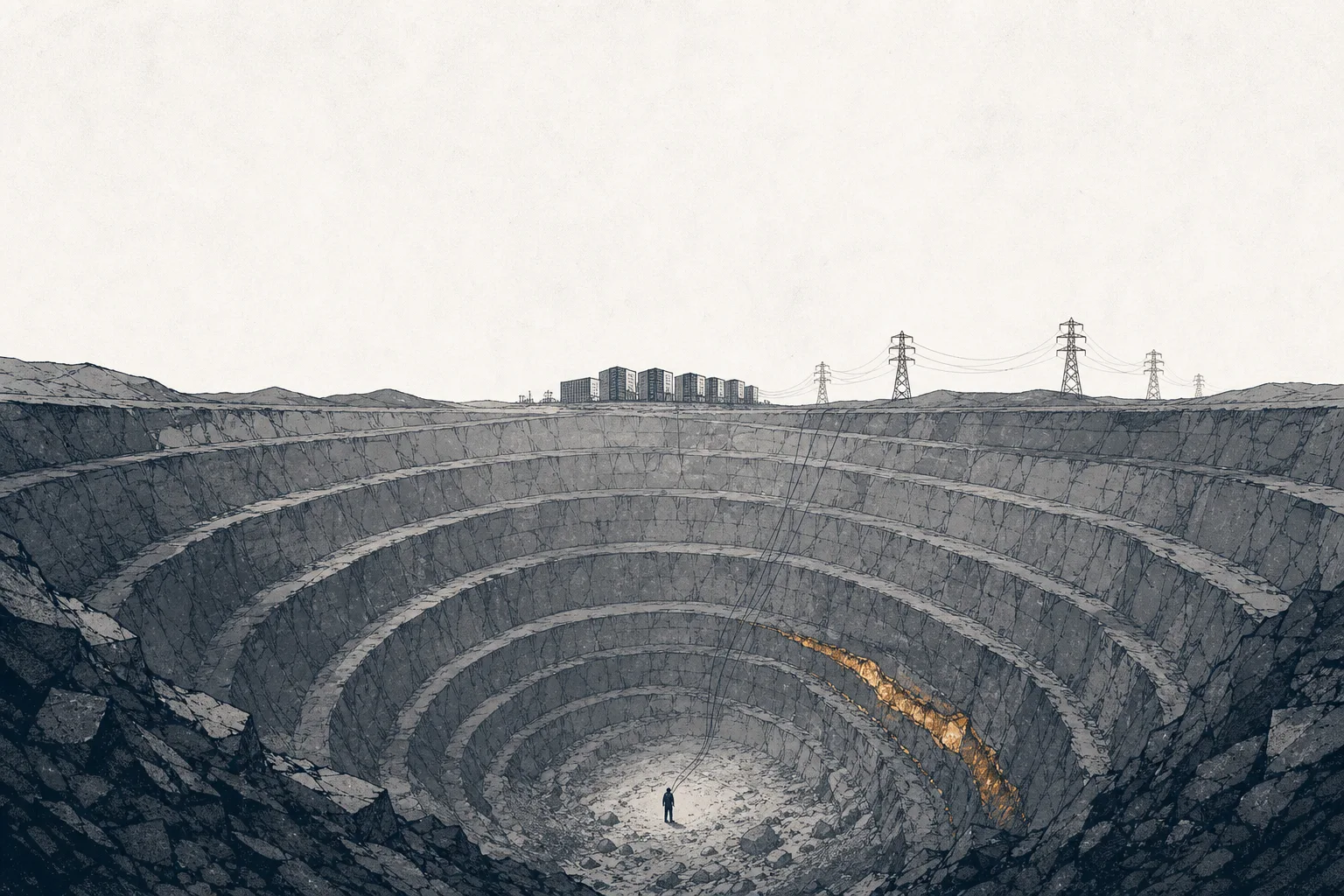
When we talk about nuclear energy, most people picture reactors and giant cooling towers. But step back to the real starting point — before there's fuel going into a reactor, someone has to "dig" it out of the ground first. And that's the story of this node: uranium mining and development, the most upstream side of the entire nuclear chain.
Uranium is a radioactive heavy metal scattered through the Earth's crust, but what's special is this — just one kilogram of uranium gives off as much energy as thousands of tons of coal, because it releases energy by "splitting the nucleus" (fission) rather than the chemical burning of fossil fuels. That's why a single nuclear plant can produce as much power as several coal plants, using only a tiny amount of fuel.
But what comes out of the mine isn't fuel yet. It's "yellowcake" (U₃O₈) — a yellowish-brown powder made by crushing the ore and extracting concentrated uranium. This is the "product" that uranium mines sell to the world. Its price is exactly what you see in the news as "uranium price per pound." From here, yellowcake gets passed on to the next step — conversion & enrichment — before it can actually become fuel for a reactor. So this node focuses only on "getting the ore and producing yellowcake." Making it concentrated enough to spark a reaction is the job of a sibling node.
On the megatrend map, this node is the deepest sub-branch under Nuclear Fuel Cycle within the big trend Energy Transition & Power Demand. If you see the whole chain as a four-stage conveyor belt — mine → convert → enrich → fabricate — this node is the very first stage. Without it, there's nothing to refine downstream.
Yellowcake (U₃O₈) = the concentrated uranium powder produced by crushing and extracting ore — the main product uranium mines sell · U-235 = the isotope of uranium that can "ignite" in a reactor; it makes up only 0.7% in nature (the rest is inert U-238), so it has to be enriched in the next step · pound U3O8 = the unit the uranium market trades in. The price you see in the news is "dollars per pound of U₃O₈."
02Why it matters — reactors are hungry, mines can't keep up
The reason uranium mining is hot again for the first time in decades comes from two forces arriving together. The first is an explosion in electricity demand. AI data centers eat enormous amounts of power and need it stable around the clock (firm power), which sun and wind can't provide all the time. So the world is rushing back to build nuclear plants and develop new small reactors (SMR) — and every new reactor built needs uranium fed to it across a 60–80 year lifespan.
The second force is a scary number. In 2025, mines worldwide dug up about 130 million pounds of uranium, but reactors worldwide needed about 180 million pounds — a deficit of over 25–30%, and that gap tends to keep widening. The market has held up so far by pulling "stockpiled supply" (secondary supply like government stocks and recycled material) to plug the gap. But the World Nuclear Association points out that these stocks are fading in importance — they currently fill about 10% of demand, and that share will gradually shrink. Which means the world leans on "real mines" more every year.
The result of this "shortage" shows up clearly in the price. Spot uranium was around $30 a pound in 2020, then broke past $106 a pound for the first time in 16 years in early 2024. In early 2026 the price was still swinging hard, spiking to $101 in late January before easing back to around $85 a pound by mid-2026 — but what tells the future better is the long-term contract price (the price plants are willing to pay to "lock in" supply for years), which climbed to $93 a pound in March 2026 — the highest since 2008.
03How it works — from ore in the ground to yellowcake
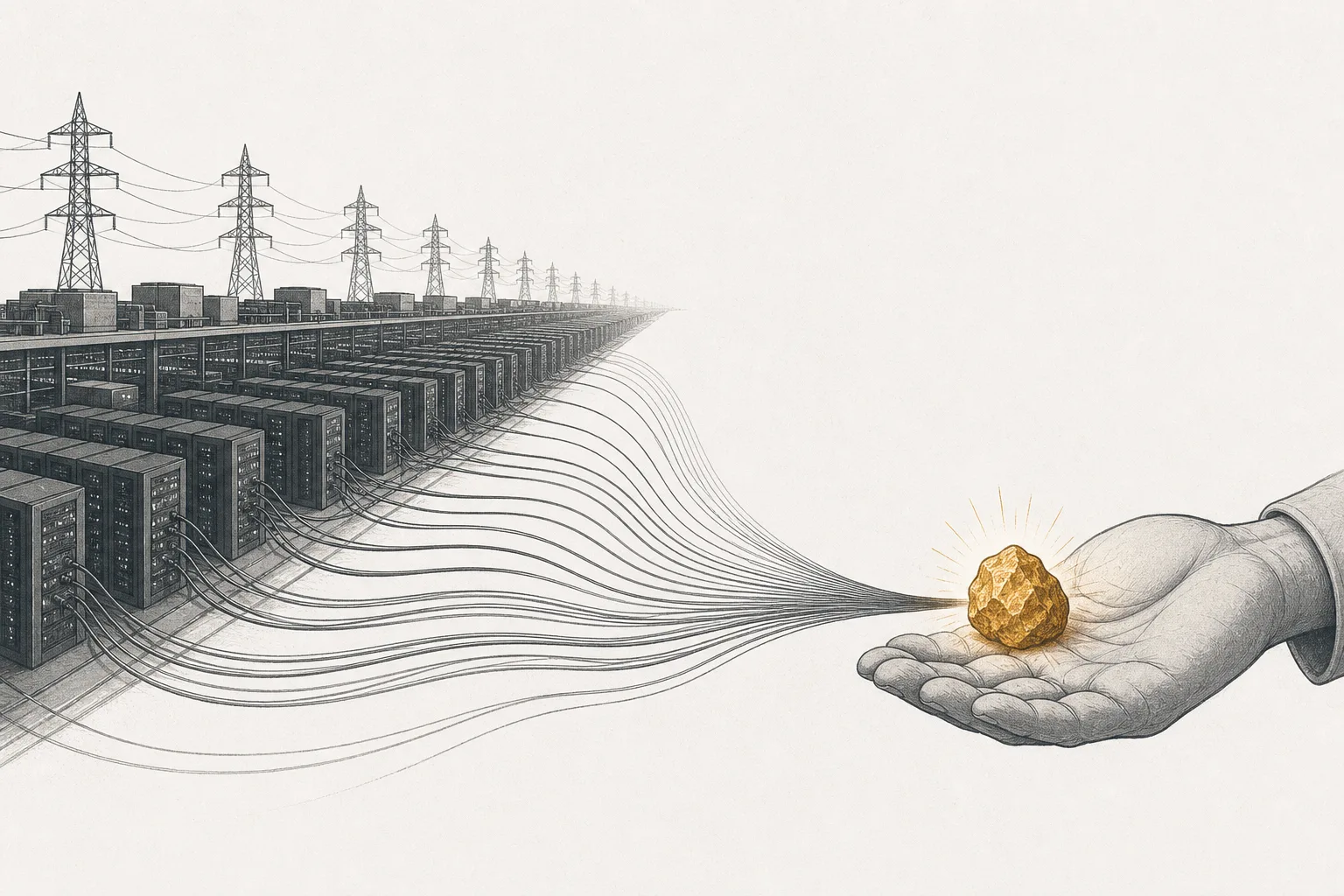
Let's follow one lump of uranium from underground until it becomes yellowcake ready to ship. What's interesting is — there are many ways to "get the ore out," and the method that dominates the world right now isn't the giant-pit digging many people imagine.
There are three main mining methods, each suited to a different deposit. (1) Open-pit digs a giant pit for shallow ore. (2) Underground mining bores tunnels down for high-grade ore that sits deep — the method for ultra-high-grade deposits like Canada's Athabasca basin. And (3) ISR — in-situ recovery, which "pumps a solution" down to leach the ore underground and then pumps up the uranium-laden water, without digging up any soil at all.
What's interesting is that ISR has already become the world's dominant method — over 50% of the uranium mined worldwide (about 56% in 2022) comes from ISR, because it's low-cost, barely disturbs the surface, and suits the kind of deposits Kazakhstan and the U.S. have. This is exactly why Kazakhstan can "rule the world" — its deposits suit the cheapest ISR.
A uranium mining method that doesn't dig up any soil at all — instead it injects a mild solution into the underground ore layer to dissolve the uranium, then pumps the "uranium-bearing water" up to separate it at the surface. It's lower-cost and disturbs the surface environment less than pit mining, so it's the dominant method in Kazakhstan, the U.S., and Uzbekistan — but it only works on deposits sitting in water-permeable sand layers.
04How it connects in the ecosystem
This node is the "most upstream" of nuclear energy. So it's the starting point of a very long chain, connected up, down, and sideways.
- Feeds Conversion & Enrichment (HALEU) directly: the yellowcake a mine produces isn't ready-to-use fuel. It has to be sent on to a sibling node to be converted into gas and then enriched until the U-235 is concentrated enough to spark a reaction — if this node is the "one who digs the raw ore," that node is the "one who refines it." Same chain, divided roles
- Ultimately feeds nuclear plants and new-generation SMRs: every reactor running, and every one being built, is a "stomach" that has to eat uranium from mines across its lifespan. The more new reactors built, the more ore has to be dug
- Driven by AI and Cloud & Digital Infrastructure: the root that made everything hot is the power demand from AI data centers needing firm power — AI's hunger for power flows back down to the miner at the very top of the chain
- Part of Critical Materials & Supply Chain: uranium is a strategic mineral too. The fact that it's concentrated in just a few countries makes this node both a clean-energy story and a materials-security story at once
05Where it stands now — the real players (2025–2026)
The first thing to understand is geographic concentration. The uranium mined worldwide is concentrated in just a few countries to a startling degree — the top 3 (Kazakhstan, Canada, Australia/Namibia) produce about 75% combined, and the top 5 reach nearly 90% of the world, with Kazakhstan alone controlling over 40% — the real "Saudi Arabia of uranium."
The real market leader is Kazatomprom, Kazakhstan's state-owned enterprise and the world's largest uranium producer by a wide margin, using low-cost ISR. But a very important point in 2026 is that — even as prices rise — Kazatomprom announced it would cut its 2026 production target, from about 32,777 tons down to 29,697 tons of U₃O₈ (about 5% of world supply gone), partly because of a shortage of the sulfuric acid used to leach the ore. This reflects the iron rule of this industry: "prices rising doesn't mean the supply comes fast."
On the Western side, the big player is Canada's Cameco, the largest producer outside Kazakhstan, sitting on ultra-high-grade deposits in the Athabasca basin. In 2025, Cameco made about $3,482 million in revenue (up 11%). Its standout is that it doesn't just mine — it has gone downstream into the conversion and enrichment business too, one of the few Western companies covering the chain broadly, and the "Western champion" that investors see benefiting fully from the "de-risk from Russia/Kazakhstan" trend.
But the most exciting story of 2026 is the wave of new mines in Canada. In early 2026, Canada's nuclear regulator (CNSC) approved the construction of the first two new uranium mines since 2004 — Denison Mines' Wheeler River project (approved Feb 2026, using ISR at the Phoenix deposit) and NexGen Energy's Rook I / Arrow deposit project (approved Mar 2026). Together the two projects total about $2.8 billion in investment and over 1,600 construction jobs — a sign the West is getting serious about "building new supply" after 20 years of standing still.
The rising stars and the players "restarting" are buzzing too. Paladin Energy has restarted the Langer Heinrich mine in Namibia (producing about 1.07 million pounds U₃O₈ in the quarter to September 2025) and is still ramping up. Uranium Energy Corp (UEC) restarted the Christensen Ranch ISR mine in Wyoming and opened Burke Hollow in Texas — the largest new U.S. ISR mine in over a decade. And behind the price surge is a key catalyst named Sprott Physical Uranium Trust (SPUT), a fund that "buys real uranium and stores it," currently holding about 66 million pounds — every time it raises money to buy more, it sucks supply out of the market and pushes the spot price up instantly.
06The road ahead
The first direction is SMRs adding another layer of demand. The small reactors that tech giants are signing power-purchase deals to feed their data centers are turning from "plans on paper" into real projects. Every reactor finished is a new stomach that has to eat uranium — and many designs need specially concentrated fuel (HALEU), which uses more raw uranium per unit of power, reinforcing that the upstream has to grow.
The second direction is "re-shoring" Western supply. Worry about depending on Kazakhstan/Russia is making the U.S., Canadian, and European governments want more mines of their own. The wave of new mines in Canada (Denison, NexGen) and the restart of ISR mines in the U.S. (UEC, enCore) is a structural theme that could last a decade — a "fuel security" story as much as a clean-energy one.
The third direction is the supply gap widening from 2030 onward, because many old mines are nearing the end of their life while new mines take years to build. So the market sees a potentially worse shortage after 2030 if new mines can't come online fast enough — which is excellent fuel for the long-term contract price that keeps climbing.
07Challenges & risks
The first risk is an extremely violent price cycle. Uranium is one of the most "sharp up, sharp down" commodities in the world. In the previous cycle the price spiked past $130 in 2007, then plunged to around $20–30 after the Fukushima accident in 2011, leaving mines worldwide running losses and shutting down in droves. This rise comes from a genuine shortage, but if mines worldwide all reopen together in 3–5 years, supply could flood and prices could plunge as they have every time before.
The second risk is geopolitical concentration. With most of the world's uranium coming from Kazakhstan, and Kazakhstan's transport routes and alliances tied to Russia to no small degree, a single tension can shake world supply instantly. This is exactly why the West is willing to pay more to have mines of its own — both a risk (for the side that depends on Kazakhstan) and an opportunity (for Western producers like Cameco).
The third risk is mines that are slow and expensive to bring online. From finding a deposit, getting permits, and building a mill, to actually producing, takes years — even a decade — and enormous money (the two Canadian projects total $2.8 billion). Many rising stars are still "not yet producing" — share prices run ahead on hope. If a project stumbles, slips, or its costs balloon, the risk falls on the investors who bought the "future" early.
In short: this node is the one at the very top of the entire nuclear chain — going down to dig ore from the ground and turning it into yellowcake to feed the next step. It's a story of "shortage" born from reactors getting hungry faster than mines can keep up, plus AI heating everything up. Understanding that "the power of the upstream lies with whoever can actually get the ore out in a moment of shortage" is understanding why a mineral once forgotten after Fukushima has come back as one of the hottest stories of the AI-power era.