Megatrend · Critical Materials
A metal that lay dead for 10 years — until AI suddenly woke it up
After the 2011 Fukushima disaster, the uranium price fell nearly 90% from its peak and then stayed "dead" for almost a decade. Mines around the world shut down; no one dared invest in new ones. But now the world is racing to build nuclear power plants again to feed AI — and a harsh truth is surfacing: mines can't dig fast enough, and building a new one takes 10–15 years. This is the story of a strategic mineral whose demand is running faster than supply, creating a "structural deficit."
01What is it? (one mineral + two sub-parts)
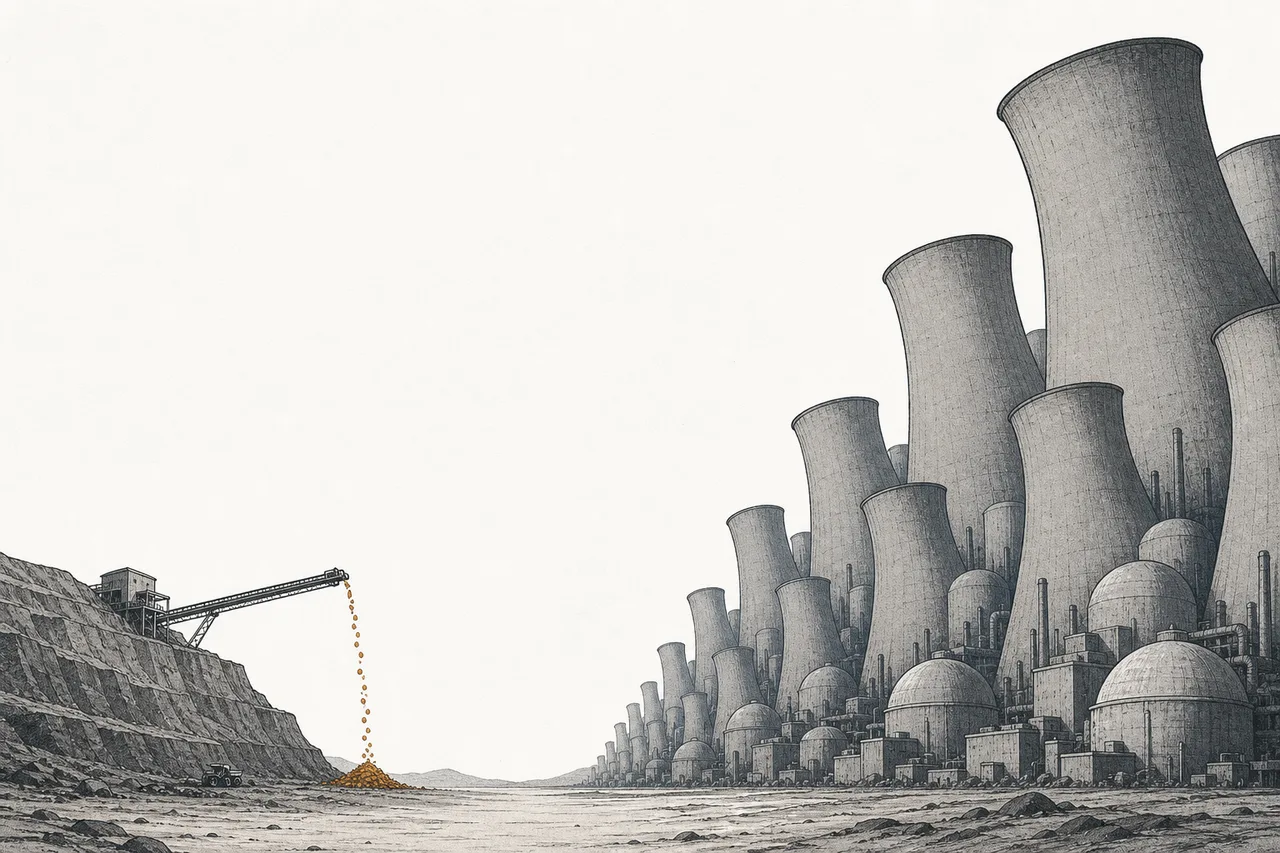
When people talk about "nuclear power," we usually picture reactors and giant cooling towers. But before a single unit of electricity comes out, something has to come first — uranium, a radioactive mineral dug out of the ground. This node is about uranium as a "raw material" — one of the strategic minerals inside Critical Materials, like copper or lithium, except this one is the fuel for the reactor.
The angle this lesson takes is the "commodity" one — it gets mined, traded, and swings in price in cycles just like other minerals. This node splits into two sub-parts that chain together:
- Uranium Mining: dig up the ore, then extract it into a concentrated yellow powder called "yellowcake" (U₃O₈) — this is the product that actually trades on the market, and the star of this lesson, because the "uranium price" you see in the news is the price of this powder
- Conversion, Enrichment & Fuel: take the yellowcake and "refine" it further until it's concentrated enough to spark a reaction in the reactor — this part is pure technology and geopolitics, which we cover separately in Conversion · Enrichment (you can see the demand side of this chain in Nuclear Fuel Cycle). This lesson only touches it enough to give you the picture, then focuses on the "mineral" side
The second side — conversion · enrichment — is the bottleneck where Russia controls nearly half the world's capacity (~45%), which means even when the West has the ore, it still can hardly turn it into fuel itself (go deeper → Conversion · Enrichment)
Put another way: if this node were an oil refinery, the "mining" side is the oil well (about price and volume) and the "enrichment" side is the refinery (about technology and who controls the tap). This lesson tells the story of the oil well.
Yellowcake is the concentrated yellow uranium powder you get from crushing and extracting the ore — it's the form that actually trades on the market. The unit is "pounds of U₃O₈," and the price investors watch (say, "$80 a pound") is the price of this powder, not the price of finished fuel that goes into a reactor.
02Why it matters — a "shortage" that built up over a decade
This story starts with an old wound. In 2007, the uranium price spiked to ~$138 a pound. Then in March 2011 came the Fukushima disaster. Japan and Germany ordered reactors shut, faith in nuclear collapsed, and the uranium price slid lower and lower until it fell below $20 a pound in 2016–2017 — a drop of roughly 70–85% from the peak. And crucially, it stayed "dead" like that for nearly 10 years.
That dead decade is the root of today's problem. When the price sits below cost for years, mining companies close mines, stop exploring, and no one dares invest in building new ones. Cameco even shut McArthur River, the highest-grade mine in the world, and Kazatomprom cut output starting in 2018. The result: global mine output once fell to only about 60% of actual fuel demand — and the gap was plugged with "old stockpiles" built up over the years.
Then demand came back — stronger than before. AI data centers consume enormous amounts of electricity and need power that's "stable 24 hours a day," which nuclear delivers better than sun and wind. So the world is rushing to build nuclear power plants again and to develop small reactors (SMR). At the end of 2024 there were 63 reactors (~71 GW) under construction worldwide — the highest level since 1990.
The result is a scary number. In 2025 the world produced about 173 million pounds of uranium from mines, but demand was around 204 million pounds — a deficit of over 30 million pounds. And analysts see demand possibly climbing to ~400 million pounds by 2040, or more than double today's level.
And the price responded. The spot price, which sat around $30 a pound in 2020, broke through $106 a pound for the first time in 16 years in early 2024, then eased back to close 2025 at about $81.55 (+12% on the year), before bouncing back to ~$101 again in early 2026 — a volatile but clearly upward cycle.
03How it works — why supply can't keep up with demand
The heart of this lesson is one "asymmetry": demand can grow fast, but supply can only grow very slowly. When those two move in opposite directions, you get what's called a "structural deficit" — not a temporary shortage, but one that comes from the mechanics of the market itself.
So why is supply so slow? There are three layers.
First layer — new mines are slow and expensive to build. Even if today's price is high enough to be worth investing in, exploring, permitting, building, and actually producing eats up 10–15 years. The clearest example is NexGen's Rook I project in Canada (a mine with capacity of nearly 30 million pounds a year, the largest in North America), which only got its construction license in March 2026 — the first Canadian uranium mine approved for construction since 2004.
Second layer — "secondary supply" is running out. Over the past decade, the gap was filled with things that don't come straight from a mine: power plants' old stockpiles, government reserves, and a technique in enrichment plants called underfeeding (squeezing more uranium out of the same feedstock). Now these buffers are running out or already locked up. The clear signal is Japan buying uranium again after disappearing for over a decade — meaning the stockpiles it once sat on are thinning.
Third layer — concentrated in just a few countries. About 40% (nearly half) of the world's uranium comes from Kazakhstan alone (~39% per WNA 2024, via Kazatomprom), followed by Canada, Australia, and Africa (Namibia, Niger). When supply is this concentrated, one big player cutting its output target is enough to shake the whole market — and that's exactly what's happening.
04How to mine it cheapest — the mine with no "mine"
When we think of a mine, we usually picture a giant pit or deep tunnels. But most of the world's uranium isn't dug that way — over ~47–50% of the world's uranium is produced using a method called ISR (in-situ recovery), or "underground leaching," which barely digs any earth up at all.
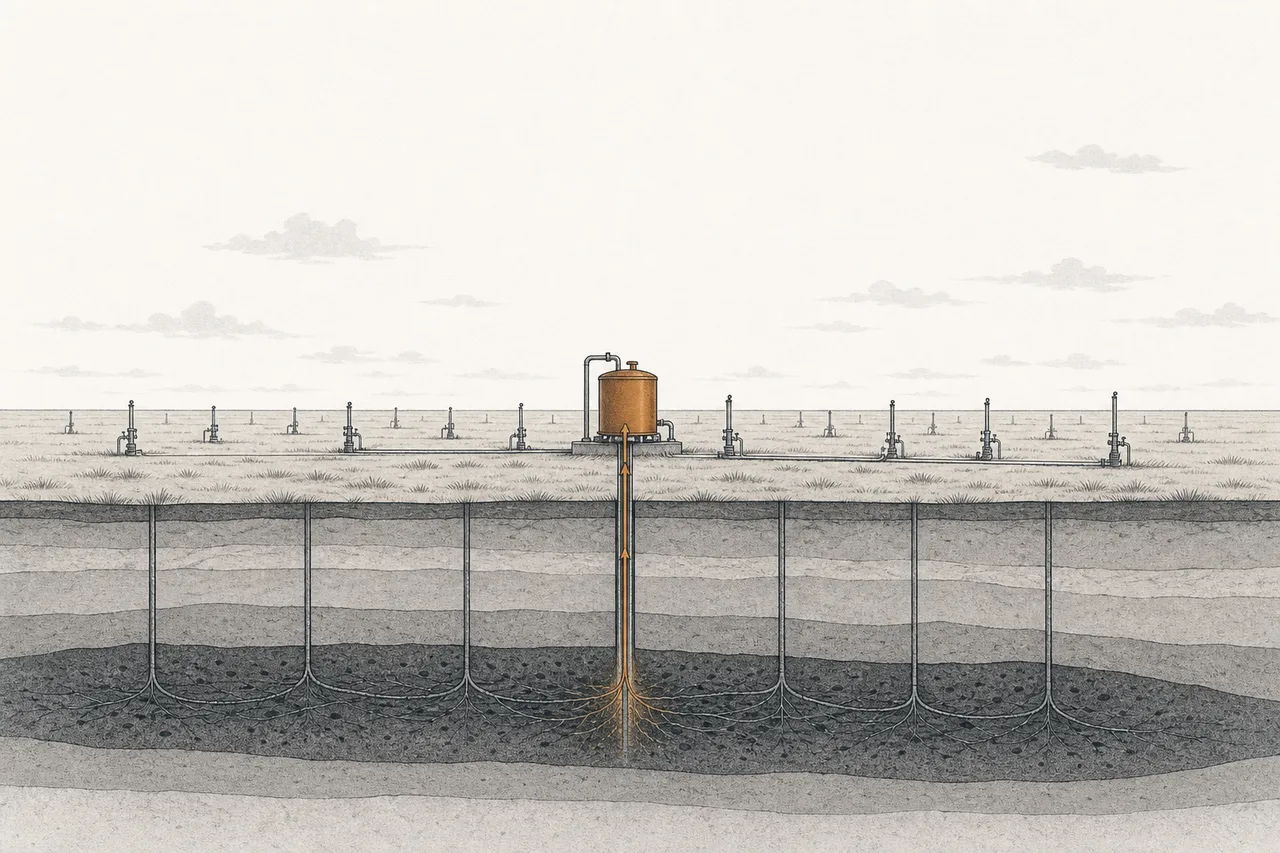
The core thing to remember is that ISR is the lowest-cost mining method — no blasting rock or hauling vast amounts of earth — which is why Kazakhstan dominates the world uranium market (Kazatomprom produces 100% this way, at costs so low rivals struggle to compete). The step-by-step mechanics of underground leaching, and how it compares to high-grade mines like Athabasca, we dig into in the child lesson → Uranium Mining
But even the cheapest method isn't a tap you can switch on and off easily — at the end of 2025, Kazatomprom announced a cut to its 2026 production target, partly because of a shortage of the sulfuric acid used for leaching. The number-one player cutting its own output while prices are climbing is the most straightforward "shortage" signal of this cycle.
05How it connects in the ecosystem
Uranium is the very "top of the stream" of nuclear energy, so it connects up, down, and sideways:
- A sibling within Critical Materials: this node sits right next to copper, lithium, and rare earths — all strategic minerals whose demand surges from the energy transition. But uranium is different in that it's a "fuel," not a building material
- Connects to Conversion · Enrichment & the Fuel Chain: the yellowcake that's mined has to be "converted" and "enriched" before it goes into a reactor — a step where Russia controls nearly half the world and which has become a geopolitical game (we tell the full story in that lesson) — for reactor-side demand, see Nuclear Fuel Cycle (the energy-side sibling)
- Feeds nuclear power plants and SMRs directly: every newly built reactor needs uranium throughout its 60–80-year operating life — orders locked in decades ahead
- The endpoint is AI and electricity demand: everything started heating up because AI and explosive growth in power use are pushing the world to need more firm power
06Where it stands now — the real players
The 2026 picture is "a cyclical upswing, plus a rush to build new mines." Both spot and long-term contract prices are hitting multi-year highs (the long-term contract price moved from $80 to ~$86 a pound in early 2026, the highest in ~18 years). And crucially, over 70% of demand after 2027 still hasn't been contracted for — the highest in 30 years, meaning there's a huge mass of pent-up buying waiting to come back into the market.
The players fall into three groups: giant producers (Kazatomprom, Cameco) that actually mine and set the price · next-generation projects (NexGen, Denison) that are about to start producing and are a bet on future prices · and funds that hold physical ore (Sprott) that pull supply out of the market until they themselves become a force pushing prices up.
The last group is especially interesting. Sprott Physical Uranium Trust (SPUT) is a fund that takes investors' money to buy "physical uranium" and stores it in a vault. By the end of 2025 it held about 72 million pounds, and in 2025 alone it bought 8.67 million pounds — nearly 3 times the year before. When someone buys ore out of the market and just sits on it, the amount circulating gets even tighter, pushing the spot price up directly.
07The road ahead & risks
There are three lines to watch going forward.
The first is the wave of new mines that's coming. High prices are waking up projects that slept for a decade. Rook I, Wheeler River, and restart mines around the world will come on stream over the back half of this decade. The question is "in time?" — because demand is growing fast too. If the mines arrive later than expected, the shortage deepens and prices climb even higher.
The second is demand from China and SMRs. China builds reactors faster than anyone in the world (approving 8–10 a year), and new reactor types like SMRs, if built in large numbers, add another layer of fuel demand. This is the long-term tailwind that makes many believe "this time is different."
The third is the one to watch most closely — the price cycle. Uranium is a commodity with a long history of prices that "rise hard, fall hard." This upswing comes from a real shortage, but if mines around the world all reopen at once (as they always have in the past), supply can flood and the price can dive fast — and don't forget that Fukushima warned us a single nuclear accident can change the whole market.
This sector has two more risks of its own: concentration in Kazakhstan (~40% of the world from one place, with transport routes tied to Russia), which makes Western supply geopolitically fragile, and dependence on nuclear policy — the whole trend rests on the assumption that governments worldwide will keep backing nuclear. If politics flips or an accident happens, demand can vanish fast, just as it has before.
In short: uranium is the story of a mineral whose price was "dead" so long that no one was prepared — and then, out of nowhere, AI and nuclear's comeback woke up demand faster than mines could keep up. Understanding "why supply is slow, and how long it stays slow" is understanding why a once-worthless metal came roaring back as one of the hottest strategic minerals of the era.