Megatrend · Critical Materials
You can mine uranium yourself — but the tap that makes it "ignite" is in Russia's hands
Uranium dug out of the ground still can't start a reaction in a reactor. It has to pass through midstream plants that "convert" it and then "enrich" it before it becomes fuel — and that's exactly where the West is most fragile, because Russia alone controls nearly half the world's enrichment capacity. However many tons of ore the U.S. and Europe have, if no one can turn it into fuel, it's like having crude oil but no refinery. This lesson is the story of a strategic bottleneck that has become the hottest flashpoint in nuclear energy security.
01What it is — the midstream of nuclear fuel
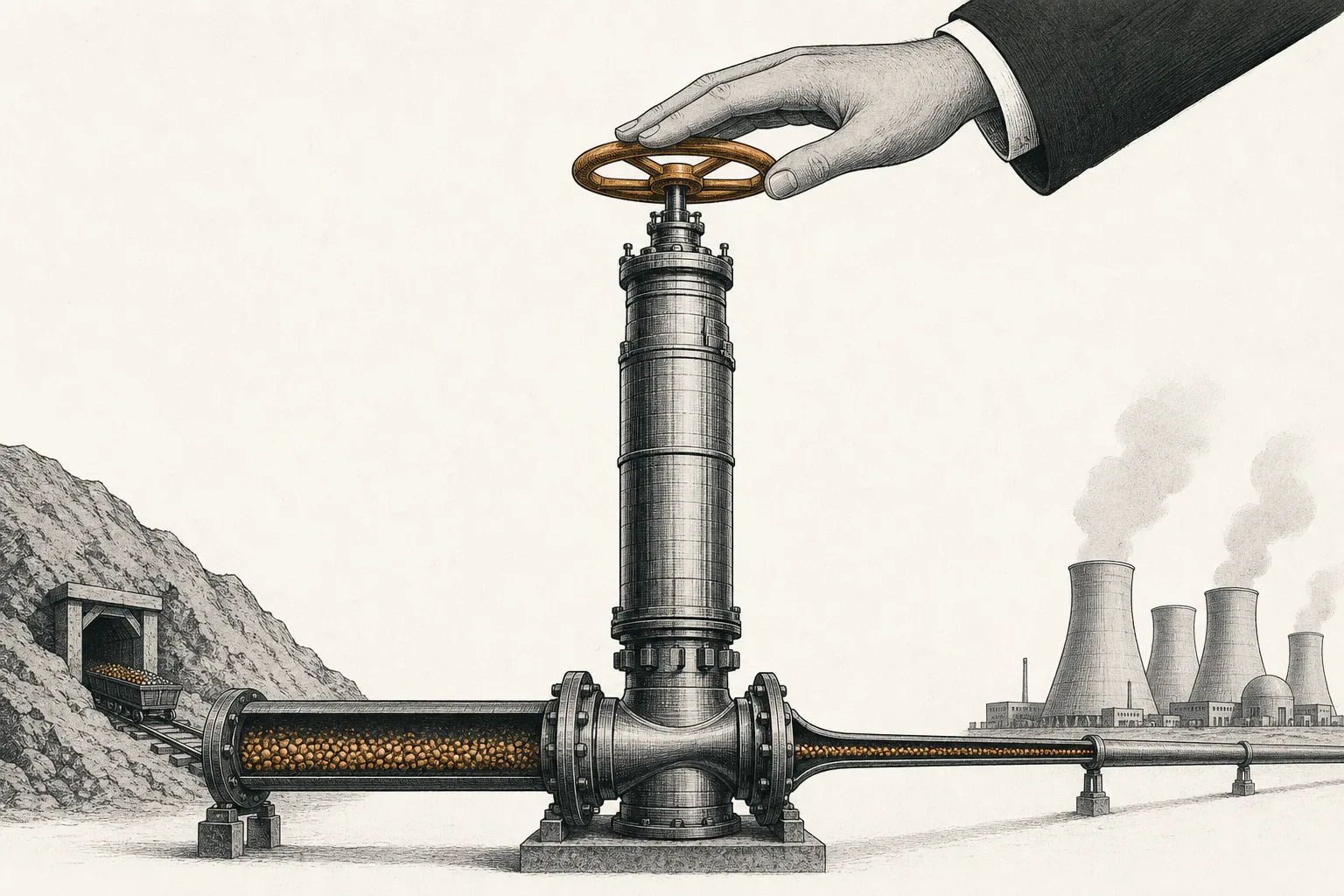
Picture oil for a moment. Crude pumped out of the ground can't fuel your car yet — it has to go to a refinery first. Nuclear fuel works exactly the same way. The uranium you mine comes up as a yellow powder (yellowcake, or U₃O₈) and can't go straight into a reactor. It has to pass through a midstream "refinery" first. This node is the story of that refinery — the step that sits right in the middle between the mine and the reactor.
This midstream has three steps chained together: (1) conversion turns the U₃O₈ powder into a gas called UF₆ so the next machine can work with it · (2) enrichment raises the share of the "ignitable" isotope in that gas · (3) fuel fabrication presses the enriched uranium into small pellets, loaded into fuel rods ready for the reactor.
On the megatrend map, this node is a branch under Uranium & Nuclear Fuel Cycle within the larger trend Critical Materials & Supply Chain. If its sibling on the other side — Uranium Mining — tells the story of "ore" as a commodity whose price swings, this lesson tells a completely different angle: the "security of the raw material". Whoever controls the technology to turn ore into fuel is the one who really holds the tap — and that tap is concentrated in just a few hands.
SWU (Separative Work Unit) = the unit that measures the "isotope-separation work" used in enrichment. Enrichment is priced in dollars per SWU · LEU (Low-Enriched Uranium) = uranium enriched to about 3–5%, what ordinary reactors use · HALEU (High-Assay LEU) = enriched more intensely (~5–20%), what newer reactors like SMRs need — and until recently, only Russia could produce it commercially.
02Why it matters — Russia holds a tap the West can't do without
There's a paradox here that people outside the industry often miss — the U.S. has uranium mines, and Canada and Australia can mine plenty too. But when it comes to "turning ore into fuel," the West can barely do it on its own. Over decades of cheap uranium and no new reactors being built, the West let its own enrichment capacity "wither" away, because Russia sold cheaper. The result: the world woke up to find the most important tap in the hands of a geopolitical rival.
The numbers spell it out. Russia (through Rosatom) controls about 44–46% of the world's enrichment capacity — nearly half the planet from one country. In the conversion step it controls another ~20%. The whole world has just 5 conversion plants actually running (one each in Canada, China, France, Russia, and the U.S.). Meanwhile the U.S. itself imports about 35% of the enriched uranium it needs from Russia, and roughly one in four American reactors runs on fuel from a Russian company (TENEX).
What turned this into a real crisis was the war in Ukraine. After Russia invaded Ukraine in early 2022, the spot-market price of "enrichment work" (SWU) shot up more than 167% — from around ~$56 per SWU to ~$185 per SWU by the end of 2024. The conversion (UF₆) price also surged to a record high of about $64–66 per kilogram of uranium on the spot market. All of it reflects one single panic — the West wants to stop depending on Russia, but doesn't yet have its own capacity to fall back on.
03What it is — from yellow powder to fuel
The real heart of this lesson is understanding "why the enrichment step is so hard" that it leaves the whole world depending on a handful of players. Let's follow one lump of uranium from the moment it leaves the mine until it becomes fuel.
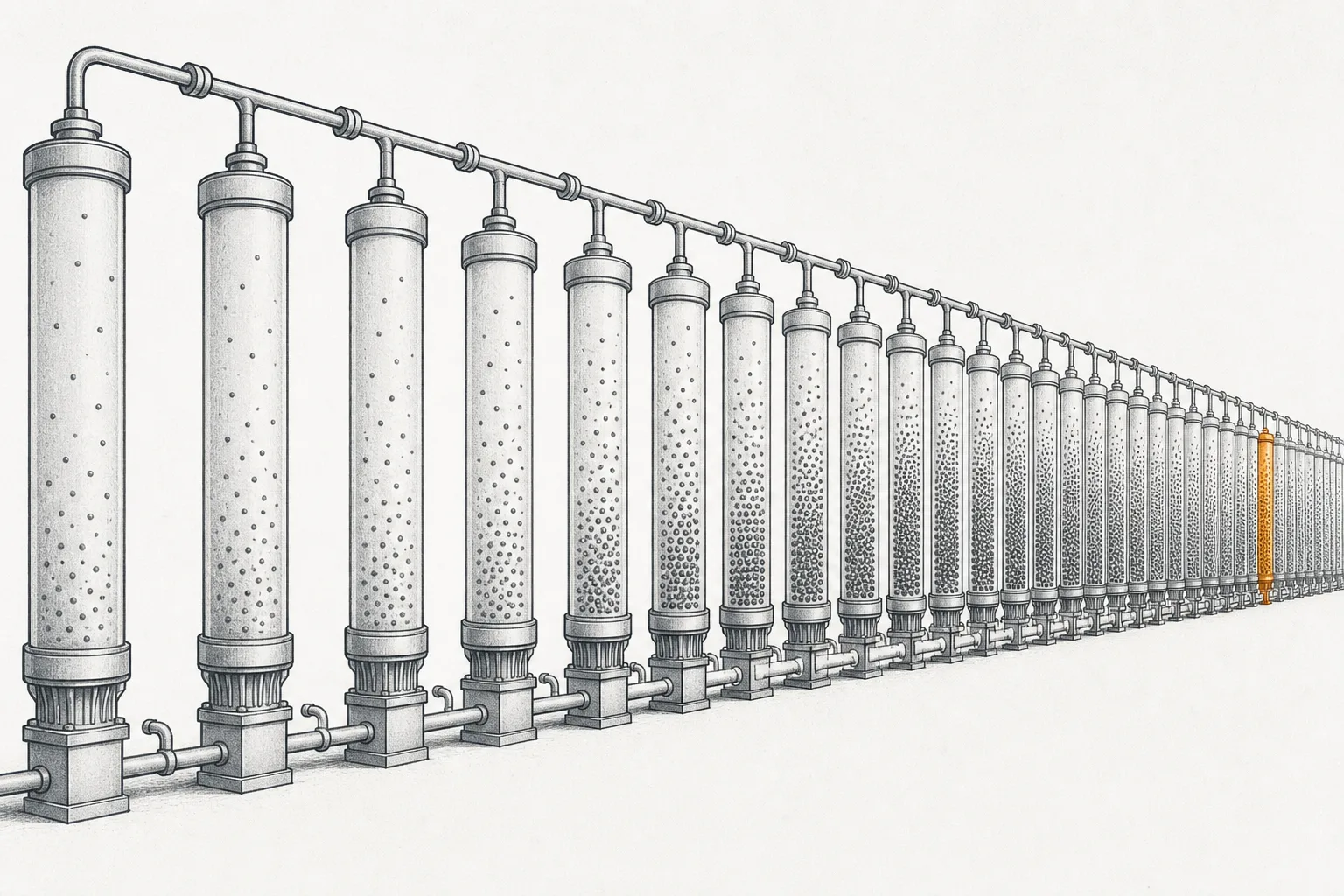
The hardest and most important step is enrichment. Here's why. Natural uranium has only about 0.7% of the "ignitable" isotope (U-235); the rest is U-238, which doesn't ignite. An ordinary reactor needs U-235 at about 3–5%, so you have to gradually "sort" the U-235 atoms to make them denser. The method is the centrifuge — spinning UF₆ gas at extremely high speed. The heavier atoms (U-238) get flung to the outside, while the lighter ones (U-235) stay in the middle.
But a single machine sorts very little, so you have to chain thousands of them into a "cascade" — each one passing slightly more concentrated gas to the next, over and over, until you reach the target concentration. The technology demands extreme engineering precision (the machines spin faster than sound and have to run 24 hours a day for years) and is also a tightly controlled "sensitive technology," because if you keep spinning you can get weapons-grade uranium. Those two reasons together leave only a handful of countries in the world able to do it.
04How it connects in the ecosystem
The midstream of nuclear fuel is a "bottleneck" that links both the upstream and the downstream. So it connects up, down, and sideways:
- Takes its raw material from Uranium Mining: the yellowcake (U₃O₈) the mines produce is this node's "raw material going into the refinery" — if the mining side is about price and volume, this side is about technology and who controls the tap. The two link into a single chain
- For HALEU/SMR demand, see the energy side of Conversion & Enrichment (HALEU): the same angle, in the trend Energy Transition & Power Demand, is told from the "demand" side — newer reactors like SMRs and advanced reactors need large amounts of HALEU. This lesson tells it from the "raw-material security" side (who can produce it once Russia is cut out). Two angles that fit together
- It's also a matter of national strategic minerals: enrichment capacity is a "security asset" the state has to step in and prop up — just like rare earths and other strategic materials in Defense & Geopolitical Fragmentation that have become bargaining chips between great powers
- At the end of the line it feeds nuclear power plants and AI: every reactor built anew to power AI data centers needs fuel that's passed through this midstream for its entire 60–80-year life — if this bottleneck can't be solved, the whole reactor-building plan stalls
05Where things stand now — the real players (2025–2026)
The picture right now is "the West cuts the bridge with Russia and races to build its own capacity." The big turning point is the Prohibiting Russian Uranium Imports Act, which the U.S. signed in May 2024 and which took effect on August 11, 2024 — banning imports of enriched uranium from Russia (running through 2040, with waivers available only until early 2028). The law also unlocked $2.7 billion in federal funding to build a domestic fuel supply chain. Russia retaliated by banning exports of enriched uranium to the U.S. in November 2024 — a game of cutting each other's taps had truly begun.
Centrus Energy — the only company in the U.S. that can run commercial centrifuges — has become the spearhead. In mid-2025 it produced and delivered America's first ~900 kilograms of HALEU to the Department of Energy (DOE), and renewed a Phase 3 contract worth about $110 million through mid-2026. This is the first time the West has produced HALEU commercially on its own, after only Russia could do it.
Europe is racing just as hard. Urenco (a British-German-Dutch capital group), the West's largest enricher, began installing new cascades at its New Mexico plant in mid-2025 and announced plans to expand U.S. capacity by about 50%. France's Orano is preparing to build a new enrichment plant at Oak Ridge, Tennessee, with permitted capacity as high as ~7.4 million SWU/year. Overall the West aims to add a combined 2.5 million SWU by 2030.
06The future — the West builds its own capacity to cut Russia dependence
The direction ahead is clear but not easy. All three lines say the same thing — the West has to "take back the tap" from Russia.
The first line is a wave of new enrichment plants. Urenco, Orano, and Centrus are all expanding or building plants in the U.S. at once. This is a fairly certain block of demand, because there's both a legal mandate (the ban on Russian imports) and state money ($2.7 billion) behind it. But the wall is time — a new enrichment plant takes years to reach full capacity (Orano expects to start production only in the 2030s). During this transition, the West still has to rely on existing stockpiles and waivers.
The second line is the race over HALEU. New-generation reactors (SMRs and advanced reactors) need more concentrated fuel, which so far almost no one outside Russia can produce commercially. Whoever builds Western HALEU capacity first wins a whole new market (we tell the demand side in full in Conversion & Enrichment — HALEU) — Centrus is in the lead, while challenger ASP Isotopes is betting on laser enrichment that could be cheaper and faster.
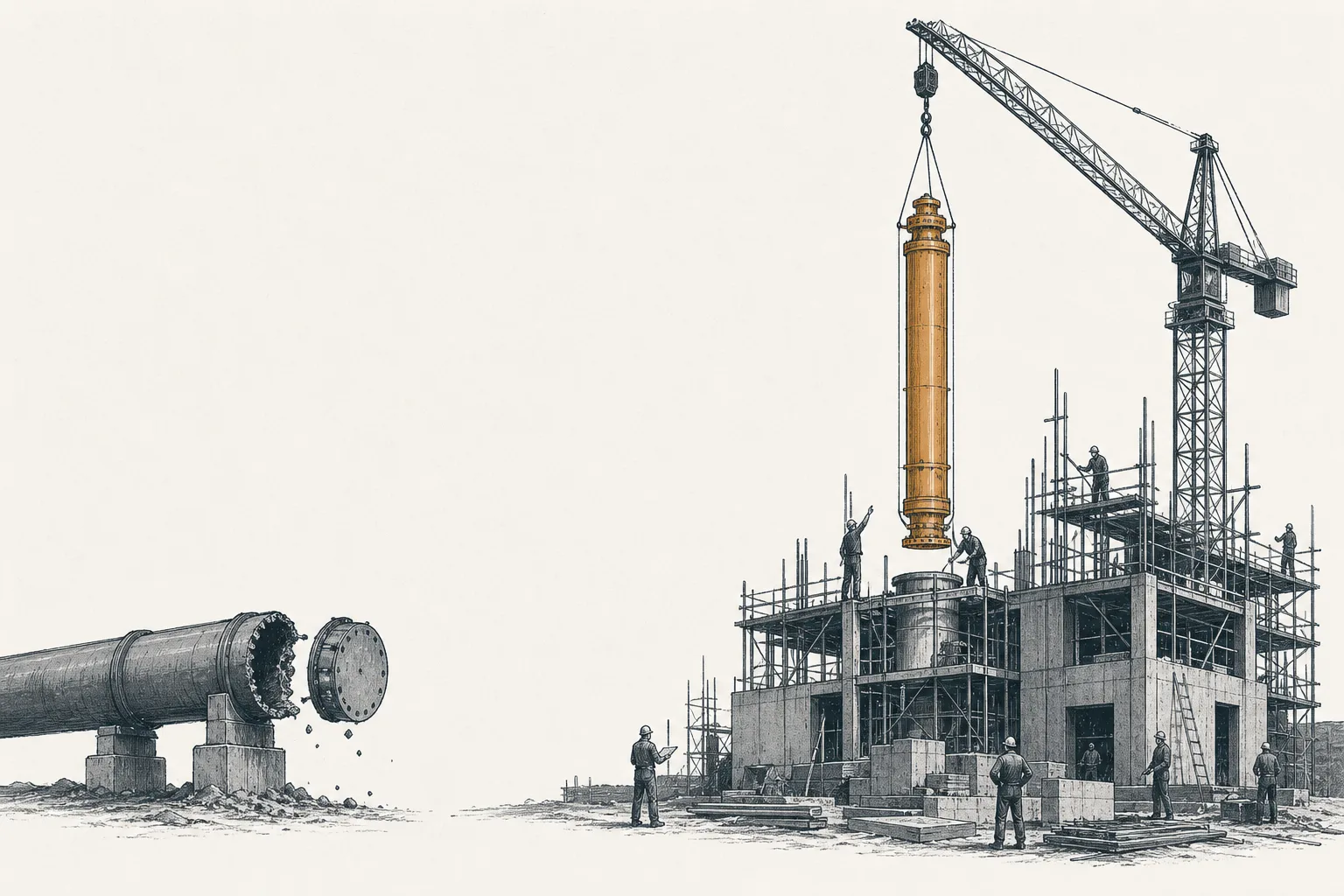
The third line is a split into two worlds, just like what happened in the chip supply chain. The bans on both sides are pushing the nuclear-fuel market to break into two systems — the West building its own capacity in parallel with the Russia/China side. In the short term this means higher costs and tight supply, but in the long term it's the security cost the West is willing to pay so a rival never controls the tap again.
07Challenges & risks
The first risk is that dependence on Russia can't be cut in the short term. Even with the ban in place, the West still has to request "waivers" to import from Russia during the transition, because its own capacity isn't enough yet. As long as the new plants aren't running at full capacity, the tap stays in the rival's hands — and if Russia cuts first (as it began to do in late 2024), the West could face an immediate fuel crisis.
The second risk is capital and time. Building a new enrichment plant costs billions of dollars and takes years, and the new capacity won't come fully online until the 2030s. In the meantime, companies have to carry huge costs before revenue arrives, relying mainly on long-term contracts plus state subsidies as a backstop. If politics flips or funding shrinks, the whole plan is at risk of stalling.
The third risk is concentration and the technology barrier. Centrifuge technology is sensitive know-how that's hard to copy and tightly controlled. The result is very few players (Centrus, Urenco, Orano + Russia/China) — good for those inside the circle because the barrier is high, but it also means the market is fragile. If any one plant runs into trouble, the whole system shakes at once. And new-technology challengers (like lasers) still haven't proven they can really work at industrial scale.
In short: this node is the midstream refinery that turns uranium ore into real fuel — the hardest step, with the fewest players, and the one the West's nuclear energy security hangs on. Understanding "why controlling the tap (enrichment) matters more than having the ore" is understanding why a story that looks like a boring technical detail has become one of the hottest strategic battlegrounds of the era.