Megatrend · Energy
One wind, two stories from completely different worlds
Wind has grown into one of the world's largest sources of renewable electricity — cumulative capacity hit 1,299 gigawatts in 2025. But look closely and it's really two completely different businesses: onshore — cheap, stable, and already profitable — and offshore, where the turbines are bigger and the wind is stronger, but which is mired in a cost crisis, with projects canceled and manufacturers posting billion-dollar losses. This lesson walks through how wind becomes electricity, why the two sides have split so far apart, and who's winning and who's hurting right now.
01What it is (and why we split it in two)
Wind is a sub-theme under the Energy Transition & Power Demand megatrend — the 'generation' side of a world trying to supply low-carbon electricity for demand surging from AI and the electrification of everything. The idea is the simplest in all of clean energy: take wind that's already blowing, for free, spin some blades, and turn it into electricity.
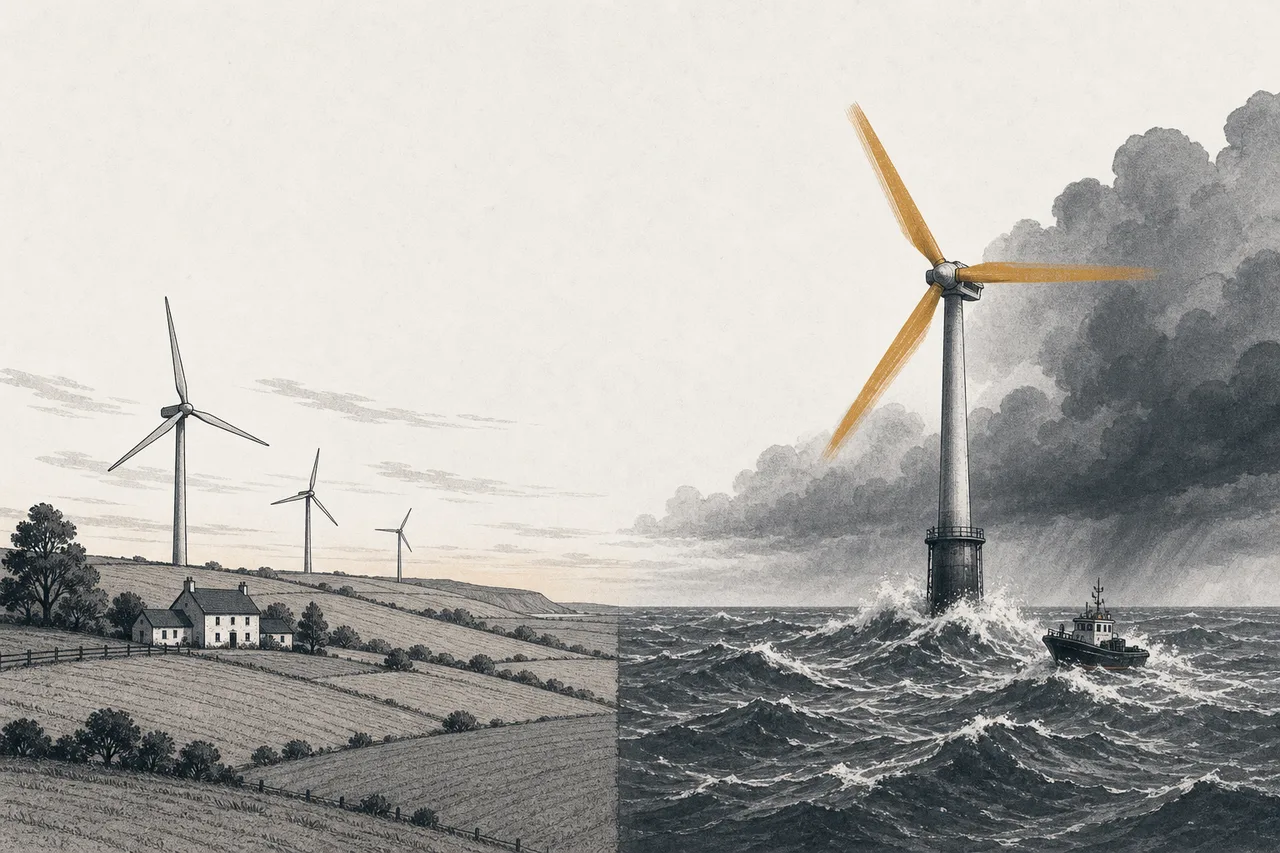
But the beginner's trap is thinking 'wind is just wind.' In reality this business splits into two completely different worlds:
- Onshore: turbines on land — on hills, in fields, in deserts. This is the industry's 'workhorse': mature technology, easier to install, far cheaper, and genuinely profitable already. It makes up nearly all of the world's wind capacity
- Offshore: giant turbines planted out at sea. The wind there is stronger and steadier, so each turbine generates more — but building at sea is many times more expensive and harder. And this is the side hit by crisis in 2024–2026
This node's definition packs the whole tension into one line: 'turbine makers and project developers across onshore and offshore wind — onshore is recovering, offshore is still in the red.' This entire lesson is that one sentence, unpacked.
There are two kinds of player in wind you have to keep straight · OEM (Original Equipment Manufacturer) = the company that 'makes the turbine' and sells the hardware — Vestas, Goldwind, GE Vernova · Developer = the company that 'develops and owns the wind farm' — it buys turbines, plants them, and sells the power — Orsted, Iberdrola, NextEra. These two face very different risks — OEMs compete on cost and quality, while developers carry the risk of interest rates and power-purchase prices.
02Why it matters to the world
Wind isn't experimental technology anymore — it's real infrastructure powering hundreds of millions of people right now. By the end of 2025, cumulative wind capacity worldwide hit 1,299 gigawatts, and that single year set a new installation record — onshore added 155 GW (up 42%), plus another 9.3 GW of offshore.
But the reason wind matters most economically is price. Onshore wind has become one of the cheapest sources of electricity in the world — its cost per unit (LCOE) runs about $25–50 per megawatt-hour, dropping to $25 in China and India, cheaper than new coal or gas plants in many markets. That's why it can grow on its own now, without leaning on subsidies anymore.
And here's where the two sides clearly diverge — offshore wind costs roughly 2–3 times more ($70–120/MWh for fixed-bottom turbines in shallow water, and floating designs cost even more). This cost gap is the root of the entire story in the chapters that follow.
03How a wind turbine works
The heart of a wind turbine is converting 'the kinetic energy of wind' into 'electrical energy' — a process that's straightforward but has to be very precise.
First, wind flows past the blades — and here's where a lot of people get it wrong. The blades aren't 'pushed' around by the wind; they work like an airplane wing: wind flowing over the curved surface of the blade creates 'lift' that pulls it around. That's why the longer the blade, the more wind area it sweeps, and the more power it makes — Vestas's new offshore turbine (V236-15MW) has a rotor diameter of about 225 meters, a single blade longer than a football pitch.
Second, the spinning blades turn a 'low-speed shaft' (about 10–20 rpm — very slow), but the generator needs a much higher speed, so a gearbox steps it up into a 'high-speed shaft' before it reaches the generator — and it's this gearbox and the main bearing that are the most fragile parts. When they fail, it's a big deal (hold that thought — it's the root of Siemens Gamesa's crisis in chapter 5).
Capacity factor = the share of power a turbine actually generates versus if it ran flat-out all the time · onshore wind runs around 25–35%, offshore wind 35–50%+, because the sea has stronger, steadier wind — this is offshore's main advantage · Direct-drive = a newer design that 'cuts out the gearbox,' connecting the blades straight to the generator. It removes the parts most likely to fail, and many newer offshore turbines use this approach.
04Where it sits in the energy world
Wind doesn't stand alone — it's one piece of a bigger energy puzzle, and its weaknesses are offset by its neighbors in the same megatrend.
The classic weakness of wind (and solar) is 'intermittency' — wind doesn't blow all the time; some days it's strong, some days it's dead calm. But the power system has to deliver electricity around the clock. That's why wind has to team up with:
- Energy Storage & Grid Flexibility: grid-scale batteries that store power when the wind is strong and release it when it dies down — the partner that makes wind more 'dependable'
- Grid, Transmission & Power Equipment: the best wind is usually far from cities (out at sea, out in the fields), so you need transmission lines and transformers to carry the power into town — and 'not enough wires' is the single biggest bottleneck for clean energy right now
- Critical Materials & Supply Chain: direct-drive generators need permanent magnets made from rare earths, and China controls almost the entire supply chain — a geopolitical risk hidden inside every turbine
On the other side, what's 'pulling up' demand for wind is Artificial Intelligence — AI data centers are enormously power-hungry, and tech companies want low-carbon electricity to meet their climate goals. So wind (especially cheap, fast-to-build onshore) has become one of the main options signing long-term power-purchase agreements (PPAs) with hyperscalers. On the energy map, wind sits right in the middle between 'electricity demand surging from AI' and 'the constraints of transmission and raw materials.'
05Where it stands now + who the players are
2024–2026 is the period when wind's 'two stories' have split more clearly than at any point in history. One side is recovering; the other is badly hurt.
Onshore: quietly making money
Onshore wind has come back to solid profitability. Vestas, Denmark's big turbine maker, closed 2025 with record revenue of €18.8 billion and an EBIT margin recovering to 5.7% (from 4.9% the year before) — driven mainly by 'improved onshore deliveries and lower warranty costs.' In plain terms: land turbines are selling well, breaking down less, and profits are back.
Offshore: a real crisis
A completely different world out at sea. Orsted, the world's number-one offshore wind farm developer, took the full brunt of soaring material costs, high interest rates, and a snarled supply chain — forcing it to cancel a New Jersey project and write down assets (impairment) of about DKK 28.4 billion (~$4 billion) and to raise emergency capital through a rights issue of DKK 60 billion, with the Danish government, its largest shareholder, having to chip in. To make matters worse, its Revolution Wind project in the US was hit with a stop-work order, costing nearly $1.5 million a day while halted.
On the manufacturer side, Siemens Gamesa (under Siemens Energy) ran into quality problems that became a cautionary tale for the whole industry — its 4.X and 5.X onshore turbines had issues with the blades and main bearings (the parts we flagged in chapter 3), to the point that the CEO admitted outright the company 'sold turbines it hadn't tested enough.' Repair and remediation costs were estimated as high as €1.6 billion-plus, wiping out the entire group's profit.
Even US-based GE Vernova, whose gas and grid businesses are booming, is still hurting on wind — in 2025 its wind business pulled in $7.7 billion in orders but still posted an EBITDA loss of about $0.6 billion (margin –6.6%), dragged down mainly by offshore. On top of that, the US government suspended permits for all large offshore wind projects in late 2025 — a policy headwind hitting the whole industry.
And then China took the board
While Europe and the US wrestled with costs and policy, China pushed ahead quietly until it became the market leader. In 2025, Chinese turbine makers took the world's top 1–6 spots for the first time and captured more than 78% of all new installed capacity — Goldwind installed 29.3 GW to claim the world title, with profit surging more than 170%, while Vestas, long a fixture in the top 5, fell to 7th for the first time since 2013.
06The road ahead
The first direction is that onshore + repowering will lead for a long time. Onshore wind is cheap and already proven. Beyond new builds, there's a wave of 'repowering' — swapping out old turbines installed 15–20 years ago for new ones that generate several times more on the same towers. For OEMs like Vestas and GE Vernova, that's steady, high-margin demand.
The second direction is that offshore will 'reset' before it grows again. GWEC expects offshore wind capacity to grow about 24% a year between 2026 and 2030 and to reach 420 GW by 2035 — but to get there, the industry has to pass through a painful stretch of re-signing contracts at more realistic prices (many old contracts were signed in low-cost times, then slammed by inflation). China remains the spearhead — in 2025 it led the world in offshore installations for the eighth year running.
The third direction is that turbines keep getting bigger. From today's 15 MW machines, the industry is eyeing 20 MW+ models. Bigger means more power per turbine and a lower cost per unit — but it also raises the challenges of transport, installation, and reliability (the Siemens Gamesa lesson warns that 'growing too fast without enough testing' is a very expensive trap).
07Challenges & risks
Wind's appeal comes with risks you have to understand fully — it's not just 'clean energy has to grow.'
The first risk is the offshore cost crisis. Offshore wind farms sink enormous capital up front, then collect it back gradually by selling power over 20–30 years. That structure 'loses badly to interest rates' — when rates spike and material costs inflate, a project that once paid off flips straight into a loss (the Orsted case). This is a structural risk, not just market timing.
The second risk is supply chain and quality. New turbines keep getting bigger and more complex, and rushing a new model out without enough testing can blow up into massive repair costs later (the Siemens Gamesa lesson). On top of that, relying on Chinese rare earths for the magnets in direct-drive units is a geopolitical fragility.
The third risk is policy and politics. Wind, especially offshore, depends on government permits and power-purchase contracts. When the political winds shift (for example, the US suspending offshore wind permits in late 2025), multi-billion-dollar projects can stall overnight.
And the last one, built into wind itself, is the intermittency of wind. As long as there's no cheap enough storage, wind still needs 'backup power' to lean on — which ties wind's true value inseparably to progress in Energy Storage and the Grid.