Megatrend · Energy Transition & Power Demand
The machine that time-shifts sunlight: store it at noon, release it at dusk
Sunlight floods in at noon, but people switch on their lights and air conditioning at dusk — after the sun has already dropped below the horizon. That gap is exactly why clean energy can't be counted on — and why "grid-scale batteries" have become the fastest-growing part of the power grid in the world right now. They're the missing piece that finally makes solar and wind usable for real.
01What is it?
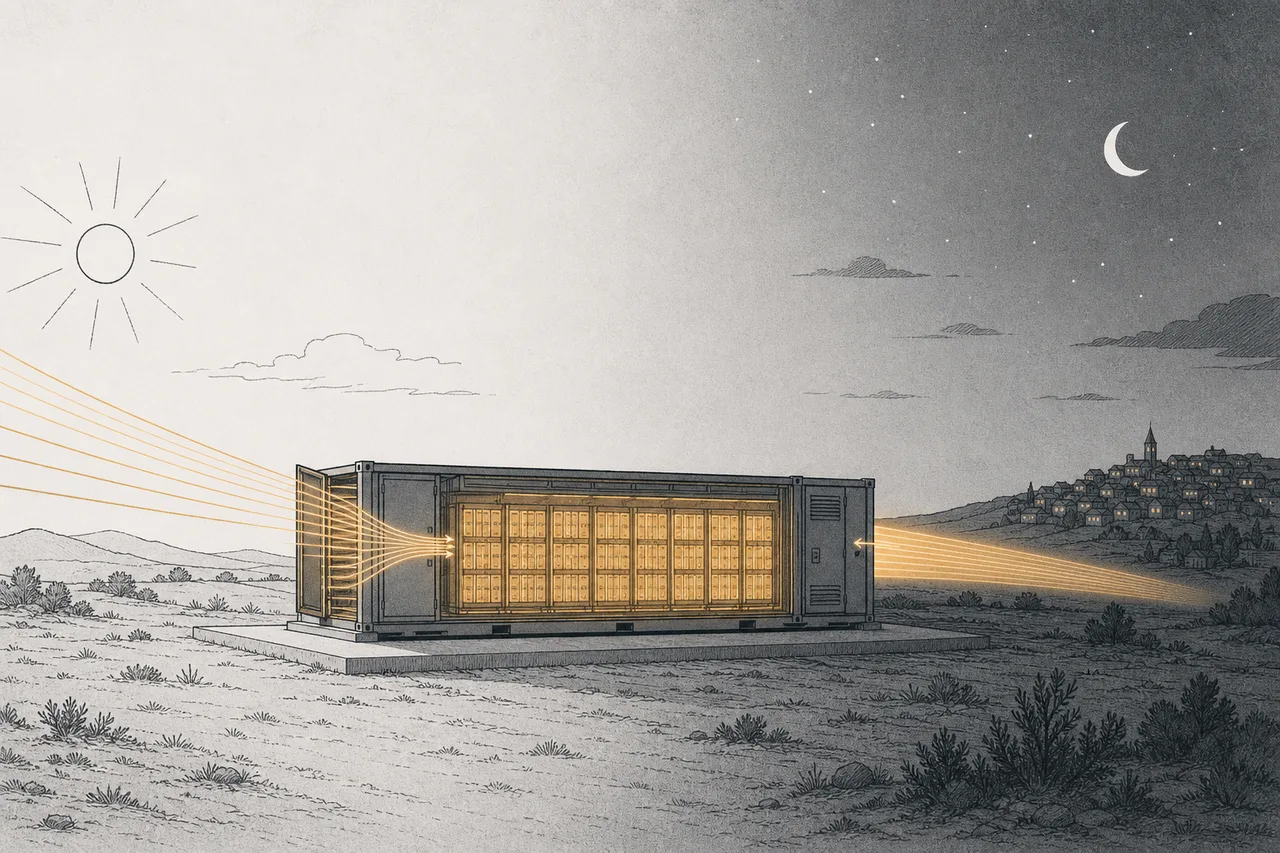
Picture a problem that sounds silly but is very real: sunlight is free and overflowing at noon — the very hours when most people are out at work, away from home. But electricity demand peaks from 6pm to 9pm, when everyone gets home, turns on the AC, switches on the lights, and cooks dinner — which is exactly when the sun has already set. The wind doesn't blow on our schedule either. So clean energy has one big weakness: it makes power at the "wrong time" from when we use it.
This node is the answer to that gap — grid-scale energy storage, or to be precise, giant batteries wired straight into the power grid. They charge on cheap (and usually surplus) power during the day, then push it back onto the grid in the evening, when power is expensive and scarce. These aren't the batteries in your phone or your EV (that's a different node) — they're "battery containers" laid out in big fields next to power plants or substations.
BESS (Battery Energy Storage System) = the grid-scale battery system we're talking about all lesson · batteries are measured in two different units: power (MW) = how hard it can push power out "in that moment," and energy (MWh) = how many hours it can store. Most lithium batteries today are the "4-hour" kind (say, 100 MW / 400 MWh) — keep these two numbers in mind, and later you'll see why "storing for several days" is a big deal.
On the megatrend map, this node sits under Energy Transition & Power Demand as the infrastructure that turns the renewable nodes beside it — especially Solar and Wind — from "comes and goes" into "something you can rely on."
02Why it matters — the thing that unlocks clean energy
Without storage, clean energy hits its own ceiling fast, because the sun and wind don't take orders. Add a lot of solar and the grid runs into a "midday glut" — more power produced than used, until you have to throw electricity away for nothing (it's called curtailment). Then at dusk it swings straight back to a shortage. Batteries plug this hole: store the part that would've been dumped, then use it when there's a shortage. That makes them a "multiplier" for all clean energy, not just one more player.
And the market knows it — money is pouring in. In 2025 the world installed roughly 92 gigawatts / 247 gigawatt-hours of new storage, up 23% from the year before, and BloombergNEF expects 2026 to jump another ~33% to 123 GW/360 GWh. Cumulative global storage capacity is projected to reach 2 terawatts (7.3 TWh) by 2035 — 8 times the 2025 level.
Another reason this "caught fire" is the price collapse. The heart of a BESS is the lithium battery cell, and its price keeps falling without pause. Lithium pack prices overall dropped to $108 per kilowatt-hour in 2025 (an all-time low), and more striking still, packs for "stationary storage" fell to just ~$70/kWh, down 45% in a single year — the cheapest segment for the first time. The cheaper the gear, the better the project economics, and the more demand explodes.
03How it works — the "duck curve" and time-shifting
To understand how batteries work, you first need to meet the most famous chart in the power business: the "duck curve". It's a graph of "net" electricity demand across the day (real demand minus the solar). When there's a lot of solar, midday sags into a deep dip — because the sun is carrying the load — then shoots up steeply at dusk when the sun is gone. The shape looks like a duck's neck and back — hence the name. The more solar you add, the deeper the duck's belly, and the worse the problem.
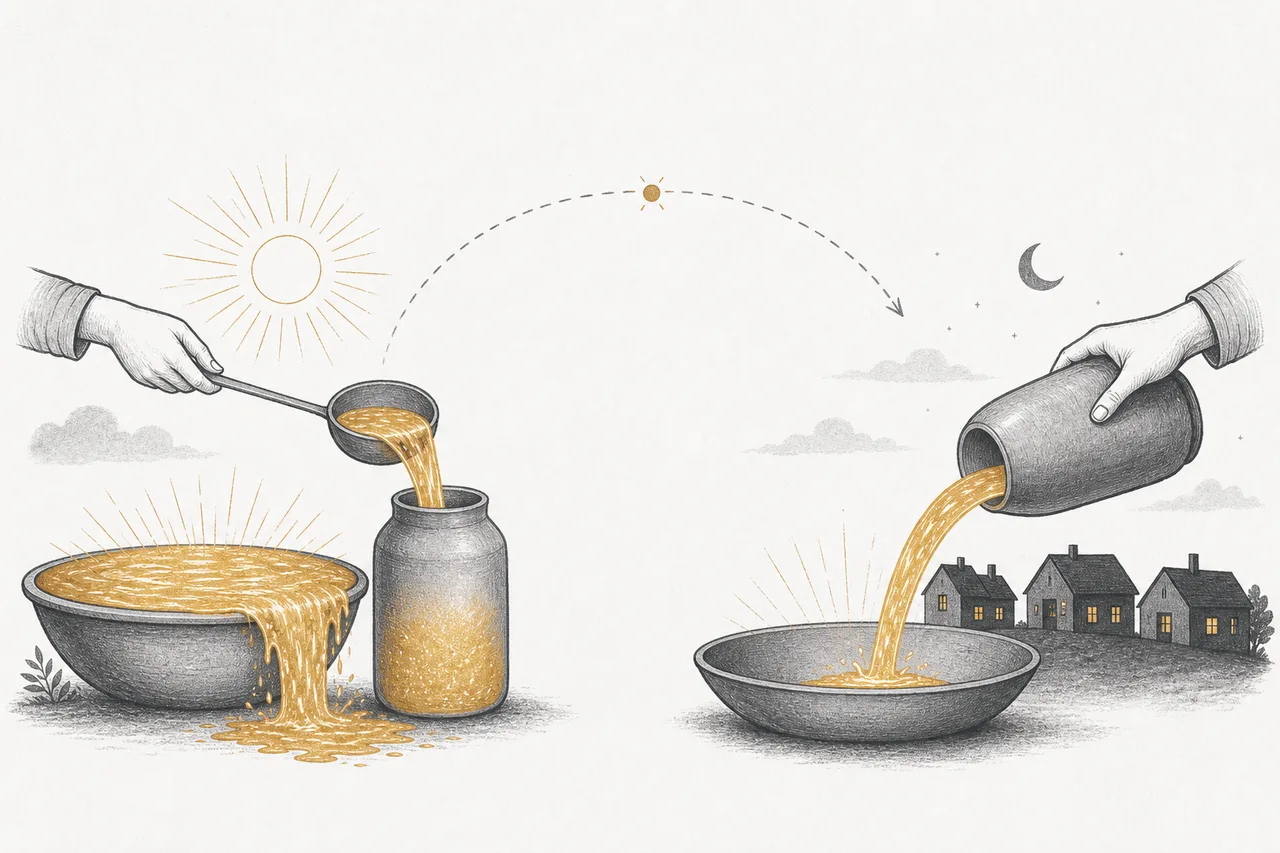
The battery's fix is dead simple: charge at the duck's belly (noon) and discharge at the duck's neck (dusk). During the day, when power is overflowing and cheap (sometimes even negative-priced), the battery soaks it up; at dusk, when it's expensive and scarce, the battery sells it back. This is called "time-shifting" energy (time-shifting), or energy arbitrage — buy cheap at one moment, sell high at another, the same day.
But time-shifting is only the headline job. Real grid batteries also sell the grid several invisible "stability services" — like frequency regulation (nudging the grid's frequency steady second by second — something big power plants do too slowly), and acting as "instant-ready backup power" when another plant trips offline suddenly. That ability to respond in a fraction of a second is what makes batteries worth more than just the price spread on electricity — it's the "revenue stacking" that makes a project pay off.
Look at the real numbers from California, the clearest test lab there is: battery power on the CAISO grid grew from just 500 megawatts in 2020 to over 13 gigawatts in early 2025 — a 25-fold jump in five years. And in the evening, batteries discharge more than 12 gigawatts at once, becoming one of the state's top power sources during the most important hours of the day.
04Where it sits in the energy system
Grid batteries are a "glue" node — they barely mean anything on their own, but they're enormously valuable because they make every node around them work better:
- Make Solar and Wind actually usable: this is the pair that can't be split — sun and wind deliver cheap power at the wrong time, and the battery lines that timing up with when we use it. Whenever a big solar farm goes up, a battery almost always comes with it.
- Feed demand from AI and data centers: AI data centers are starving for power and want it "steady and always on." Batteries absorb the peaks and guard against power spikes — making AI one of the biggest demand drivers for this node.
- Connect to Grid, Transmission & Power Equipment: batteries are the "fluid" that lets already-congested transmission lines avoid being built out — store power near where it's used instead of dragging lines in from far away.
- Depend on Critical Materials: the heart is lithium, nickel, and iron phosphate. The prices of these raw materials are the fate of battery costs (you'll meet them in the risk section).
- Back Electrification & Mobility: they use the same chemistry cells as EVs — same factories, same supply chain — just parked stationary on the grid instead of running on the road.
What's interesting is that within the same Energy Transition family, this node also "competes" with some of its siblings — Hydropower & Pumped Storage (pumping water up a hill to store it, then letting it fall to spin turbines) is energy storage too, and it stores for longer, but it needs the right terrain. Lithium batteries can go anywhere and build far faster, so the two end up filling in for each other at different timescales.
05Where it stands now + the key players
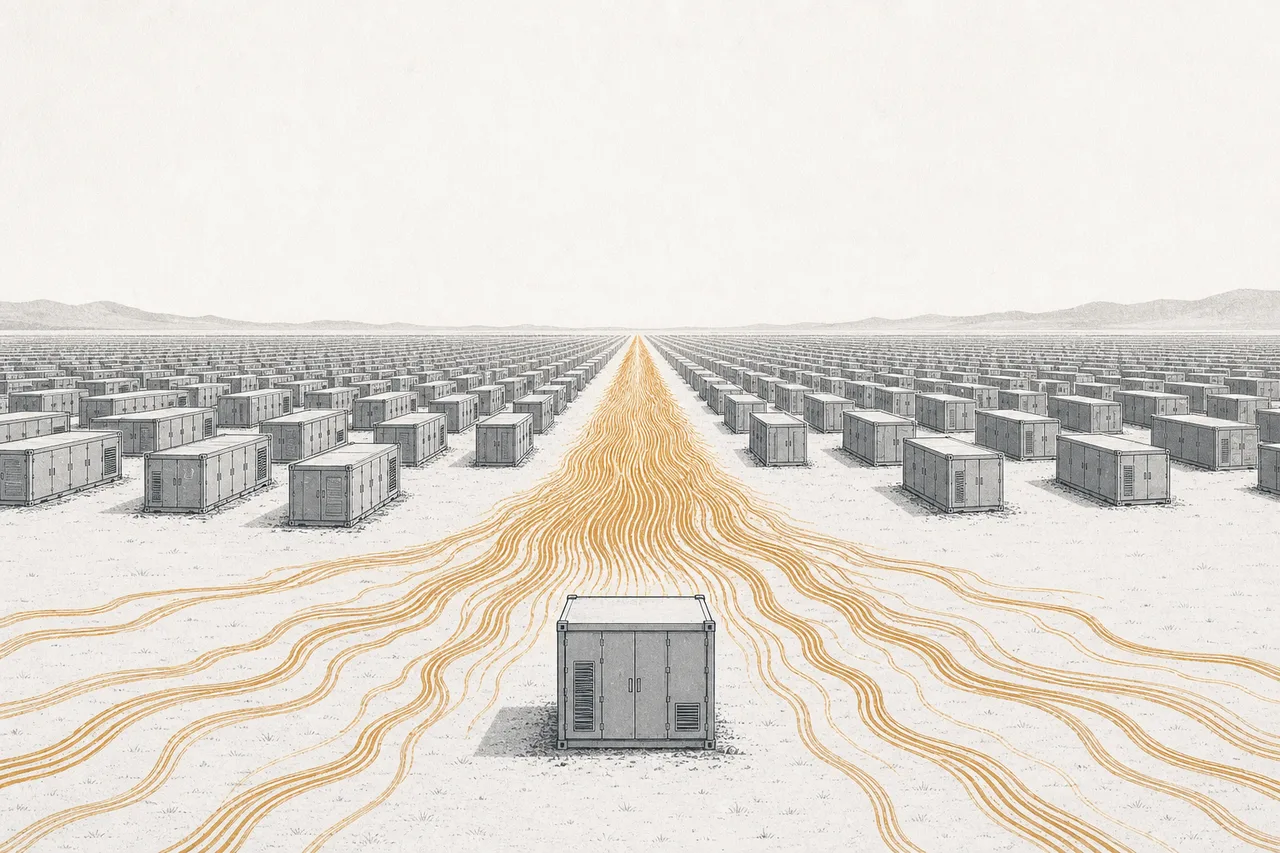
Right now the market is fully "on fire." The global BESS market is valued at roughly $50.8B in 2025, growing to ~$106B by 2030 (CAGR ~16%). But behind this growth is one fact that decides almost the whole game: China dominates the supply chain. China accounts for about two-thirds of the storage capacity installed worldwide, and nearly all the battery cells come from Chinese factories.
The winning chemistry is LFP (lithium iron phosphate) — a battery that uses iron instead of pricey nickel/cobalt, lasts longer, is harder to ignite, and is much cheaper (LFP packs average $81/kWh versus NMC at $128/kWh). For a stationary grid battery, weight doesn't matter; cheap and durable is everything — and China is the de facto home of LFP technology. That's why the Chinese players have pulled so far ahead.
Let's meet the real players in this field — there are the people who make the "cells" (the heart of the battery) and the people who make the "full systems" that take those cells and assemble, install, and write the software to control charging and discharging for maximum profit:
Notice the key pattern: this field splits cleanly into two layers — "the cell makers" (CATL, BYD, LGES), who control cost and battery chemistry, and "the system makers" (Tesla, Fluence), who control assembly, installation, and — most important of all — the software that decides when to charge and discharge for maximum profit. Long-term value may flow more and more to the software, as cells turn into a cheap commodity.
06The next frontier: storing for days (LDES)
Lithium batteries are great at "time-shifting within a single day" — store at noon, release at dusk, done in 4 hours. But they can't solve clean energy's biggest problem: "the week with no sun and no wind". If it's overcast and still for several days straight, a 4-hour battery is no help at all. Storing power for several days with lithium is also wildly expensive, because you'd have to buy a mountain of cells. This gap is what's called LDES (long-duration energy storage).
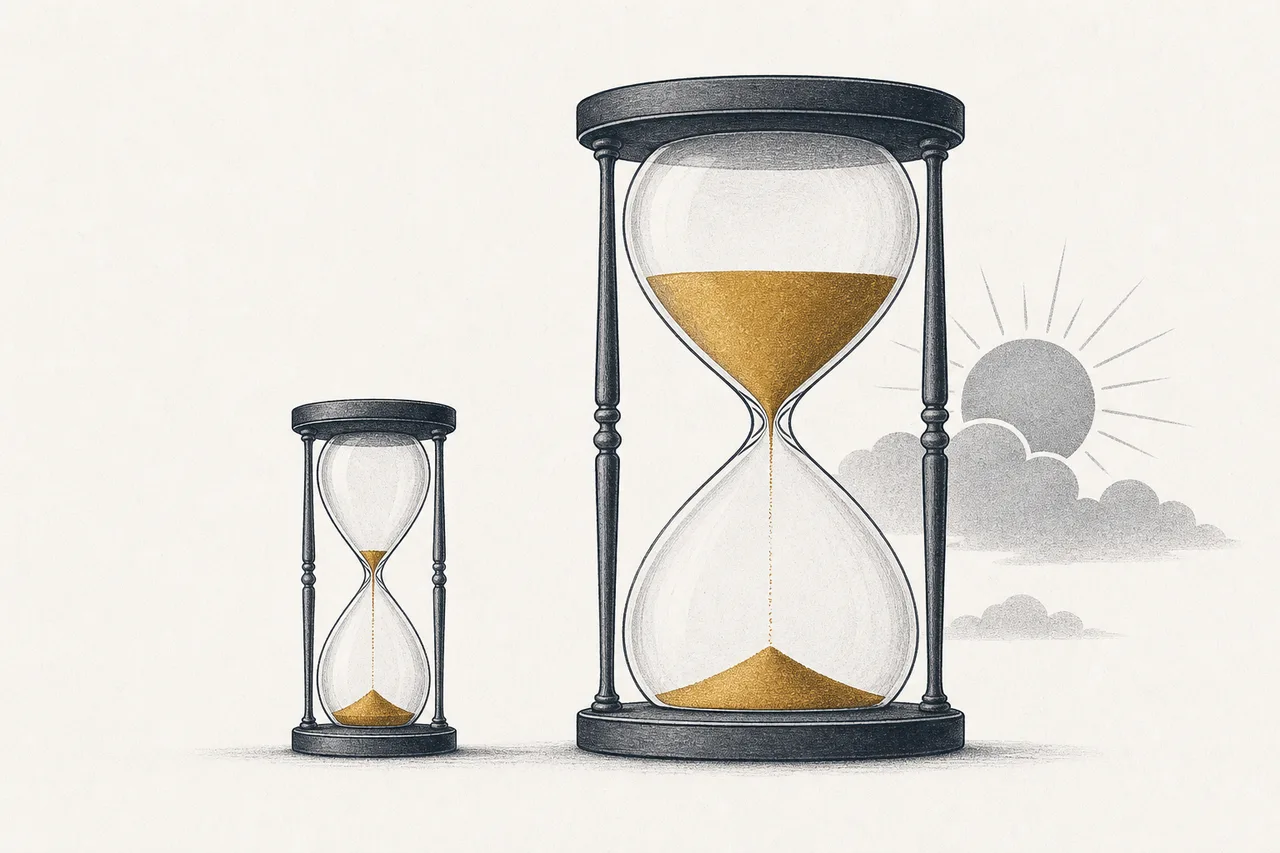
The most-talked-about hero of this frontier is the "iron-air" battery from Form Energy. The principle is to use a reversible "rust" reaction — when discharging, iron reacts with oxygen to become rust; when charging, the rust turns back into iron. The raw materials are iron, water, and air — dirt cheap and easy to find. So it can target costs as low as <$20/kWh, roughly 7–10x cheaper than lithium, and can store for up to 100 hours.
It's the share of energy you get back versus what you put in · lithium is excellent at ~85–90% (put in 100, get ~88 back), while iron-air gets only ~40–50% — losing half the energy. That sounds bad, but it doesn't matter if the energy you put in is sun/wind that was going to be dumped for free anyway. What matters more is "cost per capacity," and iron-air is vastly cheaper there. That's why these two technologies don't compete head-on — they do different jobs.
2025–2026 is a turning point for LDES: Form Energy opened a commercial plant in West Virginia (on the bones of an old steel mill) and began real shipments to big utilities like Xcel and Georgia Power. But to be straight: it's still a technology that's "unproven at large scale". The pilot projects are only just starting to come online, and the dream of rock-bottom prices still has to prove it can hold up in mass production.
07Challenges & risks
This explosively growing node has its own pitfalls to watch.
The first risk is the "lithium price cycle". Because the heart of a BESS is the lithium cell, the whole industry's cost is tied to the wildly swinging price of the mineral. Around 2022, lithium prices spiked and batteries got expensive overnight, then fell back to make packs cheapest ever in 2025. Anyone who planned a project when prices were high can get hurt — and if the mineral tightens up again someday, that beautiful cost curve could stumble.
The second risk, and the biggest geopolitically, is extreme dependence on China. With China controlling both the cells and LFP, the US hit back with a wall of tariffs — Chinese storage cells faced combined tariffs as high as ~64.9% in early 2025, and US BESS prices are estimated to rise about 35% because of those walls. On top of that, the US Department of Defense listed CATL as a "Chinese military-linked company" — politics is forcing the supply chain to split into two worlds, which means more expensive and slower outside China.
The third risk is commoditization and a price war. When LFP cells flood the market (China is building vast overcapacity), prices crash. Great for buyers, but it squeezes the cell makers' profits hard. So value shifts toward software and project management rather than the hardware itself — anyone selling just a "battery box" can get squeezed until there's no profit left.
And the last risk is the "unproven LDES frontier." The dream of cheap multi-day storage like iron-air is still in the pilot stage. Round-trip efficiency is low, and no one has yet run it at large scale, for long enough, to be sure. If it works, it changes the whole energy game. But if it doesn't, the "week with no sun and no wind" problem stays hanging there.
In short: as long as the world keeps adding sun and wind, it will need "time-shifting machines" more and more to get energy to the right place at the right time. Grid batteries aren't just an accessory — they're what makes clean energy actually usable, and that's why they've become the fastest-growing part of the grid in the world right now.