Megatrend · Energy
The world can make power. It just doesn't have the wires to move it
We talk about solar, about nuclear, about power-hungry AI data centers — but the real bottleneck of this era is the boring stuff nobody mentions: transmission towers, cables, and above all the "transformer." A plain steel box that now takes up to 4 years to order, has jumped 77% in price, and is the gate every megawatt on Earth has to pass through. This is the story of the "picks and shovels" of the energy transition — a business that suddenly holds the most pricing power in the whole chain.
01What is it?
Picture the world's whole electricity system as a giant "plumbing system," but moving electricity instead of water. Upstream you have generators (power plants, solar farms, wind turbines); at the far end you have the homes, factories, and data centers that turn on the tap. But between those two points, you need a massive set of "pipes, pumps, and valves" to carry the power across — and that's exactly what this node is.
Grid, Transmission & Power Equipment is everything "in between" — high-voltage transmission lines, underground and undersea cables, substations, switchgear (the gear that breaks, connects, and protects circuits), and the star of this story, the transformer. It also includes the EPC contractors who actually build it all.
On the megatrend map, this node is a sub-theme of Energy Transition & Power Demand and sits on its "infrastructure side." Its definition is simple but powerful: it's the heaviest bottleneck in the energy transition right now, and the point with the most pricing power.
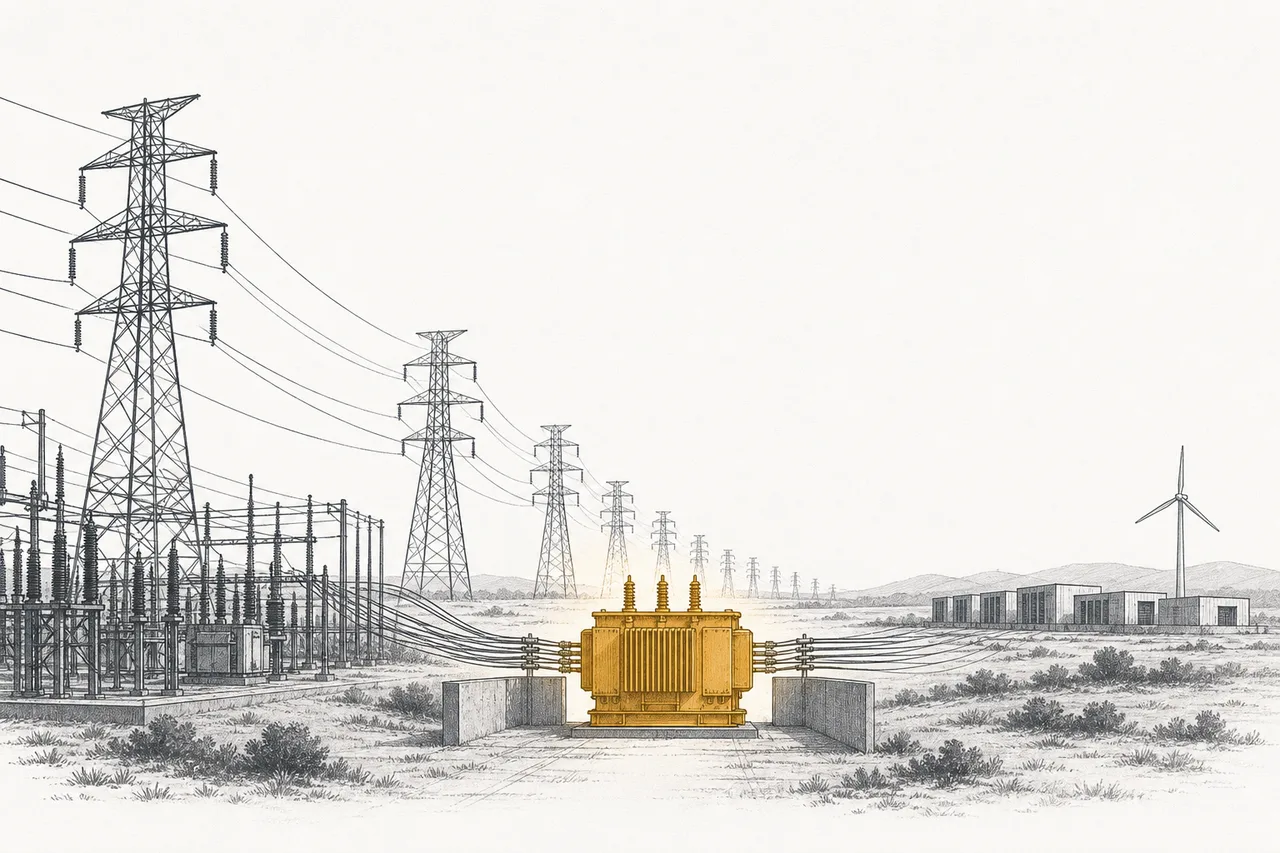
A device that "transforms" voltage up or down — on the way out of a power plant it has to push the voltage way up (into the hundreds of thousands of volts) so power can travel far with little loss, then near the user it has to step the voltage back down to a level safe enough to plug into. Every unit of electricity on Earth passes through at least 4–5 transformers, from the power plant to the socket in your home — which makes it a truly indispensable piece of the whole system.
02Why the boring stuff became the bottleneck for everything
For decades, the "grid" was the most boring business in energy — slow-growing, stable, predictable. So nobody really wanted to invest in adding transformer capacity. The world underestimated future demand for over a decade. Then, all at once, three waves of demand hit together.
The first is AI data centers, hungry for power like never before — the IEA expects global data-center electricity demand to double to about 945 TWh by 2030 (more than all of Japan uses today). The second is replacing oil with electricity (EVs, heat pumps, factories that stop burning fuel). And the third is renewable energy, which needs new transmission lines run out to where the sun and wind are — usually far from cities.
All three waves pull from the same "supplier base" that can't scale fast enough. The result is a chronic transformer shortage. Order a high-power transformer today and you wait 128 weeks (almost 2.5 years), and some types up to 4 years — while prices keep climbing.
Why does this matter enough to be "the bottleneck for everything"? Because however fast you finish a solar farm or a data center, it's worthless without a transformer and transmission lines to plug it in. The most shocking number: in the US, more than half the data centers planned this year could be delayed — because they're waiting on electrical equipment. Only about one-third of planned capacity is actually under construction; the rest is stuck in line for gear that takes 3–5 years to make.
This is why investors call this node the "picks-and-shovels of the energy transition" — in a gold rush, the people selling picks and shovels get rich more reliably than the people digging for gold. Because whether solar, wind, nuclear, or gas wins, every side has to buy the same transformers and transmission lines.
03How electricity travels — and where the bottleneck sits
To understand why the transformer is the sore spot, let's follow a single unit of electricity on its journey from source to destination. There are 5 main gates, and a transformer sits at nearly every one.
The heart of it is steps 2 and 4: power has to be "stepped up" to travel far, then "stepped down" to be used. Both stages need big, expensive, custom-built, slow-to-make transformers. Meanwhile step 3 (transmission) needs special high-voltage cable, especially HVDC, used to move huge amounts of power over long distances or under the sea.
The grid normally runs on "alternating current" (AC). But when you have to send huge amounts over very long distances, or run a cable across the sea between countries, converting to "direct current" (DC) loses far less energy. That makes HVDC the core technology for linking grids across regions and bringing in power from offshore wind farms — a hard job that only a handful of makers do well, which keeps margins high and competition thin.
04How it connects to other trends
The grid is the node that "sits in the middle" of the entire energy system. Every electricity-related trend runs through it:
- It sits under Energy Transition & Power Demand: it's the "infrastructure side" of the energy megatrend — the rest of the siblings are the "generation side" (solar, wind, nuclear, gas), which depend on the grid to sell their power
- It's the mandatory gate for AI data centers: AI creates enormous power demand, but the real bottleneck isn't "is there enough power" — it's "can you connect the power" — many projects finish but can't switch on because they're waiting on a transformer
- It's a partner to Energy Storage & Grid Flexibility: batteries and the grid go together — the more intermittent renewable power you have, the more you need both new transmission lines and batteries to keep the network "in balance"
- It receives power from Nuclear Generation and every kind of plant: whatever you generate with, you still need a step-up transformer and transmission lines to receive it — so the grid wins no matter which generation side comes out on top
- It leans heavily on Critical Materials: a single transformer eats huge amounts of copper and special "electrical steel," and cable is pure copper/aluminum — so raw-material prices feed straight into equipment prices and are one root of the shortage
What makes this node special is that it's a "common tax" on every electricity trend — no matter which energy path the world picks, every route has to run through the same transformers and transmission lines.
05Where it stands now + the real players
The best way to gauge how "hot" this node is is to look at makers' backlog (orders not yet shipped) — orders customers have already paid to reserve but that the maker can't deliver fast enough. The longer the backlog, the shorter the supply and the greater the pricing power. Right now, backlogs across the whole industry are hitting records all at once.
The numbers tell the story clearly: GE Vernova's Electrification backlog jumped from $25B a year earlier to $42.4B in Q1 2026 — power-equipment orders grew 86%. Hitachi Energy shows it most vividly: its backlog grew from $14B three years ago to $43B, with a wait for large transformers of up to 40 months. Meanwhile Siemens Energy's Grid Technologies unit has a book-to-bill as high as 1.72 (taking in orders almost twice as fast as it can ship).
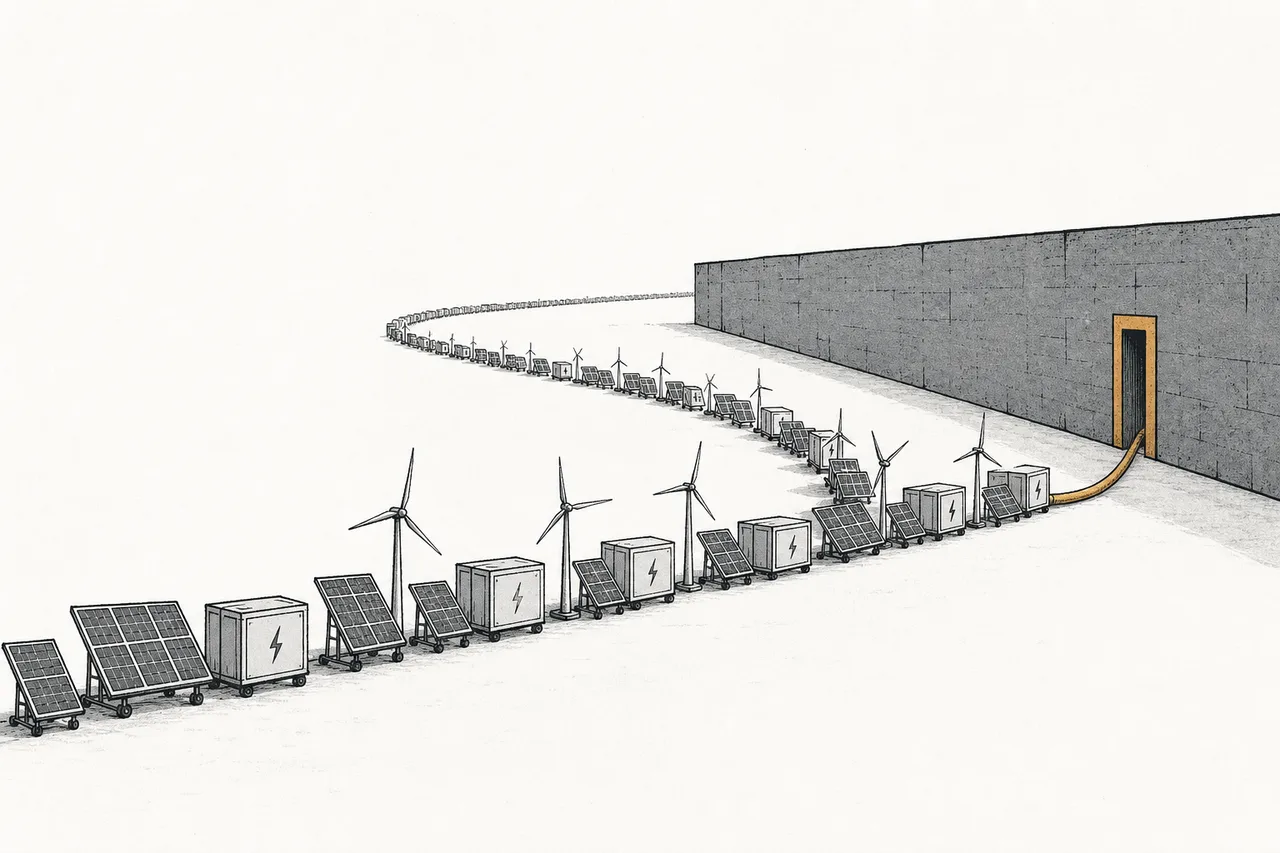
The other face of the bottleneck is the "interconnection queue" — projects already built but waiting to plug into the grid. In the US, over 2.6 terawatts (TW) of generation and storage are sitting in line, more than twice the capacity actually installed across the whole country. And the median wait has stretched from under 2 years to over 4 — a sign that "the grid itself" is the limit, not the amount of power.
The players in this field are spread around the world in an interesting way — they're not concentrated in the US like many tech trends. Europe and Japan have companies that dominate transformer and HVDC technology globally.
06The road ahead
The biggest direction is a historic wave of grid investment. The IEA estimates that global investment in power grids has to more than double, from ~$330B a year to ~$750B a year by 2030, to keep pace with energy targets — an enormous sum that flows straight into the pockets of equipment makers and grid contractors.
The second direction is capacity expansion. Everyone is pouring money into new transformer and cable plants — Hitachi Energy is investing hundreds of millions in factories worldwide, Quanta is investing to make its own transformers, and nearly $1.8B of expansion has been announced in North America alone. But interestingly, Wood Mackenzie still sees the shortage of some transformer types "getting worse" before it gets better — because building plants and training workers takes years. Which means the pricing power should stick around for a good while yet.
The third direction is new technology, like the solid-state transformer (a smaller, smarter semiconductor-based transformer) that Eaton is piloting with hyperscalers, and the expansion of cross-regional HVDC networks to link in distant renewable power — turning the grid from "just wires" into a smart network that can balance itself.
07Challenges & risks
This node's sweet pricing power comes with risks baked deep into it.
The first risk is raw materials and the supply chain. The heart of a transformer is "grain-oriented electrical steel" (GOES), which only a few plants in the world can make, and the US relies on a single domestic producer. Copper and electrical steel together make up over half of a transformer's material cost. So surging raw-material prices (copper +70%, electrical steel nearly doubled since 2020) squeeze margins and drag the bottleneck out — a direct link to Critical Materials.
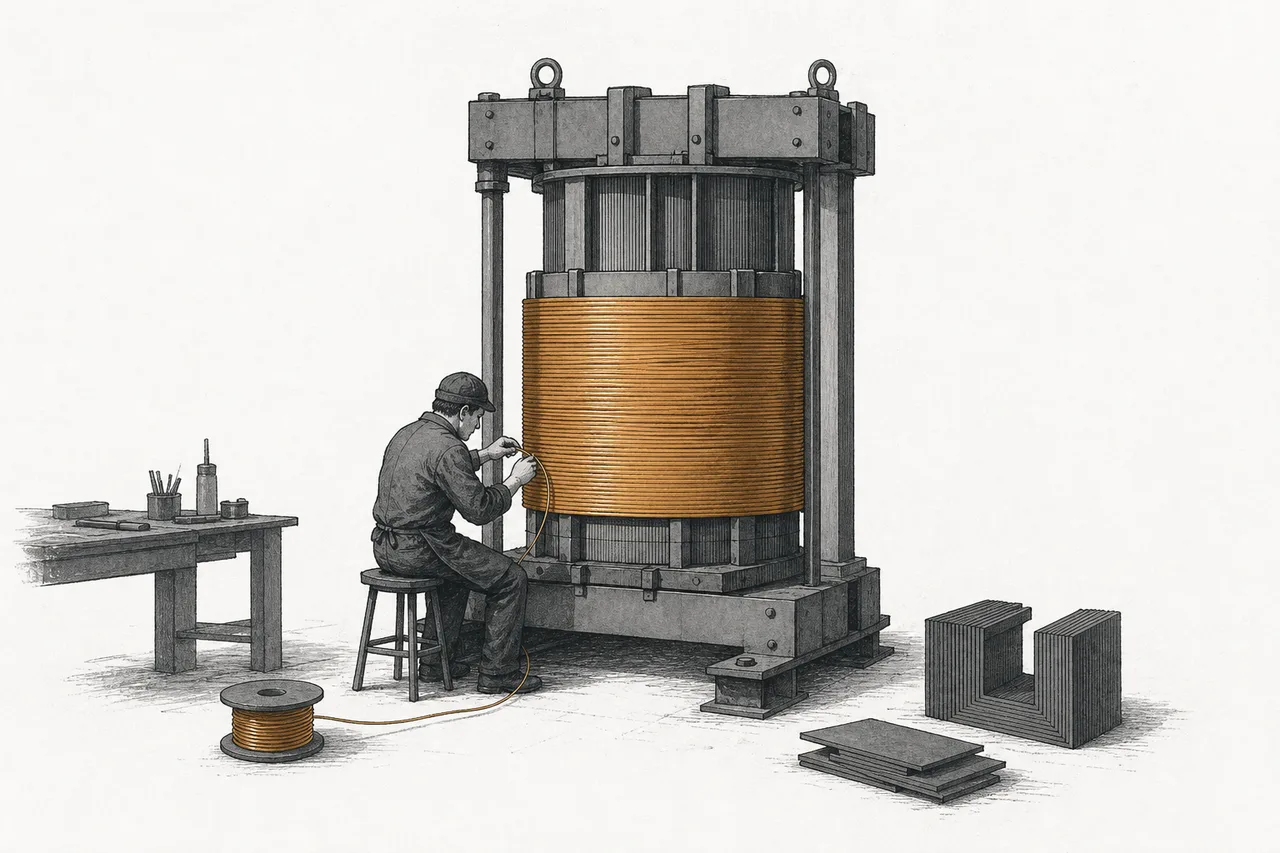
The second risk is skilled labor. This isn't a problem you can fix instantly by throwing money at it. Transformers still depend on specialized "coil winders" who take years to train — and it's a trade fewer young people are entering. Many makers name a "shortage of skilled workers" as the main reason they can't scale fast enough.
The third risk is permitting and politics. Building new transmission lines means clearing permits that take years, crossing land across many jurisdictions and owners, and often facing community opposition ("not in my backyard"). This is why the interconnection queue stretches into the TWs — sometimes the problem isn't making transformers fast enough, it's "you can't build the line."
And the last risk investors have to watch is cyclicality — even though today's demand looks structural and long-term, this kind of capital-heavy equipment business has a history of "building too much capacity at the peak." If AI demand slows, or everyone expands plants at once, today's sweet pricing power could fade within a few years.