Megatrend · Biotech & Genomic Medicine
One drug costs $2.6 billion and 13 years — what if AI could halve that?
Discovering a drug is one of the most expensive, slowest, and most failure-prone jobs in the world — millions of trials and errors just to land a single medicine. AI Drug Discovery is the attempt to 'jump the queue' at that front end: using computers to predict protein shapes, design molecules, and throw out the ones that don't work before they ever hit the lab. It's the 'picks and shovels' that speeds up the whole pharma industry — but the real thing still has to clear several more gates.
01What AI Drug Discovery is
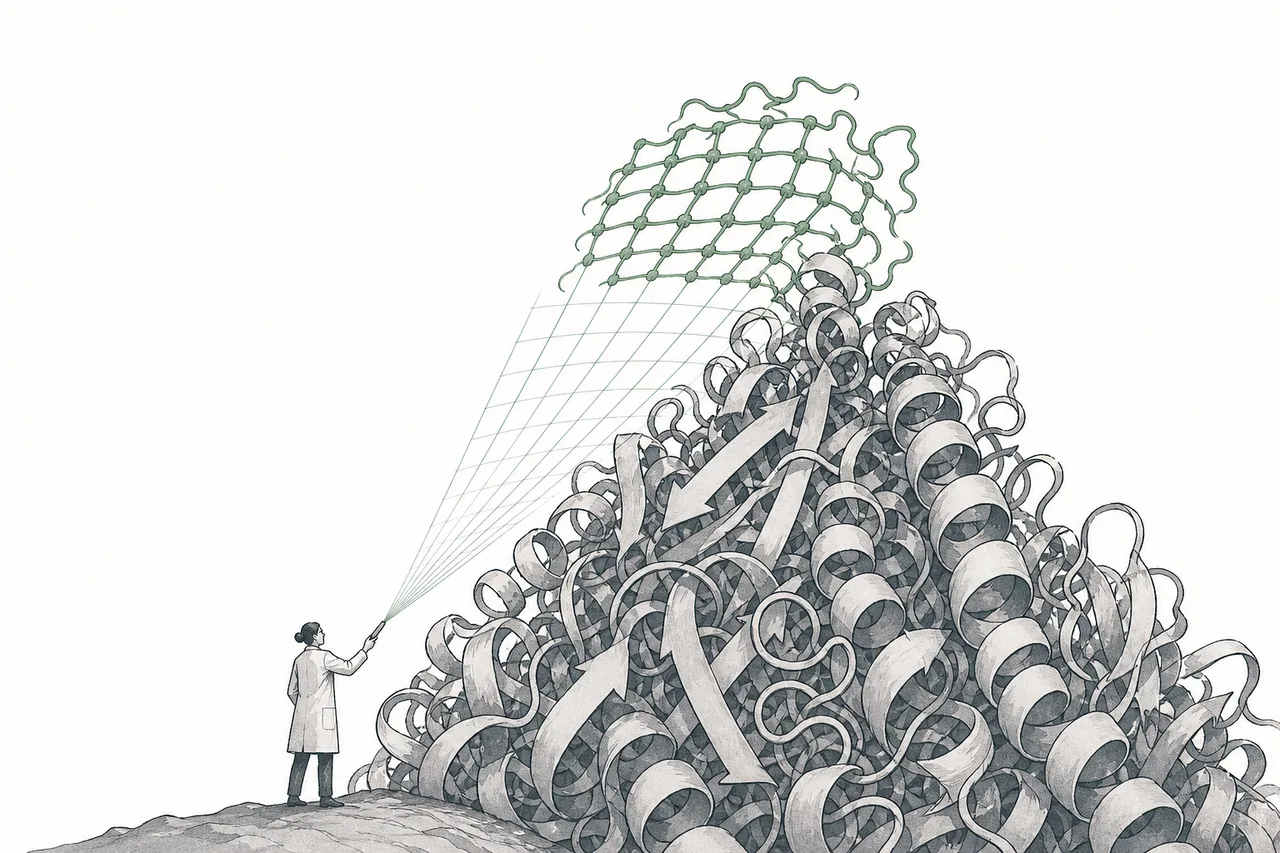
Picture it like this. To find one new drug, researchers have to find a 'molecule' that fits a disease-causing protein in the body exactly — like finding a key to open a lock. The problem is that the number of possible molecules in chemical space is more than 1060 — many times the number of stars in the universe. The old way was to 'just keep trying': synthesizing real compounds in the lab, thousands at a time, then testing which ones bind. It's slow, expensive, and misses most of the time.
AI Drug Discovery means putting AI to work on this front end instead of trial-and-error in a test tube. It does three main things: (1) predict the shape of the target protein — what it looks like, where there's a pocket for a drug to slot into; (2) design, or 'generate,' new molecules that should bind the target; and (3) screen millions of molecules on a computer to throw out the ones that don't work, then only synthesize the most promising ones for real. Put simply, it shifts from 'make first, look later' to 'predict first, then make.'
A protein or molecule in the body tied to a disease, which a drug grabs onto to switch its function 'on' or 'off' — for example, a protein that makes cancer cells grow fast. Finding the right target is the very first step of drug discovery, and it's where an AI like AlphaFold helps the most: knowing the '3D shape' of the target lets you design a drug that binds it far more precisely.
On our megatrend map, AI Drug Discovery is a sub-theme under Biotech & Genomic Medicine — but it's special. It isn't a 'disease' or a 'drug type' like sibling themes such as Oncology or Gene & Cell Editing. It's a 'platform,' a speed-up tool that sits underneath every kind of drug — the 'picks and shovels' layer of biotech. It doesn't mine the gold itself; it sells the digging gear to the whole mine.
02Why it matters — fixing the 'broken economics' of drug discovery
To understand why people are excited, you first have to look at the scary numbers of traditional drug-making. Taking one new drug from the lab to the pharmacy shelf costs, on average, around $2.6 billion and 10–15 years. And the harshest part — of the drugs that reach human trials, about 90% ultimately fail and never reach patients.
Most of the enormous spending doesn't disappear into the drugs that succeed — it disappears into the 'drugs that fail.' Every one that dies along the way has to be folded back into the cost of the ones that survive. That's why drugs keep getting more expensive, and why pharma companies won't touch small-market diseases or 'too-hard' targets: the risk isn't worth it.
This is where AI changes the equation. If you can throw out the molecules that will fail faster and cheaper right at the front end — before spending money to synthesize them for real or test them in animals — total cost drops. And more important is time: every year you shave off is a year sooner a drug reaches patients, and a year longer the patent earns.
And this isn't just small companies dreaming big — real money is flowing in. In 2024, Isomorphic Labs (an Alphabet subsidiary) signed deals with Eli Lilly and Novartis worth up to ~$3 billion combined. Nvidia teamed with Eli Lilly to invest up to ~$1 billion in its biological-AI platform BioNeMo. And in 2025, Chinese company XtalPi signed a drug-discovery deal with a partner worth up to ~$6 billion. These numbers say one thing clearly — big pharma now believes AI at the discovery stage 'has the goods.'
03How it works — a screening funnel AI squeezes narrower, faster
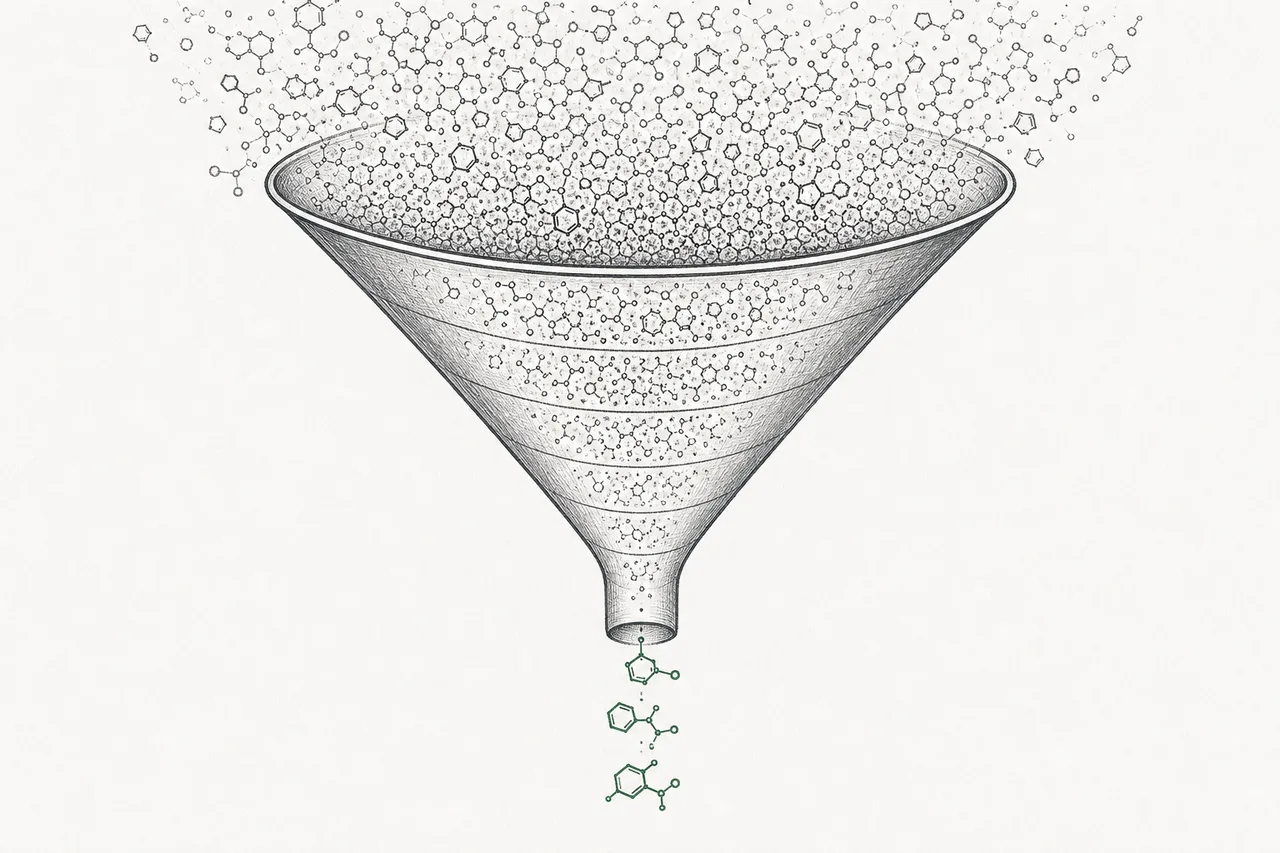
The best way to understand AI Drug Discovery is to see it as a 'screening funnel.' The top mouth is enormous — millions to billions of possible molecules. The bottom is tiny — just a few that actually go on to be tested in humans. AI's job isn't to skip any stage; it's to throw out the wrong ones faster and smarter at each layer of the funnel.
The key to all of this was a 2021–2022 leap called AlphaFold, from Google DeepMind — an AI that predicts the '3D shape' of a protein from its amino-acid sequence, a problem scientists had tried to crack for 50 years. AlphaFold released a free database of over 200 million protein structures — nearly every protein science knows of. The work was important enough to win the 2024 Nobel Prize in Chemistry, because 'seeing' the shape of the target is the indispensable first step in designing a drug.
Just as ChatGPT 'generates' a new sentence one word at a time, a generative model in drug discovery 'generates' brand-new molecular structures that never existed before, given the conditions 'give me a molecule that binds this target, isn't toxic, and can actually be synthesized.' Instead of searching an existing compound library, it designs something new from scratch — and that's the difference from old-style 'screening,' which can only pick from what already exists.
04Where it sits in the ecosystem
AI Drug Discovery's place on the megatrend map is interesting because it's more of a 'connector' than just one theme. It straddles the world of biotech and the world of AI.
- Depends directly on Artificial Intelligence: it's a heavy customer of GPU chips and large AI models. Every protein-structure prediction, every molecule generated, eats enormous compute. That's why Nvidia jumped in itself with the BioNeMo platform — it saw pharma as a big new compute market
- An accelerator for every sibling theme in Biotech: AI Drug Discovery doesn't compete with Oncology or Gene & Cell Editing — it's a 'tool' those areas use. Cancer companies use AI to find new targets; gene companies use AI to design gene-editing proteins more precisely
- Pairs with Tools, Diagnostics & CDMO: no matter how good AI gets, someone still has to synthesize the real compound and test it in a lab. So many newer players build 'robot labs' where the AI can run experiments itself, looping predict–synthesize–measure–learn as fast as possible
- Fed by demand from Aging Society & Longevity: a world where people age needs more new drugs for chronic and still-untreatable diseases. The higher the demand for new drugs, the greater the pressure to discover them fast and cheap
05Where it stands now
This is the part to state as plainly as possible, because there's a real mix of genuine hope and overblown hype around it.
What's proven today is speed and cost in the lab. AI genuinely cuts the front-end work (finding the target, designing molecules, screening) from years to months — and it can do it repeatably. A company like Insilico Medicine says it produced around 22 'candidate drugs' over 2021–2024, each averaging just 12–18 months from project start.
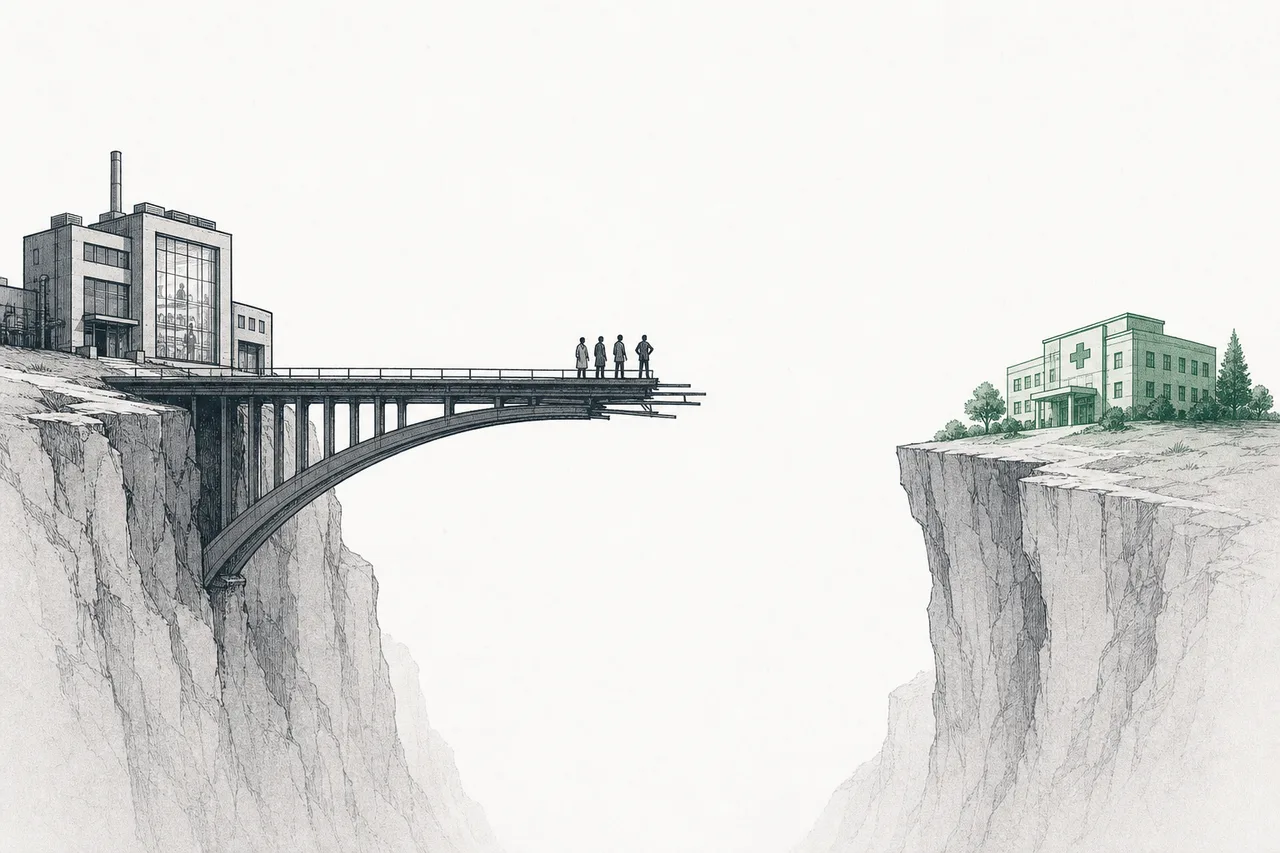
But what still hasn't happened is an AI-designed drug passing the final human trial (Phase 3) and getting approved — so far, not a single one. The closest milestone is Insilico's rentosertib (for pulmonary fibrosis, IPF), which in June 2025 published Phase 2a results in Nature Medicine — the first time a drug for which AI both found the target and designed the molecule showed signs of 'working in humans' (the treated group's lung function improved, opposite to a declining placebo group). It's a big step — but it's Phase 2a, and it still has to clear the much larger, far harsher Phase 3 over several more years.
As a market, AI Drug Discovery is still small next to the whole pharma industry — around $2–3 billion in 2024–2025. But it's growing fast; most research firms estimate a CAGR of ~30% a year (some put it lower), which, if it holds, could reach $30–40 billion by the mid-2030s.
The player landscape splits roughly into three groups: tech giants playing the game themselves (Alphabet via Isomorphic Labs, Nvidia via BioNeMo), pure-play AI-biotech companies that build the platform as their core business, and big pharma that buys or partners to use the tech. One key thing to understand — many of the most advanced players are still private or only just clinical-stage (Isomorphic Labs and Insilico Medicine aren't publicly traded stocks yet), so you have to watch both sides.
06The road ahead
The road ahead has three milestones worth watching.
The first is 'the first AI drug to pass Phase 3 and get approved' — the finish line that changes everything. The day a drug designed by AI clears a large human trial and actually goes on sale is the day the question 'can AI really make drugs?' gets answered for good. With pipelines from Recursion, Insilico, AbCellera and others moving steadily into the clinic, many expect this milestone within the next few years — but because Phase 3 is the gate where most drugs die, it's not guaranteed.
The second is hitting targets that were 'untouchable' before. Many disease-causing proteins were branded 'undruggable' because they had no pocket for a drug to slot into, or shapes too complex for old methods to design a binder for. AI's big selling point is opening these doors — Isomorphic's deal with Novartis specifically focuses on targets 'once too risky or too hard to do.' If it works, it unlocks drugs for diseases that have no treatment today.
The third is 'the fully AI-driven lab' — looping predict → robotic synthesis → measure → feed back to the AI to learn, with less and less human intervention. The Lilly–Nvidia partnership investing in 'automated labs' is a first step in this direction. The goal is to make the drug-learning cycle faster by orders of magnitude.
07Challenges & risks
This is a trend where you have to be especially wary of the 'excitement,' because the gap between the promise and the actual results is still wide.
The first and biggest risk is that 'it's still unproven at the final gate.' AI is good at speeding up the front end, but about 90% of drugs that enter the clinic still fail, same as before — and most of those failures happen in Phase 2–3, the gates where AI can't help much yet. There are real cautionary tales: DSP-1181, a drug Exscientia designed and that made big news as 'done in 12 months,' ultimately failed to pass Phase 1, and a BenevolentAI drug fell in Phase 2. Speed in 'designing' doesn't mean the drug will 'work.'
The second risk is the 'data moat.' AI is only as good as the data you feed it, and high-quality biological data — real trial results, molecular structures, patient data — is limited, expensive, and often locked inside big pharma. Players without enough data of their own may build models that 'look great on paper but don't work in practice.' That's why a giant like Alphabet (with the money, the people, and AlphaFold) has a huge advantage.
The third risk is the economics of the companies themselves. Many AI-biotech firms are pure-plays still 'burning cash' — investing heavily in platforms and pipelines, but with no drug yet to sell. Their main revenue comes from partnership deals that can stop at any time. So these stocks swing hard and are especially sensitive to 'clinical-result news' — a single bad headline can halve the value.
In short: AI Drug Discovery is tackling the most legitimate problem in pharma — economics that are too expensive and too slow — and it has already proven it can genuinely speed up the front end. So the hope rests on something tangible, not thin air. But the real finish line — the first AI drug that actually treats people and gets approved — is still ahead. Understanding that 'fast in the lab' and 'works in humans' are two different things is the key to seeing this trend clearly.