Megatrend · Synthetic Biology
Selling shovels to everyone who comes to dig for gold
Every time there's a gold rush, the people who get rich for sure aren't the diggers — they're the ones selling shovels. In an age when everyone wants to design new living things from scratch, the "shovels" are the DNA-writing machines, the reagents, the software, and the automated biology factories. This lesson is about the layer that sits beneath every synbio dream — and the harsh truth that even the shovel-sellers are losing money.
01What it is
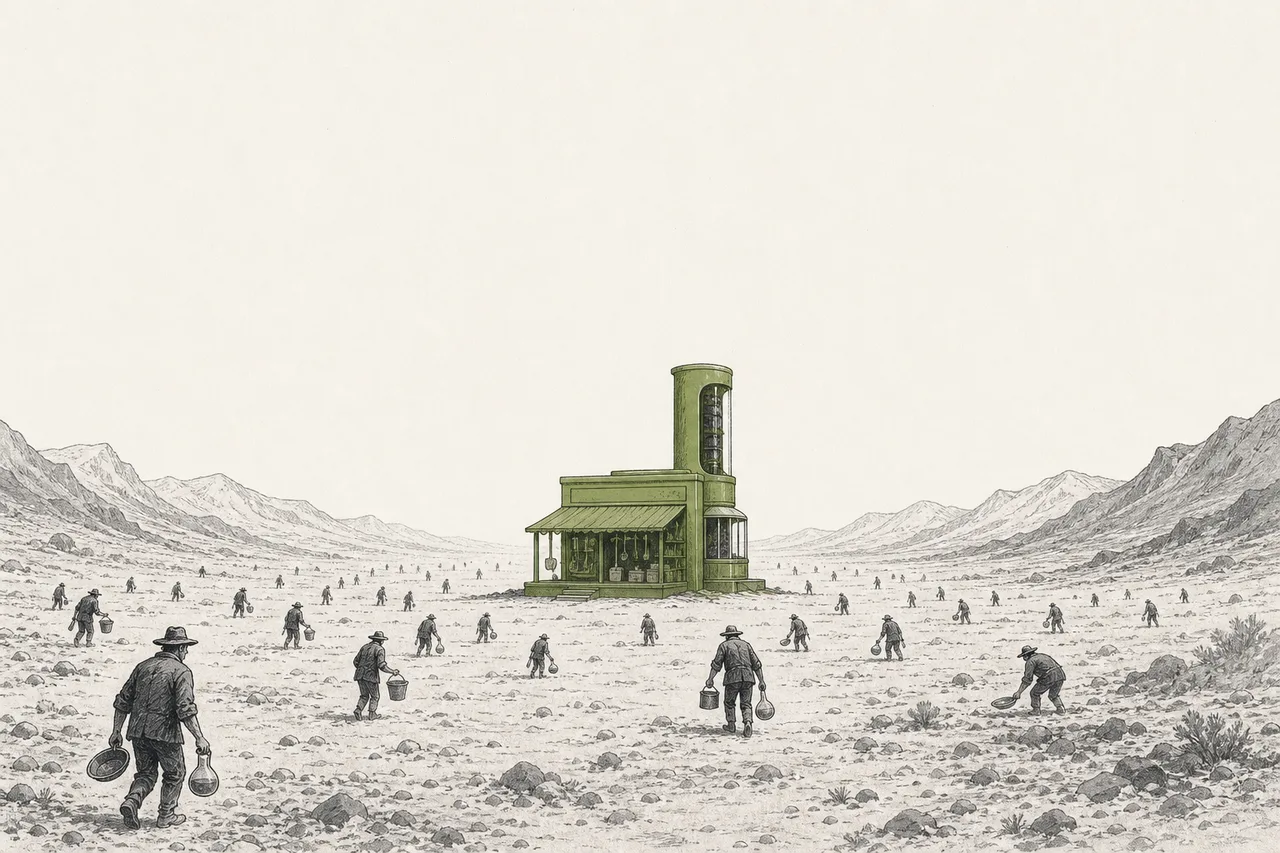
Picture the California gold rush. Hundreds of thousands rushed in to dig for gold, and most went home empty-handed. But one group got rich almost across the board — the people selling shovels, selling jeans, selling supplies. The phrase "picks and shovels" comes from exactly this: instead of betting on who'll strike gold, you sell tools to everyone who comes to dig.
This node is the "shovel-seller" for the whole Synthetic Biology industry. It's the tools layer — the machines, reagents, software, and "engineering living things" services — that lets everyone else build biology. Whether the end goal is fermented meat, bioplastics, a drug, or fuel, everyone has to pass through this layer first.
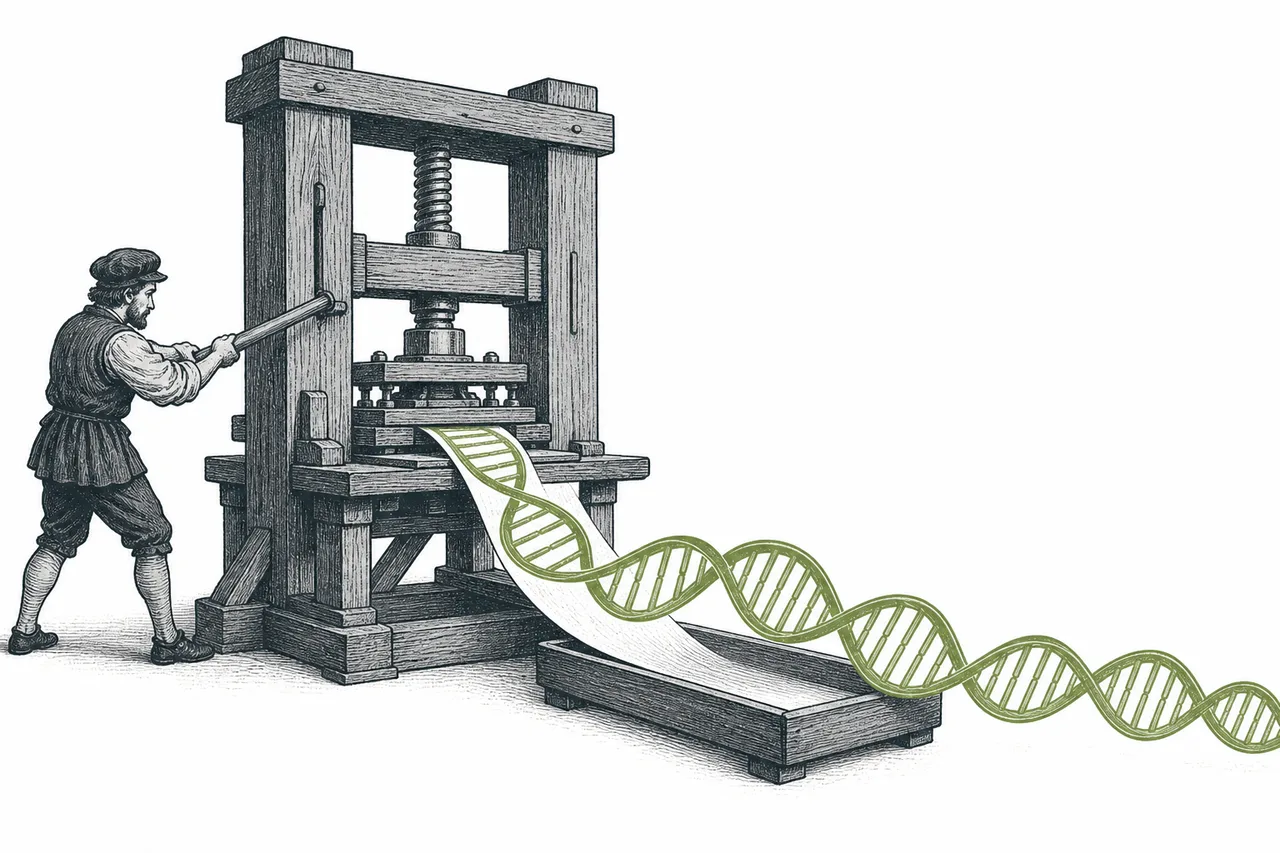
The heart of this layer is DNA synthesis — "writing" new DNA from scratch, one letter at a time (A, T, C, G), instead of copying what nature already wrote. If reading DNA (sequencing) is reading a book, then synthesis is printing a brand-new book — and it's the bottleneck that makes the whole industry move fast or slow.
Read (sequencing): take existing DNA and decode what its sequence of letters is — this got vastly cheaper and faster over the last 20 years (the market king is Illumina). Write (synthesis): actually build a DNA strand that never existed before, exactly as you designed it — harder, more expensive, and improving far slower than reading. That's why "writing" has become the most interesting (and brutal) business in the tools layer.
This tools layer has four main parts that work in sequence: (1) DNA synthesis (writing genes/oligos), (2) automation and biology factories (foundry) that run experiments with robotic arms, (3) software for design and analysis, and (4) reagents and enzymes used at every step.
02Why it matters — selling shovels to every gold rush
Why this layer matters fits in one sentence: every synbio application has to buy its DNA and tools here first. Whether the eventual winner is a fermented-meat company, a bioplastics company, or a gene-therapy company — the toolmaker already got paid, way upstream. That's the appeal of the picks-and-shovels model: you don't have to guess who wins.
This layer's total market is growing at a rate that looks gorgeous on paper. The overall DNA synthesis market is estimated at roughly $3–8 billion in 2025 (the figure varies by definition), expected to grow at a CAGR of about 15%. The whole synthetic biology market this layer underpins is projected to grow from ~$24 billion in 2025 to hundreds of billions of dollars over the next decade.
These numbers are why investors got so wildly excited about this layer in 2020–2021. The dream was: if one day "writing biology" becomes as easy and cheap as printing a document, whoever controls the printing press controls the whole bio-economy. But as we'll see, reality moves a lot slower than the dream.
03How it works — the Design-Build-Test-Learn loop
Modern biology engineering works as a four-step loop that spins again and again, called DBTL: design → write → build → test, then take the results, learn, and feed them back into the next design. The faster and cheaper you can spin this loop, the better you can engineer life — and this tools layer is what lets each step turn.
The step that's the real "bottleneck" is writing (step 2). Reading DNA got cheaper so fast it became legendary (see the box below), but writing hit a technical ceiling — the traditional chemistry method (phosphoramidite), in use for 40 years, writes one short strand at a time and accumulates errors as the strand gets longer. The new hope is enzymatic synthesis, which mimics the way cells write their own DNA — cleaner, and possibly able to write longer strands.
Scientist Rob Carlson noticed that the cost of reading/writing DNA was falling about as fast as Moore's Law in chips, so people called it the "Carlson Curve." But here's the key point many miss: the reading line keeps plunging, while the writing line has nearly flatlined lately — around $0.03–0.05 per base since 2022. Carlson himself warns that the DNA synthesis market is still too small to attract the massive research investment chips got. So writing DNA may not get cheap as fast as the dream promised.
04Where it sits in SynBio
If you draw Synthetic Biology as layers, this node is the bottom layer that supports everything. Its siblings are the "applications" up above — and every one of them depends on the DNA and tools from this layer:
- Feeds Alt-Protein & Precision Fermentation: designing microbe strains to "ferment" out a target protein starts with writing the genes in this layer
- Feeds Bio-Based Materials: the microbes that make bioplastics or industrial chemicals are engineered with the same toolset
- Feeds Sustainable Aviation Fuel & Bio-Fuels and Agri-Biotech: biofuels and agricultural microbes all start with designing and writing DNA
And it links laterally to several other megatrends:
- Makes Biotech & Genomic Medicine possible: gene therapy, mRNA vaccines, and drug development all need high-quality synthetic DNA — the pharma market is this layer's highest-paying customer
- Leans more and more on AI: the "design" and "learn" steps of the DBTL loop are increasingly driven by AI models that predict which DNA sequence will give the result you want, cutting the number of trial-and-error rounds
- Is a tool for Climate Adaptation: from nitrogen-fixing microbes to drought-tolerant crops, designing organisms to cope with the climate starts in this tools layer
05Where it stands now — the shovel-seller's winter
This is the part where we have to be blunt: the synbio tools layer is in a winter. After the 2021 wave, when these companies went public at wildly inflated valuations (many via SPAC), the bubble burst. Share prices plunged, funding dried up, and the "foundry" business model everyone cheered for still hasn't proven it can actually turn a profit.
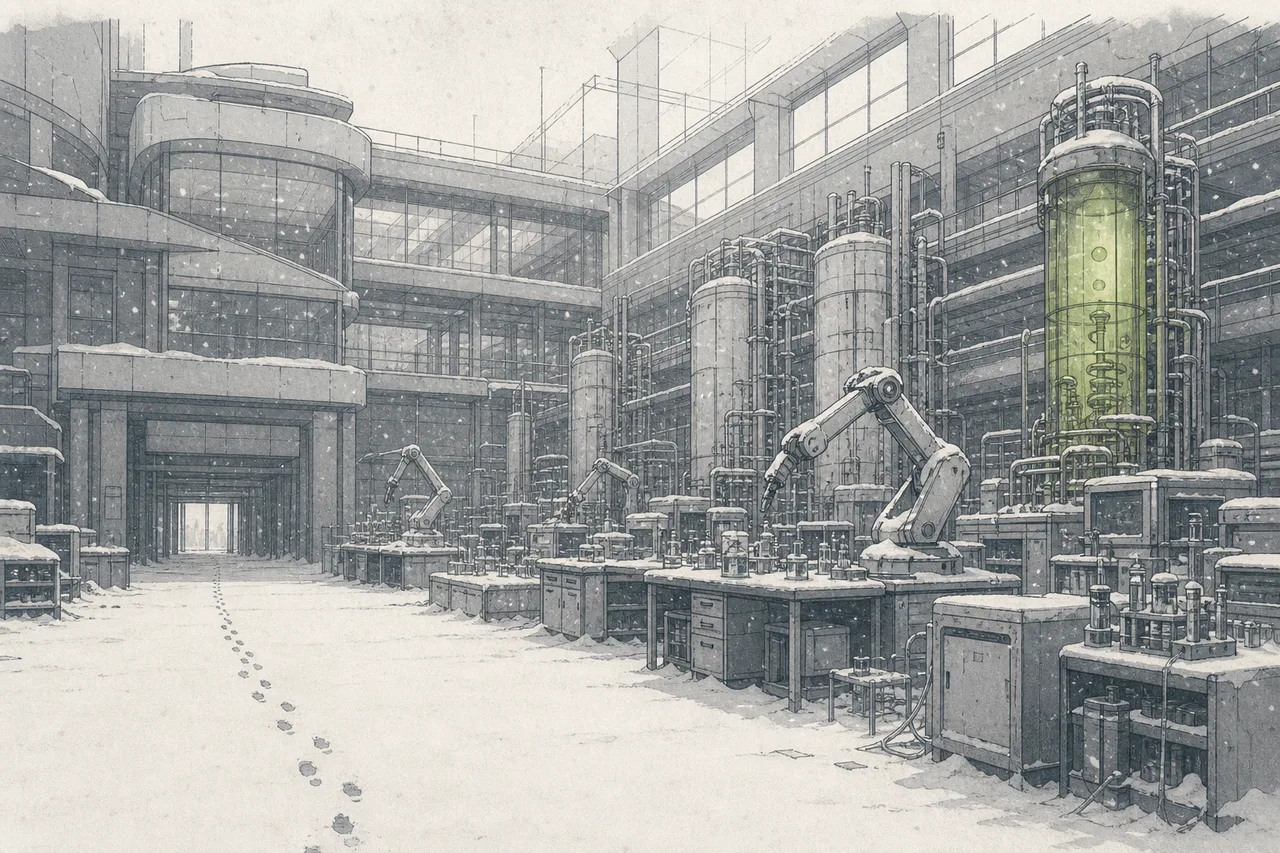
The story that says it most clearly is Ginkgo Bioworks (DNA) — once the star of the foundry model, selling "program a cell" services to customers. It went public via SPAC in 2021 at a valuation of about $15 billion, then the stock fell over 95% from its peak, forcing a major restructuring, layoffs, and a rush to cut cash burn by 55% from 2024 to 2025. This is the lesson that the foundry model looks beautiful on a slide, but the real economics still don't add up.
On the other side, Twist Bioscience (TWST) — the king of DNA writing with its "DNA on silicon" technology — tells a more hopeful story. Fiscal 2025 brought record revenue of $376.6 million (+20%), and crucially, the loss shrank to $77.7 million from a $208.7 million loss the year before. Gross margin ticked up to 50.7% — but note, still a loss. This is the typical state of this layer: revenue really is growing, but the road to profit is still long.
On the technology side, the most interesting move is the "benchtop DNA printer" — DNA Script launched its SYNTAX machine, which uses enzymatic synthesis to print 96 oligos at once right in your own lab, no ordering and waiting for delivery. And Ansa Biotechnologies (private) just raised $54 million to expand its enzymatic synthesis services — a sign that even in a tight market, investors still believe in picks-and-shovels.
And in 2025, Twist also spun off its DNA data storage business into an independent company, Atlas Data Storage, while keeping a stake and collecting royalties — cutting a cash-burning piece to focus on the core business that's closer to profit. It reflects the whole industry's new discipline in an era of expensive money.
06The road ahead
The first direction is enzymatic synthesis replacing the old chemistry. If it succeeds, it'll unlock writing longer, cleaner DNA strands right in your own lab — no waiting days for a shipment. Some analysts expect that by 2030 there could be benchtop machines writing genes thousands of bases long for under $200K — the specific market for enzymatic DNA synthesis is estimated to grow very fast (CAGR around 27%), even off a small base.
The second direction is AI changing the equation for the whole loop. If AI models can predict more accurately which DNA sequence gives the result you want, the number of "trial-and-error" rounds drops — meaning you have to write less DNA to get the same result. That's a double-edged sword for shovel-sellers: good for the whole industry, but it could push down demand for raw synthesis.
The third direction is the shakeout continuing. The era of tight money forces these companies to stop chasing revenue without regard for profit, to cut the cash-burning pieces (like Twist did with Atlas), and to focus on the markets that really pay — especially drugs and medicine. The survivors will be the ones who can prove they "sell shovels" and actually turn a profit, not just grow fast.
07Challenges & risks
This lesson has to end honestly, because the synbio tools layer is the textbook case of how a "beautiful picks-and-shovels theory" might not hold up in practice.
The first risk is profit that hasn't arrived. Twist is still losing money, Ginkgo just started cutting its cash burn. The shovel-seller is supposed to get paid no matter who wins — but in reality, the cost of building the tools and the foundry is so high that growing revenue still can't cover it. The textbook says shovel-sellers are safe, but if the shovel is too expensive to make at a profit, the seller can get hurt just the same.
The second risk is the unproven foundry model. The idea of a "biology factory that takes on any job" sounds like a chip foundry (TSMC), but biology isn't standardized like silicon. Each project is very different, which makes it hard to get the same economies of scale. Ginkgo is a test that isn't finished yet.
The third risk is DNA's "Moore's Law" stalling. Unlike chips, which keep getting cheaper, writing DNA has nearly stopped getting cheaper lately, because the market is still too small to pull in massive research investment. If the price per base doesn't keep falling, the dream of "writing life as cheaply as printing paper" gets pushed out.
The fourth risk is biosecurity and regulation. The easier and cheaper it gets for anyone to write DNA, the higher the risk it gets used to build dangerous pathogens. DNA synthesis companies have to screen orders, and tighter rules could raise costs and limit the market.
In short: this is the most important layer in synbio, because everything starts here. But it's also the layer that got hurt most this round. The lesson is that "picks-and-shovels" isn't a magic spell — even the shovel-seller has to sell shovels at a profit, not just sell a lot of them.