Megatrend · Artificial Intelligence
Trillions in AI spending ultimately have to become concrete, steel, and wiring — and these are the people who actually build it
Everyone talks about NVIDIA's chips and AI models. But before the first GPU lights up, someone has to design the building, pour the foundations, run the high-voltage power lines, set switchgear that weighs tons, and lay kilometers of cooling pipe. This node is the companies that "actually build" — the EPC contractors, the electrical-and-mechanical trades (MEP), and the engineers who turn AI spending into a building that works. They're the "picks and shovels" for the people selling picks and shovels — the work nobody talks about, but the real bottleneck of the AI era.
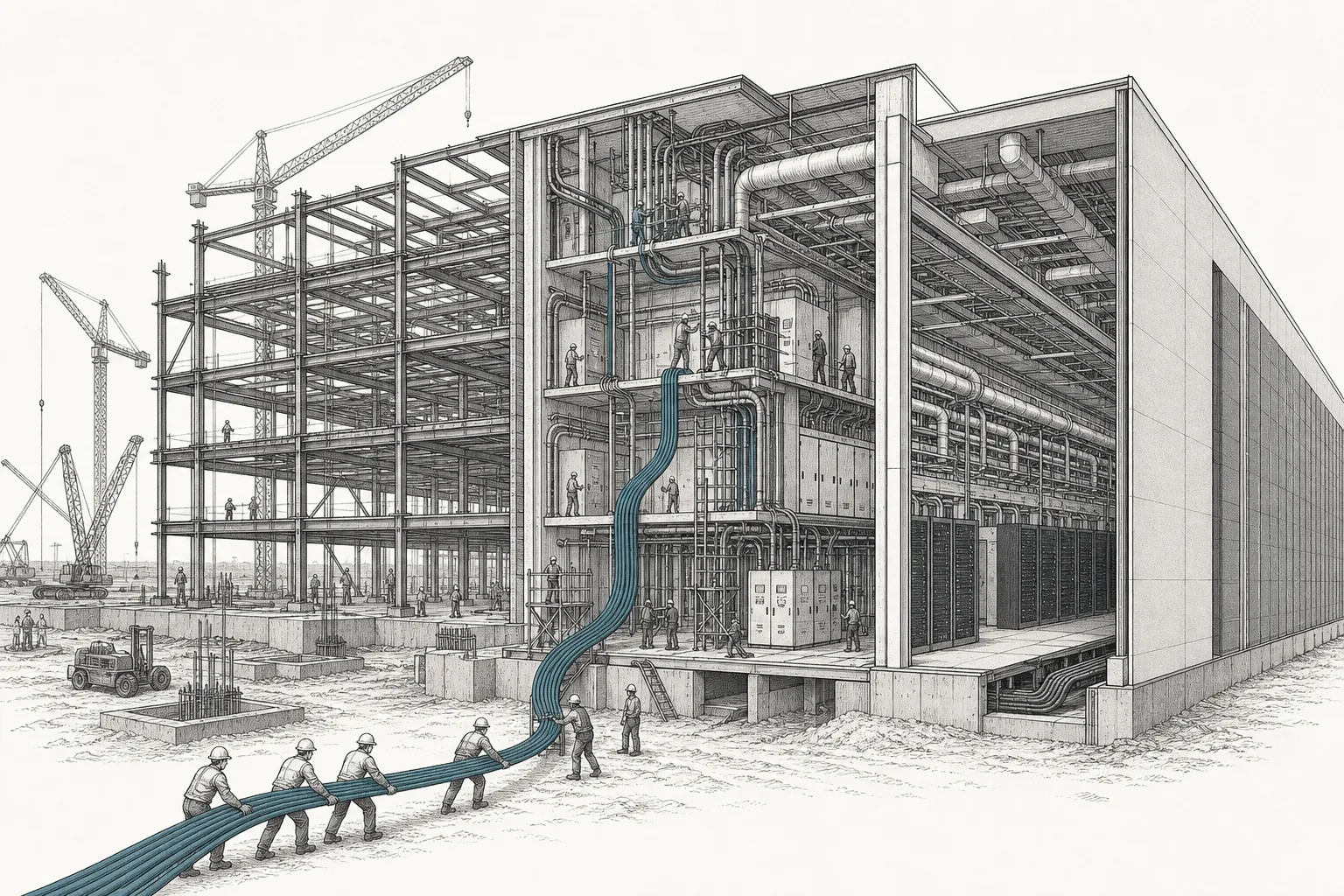
01What it is — the people who actually design and build the data center
Picture the headline you see every day: "Microsoft pours tens of billions into an AI data center." The question almost no one asks is — so who actually builds it? It's not Microsoft holding a trowel and pouring concrete, and it's not NVIDIA running the wiring. It's an army of construction firms, design engineers, and electrical-and-mechanical trades who show up on site. This node is their story.
It breaks into three clearly different kinds of work that have to move in sync: (1) Engineering and design — the people who draw the building and lay out the power and cooling before a single pile goes in (e.g. Jacobs, AECOM) · (2) EPC main contractors — taking on the whole package, from design to procurement to construction (Engineering-Procurement-Construction) · (3) Electrical-and-mechanical trades (MEP) — the people who run the wiring, install the power gear, lay the cooling pipes, and get the whole system to "switch on" (e.g. Comfort Systems, EMCOR, IES). These are the hands that give every transistor a "home" with power and cooling.
On the megatrend map, this node is the deepest branch of AI Data Center & Build-out within the big trend Artificial Intelligence. It's the "bottom physical layer" — the ones who build the building and systems themselves that everyone else then uses. Its siblings next door are Colocation & Hyperscale REITs (who own the land and building and lease it out) and AI Server OEM & System Integration (who assemble GPUs into servers). If the REIT is the "landlord" and the server OEM is the "furniture," this node is the "contractors and trades who actually build the house."
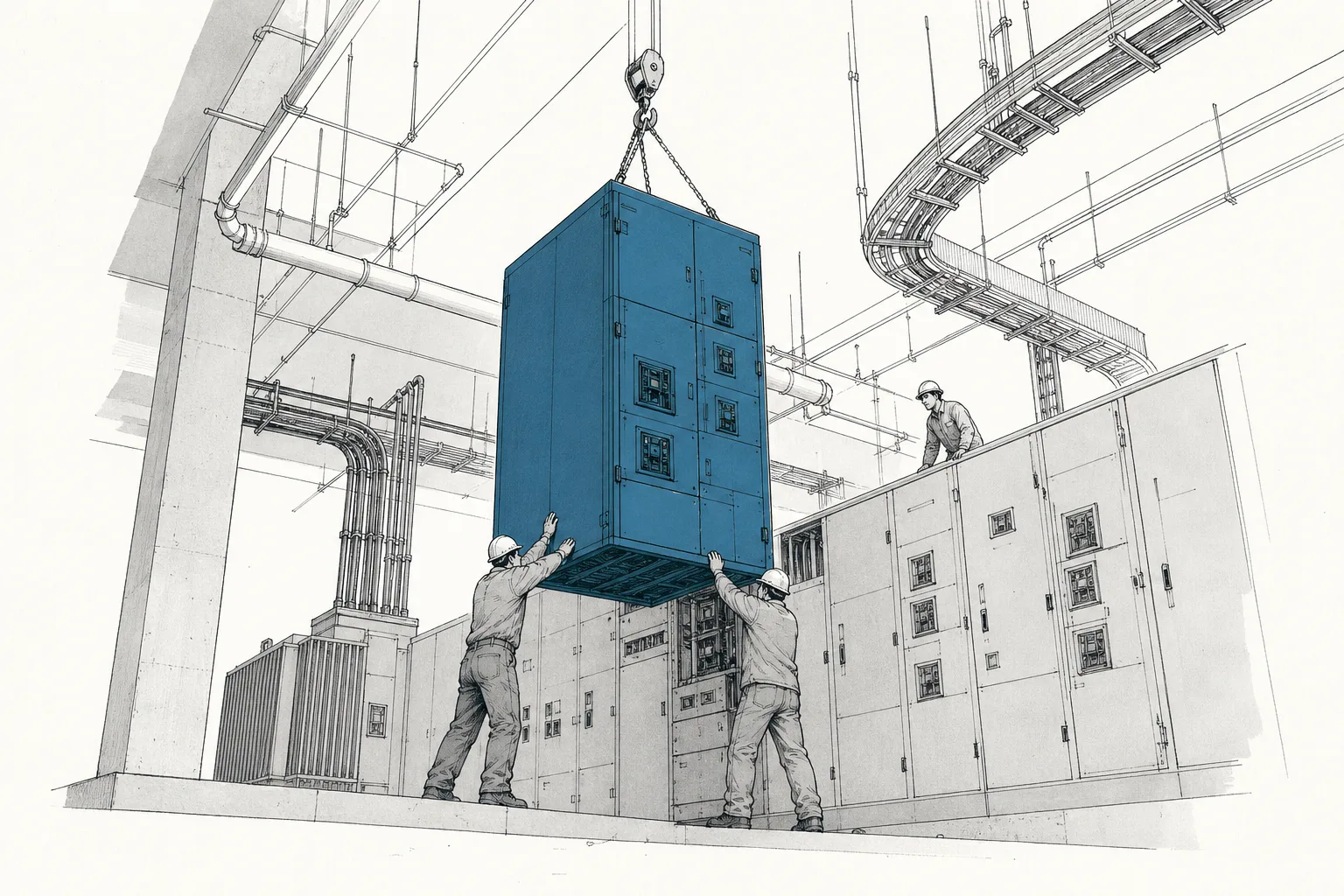
EPC (Engineering-Procurement-Construction) = an all-in-one contract where the main contractor handles everything from design to procuring materials to finishing the build · MEP (Mechanical-Electrical-Plumbing) = the building's systems — mechanical (cooling/air), electrical, and plumbing — the "veins and nerves" of the building · Switchgear = the giant high-voltage gear that distributes and cuts power, safely routing many megawatts into the racks — one of the most supply-constrained pieces of equipment right now.
02Why it matters — turning capex into concrete + speed-to-power
There's a classic line: in a gold rush, the people who get rich for sure are the ones selling picks and shovels. In AI, everyone already knows the pick-seller is NVIDIA. But there's a layer deeper still — the people who build the mine for the gold miners. That's this node. However the AI race ends, every dollar of investment has to pass through contractors and trades first. The most expensive GPU in the world is just a metal box without a building, power, and cooling.
The size of the market makes this clear. The global data-center construction market in 2025 is worth roughly $227–250 billion and is expected to grow to over $400 billion by 2030–2035, at about 7–11% a year, driven directly by AI. The U.S. alone accounts for about $59.5 billion in construction in 2025.
But what matters more than market size is the two words that became the heart of this era: "speed-to-power" — how fast you can get a building to "have usable power." In an AI race where demand jumps every quarter, whoever opens a data center first gets the customers and revenue first. Time is worth more than money. And what sets the speed isn't pouring concrete — it's finishing the electrical work and being able to deliver power, the work this node holds the key to.
This is why companies like Comfort Systems USA and EMCOR, once seen as "ordinary contractors," became stocks investors fight to own — because they turned into the bottleneck on the thing everyone wants to speed up most.
03How it works — the build sequence
Building an AI data center isn't "put up a building and plug it in." It's a sequence of steps that have to follow one another, with one step that decides when the whole project finishes. Let's walk through it.
Step by step: (1) Design/engineering — engineers draw the building and lay out the entire power-and-cooling plan. Get it wrong here and fixing it later costs a fortune. (2) Foundations and building shell — grade the site, pour the foundations, raise the steel frame and walls. (3) Electrical-and-mechanical install (MEP) — run the power lines, set the transformers and switchgear, lay the liquid cooling pipes. This is the heaviest step, the most labor-intensive, and the slowest. (4) Commission — test every system and deliver real power to prove it all runs safely. (5) Go live — bring in the GPUs, connect the power and pipes, and the system comes alive.
What makes this work "keep getting harder" is that the new generation of AI racks draws power 10× denser than before — from about 8 kilowatts per rack in the web era to 130+ kilowatts in today's GPU racks. That means wiring per unit of floor space gets far more complex, takes more copper, needs bigger switchgear, and requires liquid cooling pipes from the start — all of it work that depends on "skilled trades" who get harder to find every day.
04Where it sits in the build-out ecosystem
If you think of the build-out as building one house, this node is the contractors and trades who actually do the building, working inseparably with two sibling groups.
- Build the buildings for Colocation & Hyperscale REITs: wait — the REIT owns the land and building and leases it out, but the "building" it owns is the one this node builds for it. We're the contractor, they're the owner who collects rent. Our job ends when the building is ready; their business is just beginning
- Clearly different from AI Server OEM: the server OEM assembles GPUs into finished servers and racks (the "furniture" that gets carried in and set down). This node builds the "house" that the furniture gets placed into — different work, different skills, but they have to move in sync
- Install the power and cooling made by AI Power & Cooling: here's the key line — that node makes the power gear, UPS systems, and high-density cooling (e.g. Vertiv, Eaton), while this node installs that gear into the real building. We buy the switchgear from them, then assemble it, wire it, and make it work on site
- Drive demand for Power & Energy: our work running the power lines and tying into the grid is exactly where the data center touches the country's electrical system — the more we build, the more we push up power demand and a new round of power-plant investment
05Where it stands now
The clearest thing about this industry right now is its "overflowing backlog" — signed work waiting to be delivered is hitting record highs at almost every company, a sign that AI demand is being converted into real construction at a pace never seen before.
Comfort Systems USA, a mechanical-and-electrical contractor, closed 2025 with a record backlog of about $11.9 billion, up nearly 100% in a single year, with technology work (mostly data centers) reaching ~45% of revenue. Meanwhile Quanta Services, the leader in electrical infrastructure, closed the year with a record total backlog of ~$44 billion and electrical-segment growth above 20% — a sign that this era's bottleneck is "getting power to the site."
Another company growing explosively is Sterling Infrastructure, which specializes in site prep and foundation work — its "E-Infrastructure" segment revenue surged 123% in Q4 2025, and its backlog hit a record, up ~79% from the prior year, with over 90% of it mission-critical work. Meanwhile EMCOR saw its U.S. electrical construction grow over 20% at a margin around 13% — much higher than ordinary contracting, because data-center work demands expertise that few people can do.
But the tightest point of 2025–2026 isn't money or orders — it's "not enough equipment and people." Large power transformers now have an average wait of about 128 weeks (nearly 2.5 years), and there are reports that more than half of the data centers planned in the U.S. may be delayed or canceled — not for lack of money or land, but because the electrical equipment and skilled trades can't keep up. That makes anyone with crews ready and a grip on the delivery schedule a scarce asset with strong bargaining power.
06The road ahead
The first direction is a long backlog as a shield against volatility. With years of work in hand and AI demand still surging, these companies can see their revenue unusually far ahead — unlike ordinary contractors who take on short projects. This is a "structural tailwind" that makes investors view this group as a more tangible way to play the AI trend than the AI models themselves.
The second direction is skilled labor as the new battlefield. As the equipment problem starts to find a fix (transformer factories ramping up capacity), the next constraint becomes "people" — skilled electricians and welders take years to train. Whoever has a large crew and can train their own people gains the edge. That's why a company like Comfort Systems is rushing to acquire small electrical contractors — not just buying revenue, but buying "people."
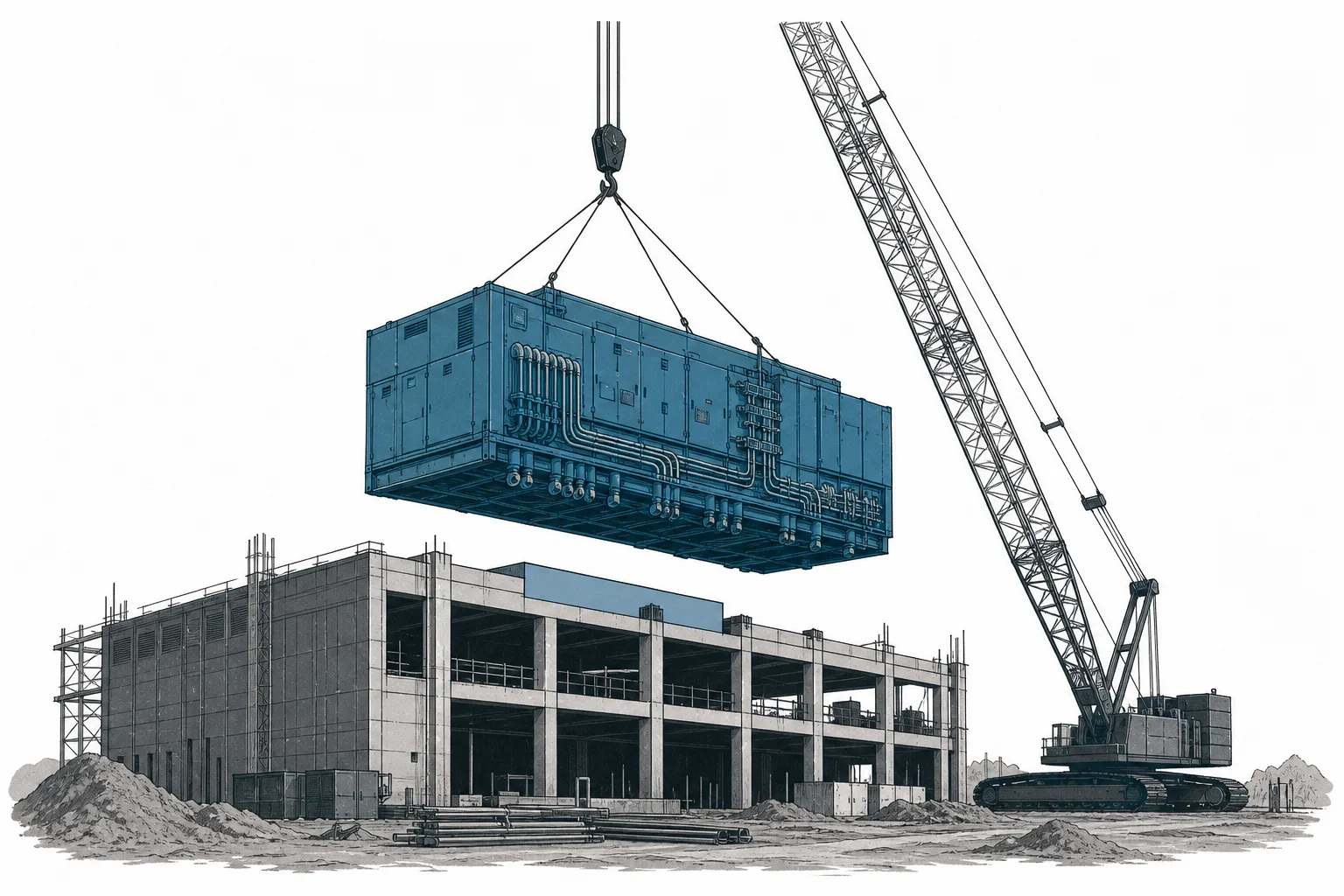
The third direction is prefab changing how things get built. To solve both the labor shortage and to speed up speed-to-power, the industry is moving toward assembling "modular power rooms" in a factory where quality is controlled, then dropping them on site as blocks. This makes switch-on up to ~50% faster and cuts reliance on on-site trades — turning part of construction into something more like an "assembly line." Whoever pivots to prefab first will control cost and time better.
07Challenges & risks
The first risk is a shortage of skilled trades. All of this work depends on skilled electricians and mechanical workers who take years to train. When every project competes for the same trades, wages spike, schedules stretch, and quality is at risk — if you can't find people, a backlog that looks beautiful on paper can't be delivered on time, becoming profit "stuck in the queue."
The second risk is equipment lead times. Transformers and switchgear with 2+ year waits make it hard for contractors to control delivery dates. A single late component can drag the whole project's timeline, and because some of the work is fixed-price, delays and surging material costs can eat into margins — a risk outside the contractor's own control.
The third and biggest risk is the AI capex cycle. All of this group's revenue is tied to big tech continuing to pour money into building data centers. If AI demand slows, or an "overbuild" leaves the tech giants easing off their investment plans, a long backlog could shrink as fast as it grew — contracting has always been a business that rises and falls with the investment cycle, and this round has its fate pinned on one question: "is the AI demand really there to match what's been invested?"
In short: this node is the hands that physically build the "body of AI," one step at a time — design, pour the foundations, run the wiring, set the switchgear, then get everything to switch on. It's work no one puts in a headline, but it's the bottleneck that decides when trillions in AI investment become a working factory — and right now, the whole world is fighting over the same group of trades.