Megatrend · Artificial Intelligence
The landlords of the AI age: the people who build the halls and rent out the "electricity"
Behind the AI battle that NVIDIA, OpenAI, and the cloud giants are fighting over, there's a quiet group collecting rent from everyone — companies that buy the land, pull in high-voltage power lines, pour the concrete, and then lease "space + power + cooling" to the tech giants. Many of them are listed as REITs (real-estate investment trusts). This lesson takes you to the most tangible layer of AI — and why, in this era, the thing you rent out is no longer square meters but "megawatts," and why tenants book years ahead, before the building is even finished.
01What it is (the building owner + REIT)
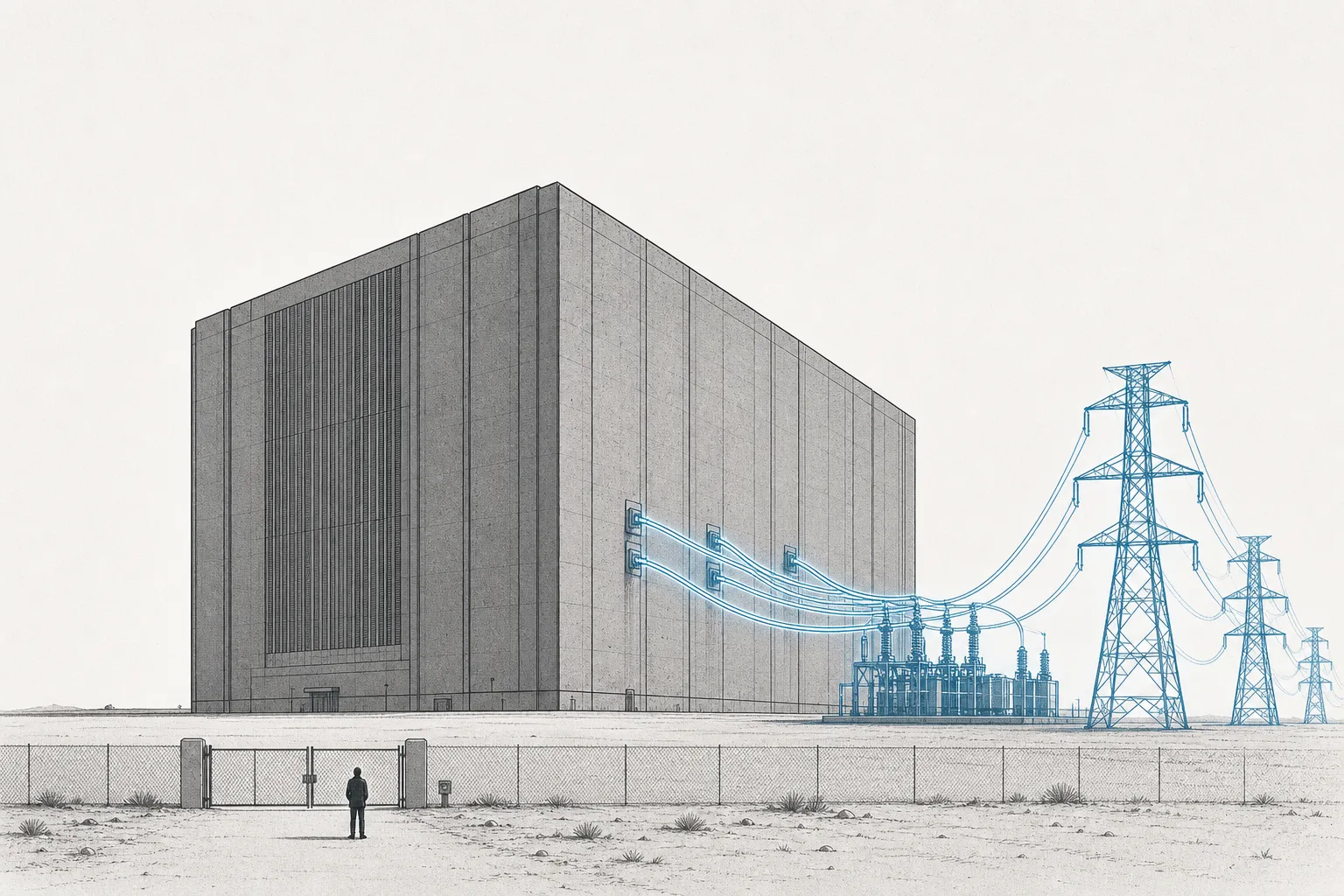
Think of the AI battle like a gold rush. Everyone knows the miners — NVIDIA selling the "shovels" (the chips), OpenAI and Google digging for the "gold" (the AI models). But there's another group almost no one talks about, even though it collects money from everyone on the field — the landlords who own the land you mine on. These are the companies that pour big money into buying land, pulling in power, and putting up buildings, then lease them out to tech giants to set up their AI servers — this node is the story of that group.
The industry's word for this business is colocation — literally "putting things together in one place." One company builds a data center with full power and cooling, then lets other companies bring in their servers and pay rent, instead of each one building its own hall. What's interesting is that many of the big players are listed as REITs (Real Estate Investment Trust), because in the eyes of the law, a data center is just another "building for rent" — like a mall or an office — except the tenants are servers and the real product is power and cooling.
On the megatrend map, this node is a branch under AI Data Center & Build-out within the big trend Artificial Intelligence. It's the "property-owner layer" of building an AI data center, and it's clearly different from its siblings: AI Server OEM is the one assembling the "servers" that go inside · Build-out & Construction is the contractor who actually "builds" the hall — while this node is the owner who holds title to that building and collects rent over the long term. The three together build one data center, but with different roles and different business models.
Colocation = renting out space in a data center with power and cooling so customers can bring in their servers · REIT = a trust that owns rental real estate; it must pay out most of its profit to shareholders as dividends in exchange for lower corporate tax · Retail colo = renting a rack at a time or a few cabinets (under ~250 kilowatts), short contracts, for ordinary businesses · Wholesale / hyperscale = renting a room or a whole building (several megawatts and up), long 5–20-year contracts, for the cloud giants.
02Why it matters — electricity is the scarce resource
There's one line that captures this business best: renting a data center used to mean renting "square meters," but in the AI era it became renting "megawatts." That's because new-generation AI servers draw a staggering amount of power. A single AI server rack can pull hundreds of kilowatts — ten times more than the previous era. So the thing that's truly scarce isn't land or concrete, it's electricity that actually arrives on schedule. Whoever controls the power controls the game.
The demand-side numbers are startling: in 2025 the world signed new data-center leases totaling over 15 gigawatts, and between 2026 and 2030 nearly 100 more gigawatts of capacity are expected to be added — the equivalent of doubling the world's entire capacity. The market is expected to grow about 14% a year through 2030. In the U.S. alone, the central bank (the Fed) estimates investment in data centers will reach roughly $370 billion a year by mid-2026.
But supply can't keep up. This is exactly why this business is so unusually profitable — when demand overflows and vacant space is scarce, rents spike. By late 2025, vacancy in North America's primary markets had fallen to just 1.4%, an all-time low. In a big market like Northern Virginia it's even below 1%. As a result, wholesale rents climbed to about $196 per kilowatt per month, up ~6.6% in a single year and around 50% over five years.
03How it works (land + power → megawatts to rent)
This node's business model is simple in principle but hard in practice — it's about turning "land + the right to use power + a building" into "megawatts ready to rent," then leasing it out by the rack so tenants can plug in their servers. Let's walk through, step by step, how a single dollar of rent comes to be.
What makes this business "deep" is that it has two very different sub-models. Retail colocation means renting a rack at a time or a few cabinets; the customers are ordinary businesses, contracts are short (12–36 months), like renting a room in a small commercial building — the per-unit profit is high because of add-on services, especially interconnection, which lets customers wire directly to each other and into the cloud within one building. Wholesale / hyperscale means renting a room or a whole building (several megawatts); the customers are cloud giants and contracts run long, 5–20 years — the per-unit profit is thinner but the chunk is big and stable because the tenants are global companies. These campuses are designed as modules that scale from 100 to 500 megawatts.
04Where it sits in the AI ecosystem
This node sits at the very center of the whole AI circuit — it's the "foundation" everything else has to rest on. Let's look at who it connects to.
- The tenants are the cloud giants (hyperscalers): Microsoft, Amazon, Google, Oracle, Meta — these are the main customers of wholesale/hyperscale colo, renting hundreds of megawatts at a time to stand up their own AI clusters. So this node's demand is tied directly to the AI capex budgets of just these few companies
- It needs power and cooling as its lifeblood: the building owner sells power, but first has to go get it — so this node depends directly on the grid, power plants, and the liquid cooling that high-density AI racks require
- Clearly different from its neighbors: AI Server OEM sells the "machines" that go in the building · Construction & Engineering does the "building" of the hall — but this node is the one that "holds title and collects rent". The three work on different rhythms, different revenue models
- It drives global demand for energy and raw materials: every new campus is a massive order for electricity, transformers, copper, and steel — this small node is an upstream force that ripples all the way to energy and commodity markets
05Where it stands now
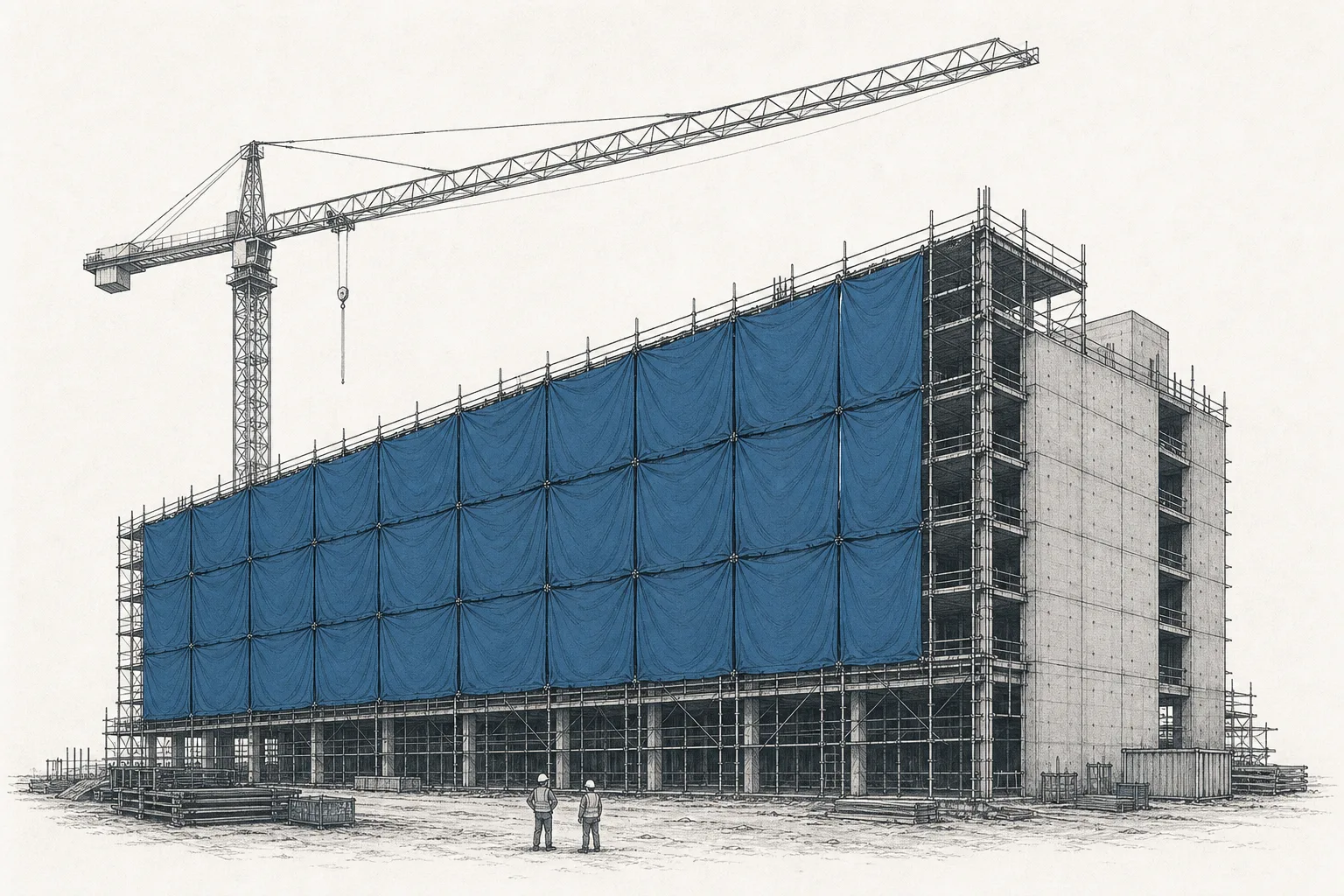
The 2025–2026 picture is a market in severe shortage. In 2025, North America's primary markets absorbed 2,498 megawatts of new space (net absorption), smashing the old record of 1,810 megawatts in 2024. Even more striking: 73% of the capacity under construction was already booked before it was finished (pre-leased) — tenants aren't waiting for buildings to be done; they're reserving years ahead because they're afraid there won't be space.
On the stock-market side, the stage is dominated by two giant REITs playing different games. Equinix is the king of retail colo + interconnection, with over 260 data centers (IBX) in 70+ cities worldwide and more than 460,000 interconnections between customers. Its 2025 revenue was about $8.4 billion, with interconnection alone making up nearly 18% — a moat that's hard to copy, because the more customers connect to each other, the more valuable the building gets. Digital Realty, meanwhile, is the heavyweight on the wholesale side, specializing in large blocks for the cloud giants. In Q3 2025 it had a signed-but-not-yet-billing backlog of $852 million a year and roughly 730 megawatts under development, with over 85% of the new supply already booked.
Another name on the rise is Iron Mountain — originally a document-storage and data-destruction company, but it built up a data-center business to about 452 megawatts of leasable capacity in Q3 2025, fully 97% leased, with a target of leasing about 125 new megawatts in a single year. On the cost side, building a data center ready for AI work now runs $20 million per megawatt and up — a capital-hungry business where whoever has cheap capital and land wired to power has the edge.
06The road ahead — follow the power
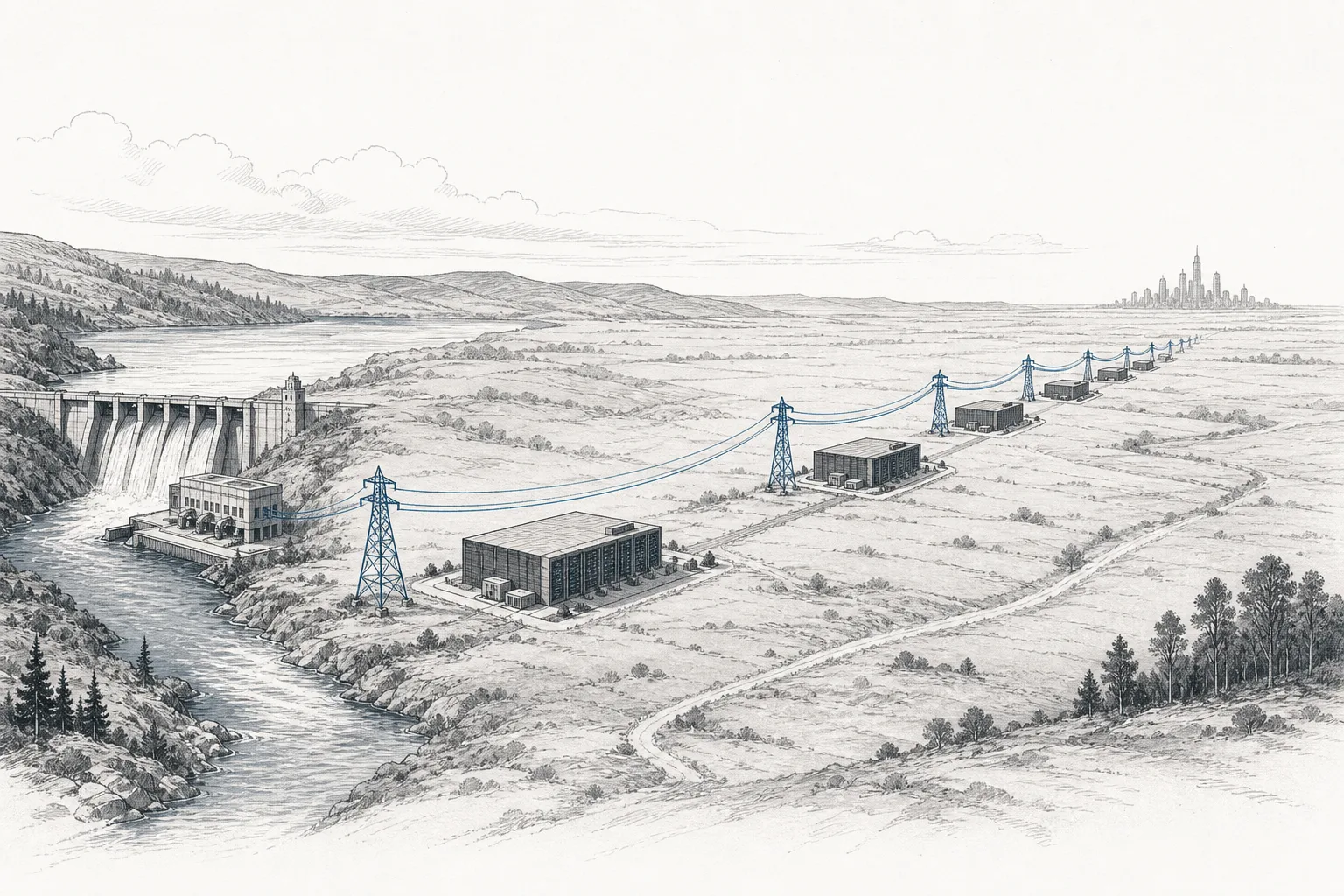
The first and most important direction is "power-first" — site by the power, not by the city. Data centers used to need to be near big cities so signals could run fast. But now the scarcer thing is power, so developers are moving to where power is available — near dams, nuclear plants, or gas sources. In some areas, the wait to connect to the grid runs as long as 5–7 years (in PJM territory and Virginia, for instance), making the "right to use power" an asset worth even more than the land itself.
The second direction is the cloud giants' "build vs. rent" game. The cloud giants used to prefer building their own data centers, but with AI growing faster than expected and the wait for power and land getting longer, they're leaning toward renting more because professional colo developers can find power-connected land and build faster. Pre-booking entire multi-year build roadmaps has become normal — this chunk of demand is a strong tailwind for this node over the next 3–5 years.
The third direction is a flood of capital pouring in. Because long-term rental income from global tenants is a steady, investable cash flow, giant funds like Blackstone and Brookfield have moved in to own major colo developers, and the M&A is fierce — like CoreWeave acquiring Core Scientific for about $9 billion in 2025 to lock up power and space — reflecting that "whoever controls the physical infrastructure has bargaining power across the entire AI supply chain."
07Challenges & risks
The first risk is the cloud giants might go back to building their own. This node's biggest customers are just a few companies, and they have enough cash to build data centers themselves. If one day the wait for power eases or they decide to control costs in-house, large-block rental demand could shrink fast — it's a business that leans on a handful of customers, so any swing in their AI investment plans hits the landlords immediately.
The second risk is interest rates and the REIT structure. This business is capital-hungry (tens of millions of dollars to build a single megawatt), so it requires large borrowing. When rates are high, financing costs balloon and directly pressure profits and REIT share prices. And because a REIT has to pay out almost all its profit as dividends, the cash for expansion has to come from borrowing and issuing new shares — making it more sensitive to capital-market conditions than an ordinary business.
The third risk is not enough power, and community pushback. What used to be an advantage (shortage, high rents) is also a double-edged sword — if power can't be connected on schedule, a finished building becomes an empty concrete box that generates no revenue. At the same time, many communities are starting to resist data centers because they hog power, hog water (used for cooling), and push up the whole town's electricity bills — regulatory and local-political risk is steadily rising.
In short: this node is the most tangible layer of AI — the people who turn land and electricity into megawatts and rent them out so the world's digital brains can run. As long as AI keeps thirsting for power, these landlords keep collecting rent from this gold rush.