Megatrend · Critical Materials
The most boring metals in the world are getting a new story
Steel and aluminum are ancient commodities — brutally volatile, with half the world's output controlled by China. Nothing about that sounds exciting. But right now they're getting a new plot, driven by three forces at once: factories coming home (reshoring), a massive build-out of power grids and AI data centers, and tariff walls that shelter domestic producers. This lesson explains why the heavy, boring stuff suddenly matters again — and why, deep down, it's still a cyclical commodity.
01What it is
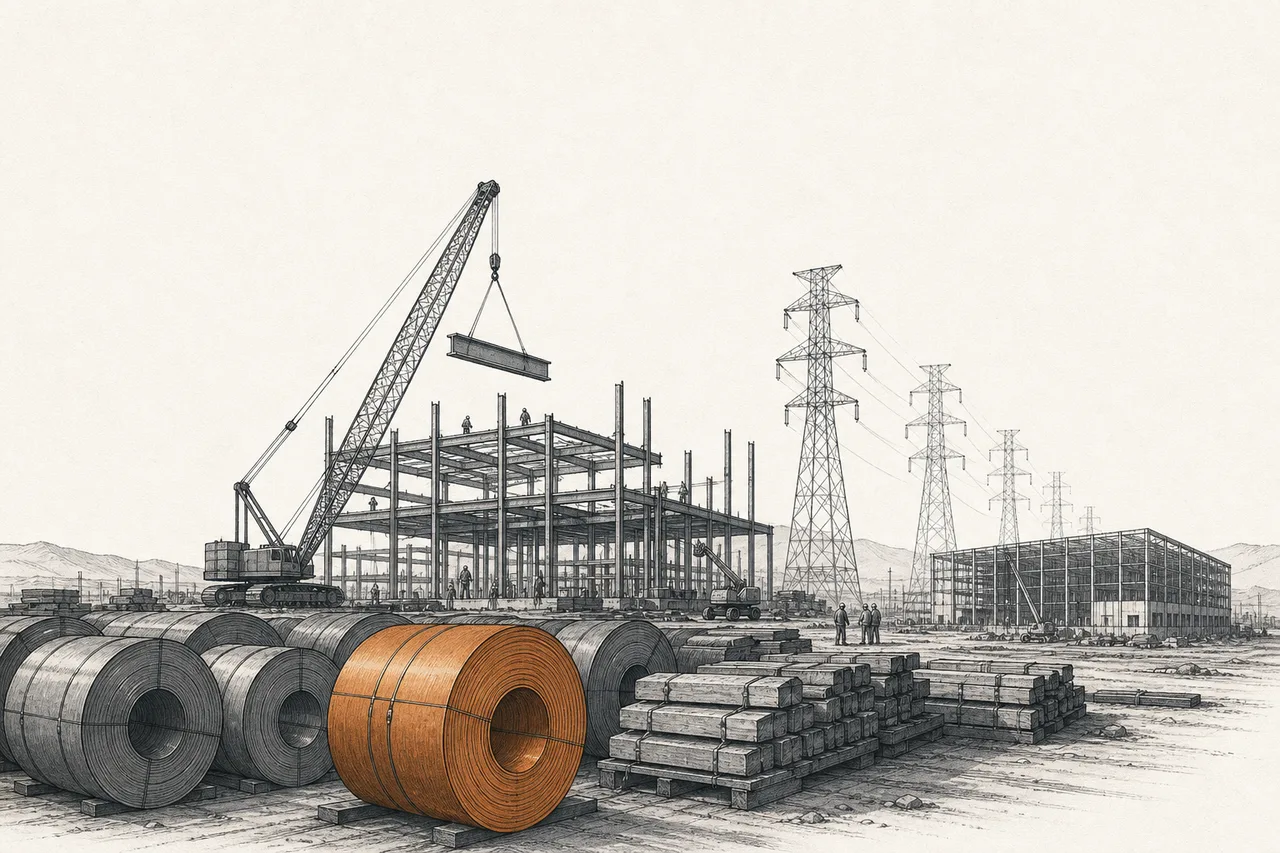
Think about the things around you right now — the building itself, power poles, bridges, car bodies, machine frames, water pipes. Almost all of it is made from a handful of materials that are cheap, heavy, and produced by the millions of tons. That's bulk & structural metals — mainly steel and aluminum, plus structural alloys like titanium and specialty steel.
These are the opposite of 'rare minerals.' They aren't scarce or hard to find. The world makes over 1.9 billion tons of steel a year, plus tens of millions of tons of aluminum. They're standardized products anyone can make, so the whole game is price and cost — a classic 'commodity' business where profits swing wildly with the economic cycle.
So why does this node sit under the Critical Materials & Supply Chain megatrend? Its definition answers plainly: these metals don't get re-rated because of 'mineral scarcity' like copper or lithium. They get re-rated because of policy — specifically US reshoring and Section 232 tariffs. This is a story about 'old metal with a new narrative,' not 'a new mineral running short.'
Moving production that had gone overseas (to China, say) back home or to allied countries, for supply-chain security. When factories, power plants, and infrastructure get rebuilt domestically, they need enormous amounts of steel and aluminum — and they want to use domestically made metal. That's the heart of this group's 'new story.'
02Why the 'boring stuff' matters again
The story starts with a fact that's depressing for Western producers: China owns this market almost completely. In 2025, China made about 1.04 billion tons of steel — ~55% of the world's total — and about 45 million tons of aluminum, ~57–60% of the world. China has ~17% of the world's population but produces roughly half its steel, aluminum, and copper.
In the old world, that's game over — the West can't compete with China on cost. But then three forces converged and flipped the equation:
(1) Tariff walls. In June 2025, the US raised import tariffs on steel and aluminum under Section 232 to 50% (effective June 4, 2025). Tariffs that high push imported steel prices so high that foreign rivals can barely sell in the US — handing domestic producers a 'home market' with price discipline and much better margins.
(2) A massive build-out. Factory reshoring (EV plants, chip plants), the expansion of grids and transmission lines, and the AI data center boom all eat huge amounts of steel and aluminum. In 2025 alone, US utilities received grid-connection requests from data centers totaling over 700 gigawatts — more than all the electricity the US used in all of 2023 (477 GW). US power demand is projected to grow +17% by 2030.
(3) Security. After the lessons of COVID and geopolitical tension, Western governments want their 'national base materials' produced at home, not sourced from a rival — so steel and aluminum are now treated as a matter of security, not just a commodity.
You can see the result in the financials. In 2025, Steel Dynamics hit a 25% EBITDA margin and ran at 86% of capacity — above the US steel industry's 77% average. Because tariffs shut the door on imports, domestic producers got price discipline and strong margins.
03How it works — from ore to structure
To see why 'domestic policy' matters so much to these metals, you first have to picture how they flow. Steel and aluminum don't end their journey at the smelter — they flow on to become the 'skeleton' of everything the other megatrends are building.
The thing to grasp is that the metal intensity of what's being built is higher than people think. An AI-era data center isn't just a box full of servers — it needs heavy steel framing, large-scale electrical systems, and metal-hungry cooling. As the share of AI-specific data centers rises from ~25% today to over 60% by 2035, the metal intensity per building only goes up.
Aluminum has its own structural story — EVs use about 60–80 kg more aluminum per vehicle than gas cars (body, battery box, motor), so EV-driven aluminum demand is projected to approach nearly 10 million tons a year by 2030. And transmission lines use aluminum as their main conductor.
04Where it sits on the materials map
This node is a sub-theme of the Critical Materials & Supply Chain megatrend, but it's clearly a 'different species' from its siblings — and that difference is the key to understanding it.
Most siblings in Critical Materials are driven by mineral scarcity — like copper, where electrification demand outpaces what can be mined, or rare earths for magnets, or lithium for batteries. For all of those, the story is 'will there be enough?'
But Bulk & Structural Metals is different — steel and aluminum aren't scarce; if anything there's a glut (China produces far more than it needs). So their story isn't 'mineral shortage' but 'who gets the right to produce and sell in which market' — decided by tariffs, policy, and national security. Put simply: the siblings' game is geology; this one's game is geopolitics and policy.
On the 'downstream' side, this node supplies the infrastructure for nearly every other megatrend:
- Feeds Grid & Transmission: transmission towers, transformers, and substation frames are all steel and aluminum — and right now a shortage of transformers and steel pipe has become the bottleneck for connecting to the grid
- Feeds AI data centers: building frames, power systems, cooling — the AI boom is an indirect structural-steel boom
- Feeds Sovereign Supply & strategic reshoring: warships, tanks, and aircraft frames need specialty steel and titanium that can be made domestically — security makes governments want to protect their national producers
- Runs parallel to Copper: the same construction and grid work that soaks up copper also soaks up steel and aluminum — but copper tells a 'shortage' story while steel tells a 'policy' one
05Where it stands now + the players
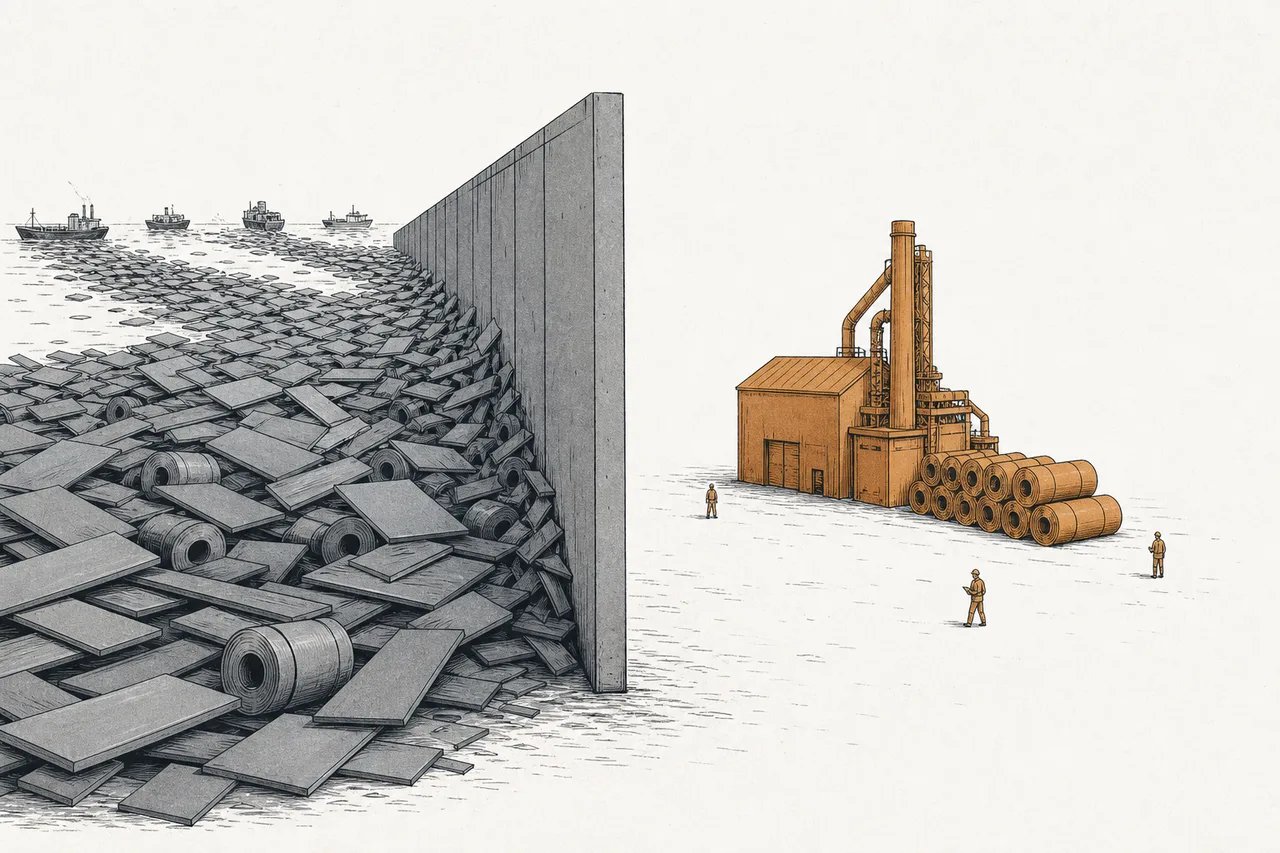
The 2025–2026 picture has two clearly opposite sides. On the US side, domestic steelmakers are in a good stretch. The 50% tariff keeps domestic steel prices above the world market, producers run flat out, and they're accelerating investment in new plants to capture reshoring and data-center demand.
But on the global-market side, things are tense. In 2025 China's steel exports hit a record 131 million tons (because China's own domestic demand shrank ~6.5%). The OECD reckons the world's excess capacity has hit a record and will rise from 640 million tons in 2025 to 745 million tons in 2028. That's the 'double-edged sword' of this trend: inside the US, prices and profits are high thanks to the tariff wall, but that same wall pushes the world's surplus steel out to crush prices in other markets.
The real players in this trend split into two worlds: domestic producers riding the tariff tailwind (America in the lead) and the global giants and China that set the baseline price for the whole market.
06Green steel
There's one more 'new story' layered on top — and it matters more than many people think. Making steel is one of the dirtiest processes in the world. The steel industry emits ~7–9% of all global emissions, because the traditional method (a blast furnace with coke) burns coal to roast iron ore, putting out over 2,000 kg of carbon per ton of steel.
The solution gaining ground is 'H2-DRI' — using green hydrogen (hydrogen made from clean electricity) instead of coal to 'pull the oxygen out' of iron ore, then melting it in an electric arc furnace running on clean power. This cuts carbon from over 2,000 kg to under 400 kg per ton.
'The price gap by which clean goods cost more than ordinary ones.' Today green steel costs about 40% more than regular steel. That sounds like a lot, but because steel is only a small slice of a finished product's cost, the green premium raises the price of one EV by only ~1% — which is why carmakers and tech firms will pay it for better carbon numbers, and why green steel has a real 'premium market,' not just a dream.
This matters to the node because it gives Western producers a legitimate reason to 'sell at a higher price.' Producers already using EAF, like Nucor and Steel Dynamics, already have far lower carbon per ton than China's coke-based mills. Giants like ArcelorMittal are spearheading H2-DRI projects in Europe. Pioneering green-steel plants like the one in Sweden started running in 2025 — 'clean steel made at home' has become a selling point that tariffs alone can't deliver.
07The road ahead
The first direction is a 'construction supercycle.' If factory reshoring, grid expansion, and the data-center boom keep going as planned, domestic steel/aluminum demand in the West stays strong for years. So domestic producers are accelerating investment to add capacity (like Nucor's new steel mill) to capture this demand before anyone else.
The second direction is 'how long will the tariff wall last?' Domestic producers' profits and investment are now inseparable from the 50% tariff. If it gets lowered, eased, or carved out with more exemptions for allied countries, the profit equation changes instantly. This is a policy variable that decides fate more than any market variable — and it's hard to predict.
The third direction is 'green steel becomes the standard.' As carbon rules tighten (like Europe's carbon border adjustment), coal-made goods get charged extra for carbon, sharpening the edge of low-carbon producers (EAF/H2-DRI) — a force that slowly tilts the field toward clean producers, but takes decades to play out.
08Challenges & risks
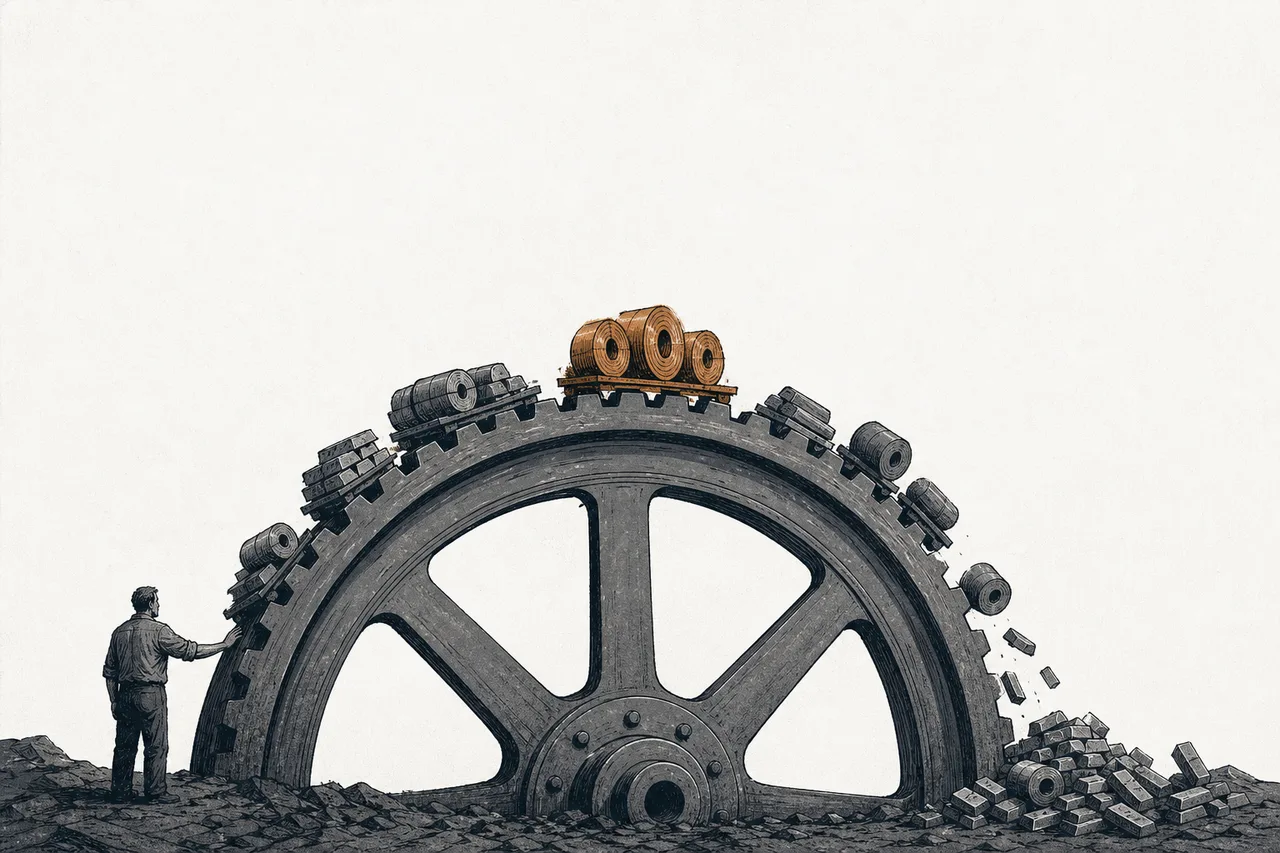
The first and deepest risk is deep cyclicality. This is a business where profits swing hard with the economic cycle. In a construction boom, profits flood in; in a slowdown, they can sell below cost. The reshoring story gives demand more of a 'floor,' but it doesn't erase the cycle — so investing in this group means learning to read the cycle's timing, not buying on good news at peak profits.
The second risk is China overcapacity. As long as China holds enormous excess capacity (global surplus hits 745 million tons in 2028) and keeps heavily subsidizing its domestic producers, cheap steel will flood toward any market without a wall, chronically pushing down world prices. A tariff wall protects only the home market — it doesn't fix the global glut.
The third risk is tariff dependence. Most of American producers' fat profits come from the 50% tariff, a political decision, not a permanent structural advantage. A change of government, a new trade deal, or more exemptions — and profits can shrink fast. It's a risk the market tends to underrate.
The fourth risk is energy cost, especially for aluminum, whose smelting eats enormous amounts of power (often called 'solidified electricity'). When power prices spike — exactly what's happening now as data centers compete for electricity — aluminum producers' costs spike too. It's an irony: the very thing driving demand (AI/data centers) is also the thing driving up the producers' own energy costs.
In short: steel and aluminum are the most boring materials around, yet they've suddenly become the skeleton of a new boom — factories coming home, grids that have to expand, and AI data centers springing up everywhere. What makes them interesting isn't 'mineral scarcity' but 'policy picking sides' — and that's both the appeal and the fragility of these metals, at the same time.