Megatrend · Defense & Geopolitical Fragmentation
The fighter jet you can't build when the raw materials are in a rival's hands
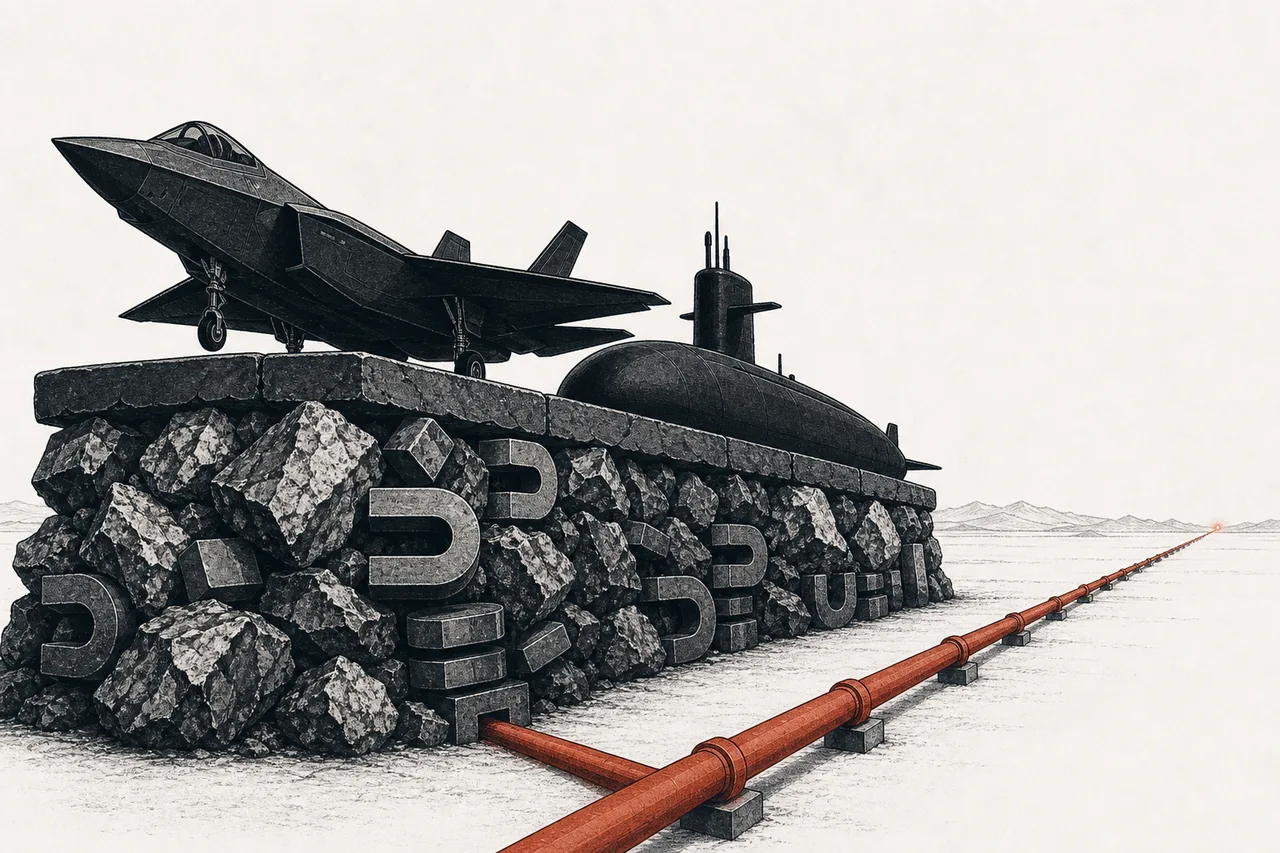
A single F-35 needs more than 400 kilograms of rare-earth magnets — and almost every magnet of that kind in the world is made in China, the same country the West is preparing to fight. This is the story of the defense industry's "deepest vulnerability," and how governments are now investing their own money to pull the raw-material supply chain back home.
01What it is
When we think of "security," we tend to picture the big, visible things — fighter jets, submarines, missiles. But there's one question people outside the industry almost never ask: where do the "insides" that build them come from? The magnets that spin the motors, the titanium that survives the heat in the engine, the special alloys in the turbine blades — most of these raw materials are not made in the country that would take them to war.
This node is about "owning the defense raw-material supply chain" (sovereign supply) — pulling the production of strategic materials and parts back into your own country or allied bloc, so the "guts" of an entire weapons system don't depend on a strategic rival. It splits into two connected worlds, which are the two sub-themes of this node:
- Upstream raw materials — rare earths and magnets (Sovereign Critical Minerals & Magnets): mining rare earths outside China, and building "permanent magnet" plants at home — the heart of the motors in aircraft, missiles, and drones
- Midstream raw materials — strategic metals and parts (Defense Industrial Base — Strategic Materials): titanium, heat-resistant alloys (superalloy), and precision parts for engines and airframes — the ones now being "pulled back home"
Reshoring = moving production that once sat abroad back into your own country · Friend-shoring = moving it to trusted allies (Australia, Japan) instead of relying on a rival · permanent magnet of the NdFeB (neodymium-iron-boron) type is the strongest magnet commercially available, made from rare earths — the "muscle" that drives the motors and guidance systems of nearly every modern weapon.
On the megatrend map, Sovereign Supply sits under Defense & Geopolitical Fragmentation and is the "deepest supply-chain layer" of them all — deeper even than the munitions, because it's the raw material used to build everything, including the munitions themselves. If this layer is missing, none of the layers above can be built.
02Why it's a big deal
The number that keeps the Pentagon up at night is about rare-earth magnets. China makes around 93% of the world's high-performance permanent magnets, controls about 70% of rare-earth mining, and dominates the hardest step — "refining" — at about 90% of the world. Put simply: even if you mine the ore somewhere else, in the end you still have to ship it to China to be processed.
Why is this especially dangerous for defense? Because modern weapons "eat magnets" by the ton. An F-35 fighter uses more than 400 kilograms of rare earths per aircraft, a Virginia-class submarine about 4 tons each, and the entire US military uses 3,000–4,000 tons of rare-earth magnets a year — these magnets sit in everything from missile guidance systems, radar, and drone motors to the JDAM guided bomb.
And this is no longer just a theoretical risk. In October 2025, China issued Announcement No. 61, the strictest export controls on rare earths and magnets it has ever imposed — and the first time it named a foreign "defense sector" as a direct target. In effect, China openly turned rare earths from a "product" into an "economic weapon."
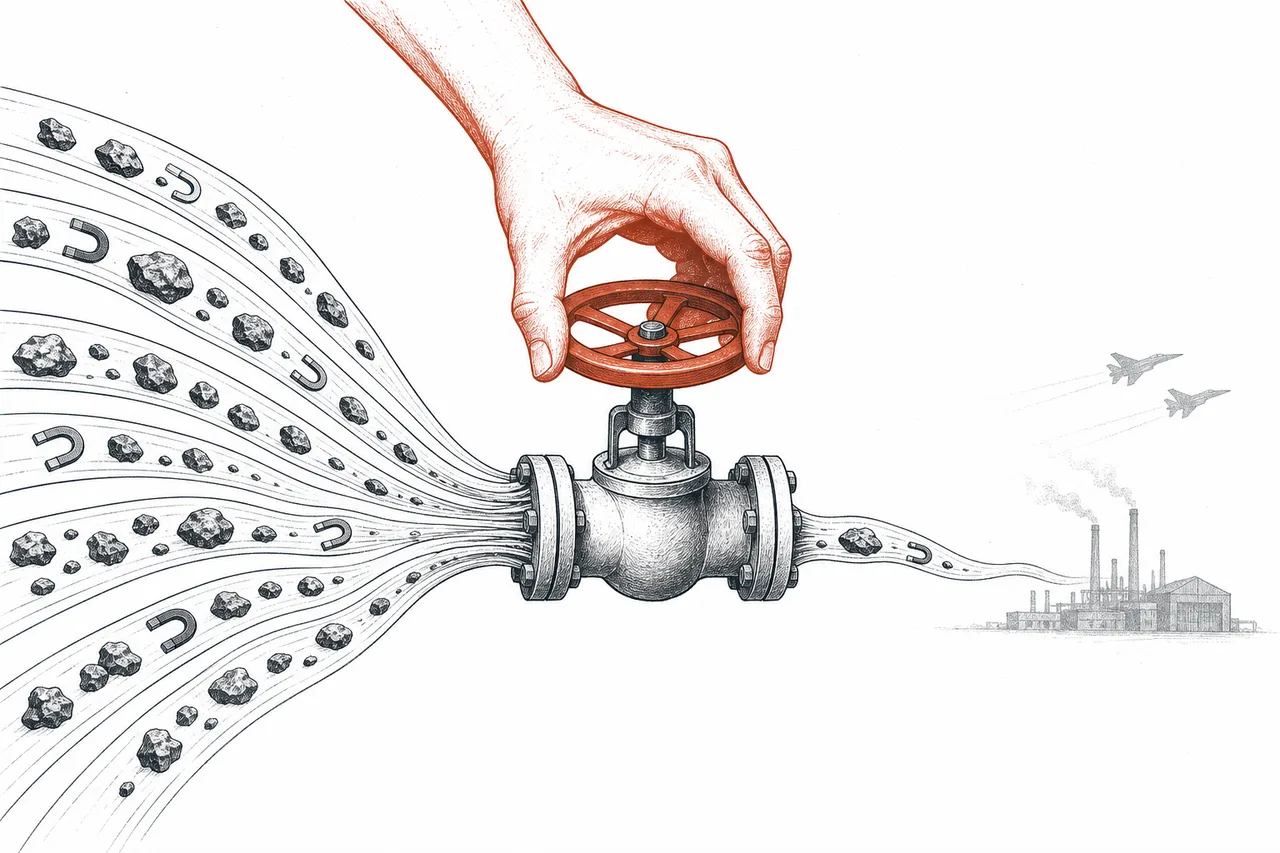
The same problem spreads to other metals. Titanium — the main metal in airframes and engines — is one the US imports as "titanium sponge" (the starting material) at over 95%, with Russia and China together controlling about 75% of the world's sponge capacity. Meanwhile antimony, used in over 200 types of defense munitions — from 5.56mm rounds to 155mm artillery shells — was banned for export by China starting in late 2024. The big picture is clear: the raw-material supply chain of Western weapons is tied to a rival at several points at once.
And the chokepoints don't stop at raw materials — "casting and forging" giant parts (submarine shafts, turbine blades) leaves several of them with a single producer in the whole country, which is why Virginia-class submarines, ordered at 2 a year, can actually be built at only ~1.1 a year (see → ?node=22090200).
03How governments are solving this
You might ask, "so just build your own magnet plant — how hard is that?" The answer is that it's hard economically more than technically — and understanding this is understanding the heart of the whole node.
The problem is that China controls the cost. China can push the price of rare earths so low that a Western plant runs at a loss before it even opens. The price of the key material NdPr (neodymium-praseodymium) inside China sits below $60/kg. Who would dare invest billions in a plant if they know that the moment it opens, a rival will undercut the price until they can't sell? This is why the private sector alone failed for 20 years.
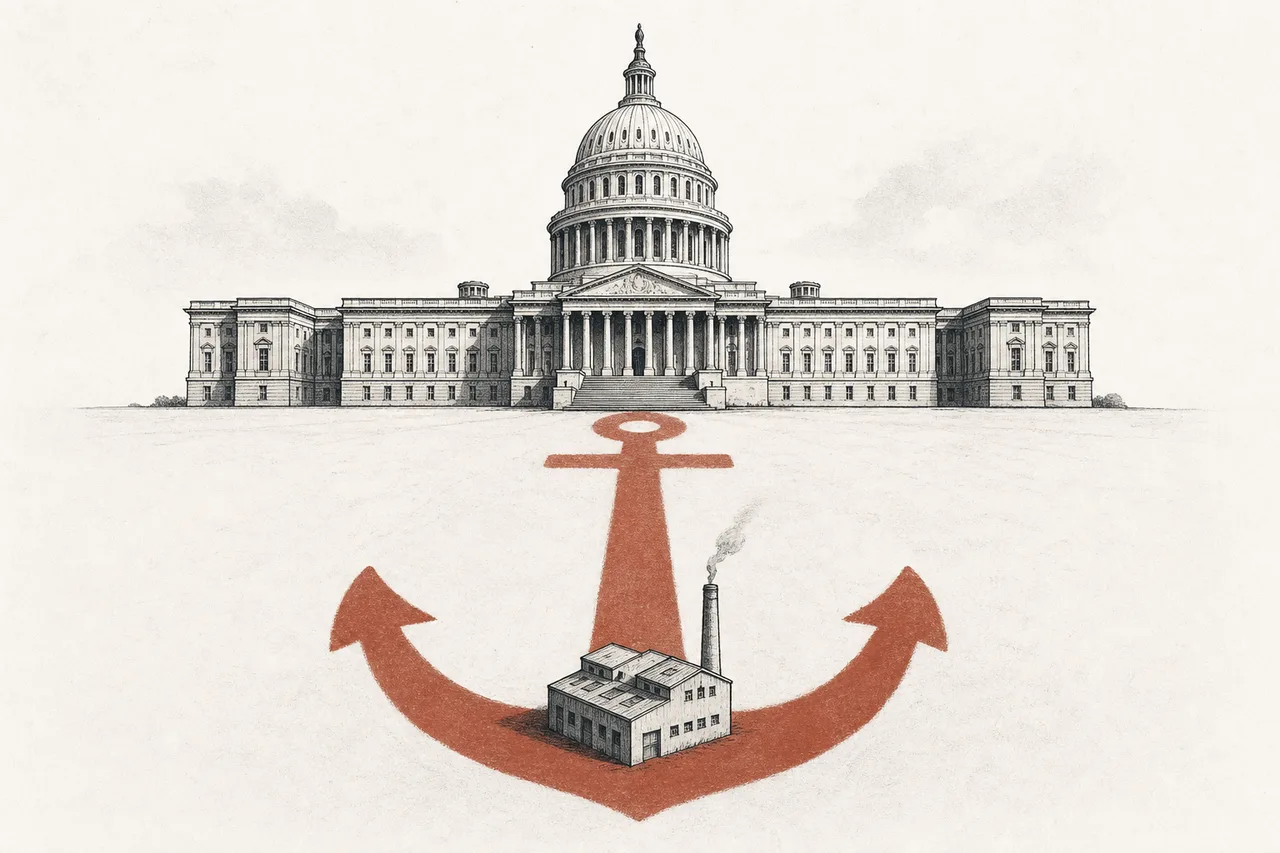
The way out that became the "template" is for the government to step in as both investor and main customer — to "carry" a domestic plant so it survives. The historic example is the Pentagon's deal with MP Materials in July 2025:
In this deal, the Pentagon bought $400 million of MP Materials' preferred stock, becoming its largest shareholder (around 15%), with a 10-year contract that guarantees a price floor for NdPr at $110/kg — if the market price falls below that, the government pays the difference. It also buys all the magnets from the new plant (the "10X Facility," ~7,000 tons/year, ~10,000 tons/year for MP overall) for 10 years. This mechanism is the exact opposite of a free market — it's the government "removing the price risk entirely" in exchange for having a supply chain of its own.
Price floor = the government guarantees a "minimum price"; if the market price falls, the government covers the difference — a shield against a rival dumping supply · Offtake agreement = a long-term advance purchase contract, so the plant knows it has a buyer for sure before pouring money into building. Both are tools that turn a project that's "too risky to invest in" into one that "actually gets built."
04How it connects in the ecosystem
This node is the "foundation" of the defense industry — it sits deeper than everything and connects up into the whole system. It splits into two sub-themes that flow into one chain:
- Upstream is rare earths and magnets (Sovereign Critical Minerals & Magnets): mining outside China and building magnet plants at home. This is the most fragile and most newsworthy layer (the MP–Pentagon deal is here)
- Midstream is strategic metals and parts (Defense Industrial Base — Strategic Materials): titanium, heat-resistant alloys, and engine/airframe parts being pulled back home to produce — the layer that feeds the "big defense companies" directly
And it connects out beyond the defense category along several lines:
- The security side of rare earths and magnets and critical materials: the same raw materials, but this node sees them through a "sovereignty and security" lens, while the Critical Materials category sees them through a market and clean-energy lens (EV, wind) — two angles on the same ore
- Feeds missiles and munitions and the big defense companies: no magnets and special metals, no missiles, no aircraft — this node is the "bottom-most layer" that props up every layer above
- Shares raw materials with commercial aviation and electric vehicles: the same titanium and magnets that defense fights over are also wanted by Boeing, Airbus, and EV makers — making demand and the scramble for raw materials run even hotter
05Where it stands now
2025 was the year this theme "exploded" into the mainstream. After China used rare earths as a pressure tool, Western governments opened their wallets all the way — and the money is flowing into both sub-themes at once.
On the rare earths and magnets side, the MP–Pentagon deal sparked a chain of deals. A few days later, Apple announced a $500 million investment in MP Materials to buy recycled magnets made in Texas (deliveries start in 2027) — a sign that even the commercial sector will pay a premium to avoid relying on China. Meanwhile Australia's Lynas and players like USA Rare Earth are racing to build rare-earth capacity outside China (for the details on heavy rare earths and the timeline, see → ?node=22090100).
The strategic metals and parts side is booming on the same wave. Jet-engine demand surged on both the commercial and defense sides, leaving special-metals makers with more orders than they can handle. ATI posted 2025 revenue of $4.6 billion (aerospace-defense about 68% of sales) and locked in another $4 billion of new metal-sales contracts running to 2040. Meanwhile Howmet Aerospace posted full-year revenue of $8.3 billion, with its engine-parts segment growing 16% — a signal that "building the real thing" can't keep up with demand.
Government support money is getting bigger and bigger too. The US government has about $1 billion in unobligated funds under the Defense Production Act (DPA) for stockpiling strategic minerals and subsidizing domestic production, and it has already started paying out real projects — for instance, a $47 million grant to IperionX to build an end-to-end domestic titanium supply chain.
06The road ahead
The first direction is that "the MP model gets copied". The invest-buy-backstop deal has proven it can actually wake up a domestic plant, and the same pattern is expected to spread to other strategic materials — titanium, antimony, tungsten, graphite — all of which share the same "China controls the price" problem. The government is shifting fully from "let the market work" to "strategic investor."
The second direction is the growth of the market behind it all. The global rare-earth magnet market sits at about $22 billion in 2025 and is expected to reach about $57–58 billion by 2035, driven by defense, EVs, and wind — demand growing in every direction makes building a supply chain outside China make business sense, not just security sense.
The third direction is "friend-shoring" — instead of doing everything at home (expensive and slow), the West is teaming up with allies. Australia (Lynas), Japan (titanium), Canada, and Europe, to spread the risk and share the cost. Building a "free-world supply chain" that never passes through China will be a decade-long investment theme.
07Challenges & risks
This hot-looking theme has shadows you have to see in full.
The first risk is "cost and time". Building a supply chain from mine to magnet at home takes years and costs several times more than buying from China. Even if you pour in the money today, it'll be years before a plant runs at full capacity — the gap between "announcing a deal" and "actually producing in volume" is the hidden risk. And China is still several lengths ahead.
The second risk is "China retaliating on price". China's most powerful tool isn't an export ban but opening the tap — dumping cheap ore back into the market just as a Western plant is about to open, to push it into losses and shut it down. This is why the government's $110/kg price floor matters so much — but it also means these projects rely on government subsidy. If the state ever stops backstopping them, the business model could wobble overnight.
The third risk is "the commodity cycle and political continuity". Ore and metal prices swing hard with the cycle, and this whole theme is tied to political will that can change with every election. A project that takes 10 years to pay off, but a policy that changes every 4 years, is an uncertainty investors have to weigh — as seen with some projects (like Lynas's Texas plant) still carrying "high uncertainty" over whether they'll go ahead.
In short: this node is a lesson that security doesn't start on the battlefield but at "the mine and the furnace." The world just discovered that a handful of raw materials are the most fragile point of military power — and that has turned governments from "weapons buyers" into "investors in mines and smelters," on the biggest scale in decades.