Megatrend · Carbon Removal
The plumbing of the carbon market: how do you turn an invisible ton of carbon into something you can actually buy and sell?
Carbon-sucking machines, biomass power plants, freshly planted forests — they all make the same one thing: "a ton of carbon pulled out of the air." But that thing is invisible and untouchable. So how do you sell it? The answer is to build "plumbing" that turns an invisible ton into a certificate you can count, verify, grade, and trade. This is the story of registries, measurement (MRV), rating firms, and carbon exchanges — at once the heart and the single greatest weak spot of the whole business of fixing the climate.
01What it is
Picture yourself as a company that just sucked 1,000 tons of carbon out of the air and locked it away in rock underground. Great — but what do you actually have in hand now? No product on a shelf, nothing to touch. Just "an event that already happened and that no one can see." So how do you sell it to Microsoft, when Microsoft can't see it either?
This is exactly the problem Carbon Market Infrastructure was born to solve. It's the behind-the-scenes "plumbing" that turns an invisible ton of carbon into a certificate (a credit) you can count, trade, and trust. Just as the stock market needs an exchange, listed companies, and auditors, the carbon market needs the same structure — and that's exactly what this field is about.
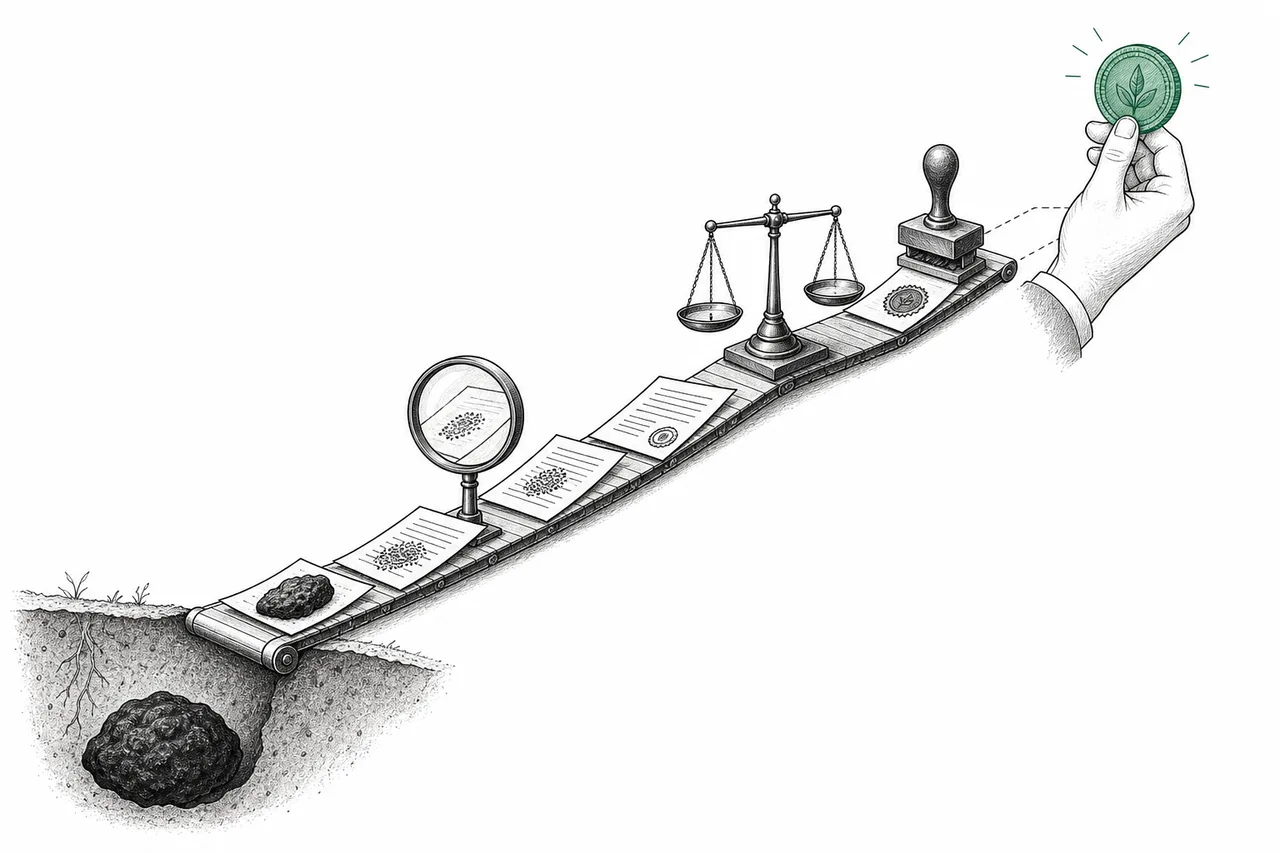
It's made of four main parts, connected like a conveyor belt:
1) MRV (Measurement, Reporting, Verification) = "measuring, reporting, and verifying" how many tons of carbon were actually removed — the truth layer · 2) Registry / Standard = the bodies that set the "standard" and "issue" credits, keeping the ledger of who holds, who resells, and who has used them up (Verra, Gold Standard, Puro.earth, Isometric) · 3) Ratings = firms that give credits a quality "grade" — the Moody's of carbon (Sylvera, BeZero, Calyx) · 4) Exchanges & Marketplaces = where credits actually trade, both spot and futures (CME, ICE, Xpansiv/CBL)
On the megatrend map, this field is the "infrastructure layer (platform)" under Carbon Removal, and it plays a special role — it removes not a single ton of carbon itself, but it's the "floor" that all its siblings stand on. Whether it's direct air capture (DAC), biomass (BECCS & Biochar), speeding up the weathering of rock, or capture through the ocean — every method pulls carbon out and then has to run back to this system to turn that work into revenue.
02Why it matters to the whole system
Start with a simple question: if this system breaks, what happens? The answer is the entire carbon-removal industry falls with it. If no one trusts the certificate, no one pays — and if no one pays, the DAC plants, the biomass power plants, the biochar projects have no revenue. Put simply, the real currency of this market is trust, not carbon.
And it matters because the market underneath is far bigger than people think. When we say "the carbon market," there are actually two worlds of wildly different size — the world of the "compliance market" where governments force factories to buy emission rights (like the EU ETS), and the world of the "voluntary market" where companies buy credits to offset their own carbon. The first world is enormous — on the ICE exchange alone, environmental contracts trade at a notional value of ~$1 trillion a year, four years running. The second world (where carbon removal lives) is still much smaller — but it's the one growing and reshaping itself the fastest.
This field is hot right now not just because it's growing, but because it just came through the biggest crisis of confidence in its history and is now rebuilding itself. In early 2023, The Guardian, working with researchers, published an investigation that shook the whole industry: more than 90% of the "avoided deforestation" credits from Verra (the world's largest registry) might be "phantom credits" that don't actually cut carbon. That research found that 94% of the credits were worthless to the climate.
Prices collapsed immediately. A typical carbon credit fell from ~$9 a ton (early 2022) to around ~$2, and the voluntary market shrank from ~$2 billion (2021) to around ~$500 million. It was an expensive lesson that woke the whole industry up to one thing: "if you can't measure it accurately and verify it, the credit is worthless" — and that's why all the money and attention now flows to the infrastructure layer: better MRV, stricter ratings, and standards you can trust.
03How it works (the life of one credit)
The best way to understand this field is to follow the life of "a single carbon credit" from birth to death — because each step in its life is a different company's business, and a different point where trust can break.
Steps 1–2 are the truth layer (MRV). Before anyone can issue a certificate, you need proof of how many tons of carbon were actually removed — measured with sensors, satellites, soil sampling, or a meter at the pipe outlet, and then confirmed by an "independent verifier." This is where the 2023 crisis broke down, because so many forest credits leaned on the assumption that "without this project, the forest would have been cut" — which is hard to prove and often exaggerated. So the new wave is dMRV (digital MRV) — using satellites, IoT, and real-time data instead of by-hand estimates, to make the numbers "impossible to argue with."
Step 3 is the heart — the registry "issues the certificate" (issuance). Once it passes verification, the registry issues a credit with a unique "serial number" and enters it into a central ledger, giving one ton of carbon an identity you can count and trace. This is exactly where direct-air-capture credits (called CORC on Puro.earth) or Isometric credits are born.
What makes a carbon credit different from a stock is that it can only be used once. When a company wants to count itself as having "offset its carbon," it instructs the ledger to retire the credit — it's "burned" out of the system permanently and can never be reused or resold. A good registry has to stop a single credit from being counted twice (double-counting), one of the carbon market's gravest sins — and the reason a transparent central ledger matters so much.
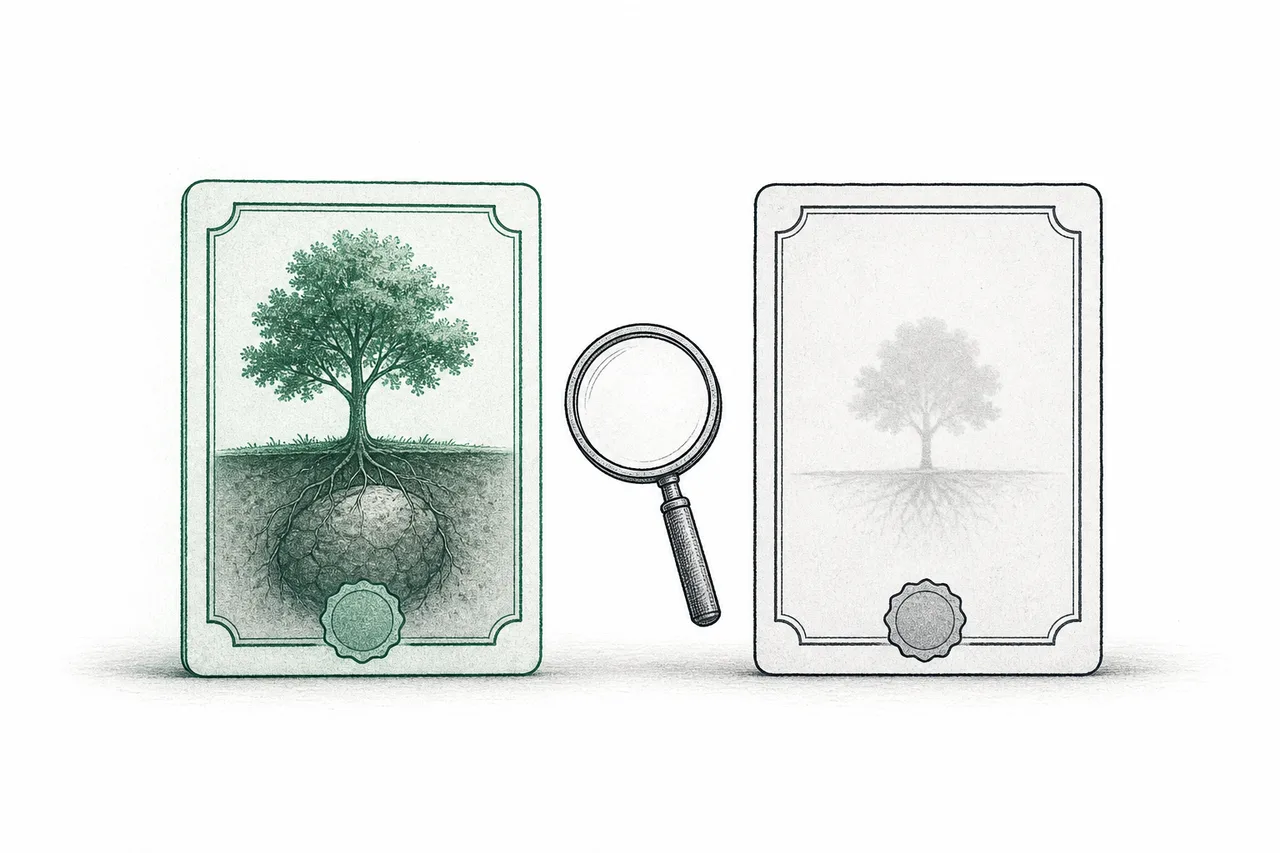
Step 4 is the "second opinion" layer — ratings, because passing the registry doesn't mean the credit is good. So firms that hand out grades sprang up (Sylvera, BeZero, Calyx), working like the Moody's/S&P of carbon — scoring credits from AAA down to D on "how much carbon they really remove, and how permanent it is." The result: the market began splitting prices sharply by grade.
Steps 5–6 are the market and the end. Graded credits get traded — face-to-face over the counter (OTC), on a spot exchange like Xpansiv/CBL, or as futures contracts on CME and ICE, letting buyers "lock in" a future price. And finally, when a company retires it, that credit ends its life — a ton of carbon that began invisible has been turned into an asset and used up with proof to show for it.
04How it connects in the ecosystem
This field is the "floor" everything in the carbon world stands on, so its relationships are different from its siblings' — it competes with no one, but is the condition for everyone else to exist:
- The exit for every carbon-removal technology: DAC, biomass (BECCS & Biochar), speeding up the weathering of rock, and capture through the ocean — every method produces "removed tons," but they can only be turned into money once they pass through this system. What's interesting is that each one has wildly different MRV challenges: DAC is very easy to measure (a meter at the pipe, locked in rock and verifiable for thousands of years), while forests and oceans are far harder — which is why "durable" credits (permanent, easy to verify) fetch many times the price of nature-based ones
- Depends on clean energy and power: the new generation of dMRV uses huge numbers of sensors, satellites, and cloud systems, and the carbon-removal projects themselves devour enormous power. So the carbon-market system "rides" on the world's energy and digital infrastructure
- Borrows tools from traditional finance: futures markets, clearing, custody — all of it technology that stock and commodity markets have used for hundreds of years, with the "blueprint" lifted straight onto carbon. That's why so many of the real players are old-line exchanges (Nasdaq, ICE, CME), not green startups
- Driven by policy and global rules: the Article 6 agreement under the Paris Agreement (approved at COP29 in late 2024) is the rule that lets countries officially trade carbon across borders — opening the door for the voluntary and compliance markets to start connecting
05Where it stands now
If 2023 was the year of the crisis of confidence, 2025 is the "year of cleansing and rebuilding" — the market grew not by volume but by quality. Money flowed out of junk credits and into high-grade, verifiable ones.
The clearest signal is that "price splits by grade", decisively. In 2025, high-grade (A–AAA) credits traded at an average of ~$14.80 a ton, while low-grade ones (CCC–B) sat at just ~$3.50 — and in reforestation projects (ARR) the gap is even wider, with high grades above $35 and low grades under $20. This is what the rating firms created: turning "quality" into a number with a price.
On the highest-quality side — "durable carbon removal (durable CDR)" — the boom has been explosive. In 2025, purchase contracts totaled ~29.6 million tons (up ~299% from the prior year), pushing the cumulative figure to ~42.5 million tons. But there's a worrying truth hidden in that number: Microsoft alone accounts for ~90% of 2025 purchase volume and has bought nearly 25 million tons all-time — meaning the entire market still leans on just a handful of "philanthropic" buyers. The moment Microsoft stops buying, the market shakes.
The registry layer saw important progress too. The neutral body ICVCM has certified 8 registry programs that meet the "Core Carbon Principles (CCP)" standard — including Verra, Gold Standard, Puro.earth, and Isometric — creating a central "quality label" buyers can use to sort the good from the bad. Puro.earth (the registry for durable credits in which Nasdaq is the major shareholder) had issued over 400,000 tons of biochar credits (CORC) by mid-2025.
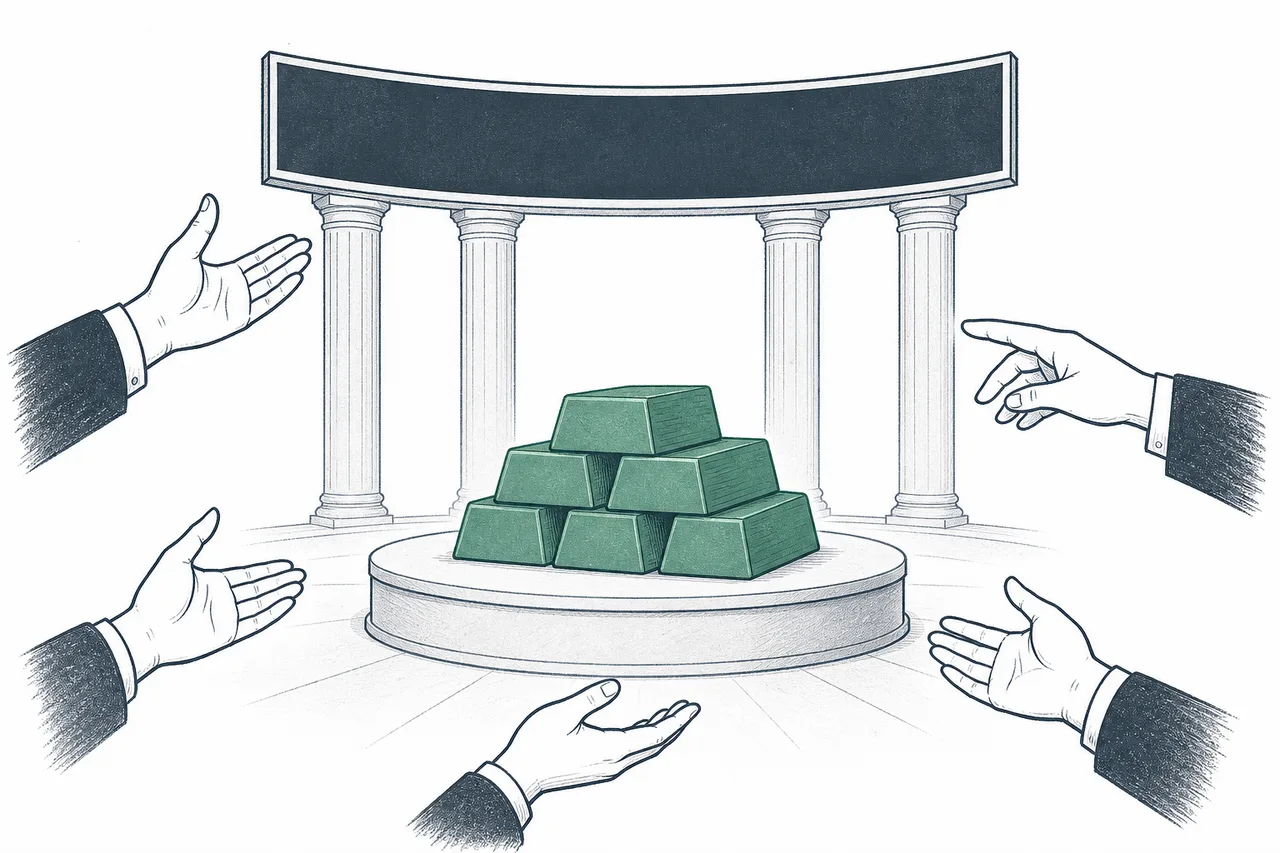
What makes this field interesting from an investor's eye is that many of the real players are already big public companies — not startups that haven't gone public yet. Because the carbon market's "plumbing" is being built by the exchanges and data firms that already exist:
06The road ahead
The first and biggest direction is "dMRV becomes the standard". The 2023 crisis proved that by-hand estimates and assumptions can't be trusted. The future is measuring with satellites, sensors, and real-time data until the numbers are "impossible to argue with" — whoever can make MRV cheaper and more accurate will win, because verification cost is one of the biggest costs of a high-quality credit.
The second direction is the merging of the voluntary and compliance markets. With the Article 6 rules now approved, high-quality credits that pass the CCP label will start to "cross the bridge" into government-recognized systems. If it works, this pulls enormous demand from the compliance world (hundreds of times larger) toward carbon-removal credits — turning it from "a market of philanthropic buyers" into "a market where people are required by law to buy."
The third direction is becoming a full-fledged financial asset. Once credits are standardized, graded, and tradable as futures, futures, options, indexes, and financial products follow. That's exactly why the big exchanges are stepping onto this field — their main interest isn't saving the world, but the "new commodity market" now taking shape.
07Challenges & risks
This field carries deep and unique risks, because it sells something completely untouchable — it sells "trust."
The first and biggest risk is a fresh crisis of confidence. This industry has only just recovered from the wound of 2023, when prices collapsed from $9 to $2 overnight. If a new investigation finds that the "durable" credits now booming (like biochar or BECCS) have MRV problems of their own, the trust just rebuilt could break again — and this time it would hurt more, because the market has placed higher bets.
The second risk is that the ratings themselves aren't always reliable. One analysis found that the three rating firms (Sylvera, BeZero, Calyx) can give the same project wildly different grades — one Amazon forest project got a high grade from Sylvera but low grades from the other two. With no "common standard" yet for what a good credit looks like, buyers stay confused, and even the "referees" are still arguing among themselves.
The third risk is a frightening concentration of demand. In the durable CDR market, Microsoft alone accounts for ~90% of purchase volume. A market this dependent on a single customer is not a healthy market — if Microsoft changes strategy or the economy cools, most of the demand vanishes in an instant, and the infrastructure built to support it may have far less to do than was invested in it.
The fourth risk is fragmentation. Today there are many registries, multiple sets of standards, multiple rating grades, and many marketplaces — and they still "can't talk to each other." A credit from one registry may not work on another marketplace. As long as there's no common standard and connected ledger, the risk of double-counting (counting the same ton of carbon twice) remains — and that's what destroys trust the fastest.
In one line: if carbon-removal technology is the "thing," this system is the "market and accounting" that gives the thing its value. It's the story of trying to build a "stock market for the air" from scratch — and the hardest job isn't capturing the carbon, it's getting the whole world to believe that an invisible ton of carbon really was removed.