Megatrend · whole-trend overview
The industry that sells something you can't see — and charges the most in the world for it
Every industry is trying to reduce its carbon emissions. This trend does the opposite — it sucks CO2 already floating in the air back down and locks it away. It sounds like magic, and the price feels like magic too (today as high as ~$600–1,000 per ton). This lesson is the map that ties the 5 categories of carbon removal together — from how you capture it, to the credit market that pays for it to happen. And we'll say it straight: why this whole industry still stands on "subsidies" and "the goodwill of a handful of buyers" (each category has its own deep-dive chapter).
01The big picture: why cutting emissions isn't enough
Picture a bathtub with the tap running — we've spent decades trying to "turn down the tap" (cut emissions), but the water keeps rising, because the carbon we already released in the past is still up there in the atmosphere. So scientists agree on one thing: turning down the tap isn't enough — we also have to "scoop water out of the tub". That's what this trend does: pull CO2 we've already emitted back down and store it.
Here's the key distinction to get right — Carbon Removal is not the same as Carbon Capture from a factory smokestack. Smokestack capture is about "not letting carbon out" in the first place. Removal is about "getting back the carbon that already got out." The latter is far harder, because CO2 in the air is diluted to just ~0.04% — like trying to filter one spoonful of sugar out of an entire swimming pool.
The challenge is "gigaton"-sized — the IPCC and the National Academy of Sciences estimate the world needs to remove around 7–10 billion tons per year by 2050 to hit the Paris Agreement target. But today, the amount actually delivered with new technology (durable CDR) has only just "crossed the one-million-ton mark" for the first time — a gap of 25–100x.
The size of this gap is both the opportunity and the risk — if it can actually be built to target, this becomes a new trillion-dollar industry within a few decades. But if the cost and the buyers never line up, it stays "expensive science." That's the map we'll lay out in this chapter.
02The map: what are the 5 sub-categories
This trend splits into 5 categories, which group into 3 "stages" in order of how the work flows — capture the carbon → store it permanently → sell it as a credit. Each category has its own deep-dive lesson (tap to read):
Stage 1 — how you capture the carbon (4 routes)
- Direct Air Capture (DAC): giant fan-factories that pull in air and filter CO2 out directly — the most precise and easiest to measure, but also the most expensive and power-hungry (the route most dependent on subsidies)
- Bio-based Removal (BECCS & Biochar): uses "plants" as nature's carbon-capture machines, then locks it in — biochar is the category that delivers the most real volume today because it's the cheapest and easiest to do
- Mineralization & Enhanced Weathering: speeding up a natural reaction — spreading crushed basalt on farmland so it reacts with CO2 and turns into carbonate rock that locks carbon away for thousands of years
- Ocean-based Removal: uses the "ocean," already the world's largest carbon sink — raising the alkalinity of seawater so it absorbs more CO2. Still the youngest category
Stage 2 — permanent storage
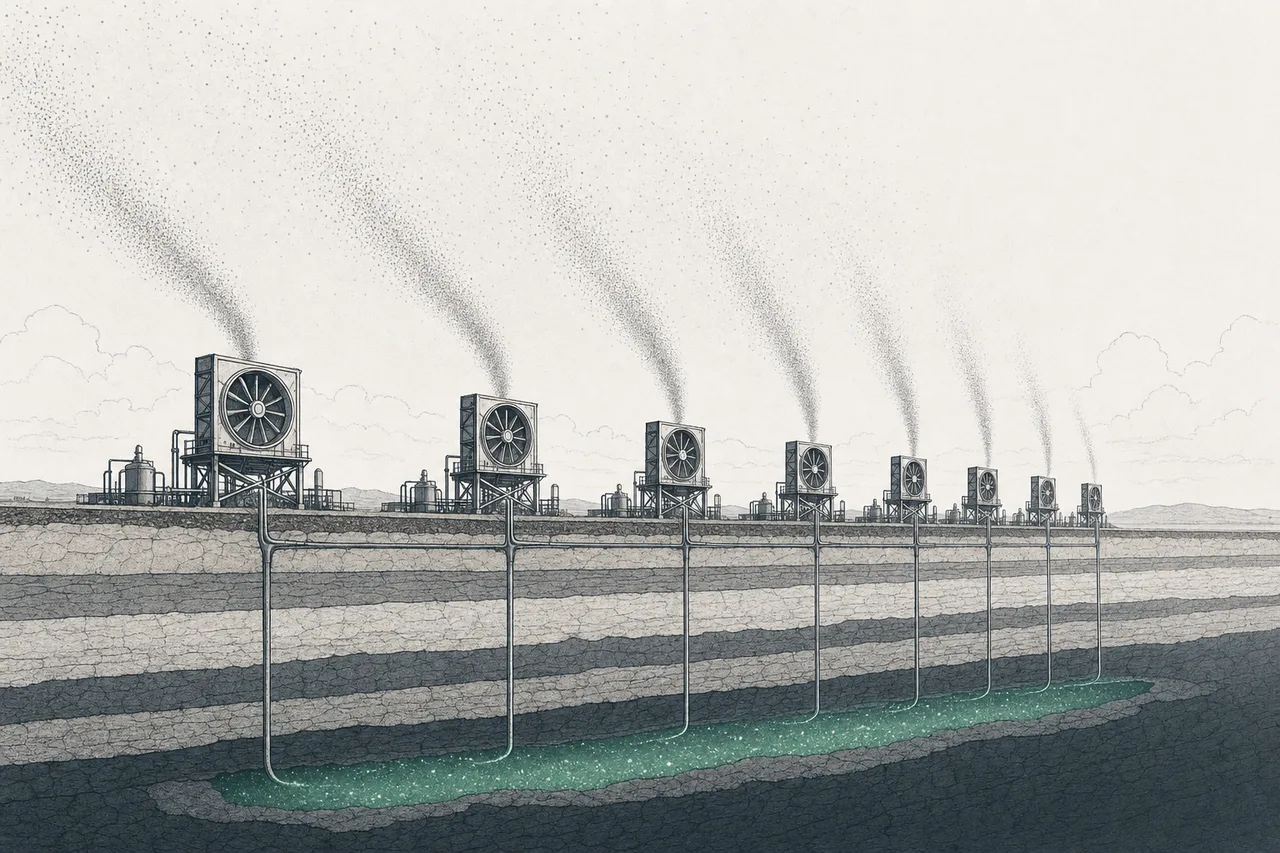
Every route above has to end in "permanent storage" — mostly injecting CO2 into rock layers kilometers underground (geologic storage) via CO2 pipelines. This category isn't a separate node but the "shared endpoint" every route depends on, and it's where it's decided whether the carbon stays underground "truly permanently" (note its link to Energy Transition & Power Demand, which controls this injection infrastructure).
Stage 3 — the market that pays (demand)
- Carbon Market Infrastructure: the system that turns "one ton of removed carbon" into "a tradable credit" — including the registry, measurement-reporting-verification (MRV), rating companies, and the credit exchanges. This is the "plumbing" that makes money flow into the other categories
03How it all connects (the carbon-removal chain)
This trend's chain is different from a normal industry — it doesn't sell a tangible product, it sells "tons of carbon that disappeared from the air". The path: many capture methods flow into "permanent storage," then get converted into "credits" through the market system, before being bought by companies that want net-zero. Let's look at the overall flow:
The clear difference from other industries is this — "this chain doesn't run on its own." The product it sells (a vanished ton of carbon) is something no one has to buy in order to use, unlike chips or electricity. It gets bought because (1) companies voluntarily promise net-zero, and (2) governments hand out subsidies. If either one wobbles, the whole chain stalls instantly — this is a "bottleneck" that isn't about technology, but about economics and policy.
04Where the value and power sit
This is the most surprising chapter — in most industries, value piles up around "the coolest technology." But in this trend, the flashiest category (DAC) is the hardest one to make money in, because it still loses a fortune per ton (cost ~$600–1,000, but a credit sells for only ~$160–180). So the real power isn't in "the capture machine" itself, but in three other places:
1. Permanent storage + land + CO2 injection permits — whoever controls the underground carbon-storage sites and the permits (like the Class VI well in the US) controls the endpoint every route must pass through. That's why an oil company like Occidental has the edge — it already has the geology and underground-well expertise.
2. The credit market system (MRV + ratings) — in a market full of distrust, whoever can "confirm the carbon was really removed" holds the power. Companies like Isometric (measurement) and Sylvera (ratings) are the "trust-certificate issuers" every deal must pass through — a "toll-collecting" model that doesn't carry the cost of capturing carbon itself.
3. Players with a policy advantage — because the 45Q tax credit pays DAC up to $180/ton, whoever can run a project big enough to "harvest the subsidy" in full has the edge — and that's usually a large, well-capitalized company, not a small startup.
The lesson for viewing this trend: don't just ask "can this company remove carbon," ask "is it standing where the subsidies are, controlling permanent storage, or issuing the certificates — or is it just carrying a capture machine that still loses money per ton?"
05The forces hitting the whole trend
Even though each category differs, four big forces hit the whole trend at once:
1. Big-tech net-zero demand — this is the industry's main artery, and it's alarmingly concentrated. In 2025, Microsoft alone accounted for about 79% of all contracted durable CDR credits (in some quarters as high as ~93%) — meaning the whole industry is nearly "dependent on a single customer." That's both a driver and a fragility.
2. Policy subsidies (45Q) — in the US, the 45Q tax credit pays DAC up to $180 per ton (versus $85 for smokestack capture), and in July 2025 the "One Big Beautiful Bill Act" preserved and expanded that credit, making it transferable for cash and extending the construction-start window to 2032 — this is the pillar that lets big projects roughly break even. If policy flips, the whole economics flips with it.
3. A cost curve that has to plunge — the whole industry is betting that cost will fall with scale (like solar panels that were once expensive and dropped 10x), from ~$800/ton today toward ~$230–540 by 2050 (ETH Zürich). But if it doesn't reach the ~$100–200 level, broad demand won't show up.
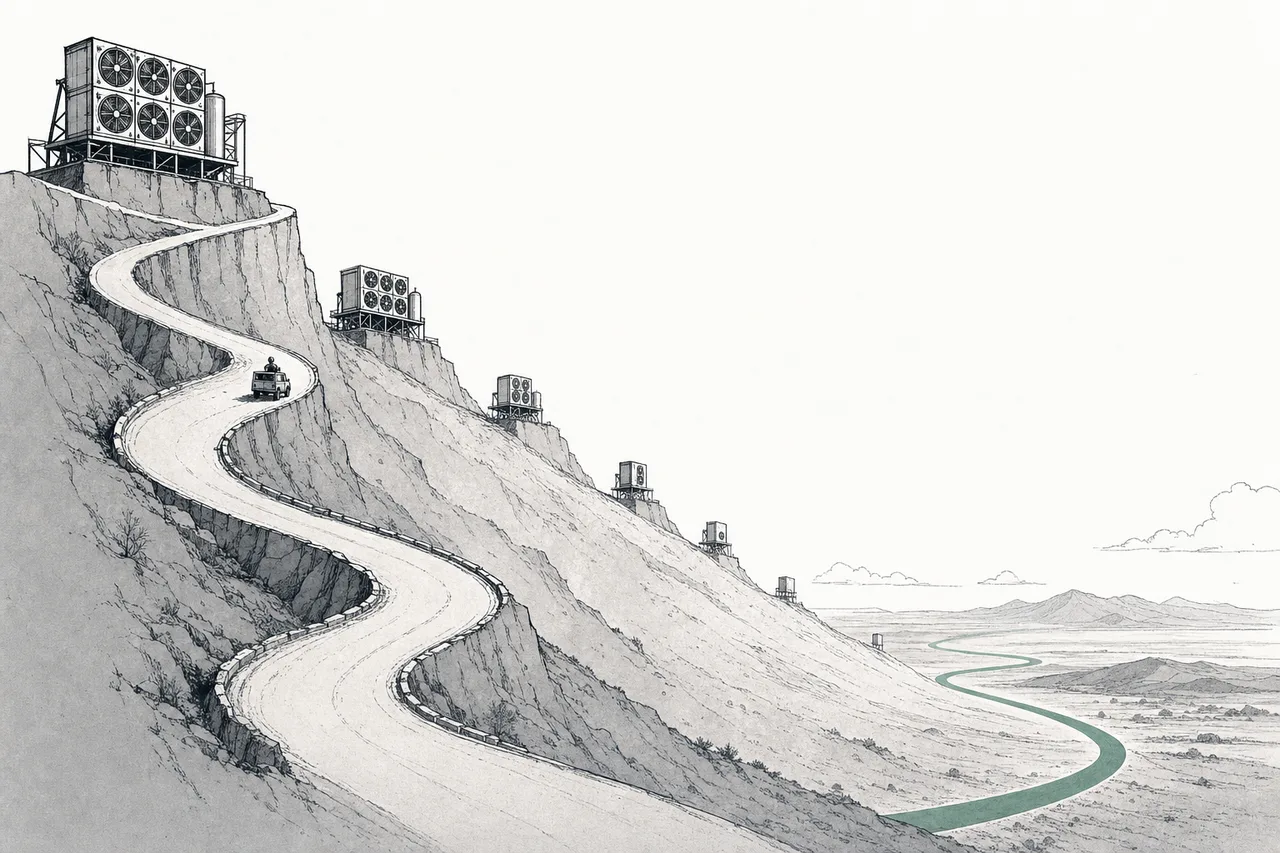
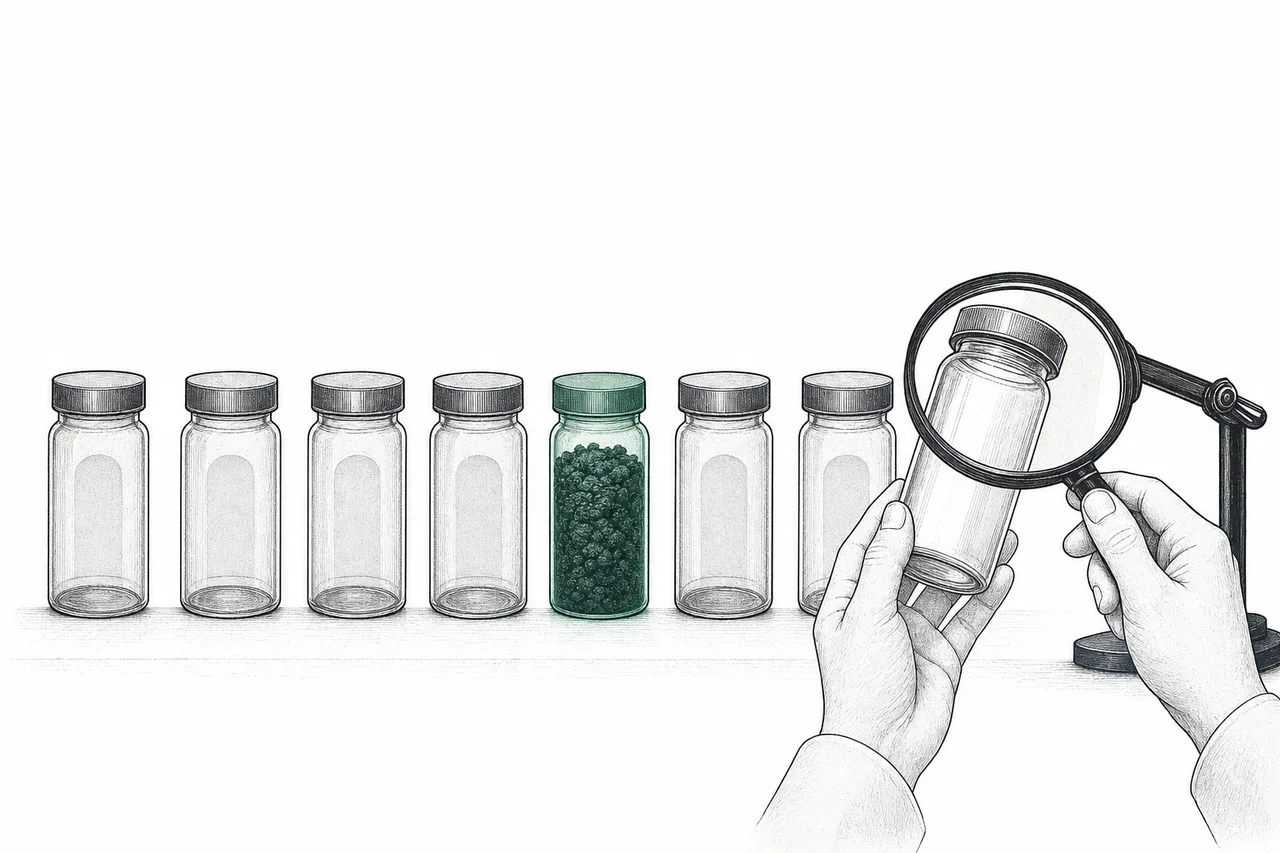
4. The credibility problem (verification) — the carbon market has a history of "ghost credit" scandals (credits claiming to remove carbon that actually didn't). That distrust is pushing buyers toward methods that are "measurable and truly permanent," like DAC and biochar — which is why the MRV system and permanent storage have become the heart of it, not just an add-on.
06Where things stand now + each category's champion
2025 was the year this industry grew enormously "on paper" — 2025 forward (offtake) contracts totaled $13.7 billion, 14x more than the value of credits actually delivered. Flagship projects like Occidental's Stratos (capturing 500,000 tons/year) only just started running late in the year. Below are each category's "champions" — notice that many of the best players are still private companies (Climeworks, Heirloom, Ebb Carbon), hard for ordinary investors to reach. So the investable side is usually the "infrastructure controllers" more than the "carbon capturers":
07The future and the risks
Looking ahead, this trend has both momentum and risks you have to view together, plainly.
On the opportunity side: the gap to gigaton scale (7–10 billion tons/year by 2050) is so big that if cost truly plunges, this becomes a new trillion-dollar industry. A big project like Stratos (500,000 tons/year) is ~14x larger than the old Mammoth plant, showing scale is jumping. And the 45Q subsidy expanded in 2025 gives some long-term confidence.
On the risk side, it has to be said clearly, because this is a far more fragile trend than other tech trends:
- Cost may not fall as dreamed: the whole industry bets on the "falling cost curve," but DAC eats enormous amounts of power, and the physics of filtering dilute air has limits. If it doesn't drop below ~$200/ton, broad demand won't come, and it stays stuck in "subsidy-dependent demo project" mode
- Reliance on a single buyer: when ~79% of the market is Microsoft alone, if one day it slows or shifts strategy (there have already been rumors of "pausing" projects), demand across the board shakes instantly
- Reliance on policy: almost all of DAC's economics rests on the 45Q $180/ton credit. The moment politics changes, the subsidy changes, and the business model changes with it
- The credibility problem: if the market has another "ghost credit" scandal, the already-fragile trust could collapse, dragging voluntary demand down with it
In short: this is a long-term bet on something the world may eventually "have to have." But today it's an industry selling something invisible, at the highest price, to a handful of buyers, dependent on government subsidies — nailing these three conditions is the best tool for telling apart what's real and coming, and what's hope running ahead of the economics — tap into the deep-dive chapter of whichever category interests you.