Megatrend · Carbon Removal
The machine that sucks CO2 out of the sky: the most expensive hope for saving the planet
Picture a factory-sized machine that does just one job — pull carbon dioxide out of the air we breathe, then bury it deep underground to vanish forever. It sounds like magic, and in a way it nearly is — because CO2 makes up just 0.04% of the air, pulling it back out is the most expensive, most energy-hungry job of every climate fix there is. This is the story of a technology that scientists call "essential" but the market still calls "too expensive."
01What DAC is
We're used to cutting carbon emissions — driving EVs, using solar power, planting trees. But Direct Air Capture (DAC) does something completely different. It doesn't stop carbon from coming out — it goes and retrieves the carbon that's already floating in the air. It's the difference between "shutting off an overflowing tap" and "mopping up water that's already flooded the floor" — DAC is the latter.
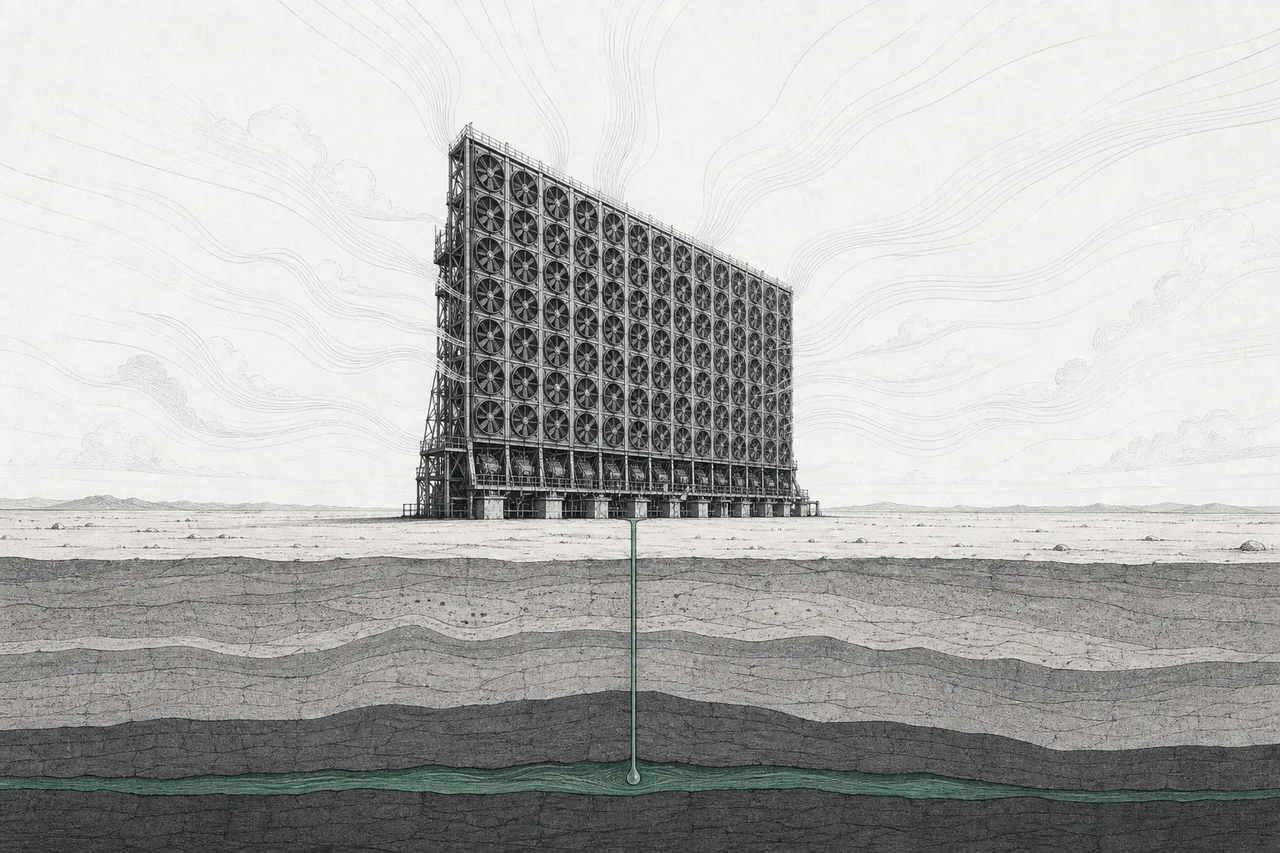
Put plainly, DAC is a plant that sucks in ordinary air, strips out only the CO2, then forces it down kilometers into rock layers to turn into carbonate stone or stay locked away permanently. The goal is to make that carbon "actually disappear from the atmosphere" — not just move it somewhere else.
Carbon Removal (which DAC is part of) = pulling out carbon that's already in the air, actually lowering the net amount of carbon in the atmosphere · CCS / point-source capture = catching carbon right at the "end of the smokestack" of a power plant or factory, before it goes out into the air — only preventing more, not reducing what's there. This is the key dividing line: DAC deals with carbon from the past, CCS with carbon in the present.
On the megatrend map, DAC is a sub-branch under Carbon Removal, and it's a sibling to other ways of pulling carbon out, like using biomass (BECCS & Biochar) and capture through the ocean. Among all the siblings, DAC is the most "pure" method in engineering terms — easy to measure, certain to verify, storing carbon permanently for thousands of years — but it's also the most expensive and most energy-hungry. Its definition in our system is exactly that: "the method with the highest subsidy, the highest energy."
02Why the world needs it
Here's a good question: "If it's that expensive, why don't we just cut emissions enough?" The answer is, we can't cut it all. Some industries emit carbon that's "truly impossible to cut" with today's technology — long-haul aviation, and making cement, steel, and certain chemicals. This group is called "hard-to-abate," and climate scientists (the IPCC) agree that to reach Net Zero, the world has to pull carbon out too, not just cut it.
This makes DAC not an option but a necessary "closer." And the gap between "what the world needs" and "what we can do today" is the biggest story of this trend. The International Energy Agency (IEA) estimates the path to Net Zero needs DAC to capture ~65 million tonnes a year by 2030, but even if every planned project succeeds, we'd get only ~3 million tonnes — 20 times short of the target.
Because it's still so small, the DAC market in dollar terms is still tiny but exploding in growth. Market size in 2025 was just ~$190 million, but many research houses expect it to surge to ~$1,700–2,600 million by 2030 — averaging over 60% growth a year, one of the highest growth rates in the entire clean-energy industry.
But the most important number for understanding this trend isn't market size — it's the "price per tonne." Today, capturing one tonne of carbon with DAC costs about $400–1,000, while planting trees or buying ordinary carbon credits might run just a few dozen dollars. This huge difference is exactly why the whole field is racing to do one thing: drive the price down.
03How it works (two main methods)
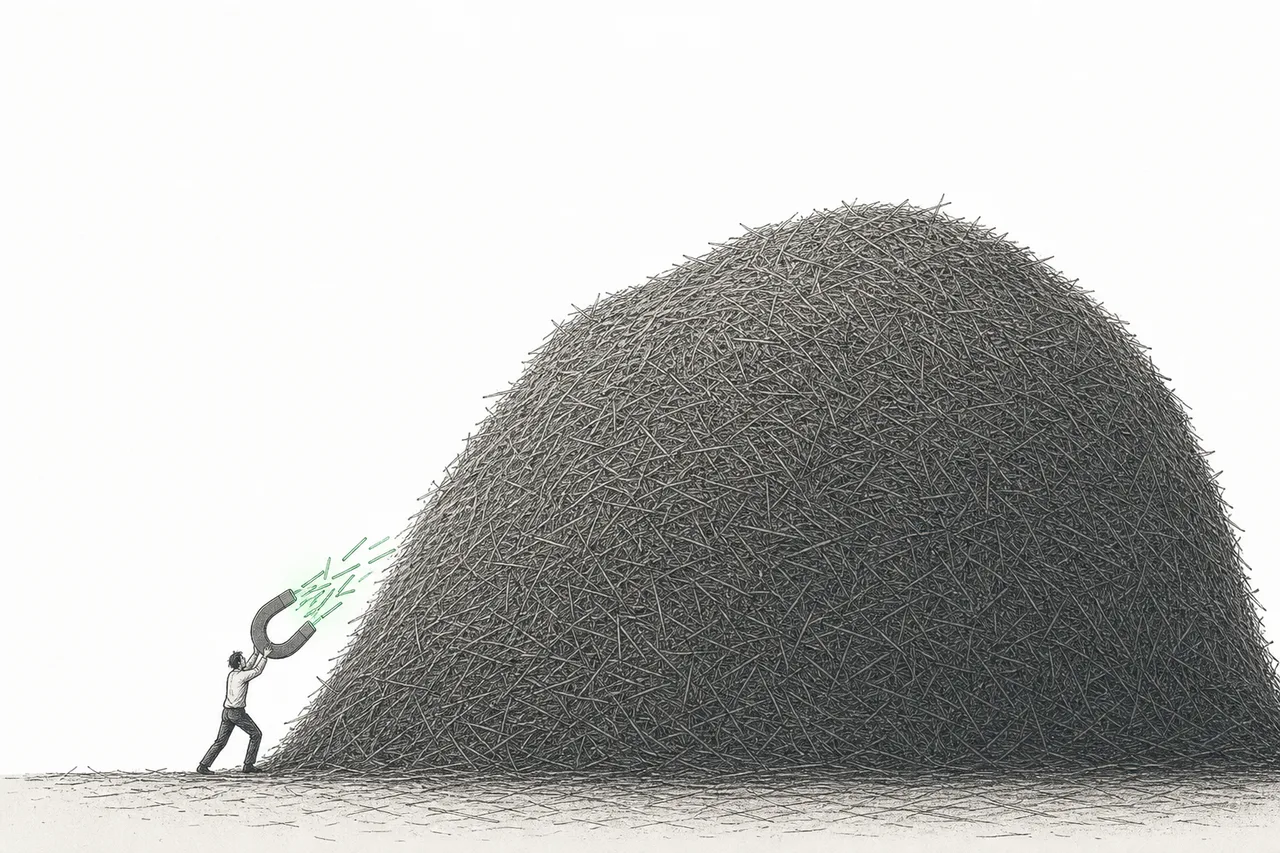
The heart of the problem is that CO2 in the air is incredibly dilute — just about 0.04% (420 parts per million). It's like fishing out a few needles from a whole barn full of hay. The more dilute the thing you want, the more energy it takes to "separate" it out. This is an inescapable law of physics, and it's why DAC is expensive.
In practice, DAC comes in two main families, differing in the "carbon catcher" and in how much heat it takes to release the carbon back out:
1) The "solid catcher" type (Solid sorbent / S-DAC) — uses sheets of sorbent material (often coated with amine-group compounds) that act like a sponge; a fan draws air through and CO2 sticks to the surface. Then low heat of ~80–120°C is applied to "drive" the CO2 back out and collect it. The upside: it doesn't need very high heat and can easily run on renewable electricity. It's the method used by Climeworks and Heirloom.
2) The "liquid catcher" type (Liquid solvent / L-DAC) — air is blown through an alkaline solution (such as potassium hydroxide, KOH), and the CO2 reacts to form a salt. Then it has to be fired at very high temperatures of 300–900°C to separate out pure CO2. The upside: it can scale up to the size of a chemical plant — but it eats more heat energy. It's the method used by Carbon Engineering and Occidental's Stratos project.
Whichever method, the cost "villain" sits at the heating step. Both kinds of DAC eat about 2,000–3,000 kilowatt-hours per tonne of carbon, of which about 80% is "heat," not electricity. And this leads to the most important paradox: if you run DAC on energy from fossil fuels, it's almost pointless — because you'd emit about as much carbon as you capture. So a "truly clean" DAC can only plug into cheap clean energy — which is exactly why Climeworks built its plant in Iceland, where geothermal energy is plentiful and almost free.
After capturing the CO2, you have to store it "permanently." The main method is forcing it down kilometers into rock layers · In Iceland, Climeworks uses a special technique: injecting CO2 mixed with water into basalt rock, where within a few years the CO2 "turns into stone" (mineralization), locked in forever — unlike planting trees, where the carbon can return to the air if the forest burns. DAC's selling point is permanence and being precisely measurable for thousands of years.
04How it connects in the ecosystem
DAC doesn't exist in isolation — it sits at the intersection of energy, policy, and a whole new financial market:
- Depends, indispensably, on clean energy and power: this is the relationship that decides DAC's fate. It eats enormous energy, so it needs cheap clean electricity and heat. But this is also a point of competition — every megawatt DAC uses is a megawatt that didn't go to replacing a coal plant. So critics ask, "Is using clean power to capture carbon really worth more than using it to replace fossil fuels directly?"
- Competes with its siblings within Carbon Removal: funding and credit buyers are limited. DAC has to compete with burying carbon via biomass, which is cheaper and can deliver more today, and with accelerated rock weathering — DAC is the most expensive, but also the "cleanest and easiest to measure."
- Exists only because of the carbon-market structure: if no one buys the "credit" for the carbon captured, DAC has no revenue. So the whole industry depends on the registry system, measurement (MRV), and a credit market that turns "one tonne of carbon buried" into a sellable product.
- Borrows techniques from synthetic biology: a new generation of research is trying to use enzymes or microbes to catch carbon instead of hot chemicals, which could cut energy use a lot.
05Where it stands now
2025–2026 is DAC's "make-or-break year" — both the year capacity leaps and the year harsh reality starts eating away at the dream, at the same time.
The good news is scale is jumping. Global carbon-capture capacity surged from ~59,000 tonnes/year in 2024 to ~569,000 tonnes/year in 2025 — almost 9 times in a single year. The driver is one single giant plant: Occidental's Stratos in Texas, worth $1.3 billion, designed to capture up to 500,000 tonnes/year — many times bigger than every DAC plant that ever existed combined.
On the demand side there's a game-changing deal too — Microsoft agreed to buy as much as 500,000 tonnes of credits from Stratos (spread over 6 years), the largest DAC credit purchase in history. Big buyers like Microsoft, Amazon, and the Frontier fund (led by Stripe, Google, Shopify) are the "first customers" willing to pay a premium to get the market going — because if no one will pay $400+/tonne today, the price will never come down in the future.
But the bad news is just as heavy. Climeworks, the Swiss pioneer — owner of the Mammoth plant in Iceland (capacity 36,000 tonnes/year) — had to lay off about 22% of its staff (~106 positions) in mid-2025, because U.S. climate-support policy wobbled under the Trump administration, and Mammoth itself hit filter problems that left actual capture below spec. At the same time, two large projects were cancelled in 2025 (Carbon Engineering's Dreamcatcher and Project Bison), erasing up to 6 million tonnes of future capacity.
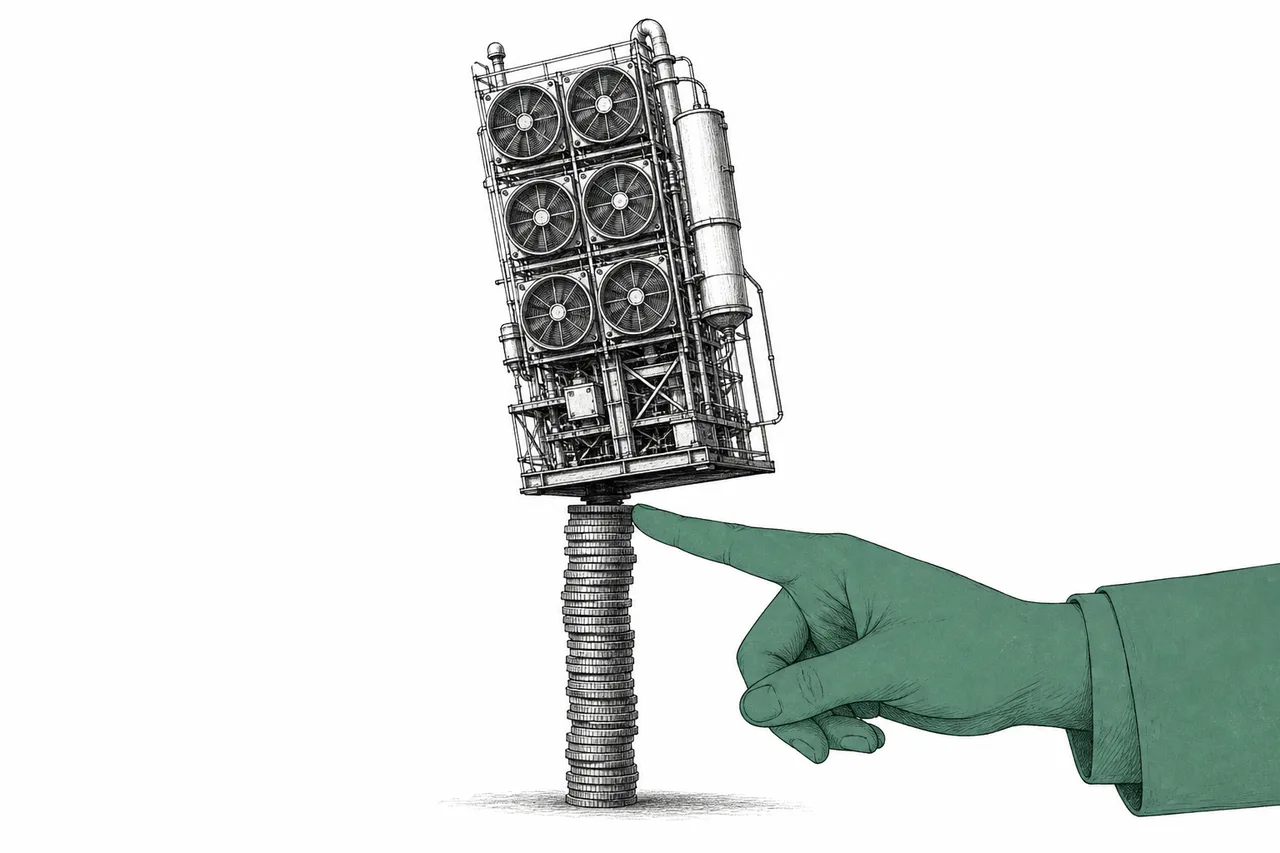
The thing that makes these numbers just about "worth it" is the U.S. 45Q policy, which gives a tax credit as high as $180 per tonne of carbon that DAC buries permanently. And crucially, it survived the politics — the "One Big Beautiful Bill Act" (July 2025) kept this credit. This is the pillar that lets U.S. projects keep moving forward, however turbulent the climate politics gets.
06The road ahead
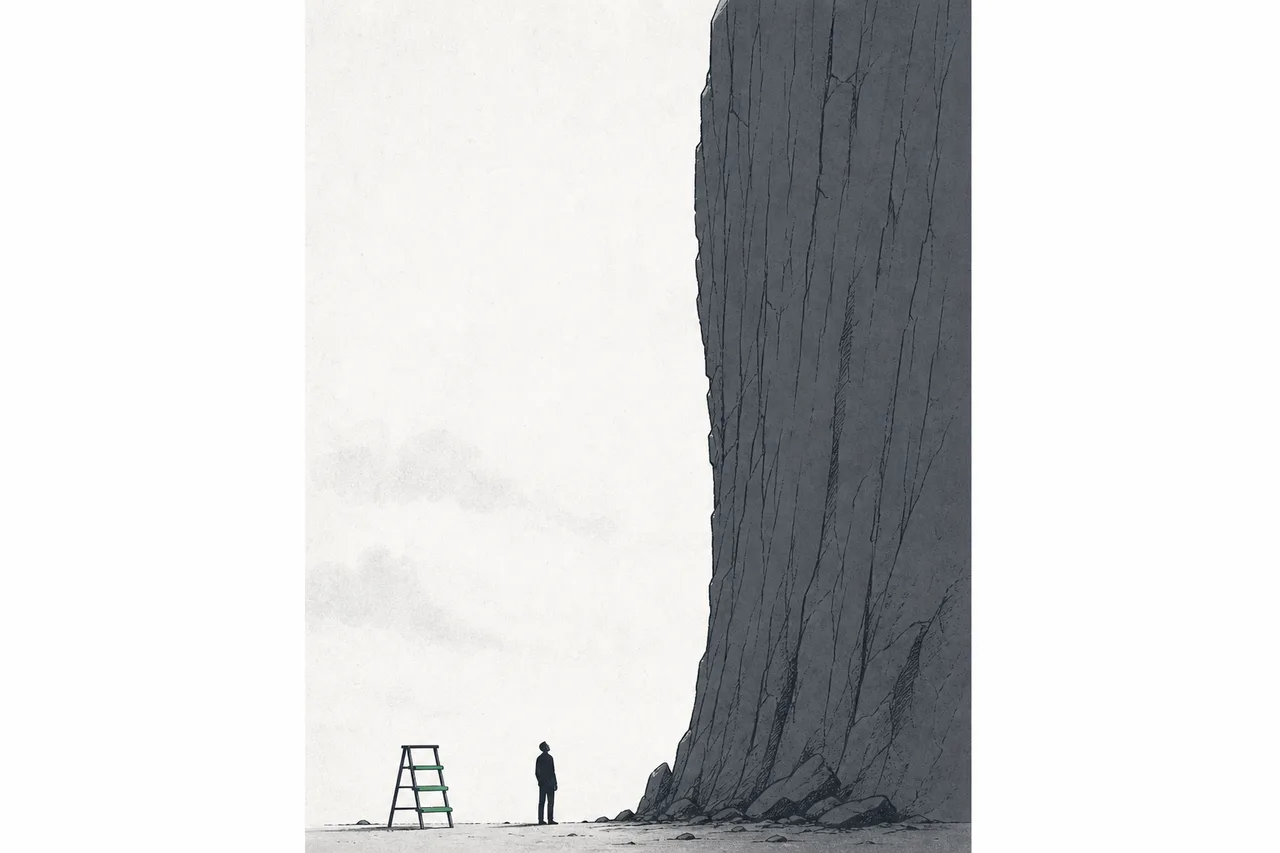
The first and most important direction is the chase for a "$100 per tonne" price. This is the magic number that, if reached, turns DAC from a "symbolic luxury" into a "climate tool used for real, at scale." Some companies aim to hit $100 by 2030 through mass production (the way solar panels once fell 90% in 10 years). But the physics of dilution makes DAC harder to cheapen than solar — it's the field's biggest bet.
The second direction is turning DAC from a "cost" into a "raw material." The carbon captured doesn't have to be buried and thrown away — it can be made into synthetic fuels (e-fuels) for aircraft, or into materials, chemicals, and even fizzy drinks. Having a "product market" to absorb it helps DAC earn more than relying on carbon credits alone.
The third direction is spreading to wherever clean energy is cheapest. We'll see DAC spring up in Iceland (geothermal), the Middle East (strong sun + capital), and Texas (wind + underground storage + the 45Q policy). DAC's geography will be set by one equation: wherever there's abundant clean energy and somewhere underground to store the carbon, that's home for DAC.
07Challenges & risks
DAC is a technology whose risks aren't hidden in the details — they're out in the open and make-or-break big.
The first risk is a cost that may never fall enough. Unlike solar panels or batteries that got cheap because they're made by the million, DAC has to fight the physics of dilution — there's a floor below which the minimum energy to separate CO2 from air can't go. If the price stays stuck at $300–400/tonne forever, DAC will remain a niche thing for those willing to pay, not a global solution.
The second risk is near-100% dependence on policy and subsidy. Today, almost no DAC plant can turn a profit on its own without the 45Q tax credit or goodwill buyers. So the whole industry is very fragile to "political winds" — Climeworks' layoffs and the projects cancelled in 2025 happened the moment the U.S. policy mood shifted. This is a business whose fate is tied to government decisions more than to the market.
The third risk is the ethical question called "moral hazard." Critics fear that if companies believe "DAC will just capture the carbon later," they might slow down real emission cuts — making it an excuse to keep emitting, even though DAC is still far too small to carry that load for decades. That's why positioning DAC as the "cleanup crew for what's left," not a "license to keep emitting," matters so much.
The fourth risk is competing for clean energy. Since DAC eats 2,000–3,000 kWh per tonne, the inescapable question is: "Wouldn't it be worth more to use that clean power to replace a coal plant directly?" In a world where clean energy is still scarce, every unit of power DAC uses has to prove it creates a real net benefit.
In short: DAC is a machine trying to do the most against-nature thing there is — separating the most dilute thing from a whole sky of air. It's both the hope that scientists call "indispensable" and the most expensive bet for saving the planet. To truly understand DAC is to understand why "cleaning up" the carbon we've already emitted is many times harder and costlier than "not emitting" it in the first place.