Megatrend · Carbon Removal
The world's biggest sponge: letting the ocean suck up carbon for us
The ocean holds 50 times more carbon than the entire sky above us, and right now it's pulling about 11–15 billion tonnes of carbon out of the air every year without us doing a thing. So the question of this trend is simple — if the ocean is already a giant sponge that's good at absorbing carbon, can we "squeeze the sponge to make room" and get it to absorb a little more? This is the story of the climate fix with the biggest potential and the lowest cost in theory — but also the hardest to prove and the most hotly debated in the field.
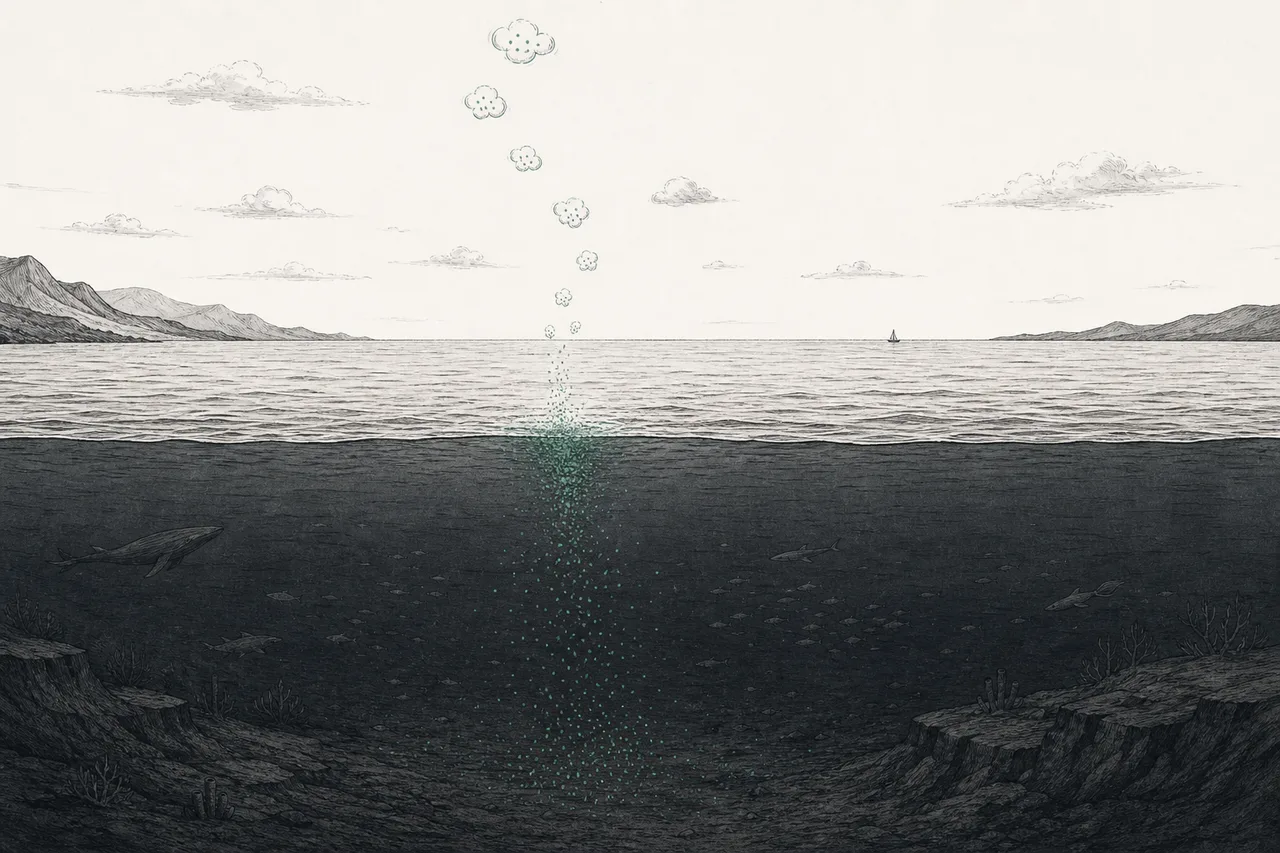
01What Ocean-based Removal is
When people hear "sucking carbon out of the air," most picture a factory-sized machine that pulls in air and filters it — that's Direct Air Capture (DAC). But Ocean-based Removal takes a completely different path. It doesn't build a giant machine to compete with nature — it goes and uses the nature that's already working, and makes it work harder.
The heart of the idea sits on one fact: the ocean already holds 50 times more carbon than the entire sky (about 38 trillion tonnes), and right now it's automatically absorbing about a quarter of the excess carbon humans emit, for free. Ocean-based Removal is about "making an arrangement" with this natural process — tweaking the chemistry of seawater a little so it pulls more carbon from the air and then locks it under the sea for thousands of years.
The umbrella name for every method of removing carbon that uses the "ocean" as the medium. Unlike DAC, which pulls straight from the air with machines, mCDR lets the surface of the sea do the absorbing from the air. We just tune the water so it absorbs better. So it's more like "expanding a lung the planet already has" than building a new one.
On the megatrend map, Ocean-based Removal is a sub-branch under Carbon Removal, a sibling to DAC, accelerated rock weathering, and burying carbon with biomass. Of all the siblings, this is the one with "the biggest potential and the lowest cost in theory" — because the ocean is enormous and you don't need to build a factory — but it's also the "hardest to prove", because what gets absorbed disappears into a sea that's flowing all the time.
In practice it splits into several families, but the two with momentum and real companies behind them are adding alkalinity to seawater (Ocean Alkalinity Enhancement) and pulling carbon from seawater with electricity (Direct Ocean Capture) — we'll dig into both in the chapters ahead.
02Why the world cares about it
The first reason is "scale." Climate scientists (the IPCC) agree: to hit the Net Zero target under the Paris Agreement, the world has to pull billions of tonnes of carbon a year out of the air — the number cited most often is 7–9 billion tonnes a year by 2050. The problem is that all methods combined today still pull only a few million tonnes. The ocean is the only place big enough to actually carry a "billion-tonne" load — without grabbing farmland or building tens of thousands of factories.
The second reason is "the price in theory." Because you don't need to build an air-sucking machine, and you don't need the high heat DAC uses, many players are targeting costs below $100 a tonne by the end of this decade — compared with DAC, still at $400–1,000 a tonne today. If it works, mCDR will be far cheaper, even if the price stays high for now because it's still at the pilot stage.
But the reason the "money" actually started flowing in over the past two years is that big buyers began pouring funds toward the ocean. In Q1 2025, buyers purchased ~230,000 tonnes of mCDR credits, which was 33% of all permanent CDR credits bought that quarter — meaning for every 3 tonnes of permanent carbon buyers paid for, 1 came from the ocean. That's a sign the market is starting to believe it can scale.
03The chemistry of the sea (the mechanism)
To understand it, you need just one mechanism: the surface of the sea and the air are always trying to "reach equilibrium". If seawater has less dissolved carbon than the air, it pulls carbon down from the air until they match. Conversely, once the water is saturated, it stops absorbing. The trick behind every kind of mCDR is to keep the surface water "hungry for carbon" all the time, so it keeps absorbing from the air without stopping.
There are two main families of ways to make the water hungry:
1) Adding alkalinity to the sea (Ocean Alkalinity Enhancement — OAE) — you pour alkaline minerals like magnesium hydroxide, or crushed rock like olivine, into the seawater. The added alkalinity "pulls" the dissolved carbon and converts it into bicarbonate (HCO₃⁻), which is very stable. The result: the surface water there is immediately short on carbon, so it absorbs from the air to refill, and the carbon that became bicarbonate stays locked in the sea for more than 10,000 years. This is the approach of Planetary Technologies and Vesta.
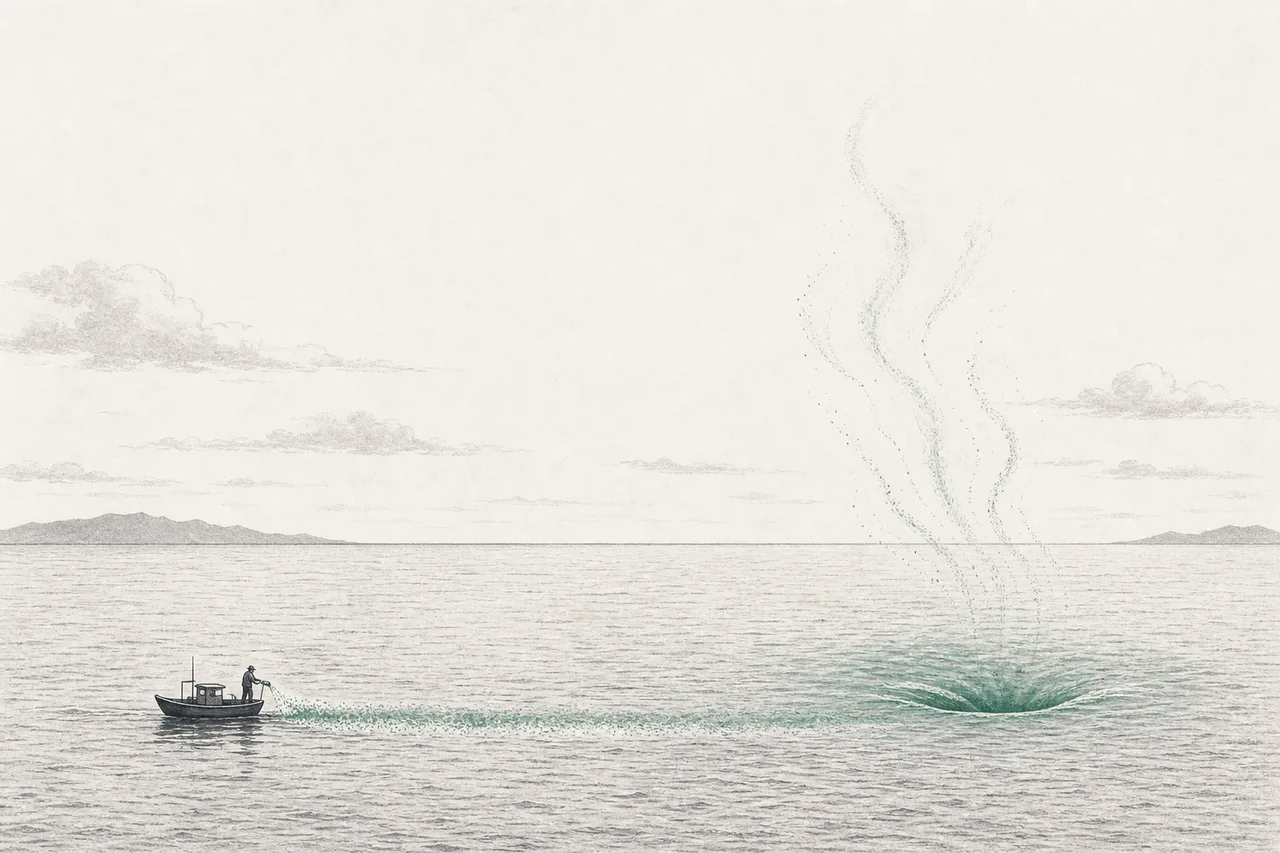
2) Pulling carbon from seawater with electricity (Direct Ocean Capture — DOC) — instead of adding anything to the sea, this method pumps seawater up and uses an electric current to make the water acidic in one spot, to "drive out" the dissolved carbon as pure CO₂ gas (which can be buried or used). Then it makes the water alkaline before returning it — the returned water is short on carbon, so it absorbs from the air to refill. Some companies even get green hydrogen as a bonus from this electrical process. This is the approach of Equatic and Captura.
The key difference between the two families is that OAE "barely uses energy" (the pull comes from nature) but needs enormous quantities of minerals and is hard to measure in the open sea, while DOC is easier to control and measure (done in a tank where you can count the CO2) but has to use electricity and pump enormous volumes of seawater — which is why it depends on cheap clean energy.
The two minerals used in OAE. Olivine is a green volcanic rock crushed into sand and spread along beaches; the waves slowly grind it finer and it dissolves to release alkalinity (Vesta's method). Magnesium hydroxide Mg(OH)₂ is an alkaline powder that dissolves faster; mixed with water, it's released through a coastal outfall pipe (Planetary's method). Both work on the same principle: more alkalinity = more carbon hunger in the seawater.
04How it connects in the ecosystem
Ocean-based Removal sits at the intersection of energy, carbon markets, and marine ecosystems:
- Depends on (and competes for) clean energy and power: the DOC methods that use electricity (Equatic, Captura) need cheap clean power, just like DAC — but in our system we frame this relationship as both "dependence" and "competition," because every megawatt used to absorb carbon is a megawatt that didn't go directly to replacing a fossil-fuel plant (OAE's advantage is that it barely uses power, so it dodges this knot)
- Competes with its siblings in Carbon Removal: funding and credit buyers are limited, so mCDR has to fight for the same pot as DAC (precise to measure but expensive), accelerated rock weathering on land (OAE's close relative, but done on the ground), and biomass. mCDR's selling point is "cheapest and scales biggest"; its weakness is "hardest to prove"
- Can't exist without the carbon-market infrastructure: mCDR's biggest problem is "how do we know how much carbon was actually absorbed" in a sea that keeps flowing. The answer has to come from an MRV (measurement, reporting, verification) system and a registry that can issue credits. In 2024–2025, when Isometric issued the world's first OAE protocol and credits, that was the event that "unlocked" this market to sell anything
- Borrows tools from synthetic biology: newer research is trying microbes or enzymes to speed up carbon absorption in the sea, but in our system we frame the two trends as gently "competing," because they fight for the same research money and attention
05Where it stands now
2025–2026 is when mCDR stepped from "lab experiment" into "selling something real for the first time" — but it's also the period when you saw the early players vanish.
The milestone that changed the game came in mid-2025: Planetary Technologies received the world's first OAE credits officially issued by a registry (Isometric), and right after, the fund Frontier (led by Stripe, Google, Shopify) signed a deal to buy $31.3 million of credits from Planetary, to pull over 115,000 tonnes of carbon between 2026–2030 — the largest OAE deal in history. Planetary uses a method of releasing magnesium hydroxide through a coastal outfall pipe in Halifax, Canada, and in 2025 it ran its V3 system, processing about 4,000 tonnes of magnesium hydroxide.
The Direct Ocean Capture side is just as busy. Equatic (a UCLA spinout) is building the Equatic-1 plant in Singapore, designed to absorb 4,000 tonnes of carbon a year plus produce 100 tonnes of hydrogen a year as a bonus — and it landed a big deal from Boeing worth $50 million, to pull 62,000 tonnes of carbon and deliver 2,100 tonnes of hydrogen. Equatic prices its credits at about $60/tonne and targets pushing costs down to $100/tonne by 2028. Meanwhile Captura runs a 100-tonne-a-year pilot system at AltaSea in Los Angeles, and made TIME magazine's "America's Top GreenTech Companies 2026."
But the picture isn't all pretty. Running Tide — a startup that once raised over $50 million to sink seaweed and wood into the sea to store carbon — shut down in June 2024, citing "the voluntary market doesn't have enough demand yet." Its collapse reflects two lessons: one, the ocean credit market is still small and fragile, and two, methods that are hard to measure (sinking seaweed — who knows how long the carbon really stays under the sea?) will always lose out to methods that are easier to measure clearly.

Crucially, the real-world numbers are still tiny compared with the contracts. Across the field, about 578,000 tonnes of carbon are tied up in pre-purchase contracts, but only ~0.3% has been issued as real credits (in the hundreds of tonnes, mostly from OAE) — the gap between "contract" and "verified reality" is the thing to watch most closely in this trend.
06The road ahead
The first and most important direction is proving MRV is trustworthy. The whole future of this trend hinges on one question: "how accurately can we measure how much carbon was actually absorbed" in a sea that keeps flowing. The first protocols and OAE credits appearing in 2024–2025 are a first step. But if MRV doesn't reach the level where buyers "believe it 100%," mCDR will be stuck at tens to hundreds of thousands of tonnes forever, never touching the "billion-tonne" potential.
The second direction is the "bonuses" that improve the economics. Equatic's DOC method gets green hydrogen to sell on the side, and OAE has a byproduct: it helps reduce ocean acidification, which is wrecking coral and shellfish — so in many places, adding alkalinity can sell both "carbon credits" and "coastal ecosystem restoration" at once. This dual revenue may be what keeps projects alive before costs come down to $100/tonne.
The third direction is choosing sites by cost. We'll see DOC pop up where there's cheap clean energy and ready seawater (Singapore, the Middle East), while OAE rides on existing infrastructure — like the outfall pipes of coastal wastewater plants (Planetary's method) or beaches that already need sand replenished against erosion (Vesta's method) — because "riding" existing structures means much lower startup costs.
07Challenges & risks
Ocean-based Removal is a trend where the risk isn't "can it be done," but "can it be proven" and "is it safe."
The first and biggest risk is MRV (measurement) in the open sea. Unlike DAC, which counts CO2 in a tank exactly, carbon absorbed through the ocean dilutes and disperses, vanishing into a mass of water that's always flowing. Proving "how many tonnes were actually absorbed, and how long it stays" relies on very complex oceanographic models — and that's why the field has 578,000 tonnes under contract but has issued only ~0.3% as real credits. If buyers don't believe the numbers, the market can't grow.
The second risk is the impact on ecosystems. Pouring enormous quantities of minerals or changing seawater chemistry could affect marine life in ways we can't yet anticipate. Heavy metals mixed into some minerals, localized pH changes, or effects on plankton are all questions without a full answer yet. This very concern is why even Planetary's small experiment in Halifax was questioned by locals and some scientists: "is this a climate fix, or dumping things in the sea?"
The third risk is the shadow of "ocean fertilization". mCDR has yet another family: adding iron to trigger plankton blooms that absorb carbon — but this method is so hotly debated it's been regulated. The UN has had a moratorium on commercial ocean fertilization for over a decade, fearing side effects on ecosystems (Running Tide itself was criticized over this and had to move to Icelandic waters). Global frameworks like the London Protocol are scrambling to keep up with which mCDR experiments to allow, and at what scale — this legal uncertainty is the wall slowing the scale-up.
The fourth risk is a still-fragile market. Running Tide's collapse in 2024 is a warning that even though the potential is enormous, real demand today still leans on a few benevolent buyers (Frontier, Microsoft). If the political or economic mood shifts, this money can shrink fast, and startups still "burning cash" are especially fragile.
In short: Ocean-based Removal is a bet on whether we can "hire the ocean" to absorb carbon instead of a machine — it's cheaper and bigger than every method in theory, but the price you pay is the difficulty of proving the result and the risk to a sea we ourselves don't fully understand. To really get this trend is to understand why "using nature" can look easy but turn out to be the most delicate bet in the whole field of climate repair.