Megatrend · Carbon Removal
How to bury carbon for 10,000 years — by spreading rock dust on a field
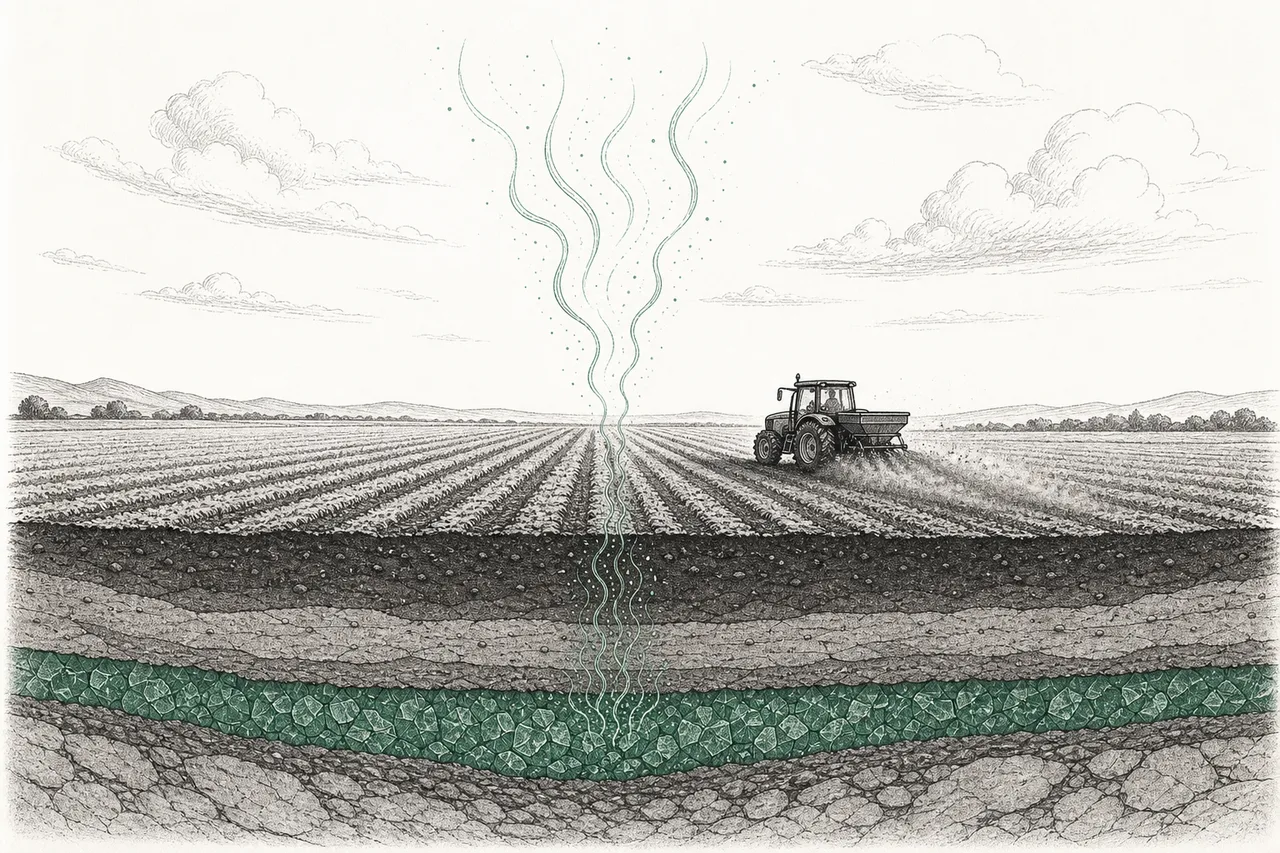
Nature has always pulled carbon out of the air through "rock weathering." The catch: it runs on a clock of hundreds of thousands of years. The idea behind this trend is almost shockingly simple — grind up volcanic rock, spread it on farmland to speed up a reaction that takes geological ages, finish it in a few years, and lock CO2 away as limestone that lasts more than 10,000 years. The only problem is that it's the hardest of all carbon-removal methods to "prove."
01What it is
Picture an old car left out in the rain. In a few years it rusts — that's "weathering," the chemical reaction where air and water slowly eat away at a material. Earth has been doing the same thing to rock for 4.5 billion years. When rain falls on certain rocks, they pull CO2 out of the air, react with it, turn that carbon into a form dissolved in water, send it down to the sea, and finally sink it as limestone. This is nature's "thermostat of the Earth" — the mechanism that draws excess carbon out of the atmosphere over the long run.
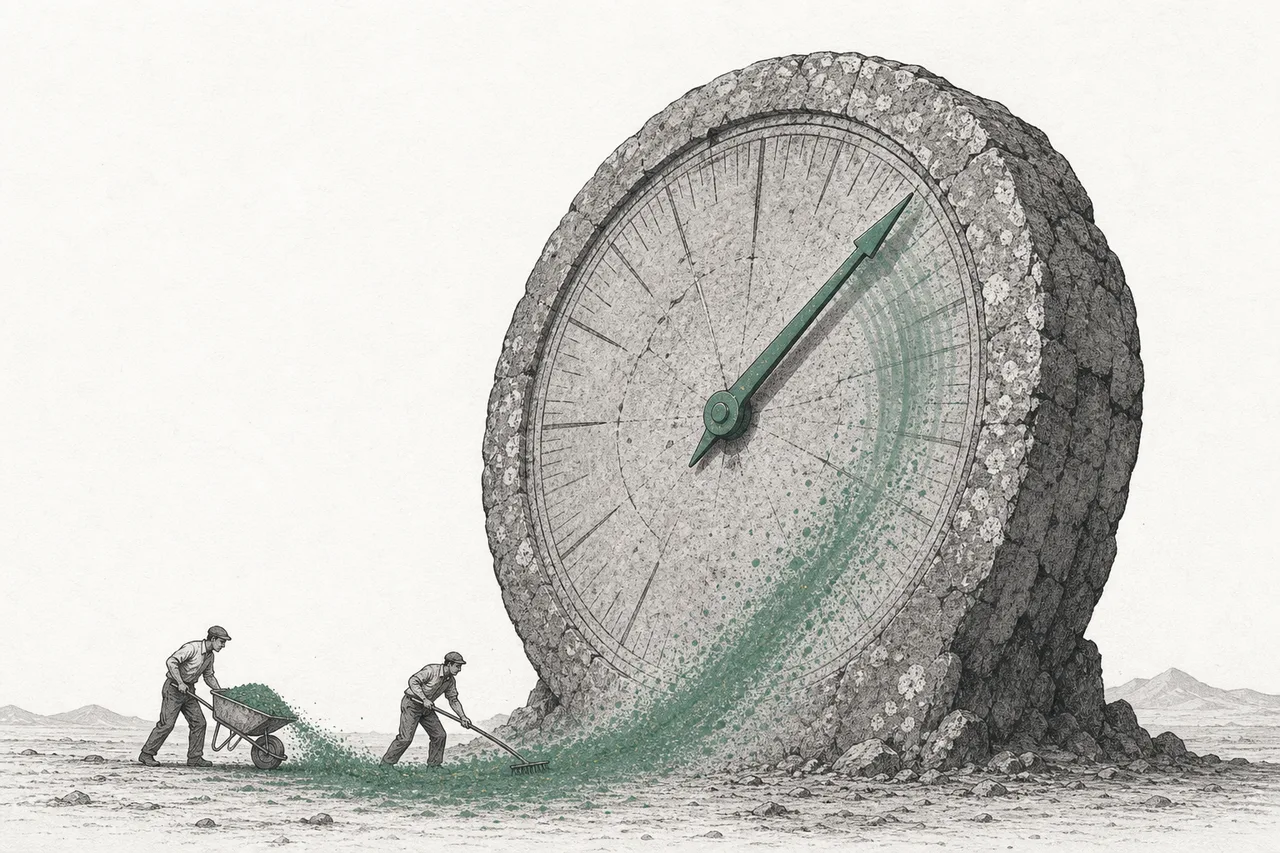
The only catch is that it's unbelievably slow. Nature takes hundreds of thousands to millions of years to absorb carbon in any meaningful amount. So the idea behind this trend is blunt: if we want to solve warming within a few decades, we have to "speed up" this natural process ten-thousand-fold.
Speeding it up is easy — grind the rock into fine powder. Big rocks weather slowly because water only touches the outer surface, but grind them to flour and the surface area touching water and air explodes. A reaction that once took ages now happens in a few years. That's where the name Enhanced Rock Weathering (ERW) comes from — take volcanic rock like basalt, grind it fine, spread it on farmland, and let the rain and soil do the rest.
Mineralization = the umbrella term for locking CO2 into a stable "carbonate rock" (like limestone) · Enhanced Rock Weathering (ERW) = speeding it up at the surface, by spreading rock dust on farmland · The other branch is In-situ mineralization = injecting CO2 directly into underground volcanic-rock layers to turn it into stone down there — all of it is "turning carbon into rock," just done above ground or below.
On our megatrend map, this node is one of the 5 pathways under Carbon Removal (pulling back carbon that's already been emitted). What sets it apart from siblings like Direct Air Capture is that it doesn't need a giant, power-hungry factory — it uses rock, rain, and soil as the machine, and it stores carbon longer than any other method.
02Why the world cares
The world is aiming for net zero. But just "cutting emissions" isn't enough — some industries (cement, aviation, steel) can't avoid all their emissions no matter what. So we also have to actually pull back the carbon we've already emitted, and it has to be removal that lasts — not tree-planting that might burn or get cut down 30 years from now.
This is where ERW stands out, because it's one of the few methods that can lock carbon away for more than 10,000 years — versus the decades you get from planting trees. And it's far cheaper than DAC. ERW carbon credits run about $200–500 per ton, while DAC, which offers comparable durability, usually costs more than $500–600 per ton because it takes enormous energy to suck in air.
And the potential is big enough to change the climate equation. ERW is estimated to be able to absorb up to ~350 million tons a year by 2050 — equivalent to taking tens of millions of cars off the road. More important still — it has a "side benefit" no other method offers. Basalt dust lowers soil acidity, adds minerals, and in many trials even raises crop yields. Put simply: farmers get free fertilizer while the world gets carbon pulled out.
So who pays? The answer is the tech giants that want "high-quality carbon credits" to offset their own emissions — especially Microsoft and the Frontier group (a pooled fund from Stripe, Alphabet, Shopify, and McKinsey), which poured money into advance purchases to build this market from the ground up.
03How it works (the chemistry of locking carbon)
The whole thing comes down to a single chemical reaction — one that's actually simpler than you'd think. Let's walk through it step by step.
Start with the rain — ordinary rainwater is mildly acidic, because it dissolves CO2 from the air and becomes "carbonic acid." When this mildly acidic rain falls on powdered basalt (volcanic rock containing calcium and magnesium silicate minerals), it eats into the rock and releases positive ions (like calcium and magnesium). These ions are what "grab" the carbon — turning CO2 from the air into bicarbonate, which is dissolved in water and stable, then flows down to rivers and the sea and finally sinks as limestone. That carbon is now "locked away" for thousands of years.
This is why "how fine the rock dust is" is everything. The finer you grind it, the faster the reaction — but grinding eats energy and money. So each ERW company has to find the "sweet spot": fine enough to absorb carbon quickly, but not so fine that the energy cost eats all the profit — and they have to pick the right rock. Basalt is popular because it's easy to find and safe, while a rock like olivine reacts faster but, from some sources, comes contaminated with heavy metals, so you have to be careful.
04Two breeds: on the farm, and under the volcanic rock
This node bundles two techniques that use the same chemistry but do it in different places — and have very different business personalities.
The first — Enhanced Rock Weathering on farmland (above ground) This is the one that's booming. The method is to grind basalt into powder and spread it on existing farmland. The upside: no new land needed, you use the tractors and fertilizer spreaders farmers already have, the upfront cost is low, and it scales fast worldwide. The downside is that it's "diffuse" — carbon is absorbed a little at a time across a vast stretch of land, which makes it very hard to measure how much was really absorbed (more on this in the risks chapter).
The second — In-situ Mineralization underground Instead of spreading on the surface, this method takes CO2 (often from geothermal power plants or from DAC), dissolves it in water, and injects it directly into underground basalt layers. The underground volcanic rock reacts with the CO2 and turns into solid stone right there. The pioneer is Iceland's Carbfix, which proved that 95% of the injected CO2 turns to stone within about 2 years — faster than anyone expected. The upside is that it's easier to measure and prove (you know exactly how many tons went in). The downside is that you need a concentrated CO2 source, suitable underground basalt layers, and a lot of water (Carbfix uses about 25 tons of water per ton of CO2).
There's a related third branch too — locking carbon into concrete. Companies like CarbonCure and Europe's Hoffmann Green use the same principle, permanently mineralizing CO2 inside the cement itself. They turn a building material that normally "emits" huge amounts of carbon into one that "stores" it instead — the point where mineralization meets the construction industry.
05How it connects in the ecosystem
Mineralization is one of 5 pathways under the Carbon Removal umbrella, all competing to answer the same question — "pull back carbon that's already been emitted, durably and at a reasonable price":
- Direct rival Direct Air Capture (DAC): DAC uses machines to suck in air. Comparable durability, but far more expensive and power-hungry — Mineralization is the "cheap and slow" option versus DAC's "expensive and fast/precise"
- Siblings under the umbrella Bio-based Removal and Ocean-based Removal: the biological side (tree-planting/biochar) delivers the most volume today but with shorter durability, while the ocean side uses similar chemistry (raising the alkalinity of seawater), a "cousin" of ERW in the ocean
- Depends on Carbon Market Infrastructure: this is the indispensable bloodstream. Absorbed carbon only becomes "money" when someone certifies it, measures it, and issues it as a tradable credit — verifiers like Isometric and Frontier are the machinery that gives ERW a market
- Competes with and depends on Energy Transition at once: grinding and hauling rock eats energy. Use fossil-fuel power and you shrink the net carbon you remove — so ERW needs clean energy to truly be "worth the carbon," and it has to fight clean-energy trends for resources and capital too
06Where it stands now
2025 was the year Mineralization clearly stepped "from the lab into real fields" — several major milestones landed at once.
The biggest was XPRIZE Carbon Removal. The $100 million carbon-removal competition backed by Elon Musk's foundation announced results in April 2025, and the $50 million grand-prize winner was Mati Carbon — a company doing ERW by spreading basalt dust on the fields of smallholder farmers in India, locking carbon while raising yields for poor farmers at the same time. ERW taking the top prize was a signal that the field believes in this pathway.
Another milestone was Carbfix winning Europe's first underground carbon-storage license in May 2025. Under the EU's CCS rules, it was authorized to inject CO2 into basalt layers in Iceland at a starting rate of over 100,000 tons a year — officially "making it legal and ready to scale."
The credit market grew fast too. In 2025, the ERW field set a record by passing one million tons of cumulative credit delivery for the first time, driven by several large advance-purchase deals:
The market is still small relative to its potential — the whole Durable CDR (durable carbon removal) field was worth about $700 million in 2025, and cumulative investment in ERW companies specifically is about $230 million (mostly equity funding). But the curve is bending up fast. And the most important fact is — almost all the real players are still private companies that haven't gone public, because the industry is only just scaling. This is mainly an arena of startups and venture capital.
07The road ahead
The first direction is clear: demand will come from tech companies that want high-quality credits. As long as Microsoft, Google, and the Frontier group have to offset their own carbon with credits that are "durable and provable," Mineralization stays one of the top choices — and these companies paying a premium to pre-order is exactly what feeds startups' ability to scale.
The second direction is that the battle over "measurement" (MRV) becomes the real arena. The company that can prove "how many tons it really absorbed" most accurately and cheaply will win, because that's what determines the credibility and price of a credit. Soil-sensor technology, geochemical models, and AI for estimating weathering will become key weapons.
The third direction is expansion into the Global South. Mati Carbon's win points the way: the most powerful model may be combining "carbon removal + raising yields for poor farmers" — because that's where you find cheap farmland, volcanic rock, and a real economic incentive for the farmers. That makes it scale fast and gives it a social dimension DAC can't offer.
08Challenges & risks
Mineralization's appeal comes with serious challenges — and the first is the biggest.
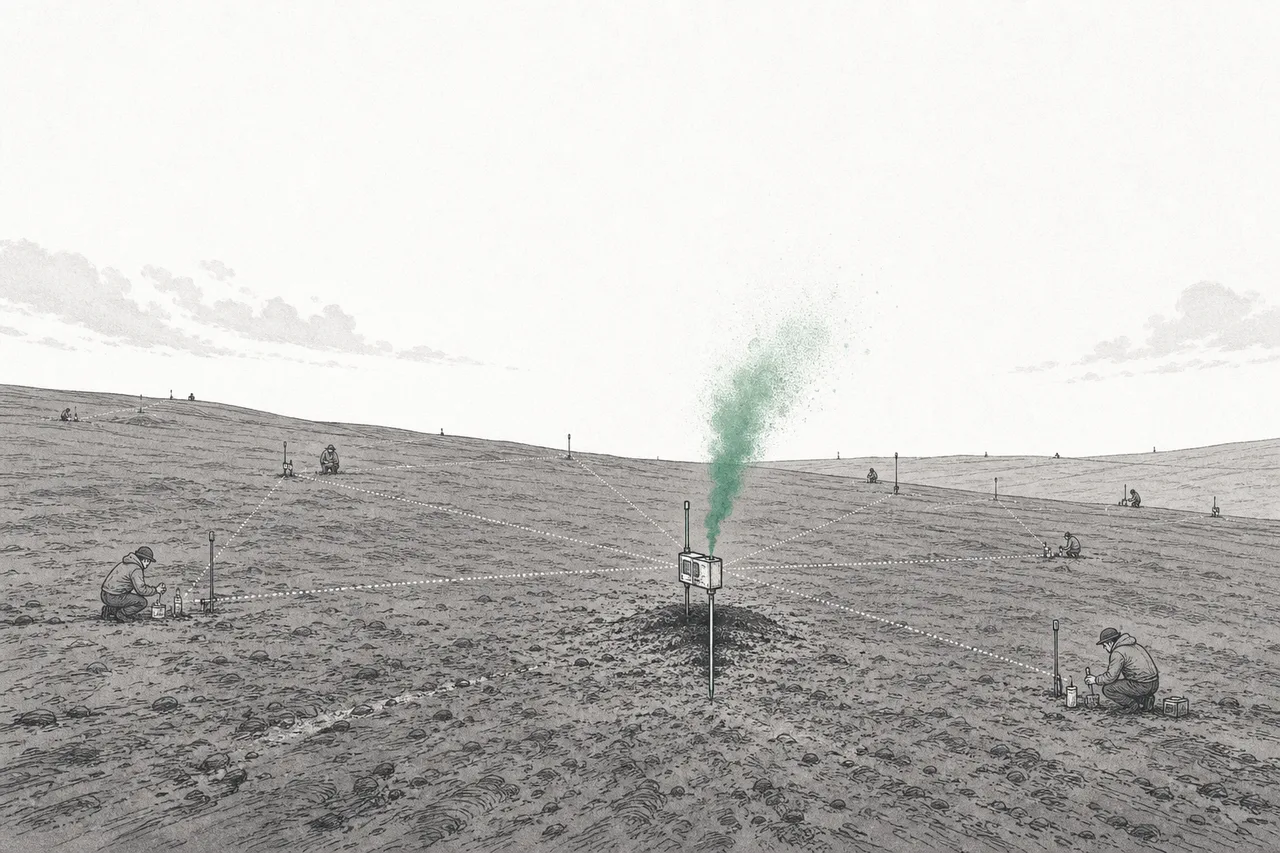
Risk one — "hard to prove" (the MRV problem). This is the weakest point of farmland ERW, because carbon is absorbed a little at a time across a vast stretch of land and seeps away underground. To be sure "how many tons were really absorbed," you have to track the positive ions and bicarbonate washed away with the water — and in some trials, most of the ions stayed stuck in the soil rather than washing out as the models predicted. That means the carbon "really absorbed" may be far lower than claimed — and if the market issues inflated credits, the credibility of the whole field could collapse.
Risk two is the energy and transport equation. Grinding rock fine and hauling tens of thousands of tons of rock dust to spread across fields all eat energy and emit carbon. Use fossil fuels and the "net" carbon you actually absorb shrinks — every ton you claim has to fully subtract the emissions from grinding, hauling, and spreading, or you're just "removing carbon by emitting carbon."
Risk three is the safety of the rock and soil. Some rocks (like olivine from certain sources) contain heavy metals such as nickel and chromium. Spreading large amounts repeatedly can accumulate them in the soil and food crops, so you have to screen the rock and test the soil rigorously — a constraint that means you can't scale carelessly.
Risk four is the market is still fragile and dependent on a few buyers. Nearly all the field's revenue comes from a handful of big buyers (Microsoft, Frontier). If these companies tighten budgets, or credit standards get stricter and cut out low-quality credits, demand could stall — and because most players are private companies that just raised money, their runway isn't long yet.
In short: Mineralization & Enhanced Weathering is about borrowing the "thermostat of the Earth" that's run for 4.5 billion years and fast-forwarding it to fit our era. It's remarkably simple — just rock, rain, and soil — but that simplicity is both its strength (cheap and durable) and its weakness (hard to prove) at once. To really get this trend is to understand why "counting carbon you can't see" has become a business that hundreds of millions of dollars are starting to flow toward.