Megatrend · Robotics & Physical AI
Flying robots that do the boring, dirty, and dangerous jobs so people don't have to
A civil drone is a 'flying robot' — it lifts a camera or sensor into the sky to do work that's expensive, slow, or deadly for a person: inspecting high-voltage power lines, spraying crops over rice paddies, surveying construction sites, flying blood across a mountain. The 2024–2026 story runs along two threads: China (DJI) dominates the world market so completely that the West woke up to a security problem, opening room for Western makers to grow — and 'delivery by drone' finally became real, at the scale of millions of flights.
01What it is
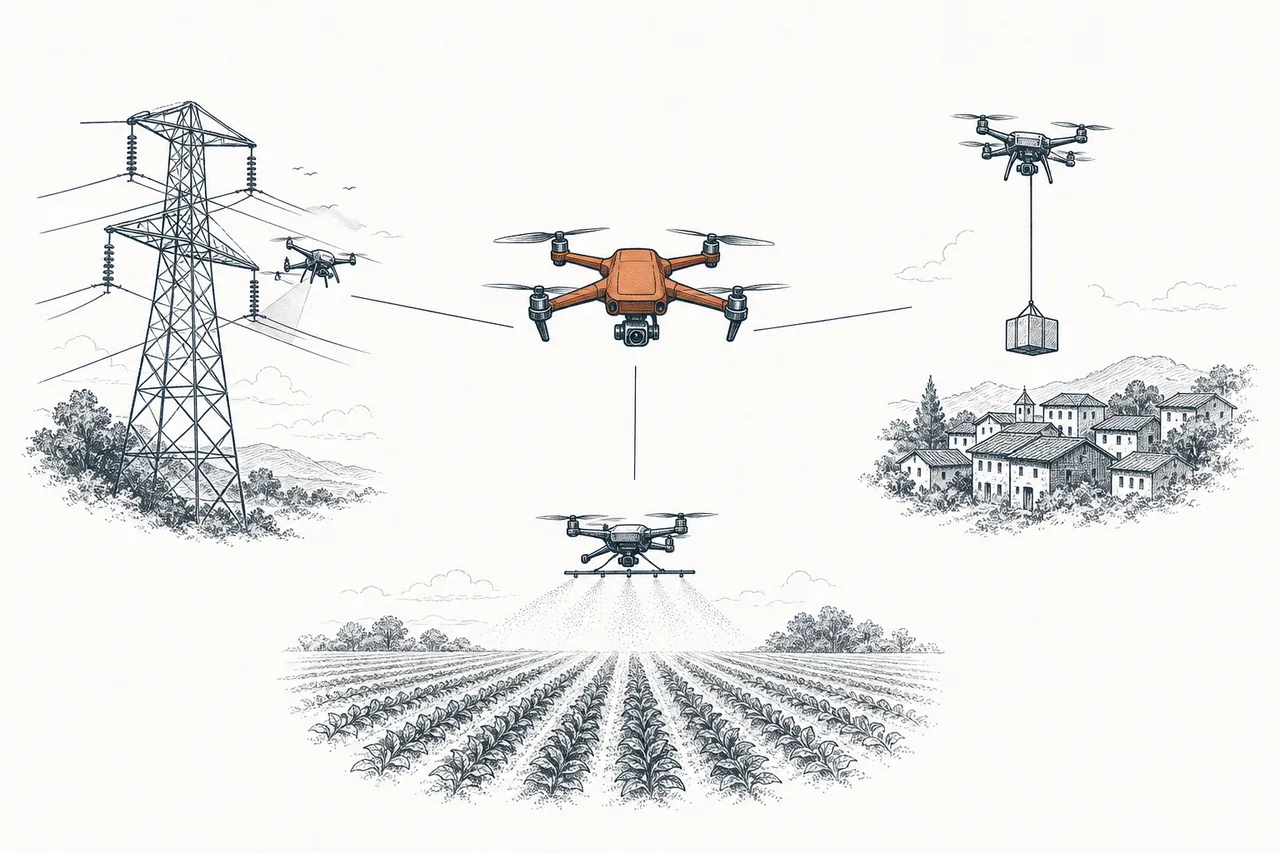
Picture the person who has to climb a 30-meter high-voltage tower to check whether an insulator has cracked, or the farmer walking all day with a spray tank on their back across a scorching field, or the delivery driver circling a mountain village for hours to drop off a few packages. These jobs share one thing: they all need to 'get something to a hard-to-reach place' — a camera, a sensor, spray, or a parcel. A civil drone (UAV) is the tool that does this work instead, with no one having to risk their life.
Put more plainly, a drone is a 'flying robot' — an unmanned aircraft flown remotely or flying autonomously. Its heart isn't the flying machine itself, but what it carries up (the payload): a high-resolution camera, a thermal camera, a LiDAR scanner, a spray tank, or a parcel box. The drone is just a 'flying tripod' that lifts these things to exactly where you need them.
UAV (Unmanned Aerial Vehicle) = the unmanned aircraft itself · UAS (Unmanned Aerial System) = the whole system (the aircraft + remote + control software) · Drone = the everyday word for the same thing. This lesson uses them interchangeably.
This node is a sub-theme under the Robotics & Physical AI megatrend — it's a branch of robotics, just one that works in a third dimension (the air) instead of on the ground like a factory robot arm or a warehouse robot. And it's important to be clear: this lesson covers civil and commercial drones only (delivery, inspection, agriculture, surveying). Military drones are a separate story, over in Defense & Autonomous Systems.
02Why it matters — the boring, dirty, dangerous jobs
There's a saying in robotics that machines should do three kinds of work: dull, dirty, dangerous. Drones are good at all three in the air, and their value is easy to put in dollars.
The clearest example is inspecting power lines and pipelines. The old way is to fly a helicopter to inspect them, which is enormously expensive — roughly $280–660 per mile of line, plus more than $4,000 a day for the helicopter; pipeline inspection by helicopter runs about $3,000 an hour. Switch to a drone and the cost drops to about $200–300 a mile, cutting total spend by 30–70%. And more important than the money: you don't send anyone up a tower or fly a helicopter along the wires.
Multiply this value across every industry — agriculture (spraying, seeding, crop-health surveys), construction (site surveys, 3D mapping), insurance (roof checks after a storm), public safety (firefighting, search for missing people) — and you see why the market is growing. The global commercial drone market was about $30 billion in 2024 and is expected to reach ~$55 billion by 2030 (growing ~10.6% a year), with the fastest-growing slice being 'delivery and logistics' at ~14% a year.
03How it works
The simplest way to think about it is to see a drone as a 'platform that lifts a payload' in three layers: the flying layer (rotors, motors, battery), the brain layer (GPS, obstacle-detection sensors, an autonomous flight system that relies on AI), and on top, the payload — the thing that makes it actually useful. One job, one payload swap: power-line inspection uses a camera plus a thermal camera, mapping uses LiDAR, spraying uses a tank and nozzles, delivery uses a parcel box.
But the thing that unlocks the biggest value isn't the hardware. It's flying beyond visual line of sight (BVLOS). Most laws today require the operator to keep the drone in sight at all times (visual line of sight), which pins everything to a radius of a few hundred meters. To really make a drone 'fly off to inspect 50 km of power line' or 'deliver across a city,' it has to fly itself with no one watching — and that takes both technology (detect-and-avoid systems) and, the tightest lock of all, the law.
Beyond Visual Line of Sight = flying where the operator can't see the drone. This is the 'switch' that, once it can be flipped, turns drone delivery and long-range inspection from experiments into full-blown commercial services — because you no longer need a person walking behind every drone.
04Where it sits in the world of robots
The civil drone is one of the 'body forms' of robots under Robotics & Physical AI, alongside siblings like warehouse robots, factory robot arms, self-driving cars, and humanoids. They all use the same 'brain' — the software on the Robotics AI & Embodiment side that lets a machine sense its surroundings, decide, and move on its own. The advances in obstacle-avoidance AI that let a drone fly itself are the very same advances that make other cars and robots smarter.
Drones also sit at the meeting point of several trends:
- Rely on AI as the brain: flying itself, avoiding obstacles, and analyzing images (e.g. 'is this insulator cracked?') are all AI jobs
- Overlap with Advanced Air Mobility (eVTOL): a drone is the 'small, unmanned version' of a flying taxi — the electric-rotor tech and airspace permitting are the same problem, and some companies (like EHang) have stepped from drones into unmanned passenger aircraft
- Close to Defense & Autonomous Systems: the airframe tech and autonomous flight are almost identical, and many makers (like AeroVironment) do both civil and military drones — the dividing line is 'what it's used for' more than 'a different machine'
- Depend on materials and the supply chain: motors, magnets, and lithium batteries mostly come from China — which becomes the spark for the security story in the next chapter
05Where it stands now
The big story of 2024–2026 runs along two intertwined threads.
Thread one: China dominates completely, and the West wakes up A single company — China's DJI — holds about 79% of the world's civil drone market (shipping over 2.4 million units in 2023) and about 70–80% of the US commercial drone market. This isn't just a 'famous brand' — it means a country's critical infrastructure (police, fire, utilities, agriculture) depends almost entirely on Chinese hardware. So concerns over data and security kept growing until Congress acted — and at the end of December 2025, DJI and Autel were placed on the 'FCC Covered List,' which blocks certification of their new equipment in the US.
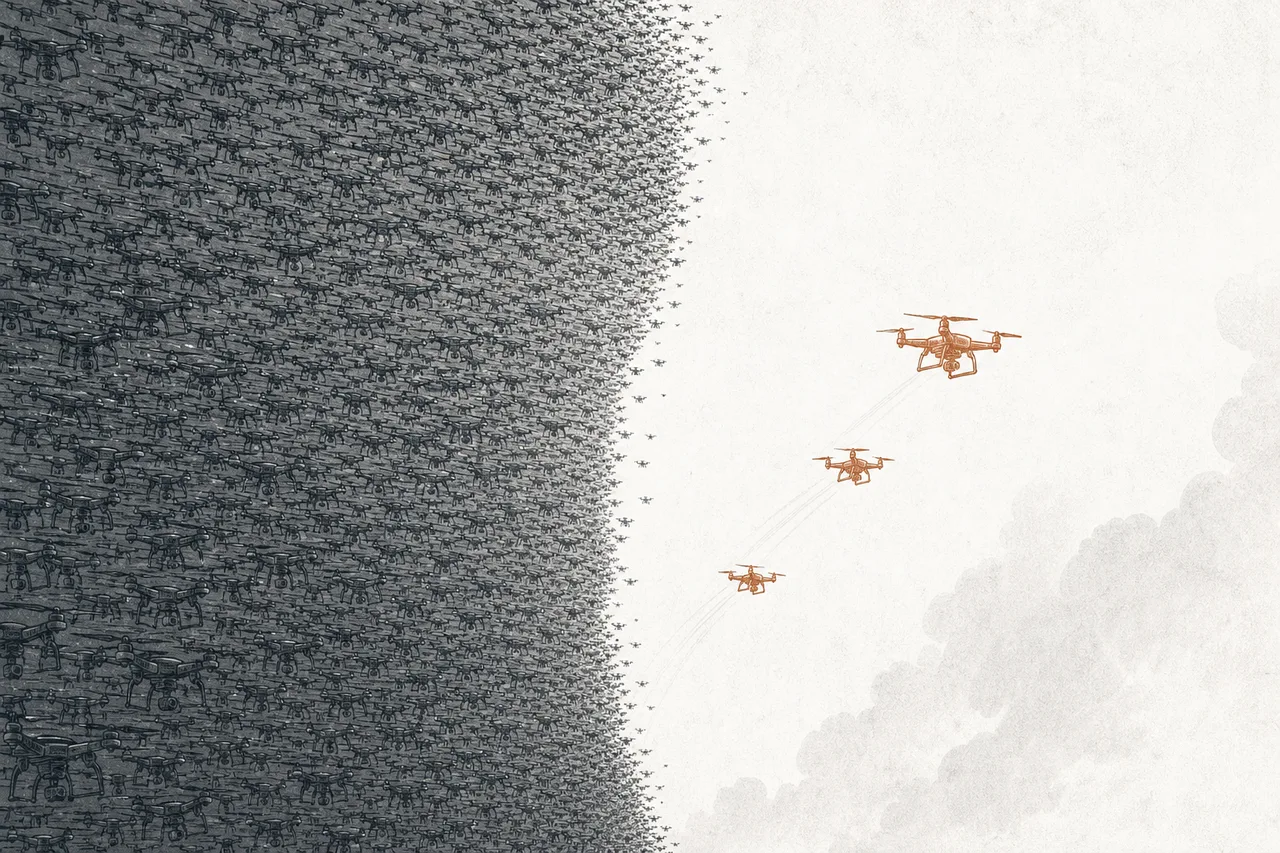
This exclusion opens a gap for Western makers that are 'NDAA-compliant' (they meet the security bar of the US defense law) to grow. Skydio, a US startup, raised $110 million in a Series F at a $4.4 billion valuation in early 2026 and is building the largest drone factory in the US. Meanwhile AeroVironment (publicly listed, ticker AVAV) posted about $821 million in fiscal-2025 revenue (up 14.5%) from both civil and military drones.
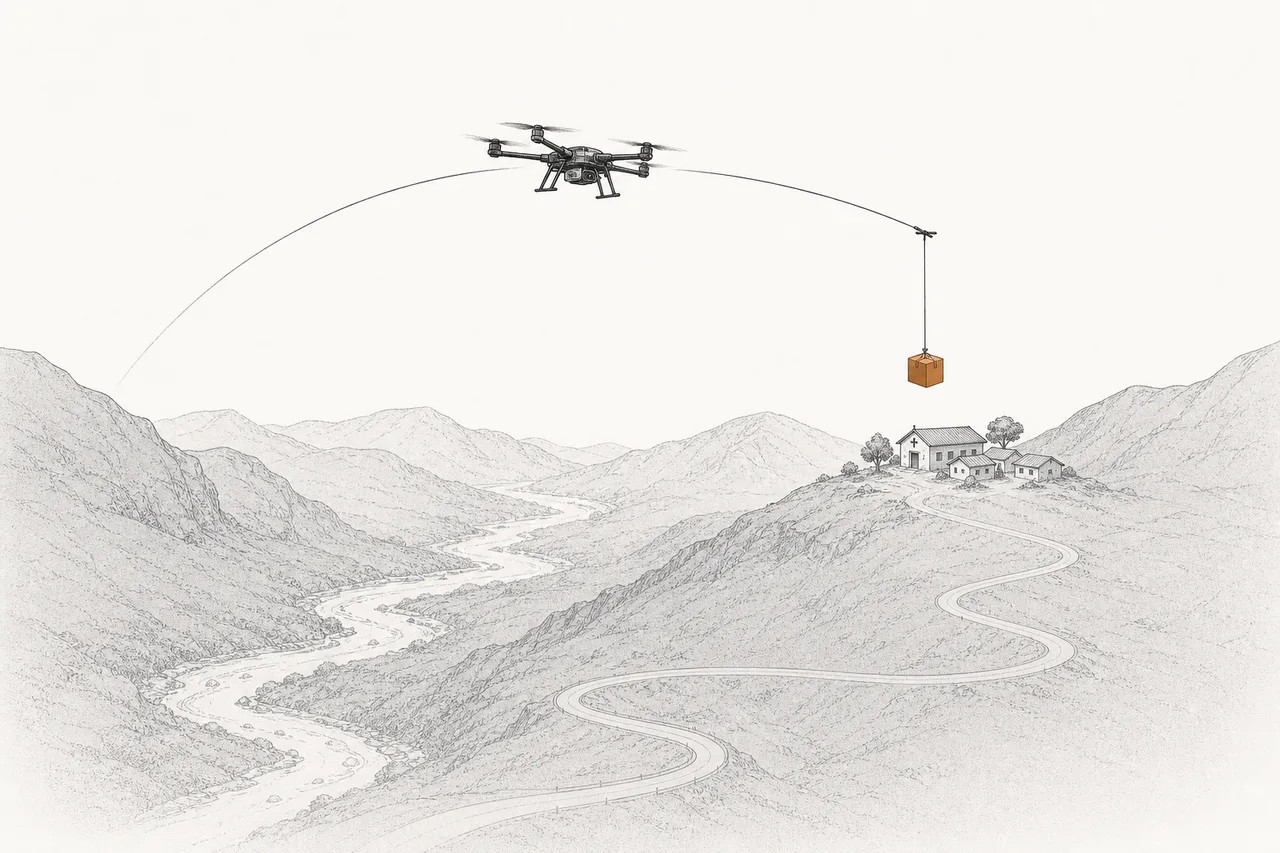
Thread two: drone delivery has become real, at the scale of millions For years, 'delivering parcels by drone' sounded like a marketing line. But now Zipline has passed 2 million successful deliveries (up from 1 million in April 2024), mostly medicine and blood across Africa and the US, and raised another $600 million in early 2026. Wing (a Google company) has passed 350,000 deliveries, and Amazon Prime Air is targeting 500 million drone deliveries a year. The factor that decides how far all this scales is the BVLOS rules — the FAA issued draft Part 108 in August 2025, with full adoption expected around spring 2026.
A quieter but very large third thread is agriculture. The smart spray-drone market was worth about $8.1 billion in 2024; China sells more than 100,000 agricultural drones a year, and this market too is dominated by two Chinese players — DJI (~55%) and XAG (~38%).
06The road ahead
The first direction is that the 'BVLOS switch' is about to flip. If the FAA's Part 108 is adopted in 2026 as expected, it turns beyond-visual-line-of-sight flight from 'permit one trip at a time' into 'approve a whole operating area' — and that's the point where delivery and long-range inspection scale from a handful of test cities into a real aerial logistics network. Flipping this single switch is the biggest variable for the whole industry.
The second direction is the 'decoupling' of the supply chain. Security pressure is creating two parallel markets: a world that uses DJI (cheap, technology-leading) and a world of 'non-Chinese' drones (pricier but cleared for government use) for public-sector and critical-infrastructure customers. For Western makers this is a golden opportunity — but also the hard question of how to compete on price with DJI, which holds a massive manufacturing scale.
The third direction is the rise of the 'low-altitude economy'. As electric rotors get more powerful and low-altitude airspace rules grow clearer, the line between delivery drones and flying taxis (eVTOL) keeps blurring — EHang, which has already earned type certification for an unmanned passenger aircraft, is the first example of crossing it.
07Challenges & risks
The appeal of civil drones comes with three very tangible risks.
The first is dependence on China and security. When a single company (DJI) holds about 80% of the market and manufactures in China, Western governments see it as a risk on both data and dependence. Excluding DJI creates an opening for Western makers, but it also forces many customers (already locked into DJI's systems) to pay more and wait longer — and it's a policy risk that can flip with politics.
The second is the law and airspace. The whole delivery and long-range-inspection industry is locked to BVLOS approval. If the rules come slower than expected, or come out so strict that compliance costs too much, many business models stall. On top of that, as more drones take to the air, managing low-altitude traffic (who flies where, how they avoid each other) and safety/privacy become real problems.
The third is the economics of delivery. Zipline has proved drone delivery works, but 'works' and 'turns a profit at scale' are two different things. Delivering high-value, light, urgent cargo (medicine, blood) clearly pays off, but delivering ordinary parcels has to compete with trucks that are already extremely cheap. The open question is how profitable a drone network can really be for everyday work.