Megatrend · Energy Transition & Power Demand
The hardest step in nuclear fuel — and the West just learned to make it itself
Plenty of countries can mine uranium. But there's exactly one step in the fuel chain so hard it needs machines spinning hundreds of thousands of times a minute, so sensitive it's controlled like a weapon, and — as it happens — nearly half the world's capacity is held by Russia. That's "conversion and enrichment," the midstream of nuclear fuel. And it's running even hotter now that next-generation reactors need a specially concentrated fuel called HALEU, which Russia was once the only one able to make and sell commercially. This is the story of a chokepoint the West is now pouring billions into rebuilding from scratch.
01What it is — the "midstream" of nuclear fuel
Picture uranium as crude oil — you dig it out of the ground but can't use it as-is; it has to be "refined" first. This node is the midstream refinery of nuclear fuel. It takes in the "yellowcake" that comes out of uranium mining, then does two things in sequence before handing it off to the power plant: (1) conversion, turning the powder into a gas, and (2) enrichment, raising the share of the isotope that's "flammable."
Why raise the concentration? Because uranium dug from the ground holds the isotope that can spark a chain reaction — U-235 — at just 0.7%. The other 99.3% is U-238, too inert to light a reactor. A typical reactor needs fuel with about 3–5% U-235, called LEU (Low-Enriched Uranium), while many newer reactors like SMRs and microreactors need much more concentrated fuel — 5–20% — called HALEU. This node's job is to "add concentration," from 0.7% up to whatever level the reactor needs.
On the megatrend map, this node is the outermost branch under Nuclear Fuel Cycle within the larger trend Energy Transition & Power Demand. It's the "midstream" that takes things from its mining (upstream) siblings and hands them to the power plant (downstream) — and it's the point where power, value, and geopolitical risk concentrate most in the entire chain.
Conversion = turning yellowcake (a solid) into UF₆ gas so the isotopes can be separated · Enrichment = raising the share of U-235 above 0.7% · LEU = fuel concentrated to 3–5% for ordinary reactors · HALEU (High-Assay Low-Enriched Uranium) = fuel concentrated to 5–20% for newer reactors (SMRs/microreactors) designed to be smaller and run longer
02Why it matters — the chokepoint Russia controls
The reason the "enrichment" step matters more than all the others comes down to one word: chokepoint. Plenty of countries can mine the ore. Plenty of companies can shape the fuel pellets. But separating U-235 from U-238 is a hugely difficult technology — it can be used to make weapons too — so it's tightly controlled worldwide. The result: the whole world depends on just four players, and the biggest is Rosatom, Russia's state nuclear company.
The numbers make this concentration clear. Rosatom controls roughly 26 million SWU/year, or about 40% of the world, followed by Urenco (Europe, ~17 million SWU), Orano (France, ~7.5 million SWU), and a fast-expanding China (CNNC). Count Russia + China together and they hold over 62% of the world's enrichment capacity (2024 data).
This dependence was never a problem, until Russia invaded Ukraine. Suddenly the West found itself buying enrichment services from its adversary. The U.S. responded by passing a law banning imports of enriched uranium from Russia starting May 2024 — but the problem is, the West still doesn't have enough capacity to replace it. The result: the price of enrichment services (SWU) blew through the ceiling, from about $34 per unit in 2018 to ~$188 per unit by mid-2025 — roughly tripling from the pre-war era.
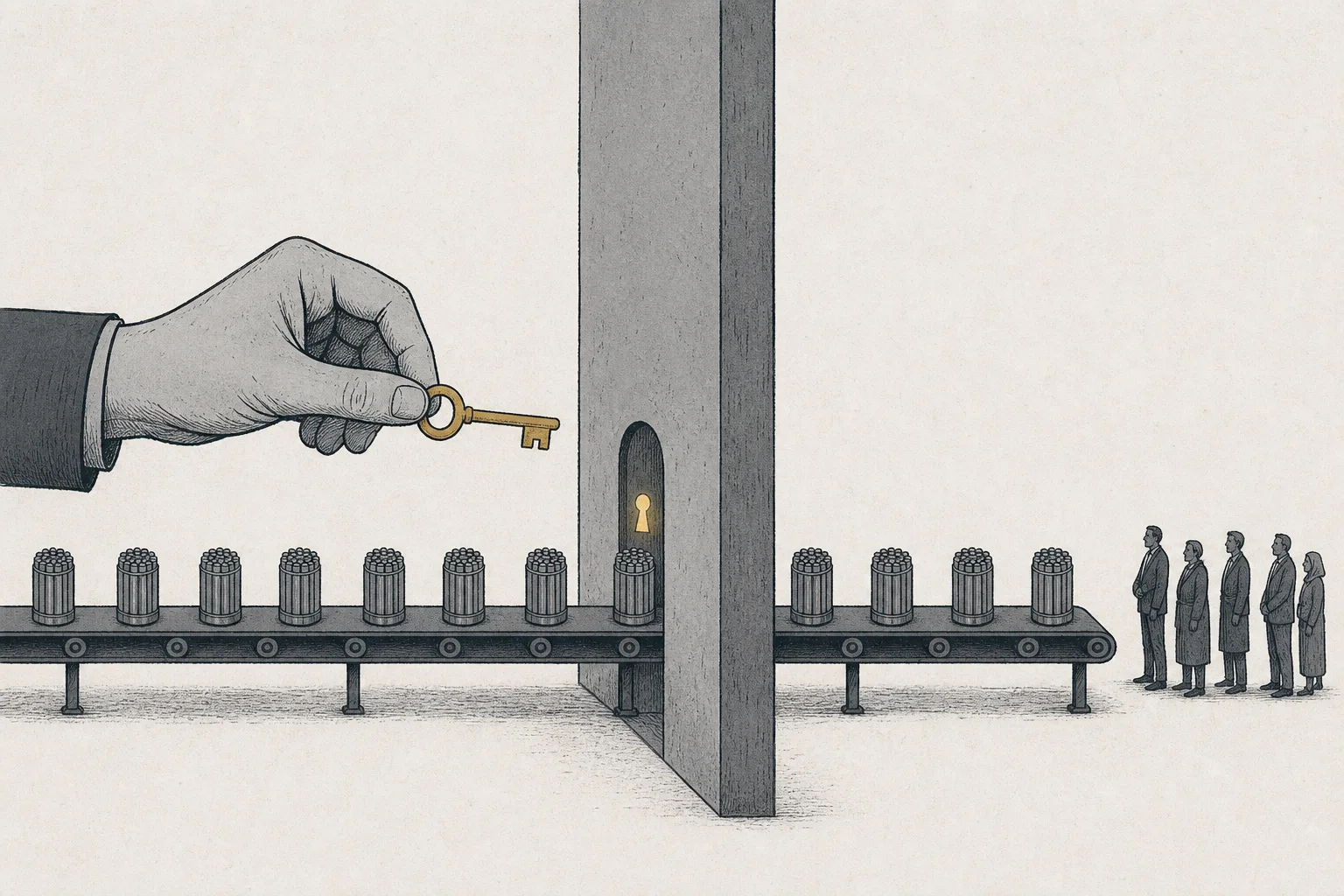
This is why a small node most people have never heard of has become a strategic chokepoint that the U.S. and European governments are pouring billions into — because if you can't control this step, the dream of a "nuclear revival to power AI" can't move forward.
03How it works — from yellowcake to concentrated fuel
Let's follow a single lump of uranium from "yellowcake" to concentrated fuel. It makes clear why the middle step is the hero of this story.
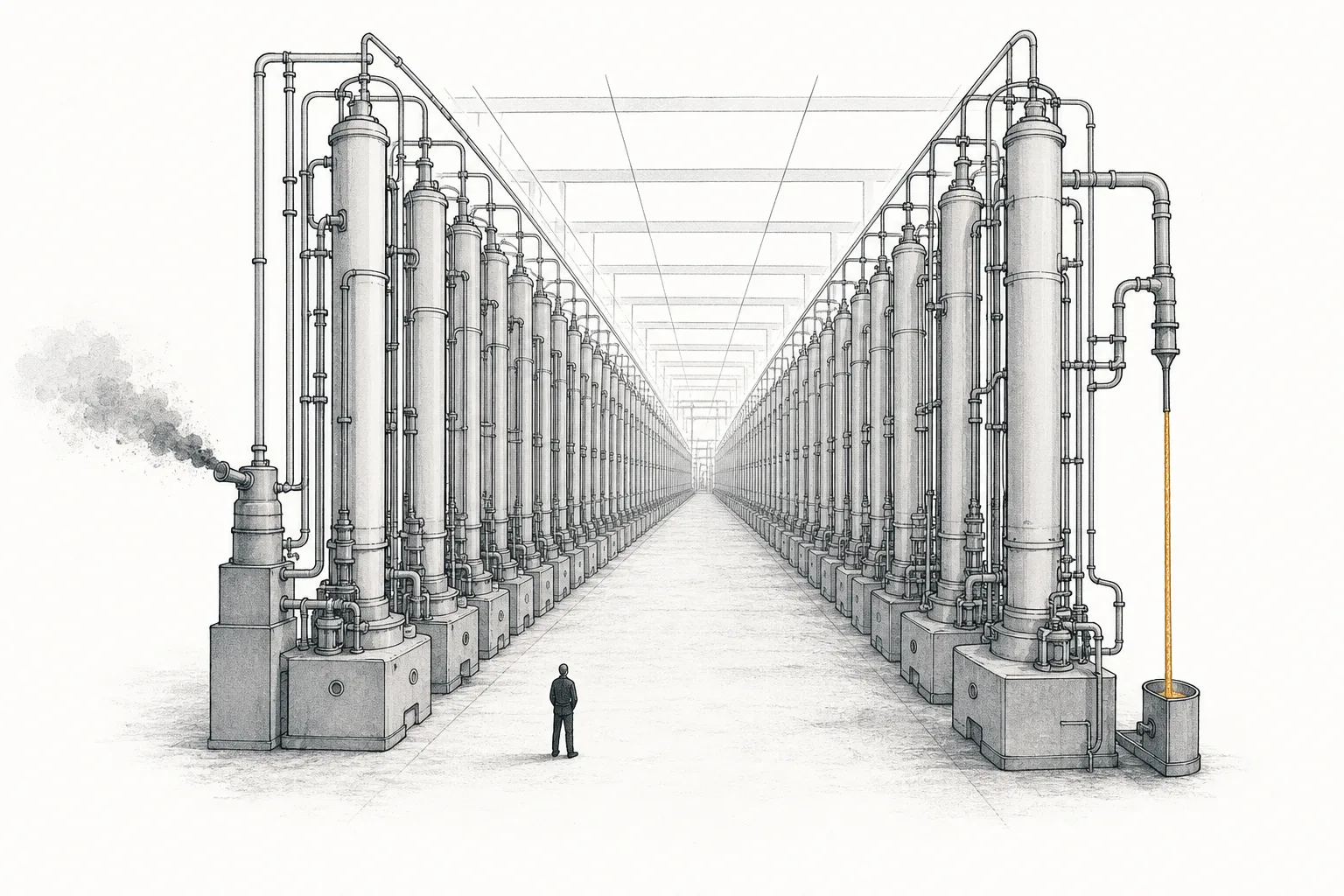
Why is the enrichment step so hard? Because U-235 and U-238 are isotopes of the same element, chemically identical, differing only slightly in weight. The way to separate them is to put UF₆ gas into centrifuges spinning at hundreds of thousands of revolutions a minute. The heavier one (U-238) gets flung to the outer edge, leaving gas richer in U-235 in the center. But one pass isn't concentrated enough — so you chain hundreds of machines into a line called a "cascade," passing the material from one machine to the next over and over until it reaches the concentration you need.
And this is where HALEU is much harder than LEU. The higher the concentration you want (20% instead of 5%), the longer the cascade it has to pass through, eating up far more "isotope-separation work" (SWU) per unit than ordinary fuel. On top of that, storing and transporting material this concentrated requires special licenses and safety measures — every step up in concentration sends costs and regulation higher.
A unit measuring the "amount of work" used to separate U-235 from U-238 — not a unit of uranium weight, but a unit of the effort to separate. Power plants buy uranium (by the pound) and enrichment services (in SWU) separately. The more concentrated the fuel, the more SWU it eats per kilo — which is why HALEU is meaningfully "more expensive per unit" than LEU.
04How it connects in the ecosystem
This node is the "midstream" of the fuel chain, so it takes things from upstream and hands them downstream two ways — old and new:
- Takes raw material from uranium mining (upstream): without yellowcake from the mines, there's nothing to convert and enrich. The mining side is about the "ore-price cycle," while this node is about "technology and chokepoints" — two clearly different faces of the same chain (you can read about the mining side in the sibling lesson)
- Feeds fuel directly to existing nuclear power plants: hundreds of ordinary reactors worldwide need LEU at 3–5% throughout their service lives. This is the node's large, steady "base market"
- Is the make-or-break chokepoint for small reactors (SMR / Advanced Nuclear): many newer reactors are designed to use HALEU. If HALEU production can't keep up, an entire generation of SMRs could be finished but with no fuel to run — making this node the "accelerator or brake" for the whole new-reactor trend
- Why it's all so hot, it's because of AI and power demand: AI data centers need stable 24-hour power (firm power), and nuclear answers that well, so the world is rushing back to build reactors — and every new reactor is a new customer for this node
05Where things stand now (2025–2026) — who the players are
The picture right now is "the West racing to build its own chain with government money." After cutting Russia off, a gap opened that needs filling fast, and U.S. and European government money is flowing into both conversion and enrichment. The players split into three groups: converters · the big existing enrichers · and the West's HALEU spearhead.
On the conversion side, the Western market is very narrow — just three main players: Canada's Cameco (its Port Hope plant controls about 18% of the world's UF₆ conversion capacity, producing roughly 11 million KgU in 2025), the U.S.'s ConverDyn/Metropolis (a recently restarted plant aiming to produce over 10,000 tons of UF₆ in 2026), and France's Orano. The price of conversion itself has also surged with the strain on the chain.
On the enrichment side that you can actually invest in on the stock market, the real star is the U.S.'s Centrus Energy — owner of the West's first commercial HALEU plant, in Piketon, Ohio. Centrus delivered a 20kg demonstration lot in 2023, then completed a full 900 kilograms to the Department of Energy (DOE) in June 2025. In 2025 the company posted revenue of about $448.7 million, net income of ~$77.8 million, and an enrichment backlog of about $2.3 billion — and the DOE also chose Centrus for a HALEU production contract worth up to $900 million.
There's also Urenco (Europe, private/state group) and Orano (France, majority state-owned) — the two largest Western players, but neither is directly traded on the stock market. Urenco USA just started running a new set of cascades in New Mexico in May 2025 (the first phase of a ~700,000 SWU capacity expansion, finishing in 2027). As for Russia (Rosatom/Tenex), even as the market's biggest player, after sanctions it became one you simply "can't invest in" if you're a Western investor.
06The future — building HALEU before the reactors go hungry
There are three lines to watch ahead.
The first is that HALEU will become the make-or-break chokepoint for the entire new-reactor trend. The U.S. Department of Energy estimates the world will need more than 40 tons by 2030, and perhaps around 50 tons a year by 2035, to feed the fleet of new SMRs. But Western production capacity right now counts only in the "hundreds of kilograms a year" — a vast gap that has to be filled in time.
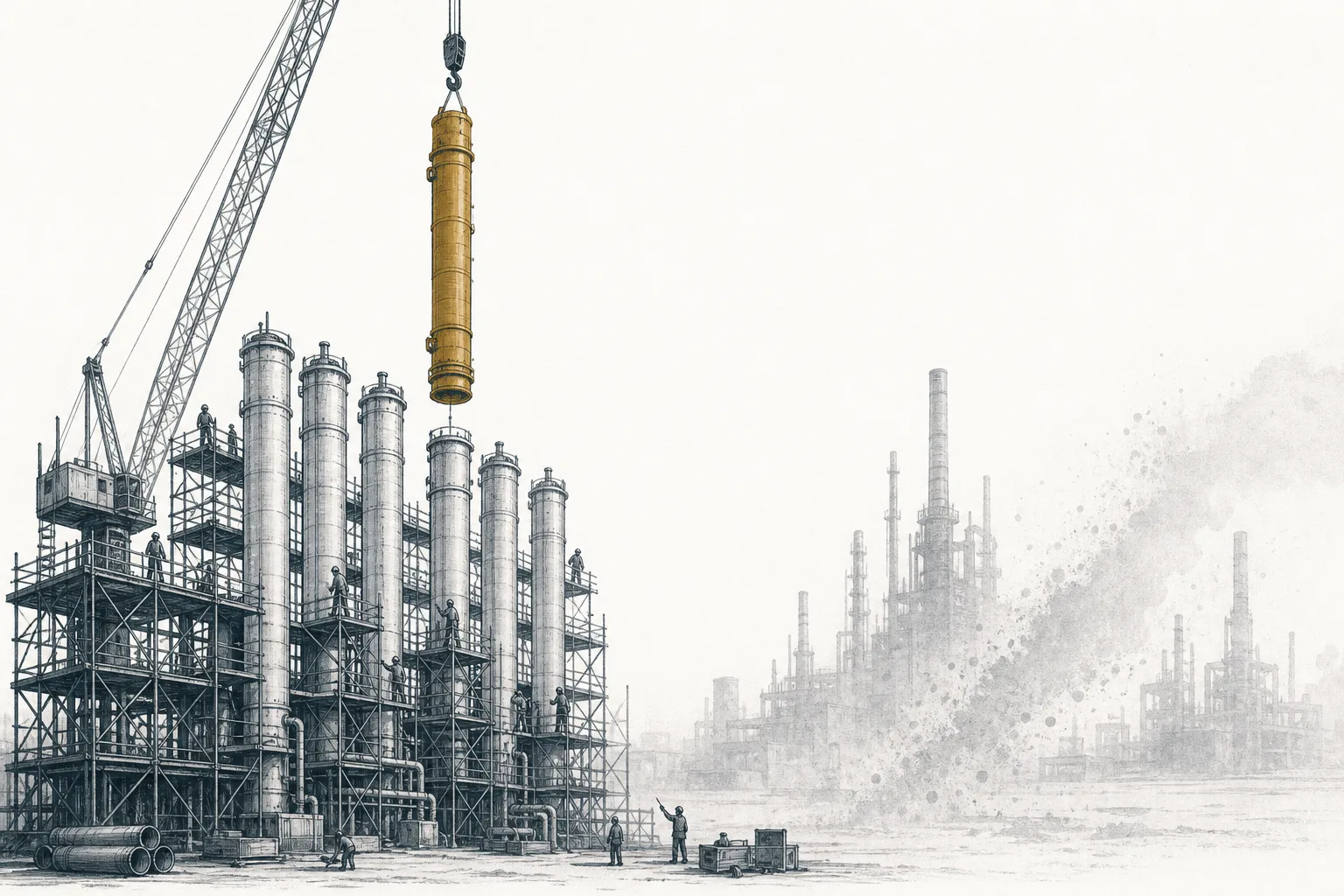
The second is the "re-shoring" to end dependence on Russia. Government money is flowing steadily into enrichment plants in the U.S. and Europe. Centrus has announced a "multibillion-dollar" plan to expand enrichment capacity in Ohio, and Urenco and Orano are rushing to build more cascades. This is a structural investment theme that could take a decade — but it's slow, because building new capacity takes years and has to clear strict licensing.
The third is alternative technology. Beyond the traditional centrifuge, there are efforts to develop new isotope-separation methods, such as using lasers, which companies like ASP Isotopes are pioneering. If it really works commercially, the cost and scale of enrichment plants could change — but it's still a long-term bet that has to be proven.
07Challenges & risks
The first risk is a dependence on Russia that hasn't truly ended. The U.S. has banned imports of enriched uranium from Russia, but truly "ending the dependence" has to wait for the West's new capacity to come online as a full replacement, which still takes years. In the meantime, the world still has to draw down reserves to plug the gap — and there's a mechanism to grant "waivers" for imports from Russia in some cases, meaning the break isn't 100% clean yet.
The second risk is HALEU's "chicken-and-egg" problem. This is a classic trap — fuel companies won't dare pour money into a large HALEU plant without confirmed long-term customers, but SMR builders won't dare commit to ordering reactors without confidence that fuel will be supplied. Each waits on the other, making the scale-up slower than it should be. So government money (like the DOE's HALEU program) has to step in to "light the fuse" on one side first.
The third risk is heavy capital and long timelines. Building new enrichment capacity costs enormous sums and takes years to pay back. Players' revenue is still tied to government contracts and the timing of the nuclear revival. If SMR construction is delayed or stalls, the expected HALEU demand may arrive later than planned, turning the heavy investment into capacity that's temporarily "idle."
In short: this node is the most powerful midstream of nuclear fuel. Conversion and enrichment are the step that's hard to do, tightly controlled, and has the fewest players — Russia once held nearly half the world. But now the West is pouring enormous money in to rebuild this step as its own, with HALEU as both the biggest opportunity and the most dangerous chokepoint at the same time.