Megatrend · Energy
Reactors built in a factory: the 'Model-T' of nuclear power for the AI era
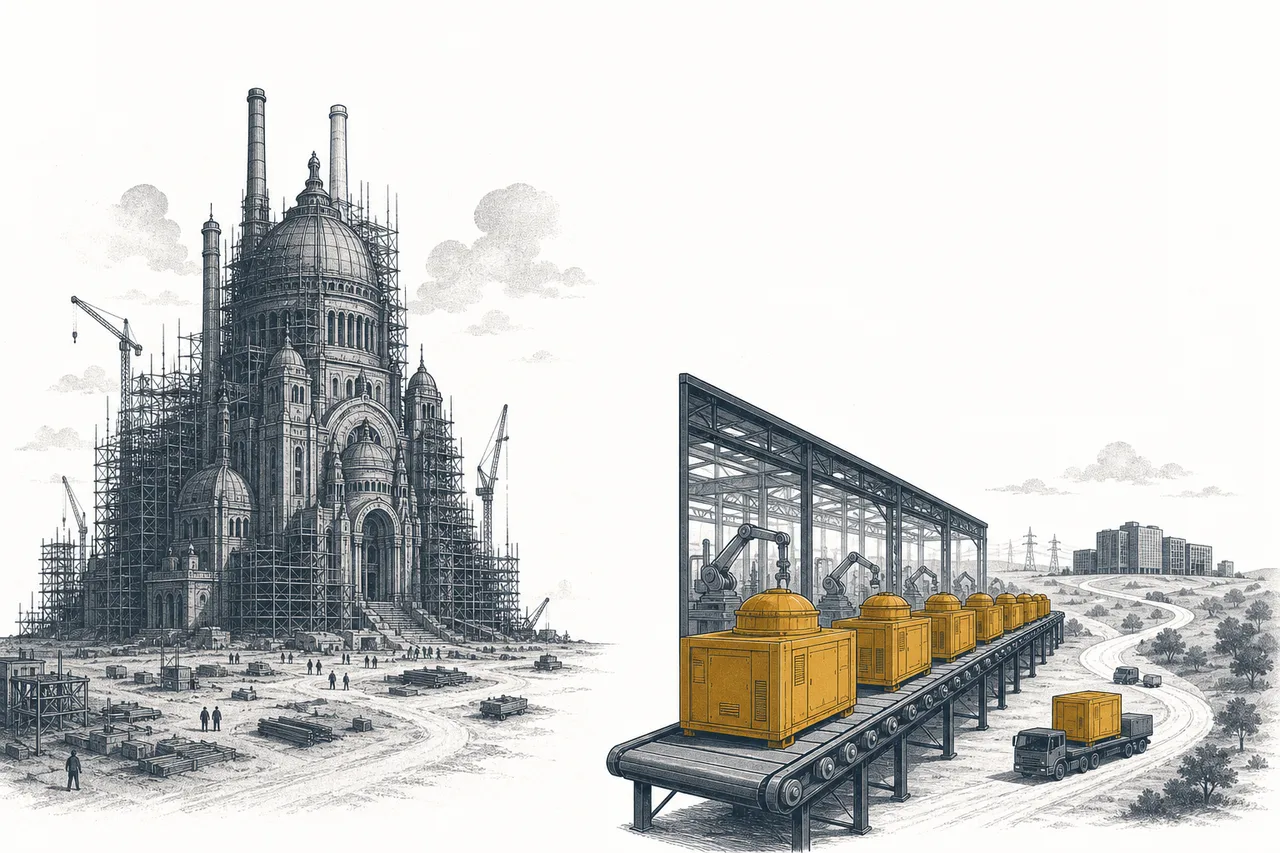
If a giant nuclear plant is a 'cathedral' — built one at a time, by hand, taking a decade and often ballooning into the tens of billions — then SMRs are the idea of turning it into a 'car assembly line': small, identical reactors built in a factory and trucked out to sit next to whoever needs the power. It's one of the hottest bets going, because AI is hungry for electricity like never before — but let's be straight: almost none of the real things are running commercially yet. Today's stock prices are a bet on 'the future,' not on profits that already exist.
01What it is
Picture the kind of nuclear plant we all know — a vast concrete building, cooling towers that scrape the sky, putting out thousands of megawatts, enough to power a whole city. Each one is a 'bespoke' design, built over a decade, with budgets that blow up so badly that some projects collapse mid-build. That's the dad-generation of nuclear — the big-brother node called Nuclear Generation & Utilities.
SMR (Small Modular Reactor) flips that logic on its head. Instead of building one giant plant at a time, you make the reactor smaller (under 300 megawatts — some just a few dozen), make them all identical, and mass-produce them as prefab 'modules' in a factory, the way you'd build cars. Then you ship the parts to the site and assemble them. And a microreactor is the even-tinier version — small enough to load onto a truck and drop off, suited to remote mines, military bases, or communities the grid never reaches.
SMR = a reactor under 300 MWe designed as prefab modules · Microreactor = the tiny version (roughly 1–20 MWe) that can be transported · 'Modular' doesn't just mean small — it means 'built as standard pieces in a factory, then connected together.' This is the most important word in the name, because it's the source of the promise to be 'cheaper and faster.'
On the megatrend map this node is a sub-theme under Energy Transition & Power Demand, and its definition is blunt and to the point: 'developers of SMRs/microreactors that are still pre-commercial, working through milestones.' That phrase 'pre-commercial' is the heart of the whole story, and we'll keep hammering it throughout the lesson.
02Why it matters — because AI is starving for power
SMRs aren't new on paper — people have talked about them for decades. But what made them 'explode' into view in 2024–2026 comes down to one word: AI.
The data centers that train and run AI models eat power on a scale the grid has never seen. The IEA estimates that global data-center electricity demand will more than double by 2030, to around 945 TWh — more electricity than the entire country of Japan uses in a year. And data centers focused specifically on AI will grow 'more than 4×' over the same period.
The catch is that the tech giants want power that's 'available 24 hours a day, carbon-free, and price-locked for the long term' — sun and wind are intermittent, and the public grid is congested and slow to connect to. Nuclear fits perfectly. And SMRs have a special appeal: they're 'small enough to sit right next to a data center,' becoming a kind of private power tank for each campus.
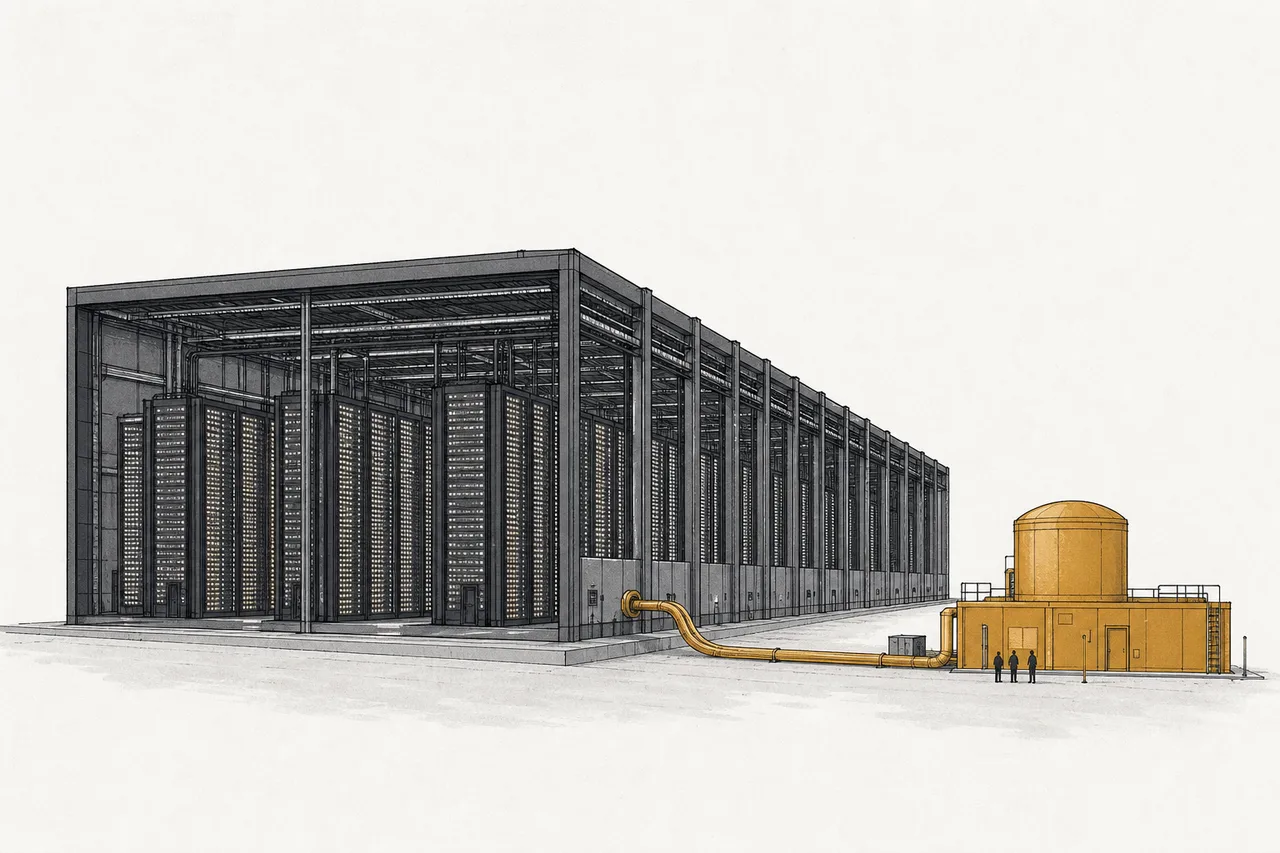
That's why the big deals came pouring out in 2024–2025: Google signed to buy power from a fleet of Kairos Power SMRs (first reactor targeted to come online ~2030, ~500 MW total), Amazon invested over $700M in X-energy and locked in power-purchase contracts of up to 5 GW by 2039, and Meta announced several nuclear deals of its own — AI demand is what turned SMRs from 'an interesting technology' into 'a field the money is flowing into.'
03How it works — cathedral vs assembly line
To see why SMRs might be cheaper and faster, you first have to understand where old-style nuclear gets 'expensive.' The answer isn't the reactor itself — it's 'construction'.
A giant plant like the Vogtle project in the US finished at a cost of nearly $30 billion — almost double the original estimate, because every plant is a bespoke design, built outdoors on-site, hitting one-off problems fixed on the fly. The slower it goes, the more interest compounds, and the more it balloons. This is the 'curse' of nuclear megaprojects.
SMRs offer a way out of the curse by switching the logic from 'economies of scale' (bigger is cheaper) to 'economies of unit production' (the more you repeat, the cheaper it gets) — the way Henry Ford turned the car from handcraft into an assembly line. You build standard reactors in a quality-controlled factory and cut on-site work down to just 'assembly,' aiming to finish in 3–5 years instead of more than a decade.
An important bonus is passive safety — many new reactor designs are built to 'cool themselves down' through physics (gravity, natural convection) even if the power goes out and no one is there to act, lowering the meltdown risk people used to fear. That's the safety selling point that makes it easier to talk about placing a reactor next to a community or a data center.
But — and this is a very big 'but' — all of this is still a promise built on assumptions, because 'the more you repeat, the cheaper it gets' only comes true if there are enough orders to run the assembly line at full tilt. Build just a few units and the per-unit cost is still eye-wateringly high (we'll see the shocking real numbers in the later chapters).
04Where it sits on the energy map
SMRs don't float alone — they're a puzzle piece that locks tightly into the other nodes of the megatrend:
- The 'little brother' of Nuclear Generation & Utilities: the big brother is the fleet of giant reactors actually running and powering the world today (proven technology), while SMRs are the next generation — smaller and still experimental, like 'mainframe vs PC'
- Feeds on fuel from Nuclear Fuel Cycle (Uranium & Enrichment): many SMRs need a special fuel called HALEU (uranium enriched to ~5–20%), and right now the world has almost no production capacity outside Russia — a bottleneck that ties SMRs directly to the fuel node and critical materials
- Driven by AI Data Center & Build-out and AI Power & Cooling: AI's hunger for power is the 'customer' that gives SMRs a business case — without the AI build-out, this demand thins out a lot
- Competes with its baseload-power neighbors: in supplying 24-hour power to AI, it fights for the slot against Firm Power & Transition Fuels (gas) and Geothermal — because they all sell the same thing: 'power that's available around the clock'
The deepest angle is the relationship with AI. It's a two-way loop: AI creates demand for SMRs (drives demand), and SMRs in turn enable AI to expand — because without enough power, you can't build the data centers. 'Power' becomes the real bottleneck of the AI era, and SMRs are one of the answers being bet on.
05Where it stands now
This is the part we have to be most honest about, because it's the line that separates 'the story' from 'reality.'
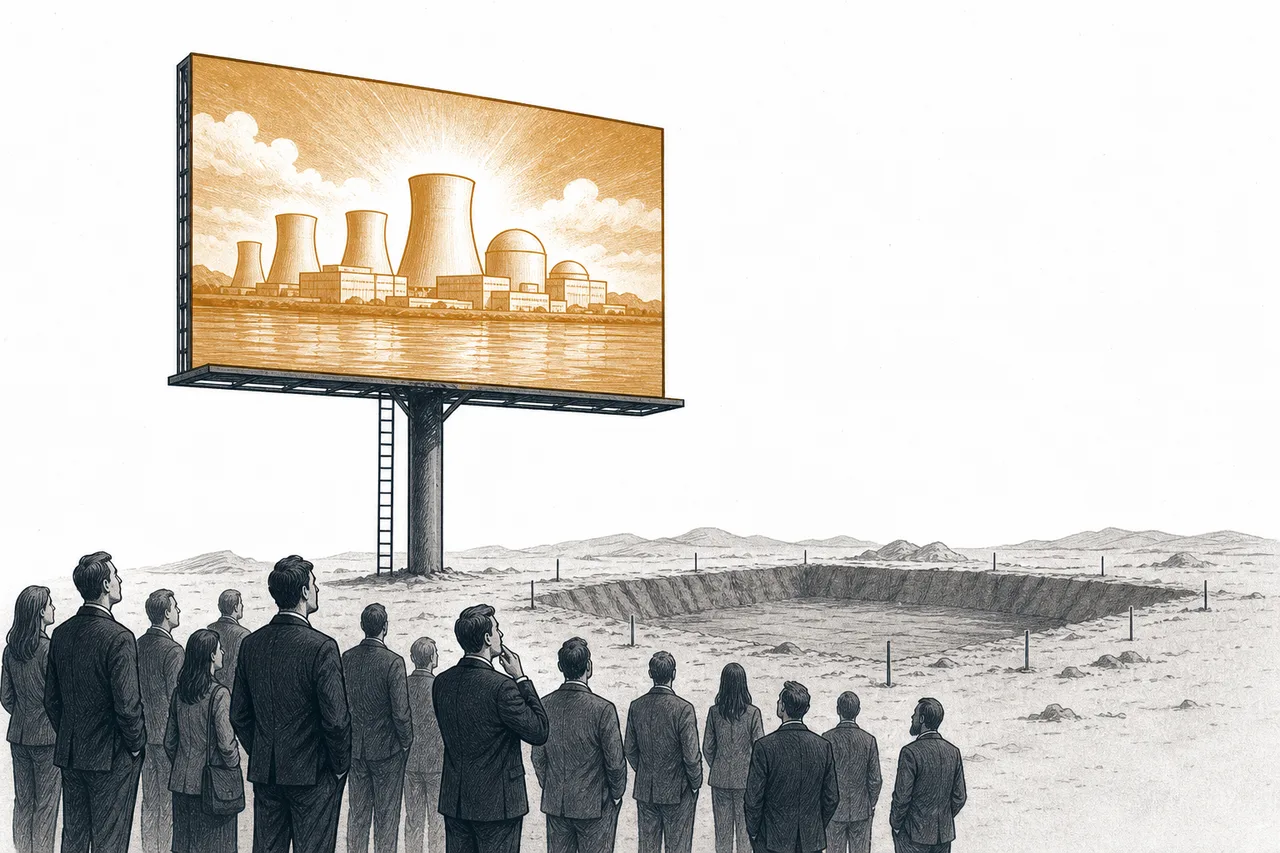
The reality is: almost no SMR is yet running full commercial operation in the West. The first US reactors target coming online around 2027–2031 — Oklo only just broke ground on its first Aurora at Idaho in late 2025, aiming to run around 2027–2028, while Kairos targets a first reactor feeding Google around 2030. Put simply, today's stock value is 'paying in advance for the future' — not profit that has actually happened.
The numbers tell the story with startling clarity: Oklo (OKLO) saw its market cap leap from around $2.6B in early 2025 to over $11B by year-end — even though revenue is still zero and it has a 'talked-about' project backlog of roughly 14 GW that isn't yet a confirmed order. This is the definition of a narrative-driven market, not one driven by results.
The side with 'real things' closer at hand is the story of licensing and government support — NuScale (SMR) is the only one to win design approval from the US NRC and targets a power cost of about $89/MWh (before IRA subsidies). The government, too, is opening its wallet: the US Department of Energy (DOE) selected 11 projects for the Reactor Pilot Program, granted Kairos $303M, and announced plans to pour in another ~$800M for SMRs.
So who are the real players on this field? You have to separate who 'builds the reactors themselves' (and is still pre-revenue) from who is the 'pick-and-shovel seller' already turning a profit.
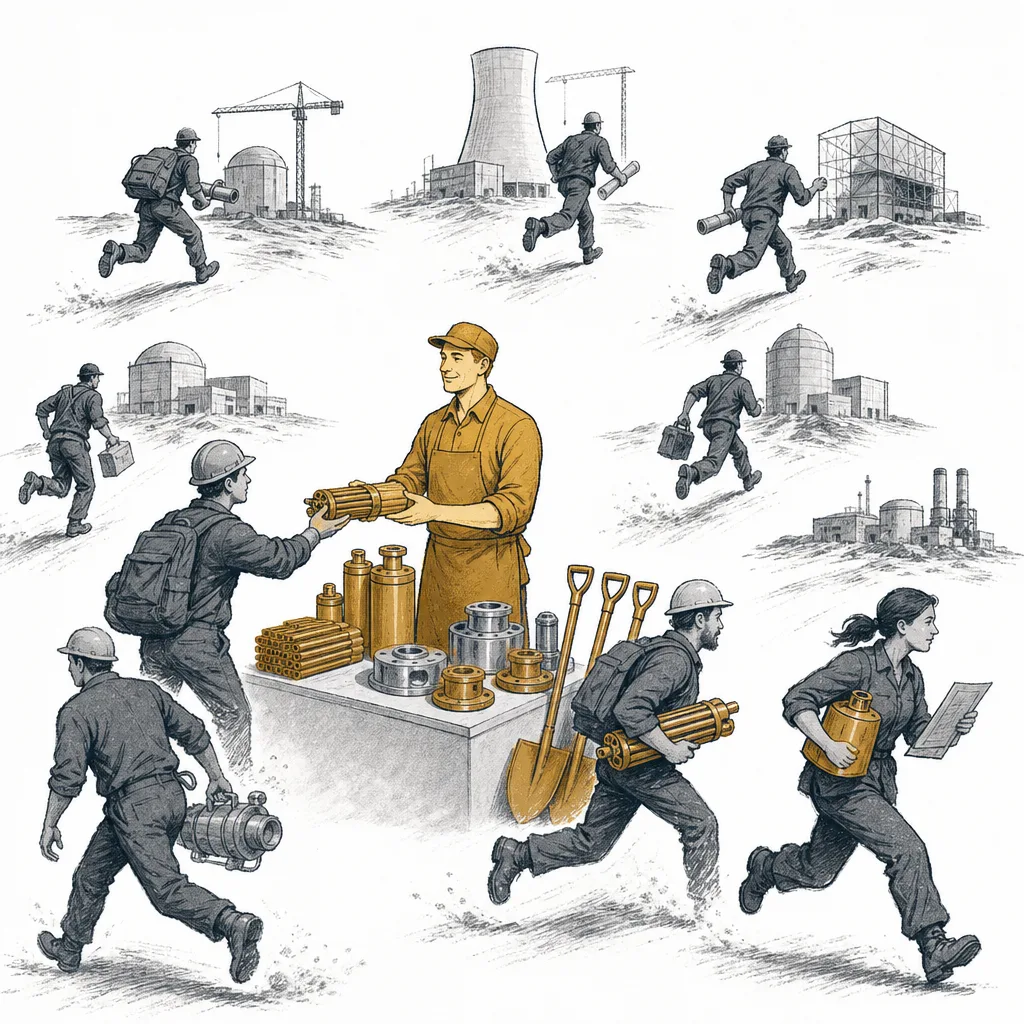
Notice the key pattern: many of the real players are still pre-revenue companies or private firms you can't buy on the stock market (like Kairos) — this isn't a flaw, it's the reality of an industry that's still 'pre-commercial' across the board. The side that's a big, steadily profitable company tends to be the one supplying the field (BWXT), or heavy-industry groups doing SMRs as a side business (like Rolls-Royce in the UK, or Doosan in Korea casting heavy reactor parts) — rather than a 'pure-play SMR' company.
06The road ahead
If everything goes as dreamed, the road ahead looks like this: the first demonstration reactors run successfully in 2027–2031 and prove you 'really can build them, on budget, on time.' Then orders flow in, the factory line runs at full tilt, and the 'the more you repeat, the cheaper it gets' logic starts to kick in — the cost of reactor number 10, 20, 50 keeps falling until it can compete with gas.
The market expects the size of the SMR industry (reactors + parts) to grow from around $6–7B in 2025 to roughly $16–17B by the mid-2030s — though, to be honest, the estimates from each research house vary widely (CAGR from ~3% to nearly 9%), because it all rides on a single assumption: do the first reactors 'succeed' or not?
Three variables will decide its fate: (1) how the first reactors turn out — if they come in on time and on budget, confidence will explode; but if they balloon like UAMPS again, the whole group gets heavily questioned · (2) whether there's enough HALEU fuel — if the West can't produce HALEU in time, you've got reactors but no gasoline · (3) how much the AI deals become real orders — most of the splashy announced deals are still 'intentions' rather than binding contracts that have been paid for.
On top of that, China is an important quiet variable — it is running commercial SMRs (Linglong One/ACP100) ahead of the West, with companies like a heavy reactor-parts maker in Shanghai feeding the supply chain — making 'who controls the standards and the market for the world's SMRs' both a technology game and a geopolitical one.
07Challenges & risks
This is a node where 'risk is the protagonist' — not a small footnote at the end of the chapter.
The first and biggest risk is being literally 'pre-commercial' — almost the entire field has no real revenue yet from selling power. Today's stock value reflects faith in the future. If the timeline slips (and in nuclear history, 'slipping' is the default), or the first reactors fail, the price can correct hard and fast. This isn't a stock you read off profits — you read it off 'milestones,' one step at a time.
The second risk is that 'costs may not be as cheap as advertised.' The most painful lesson is the NuScale–UAMPS project at Idaho: the estimate jumped from ~$3.6B (2020) to ~$9.3B, and the per-kilowatt cost blew past $20,000/kW — more expensive than the giant Vogtle plant everyone criticized as costly. The project was ultimately canceled in 2023 for lack of enough power buyers. It's proof that 'the more you repeat, the cheaper it gets' only comes true with enough orders — but orders only come when the price is cheap enough. It's a 'chicken-and-egg' no one has cracked yet.
The third risk is fuel and regulation. Many next-generation reactors need HALEU, whose production outside Russia barely exists yet, and getting a nuclear license is, by nature, a slow and expensive process — even as the US government tries to speed it up (the Reactor Pilot Program), nuclear safety is something you 'can't rush much' without trading it for risk.
And the often-forgotten fourth: social and siting acceptance. Placing a reactor next to a community or a data center sounds lovely on a slide, but in real life it has to get past local opposition, nuclear-waste handling, and safety questions rooted deep in how people feel.
In short, SMR is the story of trying to turn nuclear from 'a cathedral built one at a time' into 'a car built many at a time' to feed the AI era's hunger for power. The idea is powerful and the bottleneck it solves is genuine — but as of 2026 it's still a promise being tested, not a victory already won. Understanding the line between 'the story' and 'a reactor that's actually running' is the most important thing in reading this node.