Megatrend · Defense & Geopolitical Fragmentation
The invisible war: when a weapon's 'senses' are worth more than the weapon itself
Billion-dollar fighter jets, warships, satellites, tanks — what lets them 'see,' talk to each other, and survive on the battlefield isn't the steel or the engine. It's the layer of electronics buried inside. Radar is the eyes, communications are the nerves, and electronic warfare is the fight over the 'spectrum' — the very thing Ukraine just showed the world how much it matters. This is a high-margin business hidden inside every platform, and it's eating an ever-bigger share of the cost.
01What it is
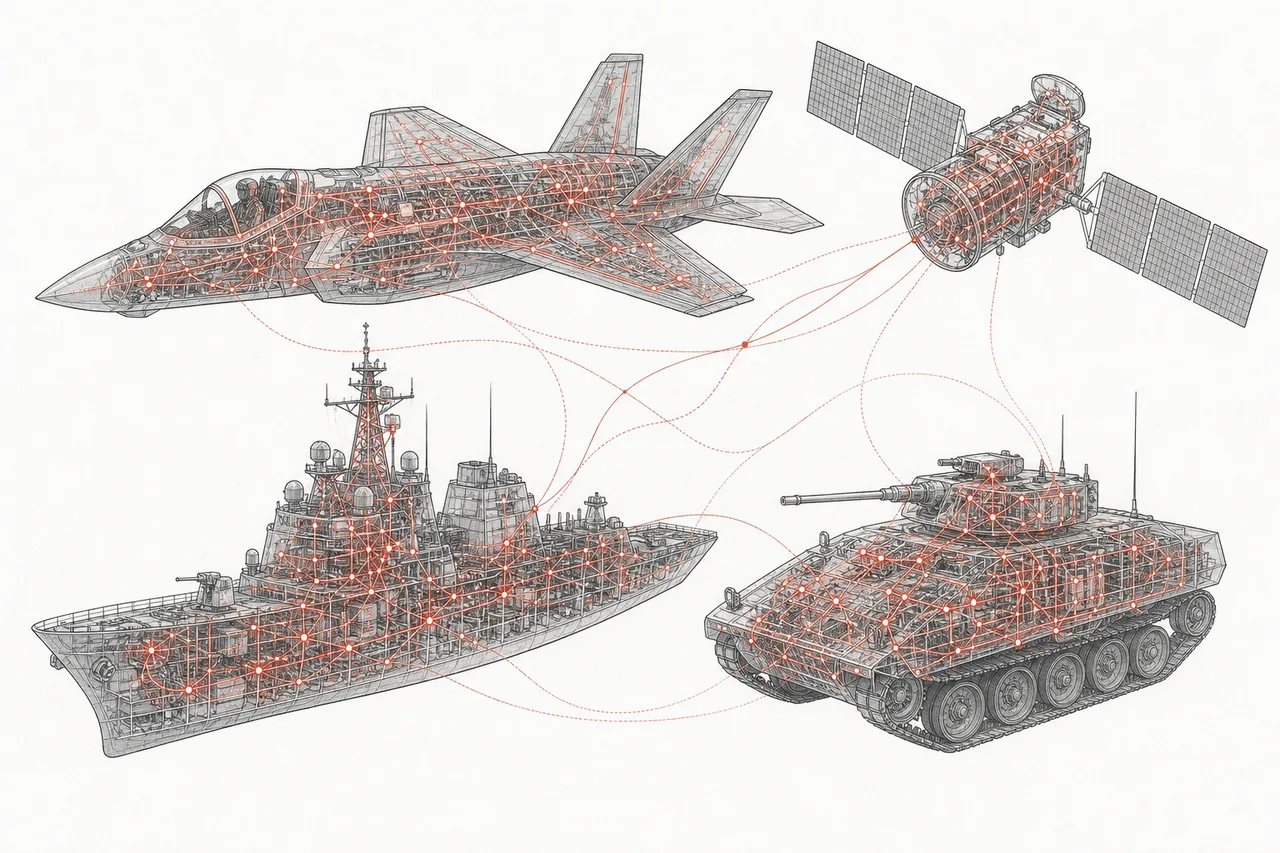
When we watch weapons in the news, we tend to get excited about the 'shell' — the stealth jet, the destroyer, the tank. But these are like a 'body' that means nothing without its senses. A multi-billion-dollar fighter that can't see the enemy, can't talk to base, and gets jammed until it's lost is just an expensive flying chunk of metal. This node is about the 'eyes, ears, and nerves' of every military platform.
It breaks into three worlds that work together:
- Sensors & radar (the eyes): systems that let a platform 'see' — radar that detects targets hundreds of kilometers away, infrared/optical sensors that see in the dark, ISR systems that watch the battlefield
- Secure communications (the nerves): systems that let every unit talk without the enemy listening in or cutting the signal — the 'nervous system' that carries orders and data across the whole force
- Electronic warfare — EW (the fight for the spectrum): controlling the 'electromagnetic spectrum' — making the enemy's radar and signals useless while keeping your own working. This is the new, 'invisible' battlefield that decides who wins and who loses
EW (Electronic Warfare) = using the electromagnetic spectrum as both weapon and shield — jamming the enemy's signals, detecting what they're transmitting, and protecting your own · ISR (Intelligence, Surveillance, Reconnaissance) = gathering intel, watching, and scouting with sensors · C4ISR = ISR plus the 'brain' that commands it (Command, Control, Communications, Computers) — this lesson focuses on the 'sensory hardware,' while the 'software brain' layer lives in Defense Software & C4ISR.
On the megatrend map, Defense Electronics sits under Defense & Geopolitical Fragmentation, and it's the 'supply chain layer' buried deep inside everything — aircraft, ships, vehicles, satellites, even infantry. Every platform needs this layer. It's the 'electronics bottleneck' inside every national-defense system.
02Why it's a big deal
The first reason is pure money: electronics are eating an ever-bigger share of a platform's cost. Take a modern fighter jet — the 'avionics' (radar, weapons management, self-defense systems) can account for more than half the price of the whole aircraft, while the engine takes about 20% and the airframe another ~30%. Where 'steel and engines' used to be the main cost, now it's the 'brains and senses' that are most expensive.
That makes this market both large and steadily growing. The global defense electronics market sits at roughly $178 billion in 2025 and is expected to reach ~$234 billion by 2030 (about 5.6% annual growth), with Asia-Pacific the fastest at ~7%, driven by China's and India's modernization and South Korea's exports.
But the hottest part of this node is electronic warfare (EW), the fastest-growing segment of the group (around 8% a year — much faster than the market average), because modern war has moved fully onto the 'spectrum.' The global EW market is roughly $18–20 billion in 2025, and many firms expect it to reach ~$27–38 billion by the early 2030s (the range depends on how each firm defines the market's scope).
03How it works — eyes, ears, and the fight for the spectrum
The easiest way to understand this node is to see every platform — aircraft, ship, or satellite — as having three stacked 'electronic layers' that work as a team. And these three layers are exactly what this node sells to the platform's owner.
The first layer is the sensor — at its heart, modern AESA radar, which uses thousands of tiny transmit-receive modules working at once (instead of an old spinning dish), so it scans fast, accurately, and is harder to jam. Add the infrared and optical sensors that 'see' in the dark and pick up heat. What keeps making these more advanced is new-material chips like gallium nitride (GaN), which push signals stronger and farther than the old silicon.
The second layer is communications — letting aircraft, ships, infantry, and command centers see the same picture in real time. The hard part is keeping the signal 'reliable' even as the enemy tries to listen in or cut it off.
The third layer is EW, the star of this era. The idea is simple: everything on the modern battlefield — from a missile's GPS to a drone's video feed — 'runs on the spectrum.' Control the spectrum, and you can blind and deafen the other side without firing a shot. It's about making the battlefield 'silent' for the enemy but 'loud' for your own side.
AESA (Active Electronically Scanned Array) = a new kind of radar that uses many tiny transmit-receive elements instead of a spinning dish, so it scans fast and resists jamming · GaN (Gallium Nitride) = a semiconductor material that handles heat and high power, letting radar and EW push signals stronger and farther than ordinary silicon chips — the point where defense electronics connects to the world of semiconductors.
04How it connects in the ecosystem
This node is the 'central nervous system' of the defense industry — it doesn't build platforms itself, but it embeds into everyone else's. That makes it unusually wide-reaching:
- Embedded in the U.S. primes and every platform: radar, comms, and EW get installed in the primes' aircraft, ships, and vehicles — so this node 'sells to everyone,' even competitors. Sometimes an electronics company is a supplier to both sides of the same deal
- Paired with Defense Software & C4ISR (its closest sibling): if this node is the 'sensory hardware' (eyes, ears), C4ISR is the 'software brain' that takes the sensor data and makes decisions — both have to work together to mean anything
- Feeds and depends on Space Defense & Missile Warning: missile-warning satellites are 'sensors in space,' and they need the radiation-hardened (rad-hard) chips that are this node's specialty
- Depends on semiconductors as raw material: modern radar and EW are 'high-performance chips,' especially GaN and rad-hard chips. Access to a 'trusted foundry' is a strategic bottleneck
- Depends on AI and critical materials: AI helps sensors 'understand' what they see and lets EW adapt faster, while rare materials are the raw input for chips and sensors
05Where it stands now
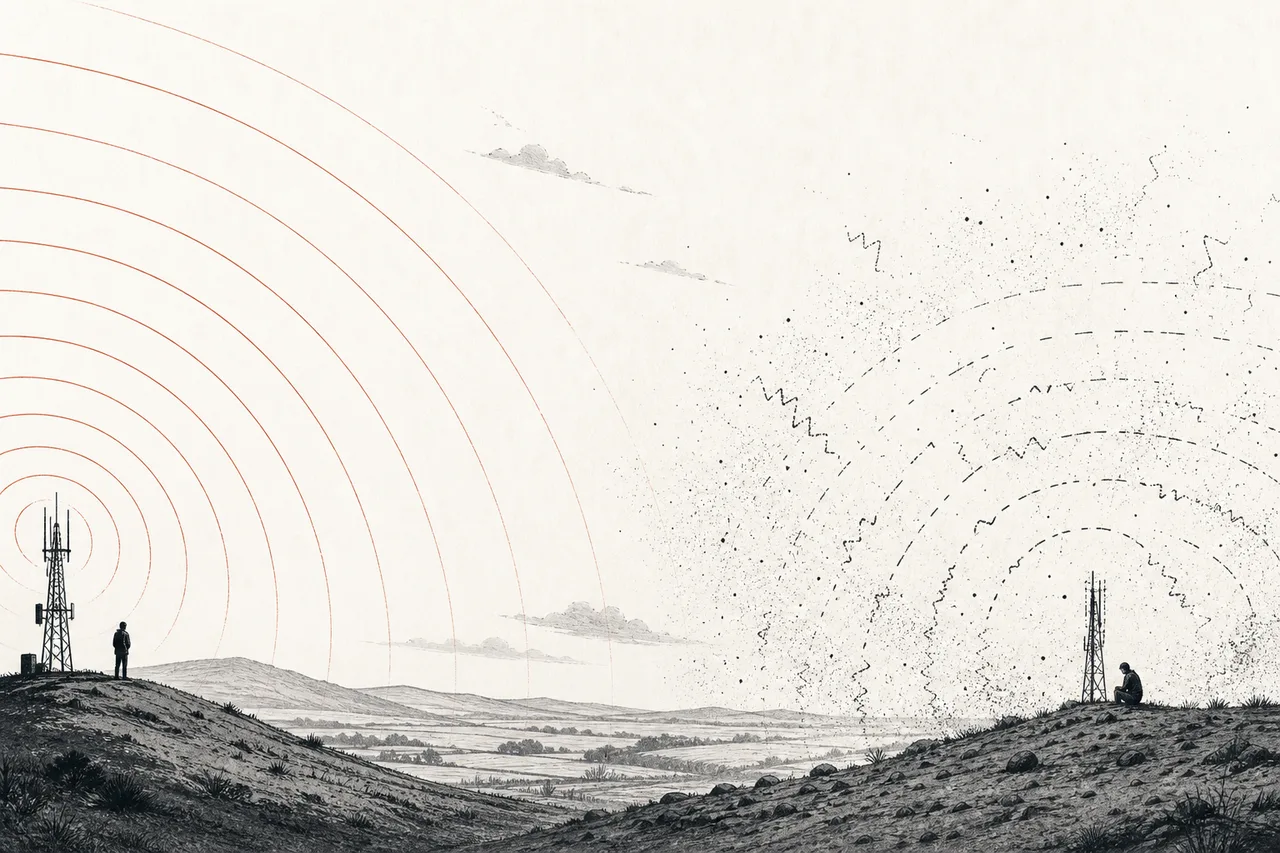
The thing that shook the whole industry most is the 'return of electronic warfare,' with the war in Ukraine as the trigger. For decades after the Cold War, the West barely invested in serious EW, because it fought opponents without the capability. But in Ukraine, both sides turned the 'spectrum' into the most intense battlefield there is — GPS signals vanished, drone video went to a blank screen, and guided weapons drifted off by hundreds of meters. All of it from the 'fight over the spectrum,' not from gunfire.
The result: every country rushed to top up its EW and sensor budgets, sending the specialists in this group surging in revenue and orders. The brightest star is Israel's Elbit Systems — in 2025 it posted $7.94 billion in revenue (+16%), and its backlog blew past $28.1 billion (up $5.5 billion in a single year), reflecting demand spilling over from both home and exports.
Europe is running just as hot. Germany's Hensoldt (the radar-and-sensor heavyweight) posted €2.455 billion in 2025 revenue (~+10%), but the more striking number is order intake jumping 62% to €4.71 billion, lifting its backlog by a third to €8.833 billion — the company even raised its 2026 revenue target to ~€2.75 billion. This is the picture of Germany's 'Zeitenwende' (turning point) flowing straight into sensor-makers' pockets.
Another hot theme is 'defense chips.' Modern radar and EW need high-power GaN chips, while satellites and missile-warning systems need radiation-hardened (rad-hard) chips that only a handful of factories in the world can make — BAE Systems just unveiled a 28-nanometer rad-hard chip for satellites. The catch is that 'trusted' rad-hard chip capacity is very limited, because commercial fabs focus on mass-producing for general customers, making this specialist segment's capacity a bottleneck.
06The road ahead
The first direction is 'the spectrum is a permanent battlefield.' Ukraine proved that controlling the spectrum is as important as controlling the sky and the ground, so every country will keep investing in EW. And the standout is that modern EW is increasingly software-defined — letting it adapt to new threats fast, without swapping out the whole hardware. That's the 'keep updating forever' model investors love, because it brings steady recurring revenue.
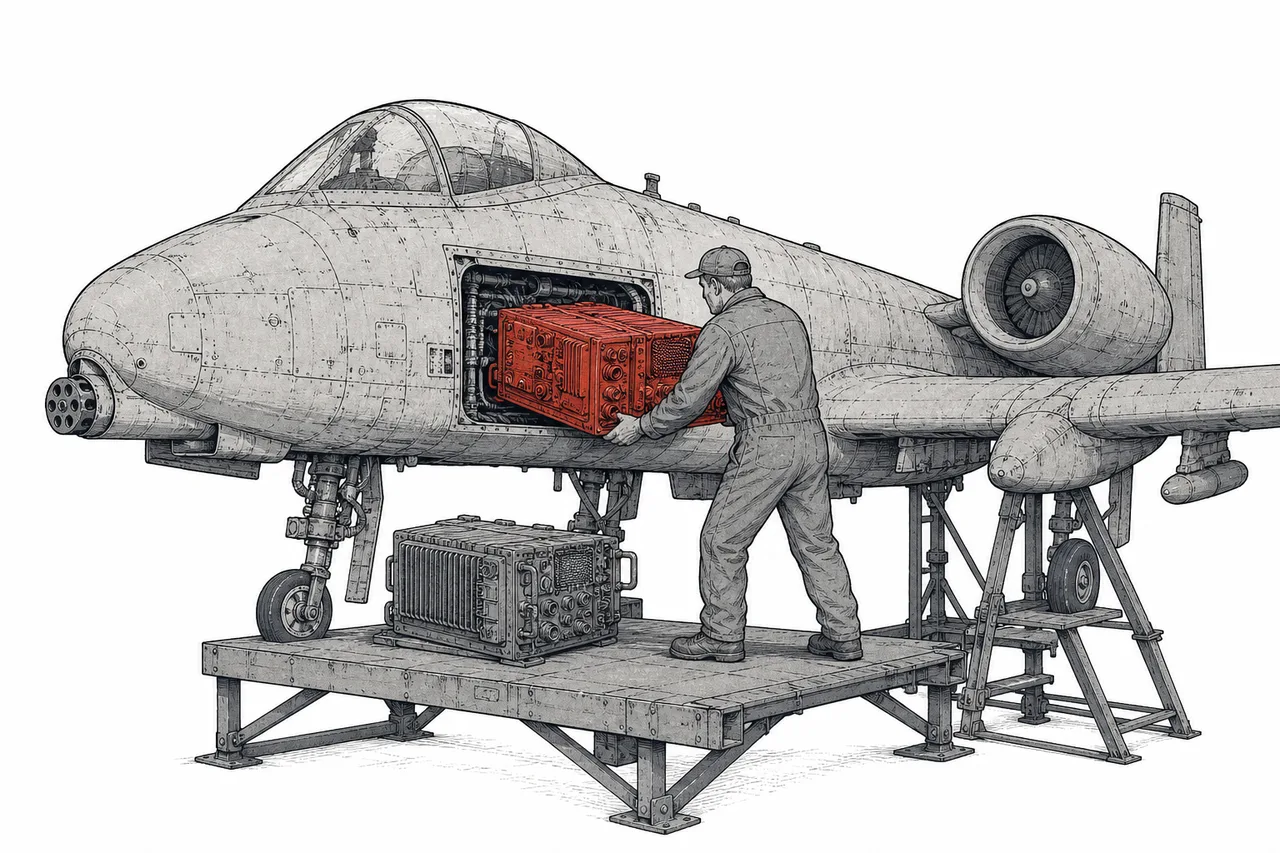
The second direction is 'electronics keep taking a bigger share.' As new platforms get more expensive and slower to build, militaries will turn to 'upgrading the old' — modernizing radar, sensors, and EW systems, swapping out the 'brains and senses' without rebuilding the whole body. That keeps lifting electronics' share of defense budgets.
The third direction is 'defense chips become a security agenda.' With radar and EW depending on GaN and rad-hard chips, having 'trusted' chip factories at home becomes a national-strategy issue — tied directly to the semiconductors theme and the push to bring the chip supply chain home.
07Challenges & risks
This trend may look hot, but it has shadows you need to see in full.
The first risk is 'fast obsolescence.' EW is an endless game of 'cat and mouse' — a jamming method that works today can be countered in a few months. A company that stops developing falls off the pace fast. That means pouring into R&D constantly, and what you've already sold can go 'out of date' faster than other platforms — it's both an opportunity (keep selling upgrades) and a risk (fall behind and you lose).
The second risk is the chip bottleneck. With the heart of radar/EW being GaN and rad-hard chips that only a few factories can make, dependence on the chip supply chain is a weak point. If you can't access a 'trusted' factory, or rare materials run short, all production stalls — which is why this node is inseparably tied to semiconductors and critical materials.
The third risk is competition and customer concentration. This market has both giants (RTX, BAE, Leonardo) and small specialists (Mercury, Hensoldt) competing on sophistication. At the same time, the main customers are a handful of governments — if defense budgets shift, or a big program is delayed or canceled, revenue takes an immediate hit. And as with the whole defense sector, there's the ethics/ESG question that narrows the investor base more than usual (though lately many European funds have started easing up on security grounds).
In short: this node is the lesson that modern war isn't won by 'how thick the steel is,' but by 'who sees farther, can talk even while jammed, and controls the spectrum better' — and that makes the 'invisible senses' one of the highest-margin, fastest-growing defense investment themes of the era.