Megatrend · Aging Population
The customer who has to come back every week, for life — and the new drug that might take them away
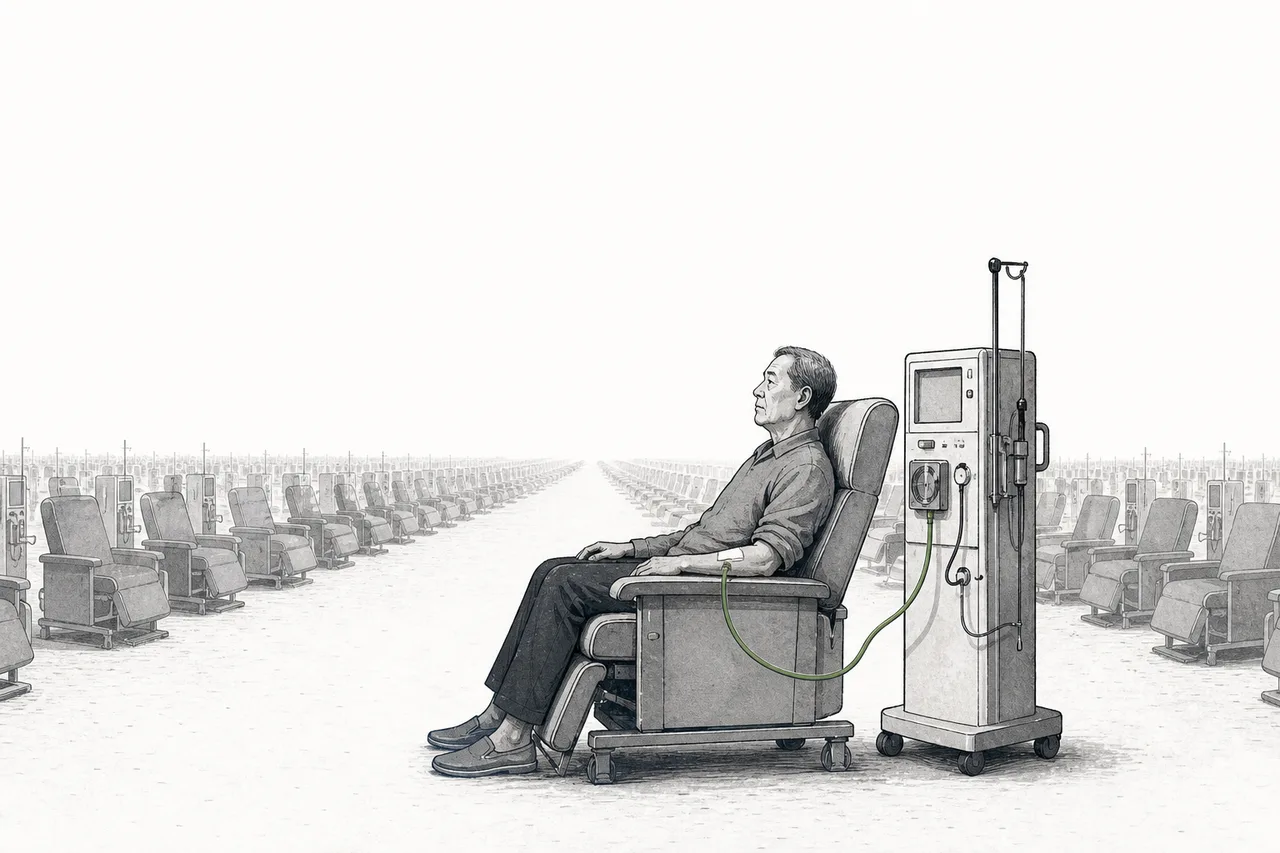
When your kidneys fail for good, you have to sit and get dialysis three times a week, every week, until you get a transplant or you die. It's the most reliable recurring-revenue business in all of healthcare, and in the US two companies own it almost completely. But in 2024–2026 a new question is shaking the foundation: could the GLP-1 and SGLT2 weight-loss/diabetes drugs that 'slow down' kidney decline gradually shrink the number of dialysis patients in the years ahead?
01What it is
Your kidneys work like your body's 'water filter' — straining waste and excess fluid out of your blood, 24 hours a day. You never feel them working, right up until the day they break.
When kidney function declines to its final stage (doctors call it ESRD — end-stage renal disease), the kidneys are working at under ~10–15%, and waste starts building up in the body until it's toxic. At that point you have just two options: a transplant, which means waiting for a compatible donor — chronically in short supply — or dialysis, using a machine to filter the blood in place of the kidneys that failed.
This node is the whole system of dialysis: from the network of dialysis clinics where patients go to get treated, all the way down to the dialysis machines and consumables (filters, fluids, tubing) that have to be replaced every single time. On the megatrend map, it's a sub-theme of Aging Population — because the older people get, the more they develop diabetes and high blood pressure, the two leading causes of kidney failure.
Hemodialysis (HD): blood is pulled out, run through a filter outside the body, and sent back — the kind most people picture. Done at a clinic about 3 times a week, ~4 hours each session · Peritoneal dialysis (PD): uses your own abdominal lining as the filter, with fluid going in and out through a tube in your belly — and it can be done at home, every day. This is the key to the 'home dialysis' trend.
02Why it's the most recurring-revenue business in the field
Picture an investor's dream business: a customer who has to buy, buys regularly, can't stop, can't negotiate the price, and comes back every week for years. Dialysis demand is exactly that. ESRD patients can't skip dialysis — waste builds up and kills within days. So it's a 'necessary-for-life' service with no swings tied to the economy. Good times or bad, the patient still has to come in.
And the market is huge. As of end-2025, roughly 4.9 million people worldwide need dialysis. The market for treating end-stage renal disease was about $150 billion in 2025, and is expected to grow to about $286 billion by 2030 (CAGR ~11–12%). The driver is something unavoidable — an aging population plus diabetes and high blood pressure spreading worldwide.
Another charm of this business is 'who pays'. In the US — the biggest and most profitable market — the government has guaranteed dialysis coverage for every end-stage renal patient through Medicare since 1972 (it's the only disease Medicare covers regardless of age). That means providers have a rock-solid payer, backed by the federal government.
03How it works — the 'dialysis treadmill'
The best way to understand the economics of this business is to see it as a 'treadmill'. Patients flow in from upstream — people with diabetes/high blood pressure whose kidneys slowly decline — and when the kidneys fail completely, they get 'put on the treadmill', meaning dialysis begins. Once you're on, you have to keep walking on it — coming in three times a week, every week — until you step off through a transplant or death. As long as people flow in faster than they step off, the patient base (and the revenue) keeps growing.
The economics of the 'consumables' are just as beautiful. Every HD dialysis session needs a filter (dialyzer) with a special membrane, plus a fresh set of fluid and tubing — thrown away every time. Multiply that by ~156 times a year, per person, by millions of patients. This is the 'recurring-consumable' revenue stream that equipment makers like Fresenius, Baxter, Nikkiso, Asahi Kasei and Toray fight over.
The filter is a small cylinder packed with tens of thousands of hollow fibers, made of a special membrane (like the polysulfone membrane from Toray/Asahi Kasei). Blood runs inside the fibers, fluid runs outside, and waste seeps across the membrane and out — it's where the 'materials science' of Japanese chemical companies meets medicine, and a product that sells over and over, endlessly.
04How it connects in the ecosystem
Dialysis doesn't sit alone — it's the end of a whole chain of chronic disease, and that ties it to other trends in meaningful ways:
- A sibling under Aging Population: the older the population, the more kidney-failure patients — it sits right next to Chronic-Disease Pharma and Medical Devices for the Aging Body in the same trend
- Upstream is Metabolic / Diabetes & Obesity: diabetes is the #1 cause of kidney failure, so whatever happens in the world of diabetes/weight-loss drugs always 'flows down' to the number of dialysis patients — this is the heart of the GLP-1 threat we'll cover in the later chapters
- The best way out comes from Biotech & Genomic Medicine: kidney transplants, implantable kidneys, and lab-grown organs are all long-term hopes that could one day 'shut the treadmill off'
Structurally, Dialysis is a trend that 'benefits when prevention fails' — it grows because we don't control diabetes/high blood pressure well enough. Which means that if the world gets better at 'treating upstream' (with new drugs), then downstream — dialysis — grows more slowly. It's an 'inverse' relationship investors need to understand.
05Where it stands now + who owns the field
The US picture is very clear: as of early 2025 there were about 7,556 dialysis centers caring for over 500,000 dialysis patients. And this is where the 'near-monopoly' shows up — the market is held by two companies in a duopoly (two big players): Fresenius Medical Care (Germany) and DaVita (US), which together control about 75–80% of US dialysis clinics.
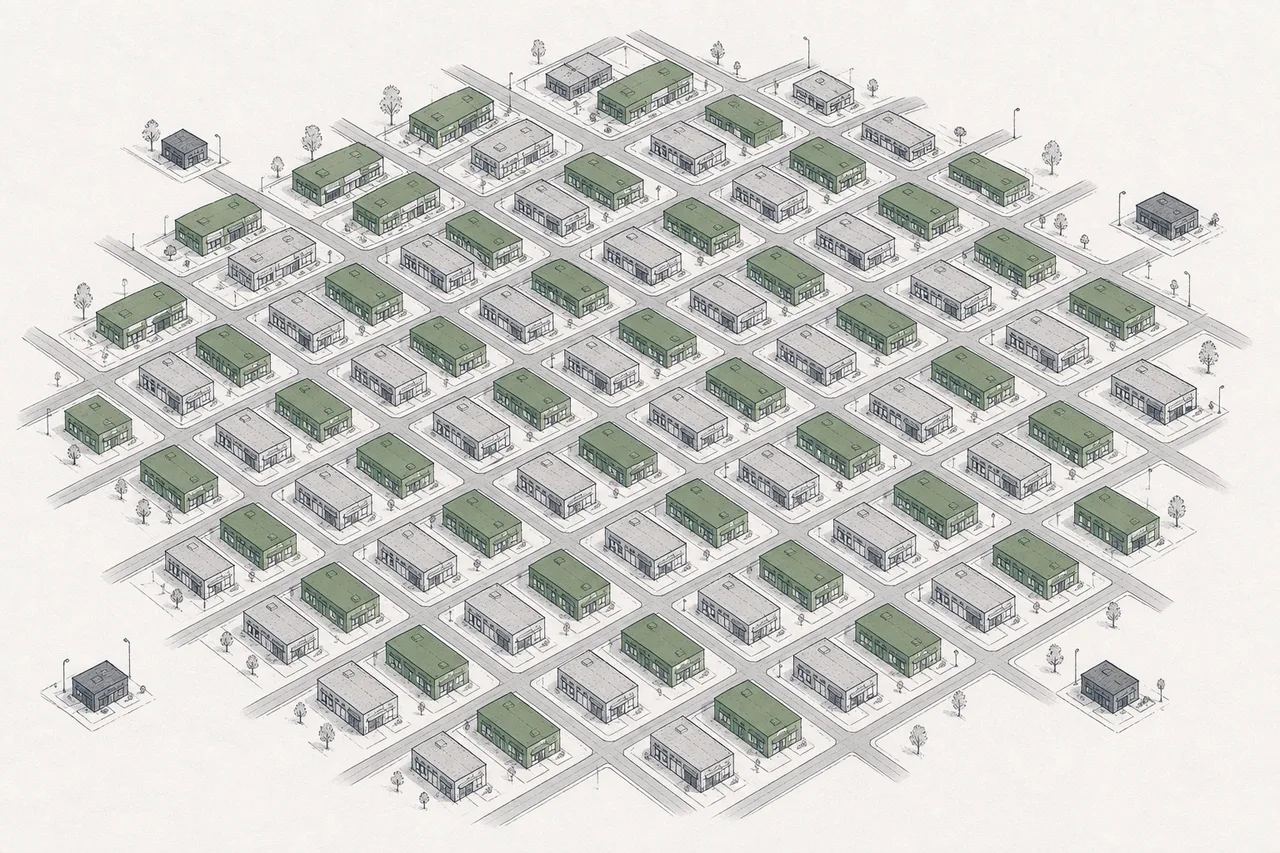
Why such a strong monopoly? Because the moat in this business is unusually hard — you have to invest in building a network of real clinics close to where patients live (they come 3 times a week, so you can't make them travel far). You also need relationships with medical directors and payers (Medicare/insurers) that take decades to build. So new entrants find it extremely hard to compete.
These two companies' numbers show how 'big and steady' the business is — DaVita made $12.8 billion in revenue in 2024, caring for about 281,100 patients across 3,166 centers (2,657 in the US, the rest in 13 countries). Fresenius made €19.3 billion in 2024, caring for about 311,000 patients worldwide across ~3,757 clinics, with operating profit up 18% that year.
Just as important is the 'hardware side' — the companies making the dialysis machines, filters, and membranes. In the 2024 hemodialysis equipment market, North America held the largest share (~38%), and the standout is how strong Japanese chemical/materials companies are in the 'filtration membrane' that is the heart of the filter.
06The future + the threat named GLP-1
For decades, Dialysis was seen as a 'stable-growth, durable, predictable' trend. But in 2024–2026 a new question has come up that executives at both DaVita and Fresenius have to report to their boards as a top item: will GLP-1 and SGLT2 drugs shrink this treadmill in the future?
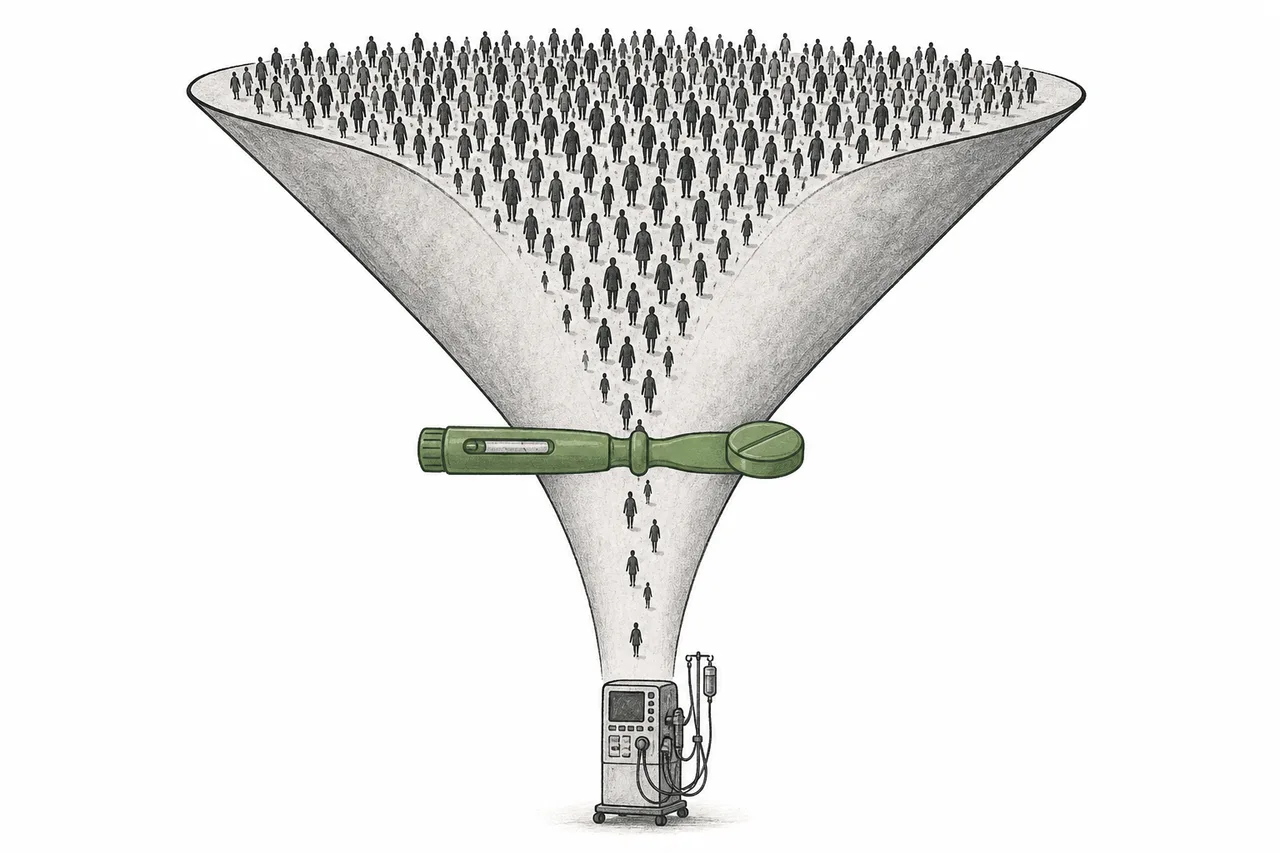
The evidence on kidney protection is genuinely strong. A major trial called FLOW (Novo Nordisk's semaglutide) showed that GLP-1 drugs cut the risk of 'serious kidney-decline events' by 24% in diabetic patients with kidney disease. SGLT2 drugs had already proven they slow kidney decline. As these two classes get used more widely, people who used to flow into kidney failure within 5 years may be pushed back.
But — and here's where you shouldn't get swept up in the headline drama — these drugs 'slow down', they don't 'cure'. They push back the time a patient has to start dialysis by about 2.5 years on average, not prevent it for good. Most patients still arrive at kidney failure eventually. Both companies estimate the revenue hit from GLP-1 will be a 'mild headwind' — no more than ~1% of revenue a year. Today about 8% of kidney-disease patients use these drugs, and that could rise to ~30% in the next few years.
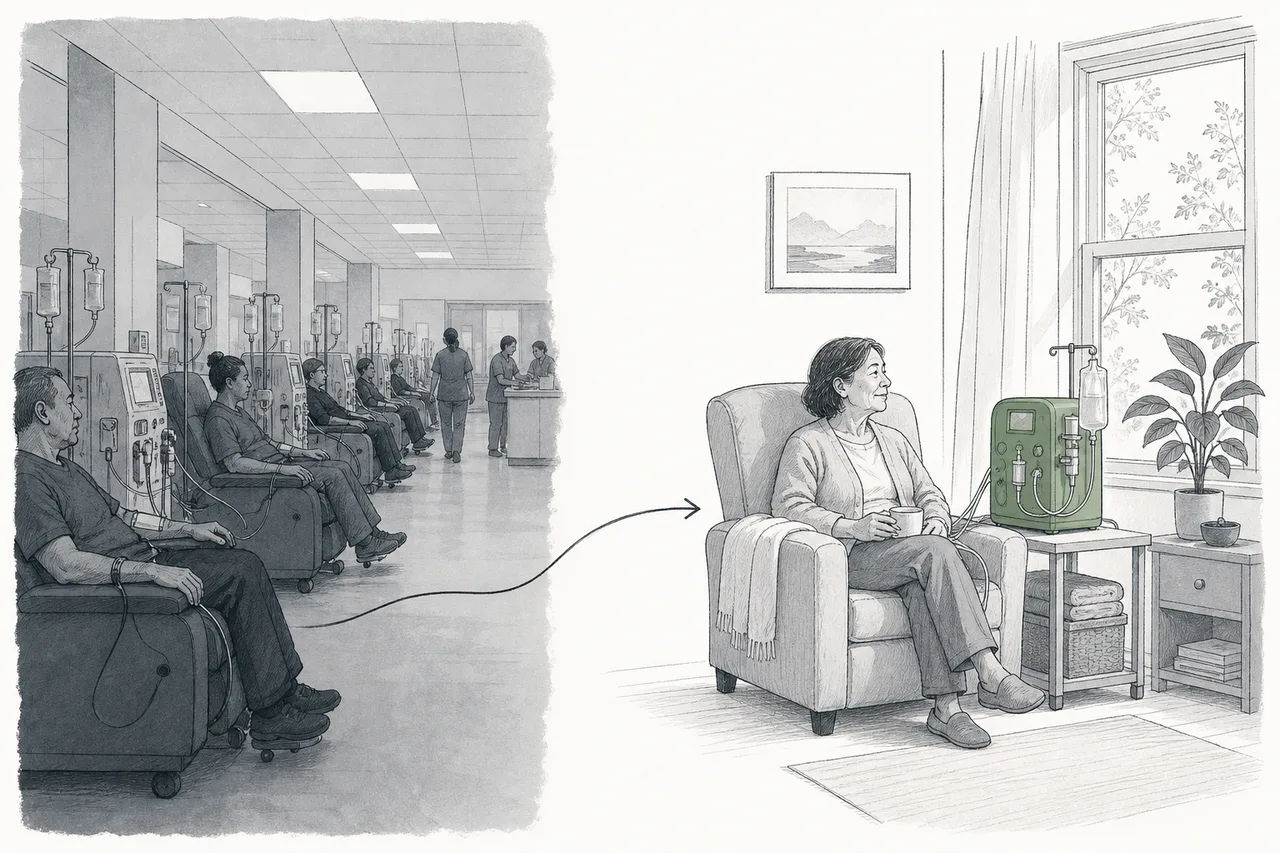
The second direction for the future is the shift to 'home dialysis'. The share of US patients doing dialysis at home rose from 8.5% (2012) to 14.5% (2022), and new payment systems are accelerating the trend — value-based care models like CKCC drove home dialysis up 22–32% among the groups that took part. This changes the economics: from selling a service 'per visit at the clinic' to 'taking on the whole-person health of the patient' — which is why DaVita is pouring resources into integrated kidney care.
07Challenges & risks
This durable-looking trend has its own risks you need to understand fully, before concluding 'recurring revenue = safe'.
The first risk is the long-term threat from GLP-1/SGLT2. The short-term impact is mild (<1%/year), but if these drugs get used early and very widely over the next 10–15 years, the rate of 'flowing onto the treadmill' could slow significantly, so the patient base grows more slowly than before — this is the real structural risk to the industry's 'grows forever' story.
The second risk is dependence on government payers (reimbursement). Because a big chunk of revenue comes from Medicare, anything the US government does — revising the payment formula, switching to bundled (value-based) payments, or pushing prices down — hits profit directly. So this industry is more vulnerable than a normal business to a single 'stroke of the pen' from policymakers.
The third risk is labor and cost. Dialysis needs a lot of nurses and technicians per patient. Wages and staff shortages keep squeezing margins, and on top of that there's scrutiny over the 'duopoly pushing up commercial prices', which could lead to regulatory pressure.
In short, Dialysis is a textbook example of the 'dream recurring-revenue business' — customers who can't stop buying, a near-monopoly market, a government-backed payer. But it's also a lesson that no moat is safe forever — because this time the threat isn't a competitor, it's 'a drug that makes people less sick', which is good news for humanity but a structural challenge for an industry that grew on us being ill.