Megatrend · Aging Population
The repair shop inside our bodies
A heart that starts skipping its beat, a valve that narrows shut, a knee worn down until you can't walk — an aging body is a body that slowly breaks down. And there's an industry that sells the small parts built to "repair" it, from heart pacemakers to artificial hips. This is a business whose demand is guaranteed by the single most certain thing in the world: every year, people get older.
01What is it?
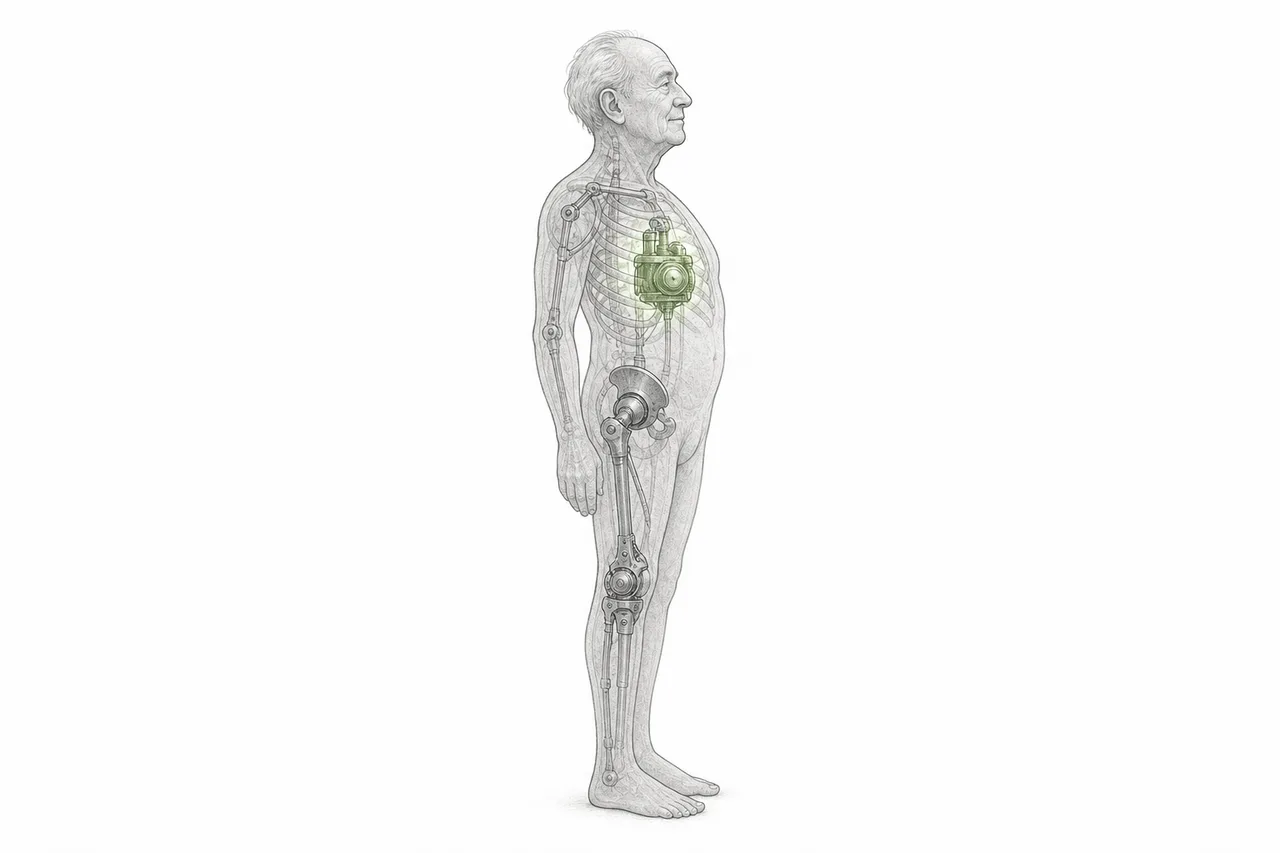
Picture a car that's been running for 70 or 80 years. The first parts to wear out are the ones that never stop working — pumps, valves, the joints that move every day. The human body is no different. As we age, the heart, heart valves, and joints are the first to break down — and that's the heart of this lesson.
This node is the business of "medical devices for the aging body" — hardware that doctors put inside the body to repair or replace organs that have worn down with age. Not drugs, not care services, but real parts that get implanted or inserted. It focuses on three big families that grow directly with age:
- Cardiac rhythm devices: pacemakers, implantable defibrillators (ICDs), and devices that treat atrial fibrillation (AFib), which becomes far more common with age
- Structural heart: above all artificial valves for valve stenosis — almost entirely a disease of the old
- Orthopedic: artificial hips and knees for joints worn out by osteoarthritis and osteoporosis
On the megatrend map, this node is a sub-theme under Aging Population — the megatrend covering every business that cares for, treats, and supplies "people who are already old" (65 and over). Medical devices are the "hardware side" of that trend — the tangible part, the part actually implanted inside real people.
02Why it's such a good business (and why investors love it)
Medical devices are seen as one of the highest-"quality" businesses in the stock market, and the first reason is almost startlingly simple: demand is guaranteed by demographics. The number of people aged 60 and over worldwide will jump from ~1 billion in 2020 to 1.4 billion in 2030, and 2.1 billion by 2050. Every person in that wave is a heart, a valve, and a set of joints that will wear out over time — a queue of customers you can see decades ahead, and one that doesn't depend on the economy (nobody postpones heart surgery because the stock market fell).
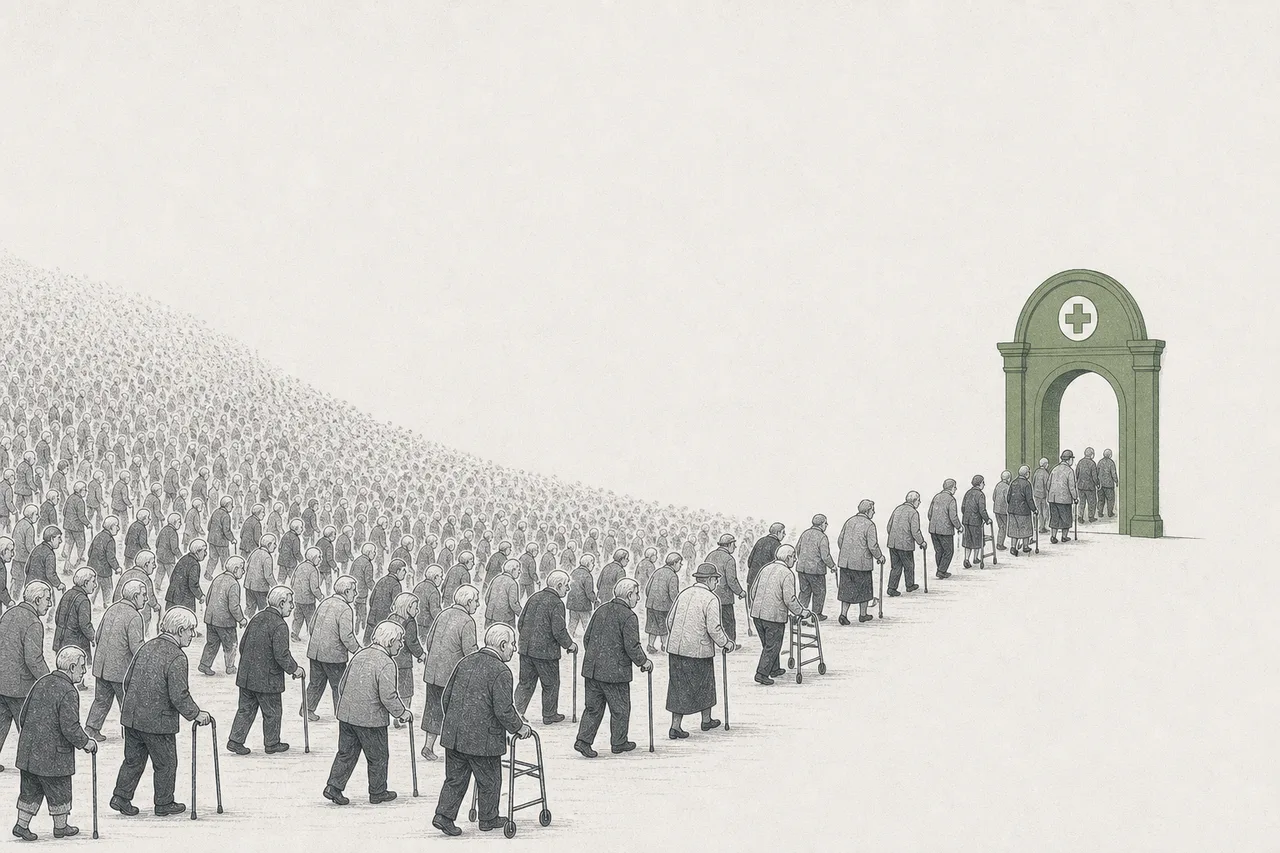
The result is a market that's both large and steadily growing. The global medical-device market sits at around $690 billion in 2025 and is expected to grow to nearly $1.4 trillion by 2035 (about 7% a year), with the cardiac segment the fastest-growing of all (~7.7% a year).
But the second reason is what makes this business truly beautiful: the "razor-and-blades" model. Expensive equipment — surgical robots, heart-catheter systems — is the "razor handle" you sell once and that locks the hospital in. After that, every procedure needs a "blade": a consumable part (a valve, an implant, a catheter) that sells over and over at a high margin. Revenue like this is predictable and well-walled — a surgeon trained to be fluent on one brand's system rarely wants to switch to a rival.
A business model where you sell the "hardware" (the installed base) cheaply, or to lock in the customer, then make the real profit on the "consumables" they have to keep buying for the life of the equipment. In medical devices, those consumables (a fresh valve for every case, single-use catheters) are the recurring revenue that keeps cash flow steady — a bit like a "subscription," but embedded in the operating room.
The third reason is the regulatory moat. Getting a device that goes inside the body through FDA approval and years of clinical trials costs enormous money and time. That keeps newcomers out, so most of the market ends up owned by a handful of giants.
03A map of the aging body's parts
The best way to understand this node is to see the body as a "parts map" — every spot that wears out with age has its own specific device, and its own market. Let's go from the head down.
The most dramatic spot on this map is the heart valve, because it shows so clearly how technology can change an old person's fate. "Aortic stenosis" is when the heart's valve hardens until blood can't flow through easily — found in about 4% of people in their 70s and nearly 10% of those 80+. The only fix used to be open-chest surgery, which the very elderly often couldn't survive, so many were left untreated until they died.
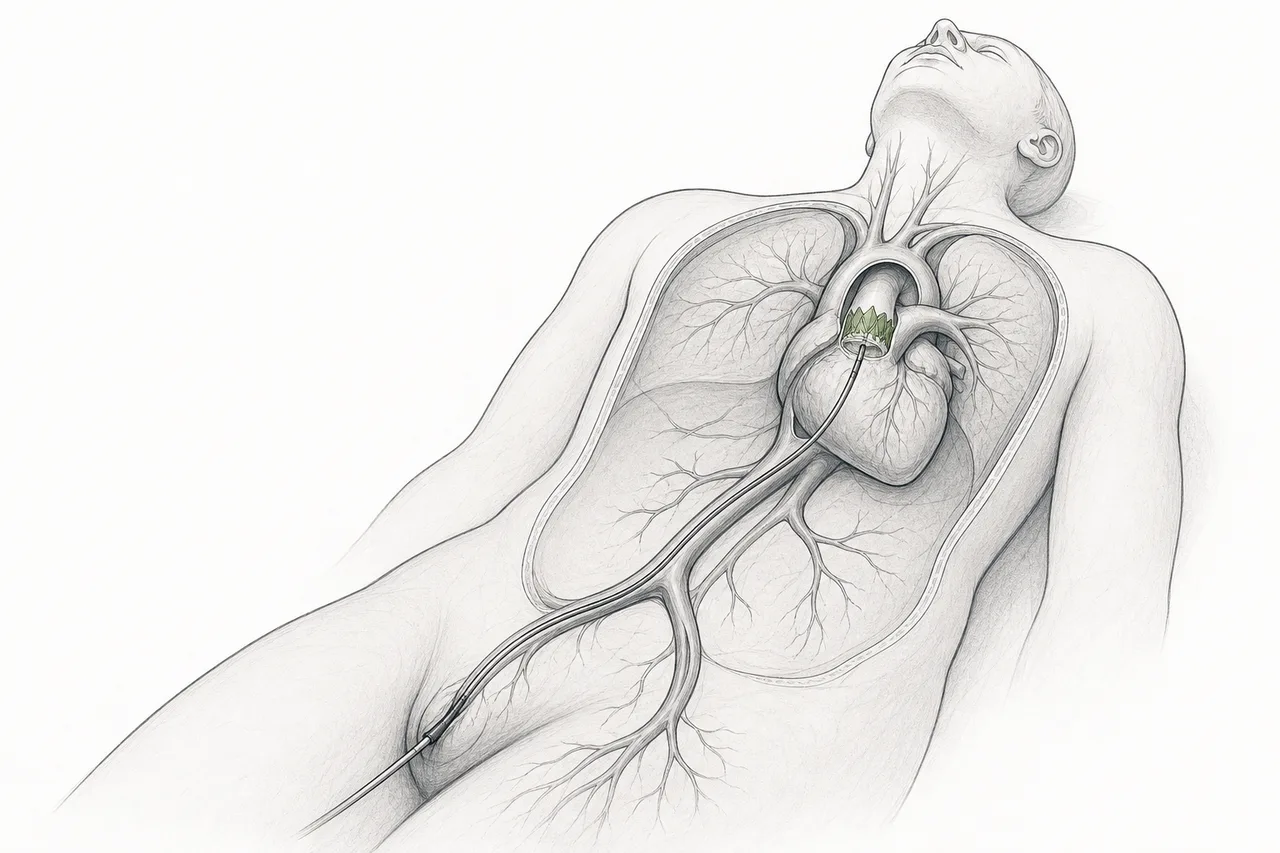
Then a technology called TAVR changed everything — instead of opening the chest, doctors thread a new valve through a catheter that enters via a blood vessel at the groin and open it inside the still-beating heart. A patient of 85 who once had no option can go home in a few days. That's why the TAVR market grows especially fast — it doesn't just take share from traditional surgery, it "creates new patients" who couldn't be treated before.
TAVR = Transcatheter Aortic Valve Replacement: replacing the aortic valve through a catheter, without opening the chest or stopping the heart. The replacement valve is folded small, pushed up through a blood vessel, and opened inside the heart — turning a major operation many elderly patients couldn't survive into a fast-recovery procedure. In 2025, the U.S. FDA expanded approval to use TAVR even on severe-stenosis patients who are still symptom-free — widening the market further.
04How it connects in the ecosystem
Medical devices don't sit alone. They're the "hardware" sitting right in the middle of the other trends of aging and health:
- Sits under Aging Population, alongside its siblings: as the hardware side of the aging trend, paired with Chronic-Disease Pharma, the "drug" side — one elderly person usually uses both: taking pills for blood pressure and diabetes and getting a heart valve or an artificial joint
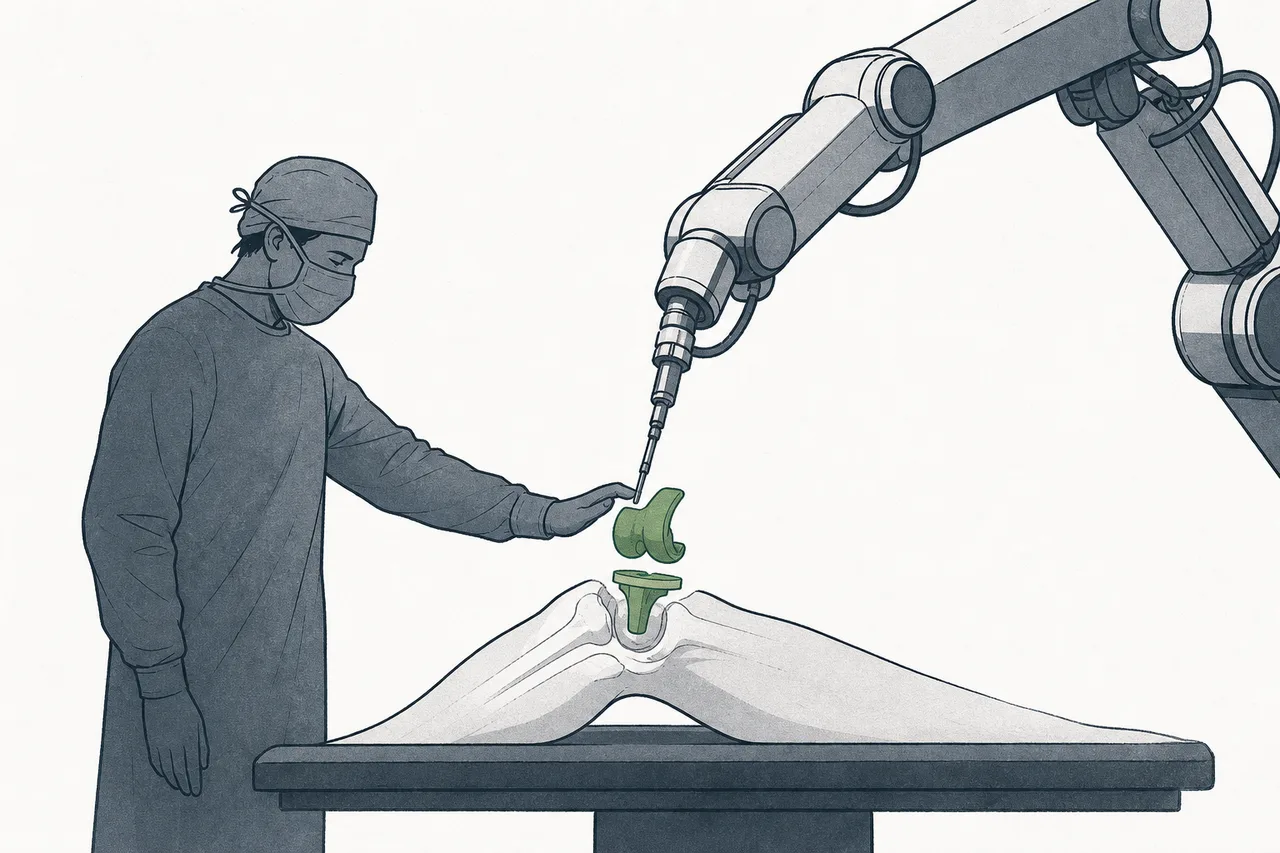
- Meets Surgical & Medical Robotics: the hottest junction. Knee and hip replacements are moving onto robotic arms that can place a device to millimeter precision — so the device (blade) and the robot (razor handle) are tightly entangled
- Overlaps with Cardiovascular devices: this node's heart side is part of the larger cardiac-disease trend — just focused on the parts that grow with age (valves, rhythm)
- Connects to Diabetes Devices: continuous glucose monitors and insulin pumps — a disease that grows more common with age, and many of the same companies work both markets
- Depends on and complements Biotech & Genomic Medicine: advances in biomaterials (like longer-lasting valve tissue) come from the biomedical side
05Where it stands now
The 2025 picture is "two waves of innovation at once" — one in the heart, the other in bones and joints.
On the heart side, the biggest story is that TAVR is still growing strongly and reaching new patient groups. Edwards Lifesciences, the TAVR pioneer, posted Q3 2025 heart-valve sales of $1.15 billion, up 12.4% year over year. Meanwhile, on the heart-rhythm side, a new technology called PFA (pulsed field ablation) for treating atrial fibrillation (AFib) is booming, with Boston Scientific rising to the lead with its FARAPULSE system — now the company's main growth engine.
On the bones-and-joints side, the big story is robots. The global knee + hip market was around $17.4 billion in 2024 (knees $9.5B, hips $7.9B), and surgery is moving onto robotic arms fast. By the end of 2024, over 45% of knee replacements worldwide and over 20% of hips were done on Stryker's Mako robot — and in the U.S., two of every three knees are already done on a Mako. That's the "razor handle" that locks hospitals into buying the same brand's "blades" (the implants).
Step back, and this market is owned by a handful of giants almost everyone knows (if you've ever been to a hospital) — each with a turf of its own.
06The road ahead
The first direction is that robots and precision become the standard, not a luxury. Every orthopedics maker is racing to build its own robot. Zimmer Biomet aims to be the first with a semi-autonomous joint-surgery robot (from its acquisition of Monogram, which got FDA clearance in 2025) — the battleground is shifting from "whose implant is better" to "whose robotic system captures more operating rooms," because the system is what locks customers in long-term. It connects directly to the surgical robotics trend.
The second direction is that structural heart still has lots of "open space" to grow, because about 40% of severe valve-stenosis patients are still untreated — and many haven't even been diagnosed. FDA expanding TAVR to symptom-free patients, plus the development of other valve-repair techniques (like mitral and tricuspid valves), will keep opening larger new markets as the elderly population grows.
The third direction is devices that are "smarter and smaller": wireless pacemakers the size of a capsule, sensors that stream data to a doctor's phone in real time, and devices tied to AI to catch problems before they happen. The line between "device" and "continuous monitoring" is blurring, which makes the recurring-revenue model (blades + service) even stronger.
07The big question: will weight-loss drugs destroy this market?
There's one question making investors in the bones-and-joints group anxious right now: will GLP-1 weight-loss drugs (like semaglutide, tirzepatide) make people thinner, drop their weight, and stop them from needing knee replacements? Because body weight is the single biggest accelerant of knee wear.
The medical evidence points partly that way — a large study (published via the BMJ) found that people who use GLP-1 consistently have a significantly lower long-term risk of needing a knee replacement. Logically, if fewer people are obese, some knee surgeries should drop.
But the real picture is more complex, and most of the industry isn't worried — for three reasons:
- Many obese people "couldn't have surgery" because they were too heavy — once GLP-1 brings their weight down, they actually qualify for the operation. A Zimmer Biomet survey found that in 2025, 16% of obese knee-replacement patients were on GLP-1 (versus just 4% in 2019) — the drug "unlocks" a new group of patients to operate on
- A joint that's already worn won't heal just because you lose weight — cartilage that's worn away doesn't grow back when the pounds come off. The drug slows the damage, but it can't reverse what's already happened
- The main driver is age, not just weight — valve stenosis, arrhythmias, and many joint-disease cases come straight from "age," which GLP-1 doesn't touch, and the aging wave keeps growing
Bottom line: GLP-1 is a risk to watch for the knee segment in particular, but it's not a "catastrophe" for the whole node — because the backbone of this business is tied to age, not just weight.
08Challenges & risks
A business this good still has fragile spots investors need to understand.
The first risk is payment and reimbursement. The real customer for most medical devices isn't the patient but the government and insurers who pay. In the U.S., Medicare sets the price it's willing to pay per procedure. If the government drives reimbursement down, the whole industry's margins get squeezed instantly — a policy risk beyond any company's control.
The second risk is competition and price pressure. Once a technology grows into a standard, rivals follow. TAVR, which Edwards once owned alone, now faces fierce competition from Medtronic, and in China there are local makers selling far cheaper. China's government also runs a "centralized procurement" (VBP) policy that drives the price of imported devices down hard, squeezing Western giants' profits in one of the world's largest markets.
The third risk is substitute technologies (including GLP-1). As we discussed last chapter, a new drug or treatment can lower the "need" for certain devices in certain segments — knees are the clearest example. This isn't an immediate threat, but a long-term pressure to keep tracking.
And the fourth risk is safety liability. If a device implanted in the body turns out to be defective, the fallout is recalls, lawsuits, and severe reputational damage — far more than for an ordinary product, because this is about people's lives.
In short: this node is the story of the repair shop inside our bodies — an industry that grows alongside the most unavoidable thing in life, aging. As long as hearts keep skipping their beat, valves keep narrowing, and knees keep wearing out, the customer queue only gets longer — and the winners are the ones who don't just sell "parts" but own the "system" the whole medical world can't do without.