Megatrend · Digital Finance
The gateway into crypto — and the vault that sits behind it
Before a dollar can become a bitcoin, and before big funds dare to hold digital assets, the money has to pass through a trusted "gateway" and get locked in a "vault." This is the business that sells picks and shovels to the gold miners: the exchange that's the way in and out, and the custody provider that's the institutional safe. After 2024, when US law flipped from enemy to friend, institutional money started flowing in for real — and the game changed.
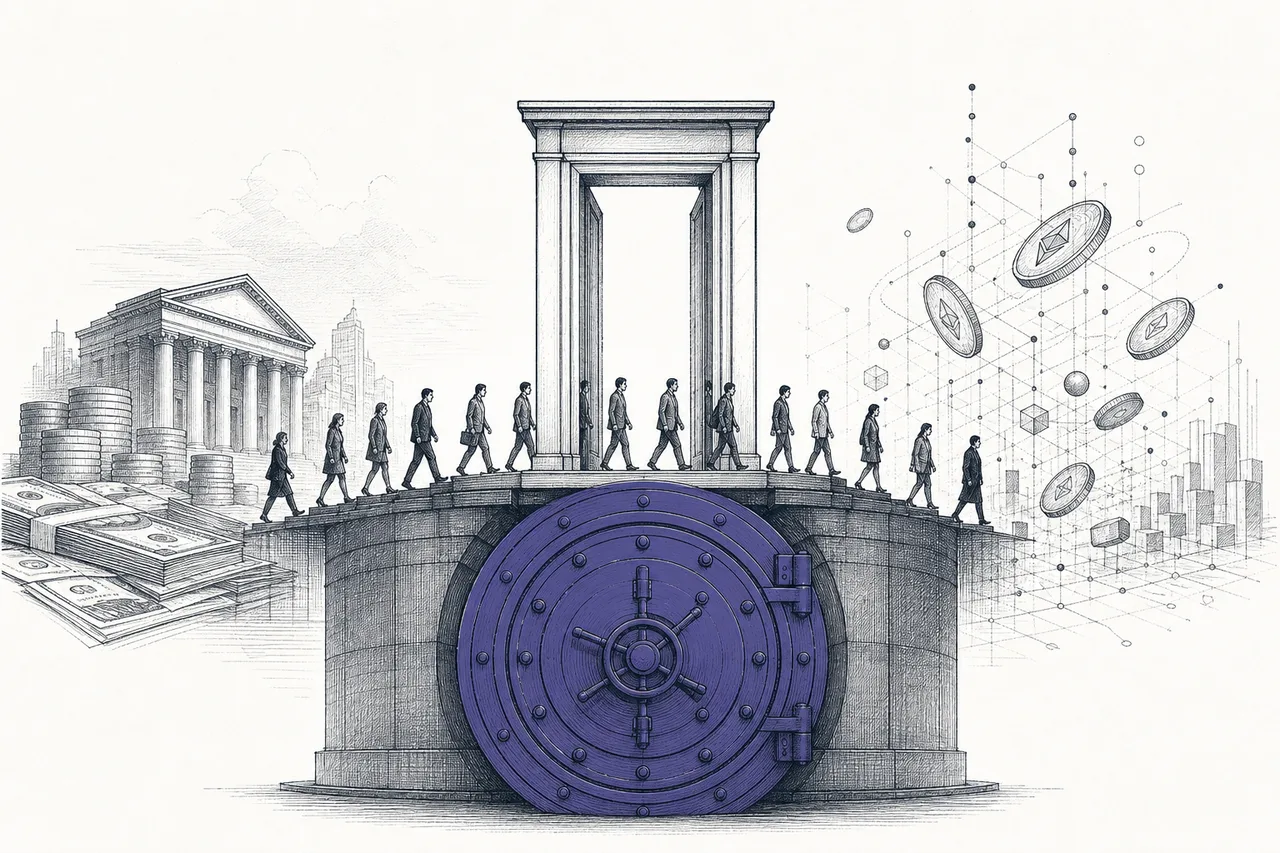
01What it is (gateway + vault)
Think back to the first time you wanted to buy bitcoin. You've got money in your bank account — baht or dollars. But bitcoin isn't in a bank; it lives on a computer network in another world. The question is — how does your real money "cross over" into crypto? And once you've got it, where do you keep it safe? These two nodes are the answers to exactly those two questions.
This node is made of two intertwined businesses:
- Exchange = the "gateway" and the "marketplace": where real money (fiat) turns into crypto and back — the on-ramp / off-ramp — and where people meet to trade. The original main revenue is the trading fee
- Custody = the "vault": when a fund or company holds a huge amount of crypto, they don't dare keep the keys themselves (lose them and it's over; get hacked and it's over). So they hire a licensed, audited firm to hold them — this is where the biggest institutional money and the deepest moat sit
- Other infrastructure (picks-and-shovels): staking (deposit coins to earn a return), prime brokerage, settlement — the back-office work that makes everything run
On-ramp = the path where real money turns into crypto · Off-ramp = the way back, crypto turning into real money (the exchange controls this gate) · Custody = the service that holds the "private key" that controls crypto on the owner's behalf — whoever holds the key controls the coins. So whoever can hold an institution's keys credibly holds the biggest card.
On the megatrend map, this node is a sub-theme under Digital Finance & Tokenization, and its definition is the "infrastructure layer" — whichever coin rises or falls, whoever trades whatever, everything has to run through this gateway and get stored in these vaults. It's the system's "toll collector."
02Why it matters to the economy
What made this node matter so much more this cycle isn't the price of bitcoin — it's the word "institutions." Crypto used to be mostly a retail-investor arena. But in 2024 the US approved the spot Bitcoin ETF (a fund that holds real bitcoin so you can buy it through a normal brokerage account), letting money from funds, companies, and financial advisors flow in like never before.
The numbers tell the story clearly. BlackRock's IBIT (the largest spot Bitcoin ETF) hit $70B in AUM in just 341 trading days — about 5x faster than the gold fund (GLD) — and pulled in another $25B of inflows in 2025 alone. This huge pile of money doesn't just float in the air; someone has to hold it. And most of who holds it is the custody in this node.
From an economic angle, this is building the "pipe" that connects traditional money (TradFi) to digital assets. The global digital-asset custody market is projected to grow from a few hundred billion dollars to ~$1.6 trillion by 2030, at a compound annual growth rate (CAGR) of about 24%, with institutional investors driving more than half of it.
Here's the heart of it: in a gold rush, the richest people usually aren't the diggers — they're the ones selling picks and shovels and opening a store in town. This node is the "pick seller" of the crypto world — collecting a toll on every transaction, whether the market goes up or down.
03How it works
Let's follow one pile of money. It starts as dollars in a bank account and ends as crypto resting in a vault — and the whole journey has two parts: the gateway (conversion and trading) and the vault (storage).
The core of security is separating "hot" from "cold." An exchange keeps a small amount of crypto in a hot wallet that's always online so you can trade instantly (but it's the most exposed to hacks). The big assets — often more than 90–95% — get moved to cold storage that's completely cut off from the internet. Pulling it out requires turning several keys at once (multi-sig) — like a bank vault that needs several people turning keys simultaneously.
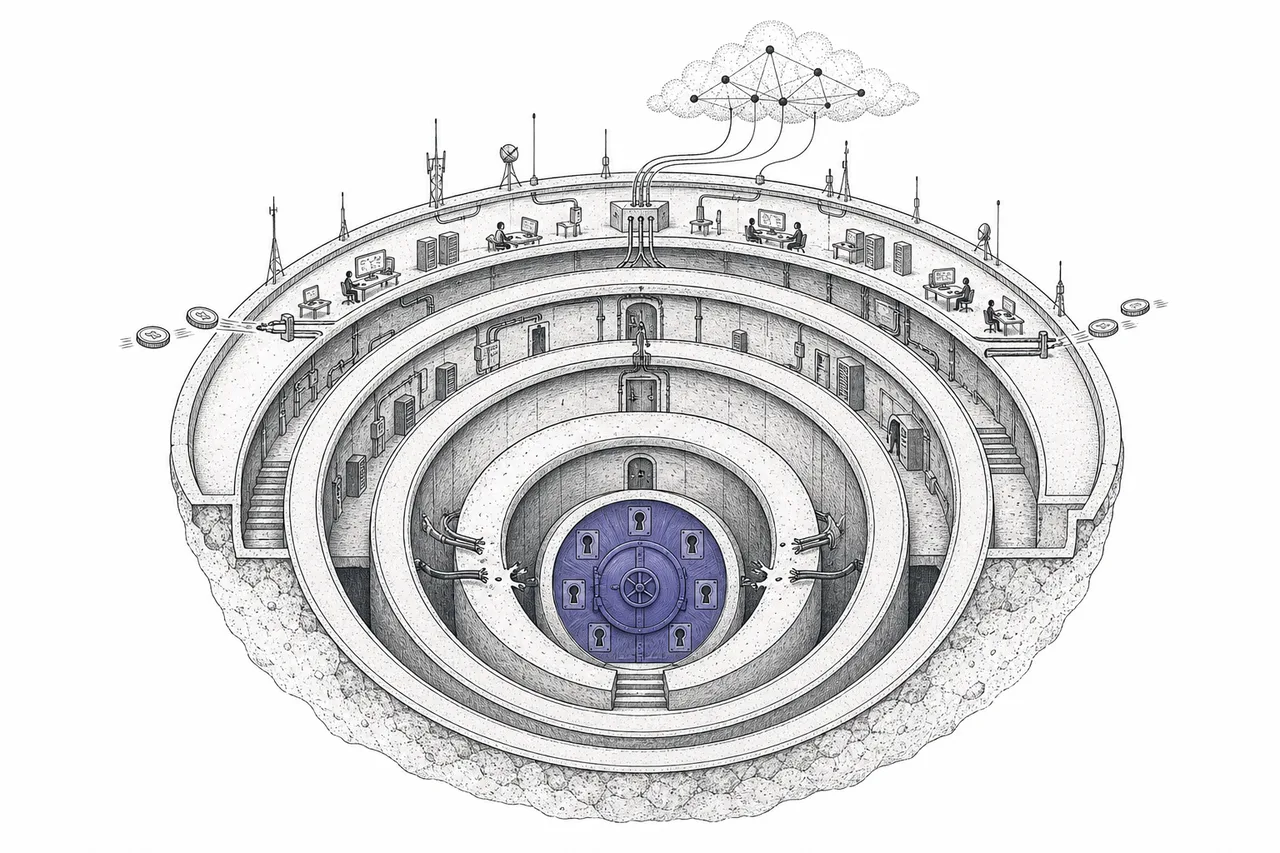
This is why custody is the real moat of this business. Anyone can spin up a trading site. But earning the trust of a pension fund or a public company to hold tens of billions takes licenses, audits, a security track record, and time — none of which can be faked overnight.
04The turning point: the law switched sides
To understand why this cycle is "different," you only need to grasp one thing: the US government's stance flipped from enemy to friend. For years, regulators eyed crypto with suspicion, sued exchanges, and had an accounting rule called SAB 121 that forced any bank wanting to custody crypto to record customer assets as a liability on its own balance sheet — which all but slammed the door on big banks doing custody at all.
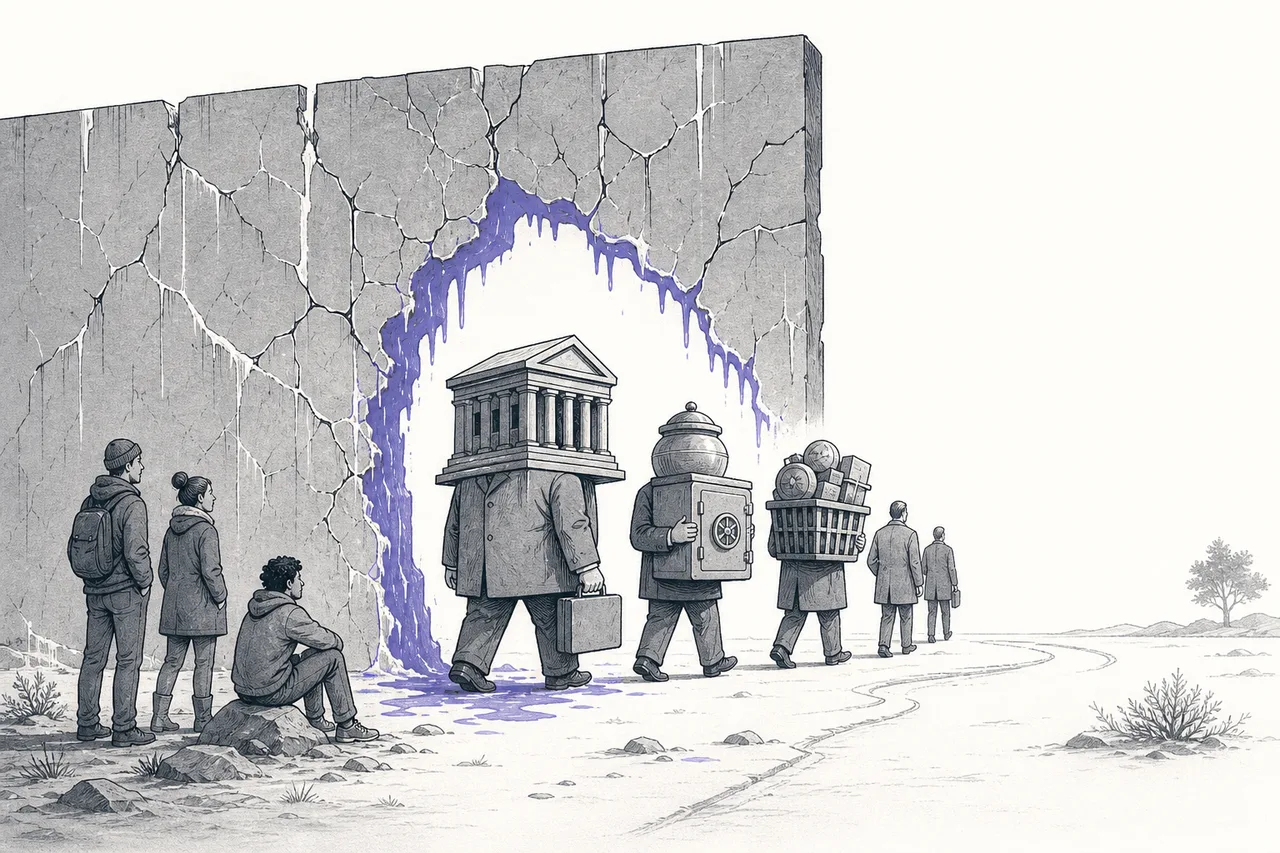
Then in 2025, everything changed:
- SAB 121 repealed: regulators repealed that accounting rule, replacing it with SAB 122, which lets big banks custody crypto without carrying it as a liability on their balance sheet — the door for banks opened
- GENIUS Act (signed July 18, 2025): the US federal government's first law setting a framework for stablecoins, requiring 1:1 backing with cash/short-term Treasuries and monthly disclosure — creating the legal clarity institutions had been waiting for
- CLARITY Act (passed the House July 17, 2025): a bill that would clearly assign most digital assets to CFTC oversight — reducing the ambiguity that used to keep players from investing
SAB 121 = the old accounting guidance that forced crypto custodians to record customer assets as a liability on their own balance sheet, spiking capital costs, so banks didn't want to touch it · SAB 122 = the replacement, giving more discretion and unlocking mainstream financial institutions to actually do custody — this is the switch that opened the gate for "institutional money" to flow in.
The result: custody firms that used to be on the margins became hot property. BitGo got a national bank charter (OCC charter) in December 2025 and filed for an NYSE IPO in January 2026, while Anchorage Digital, a nationally chartered "digital bank," raised a Series D at a valuation above $3B — a signal that the market believes custody is a business that's here to stay.
05How it connects in the ecosystem
This node is the "base layer" of all of Digital Finance & Tokenization — nearly every sibling sub-theme has to run through these gateways and vaults:
- Twin to Stablecoin Issuers: stablecoins are the "cash" of the crypto world, and exchanges are where they're used and exchanged most — Coinbase holds an average of $19B in USDC (over 25% of all USDC) and gets a cut of the interest income on those reserves
- Keeper for Bitcoin / Crypto Treasury: companies that buy bitcoin into their portfolio (treasury) need someone to hold it — Coinbase is the custodian for 8 of the 10 largest public companies holding bitcoin
- Rails for RWA Tokenization: when real assets (bonds, real estate) get tokenized, they need the same place to trade and store them
- Feeds Digital Wealth & Robo-Advisory: digital wealth platforms that want to put crypto in client portfolios have to connect to these exchanges and custodians
And it also leans deeply on trends outside its own home: the whole system sits on Cloud & Digital Infrastructure (servers processing millions of orders per second) and stakes its life on Cybersecurity & Digital Trust — because when the entire business is "trust," a single hack can topple the whole company. Security isn't a cost here; it's the product.
06Where it stands now + the players
The biggest story of 2025–2026 is diversifying revenue away from trading fees. Exchanges used to be a business that "gets rich when the market's hot, goes broke when it's quiet," because almost all revenue came from trading fees, which swing with the market's mood. But leaders like Coinbase are reshaping themselves to stand on "several pillars" — custody, stablecoin revenue, and subscriptions.
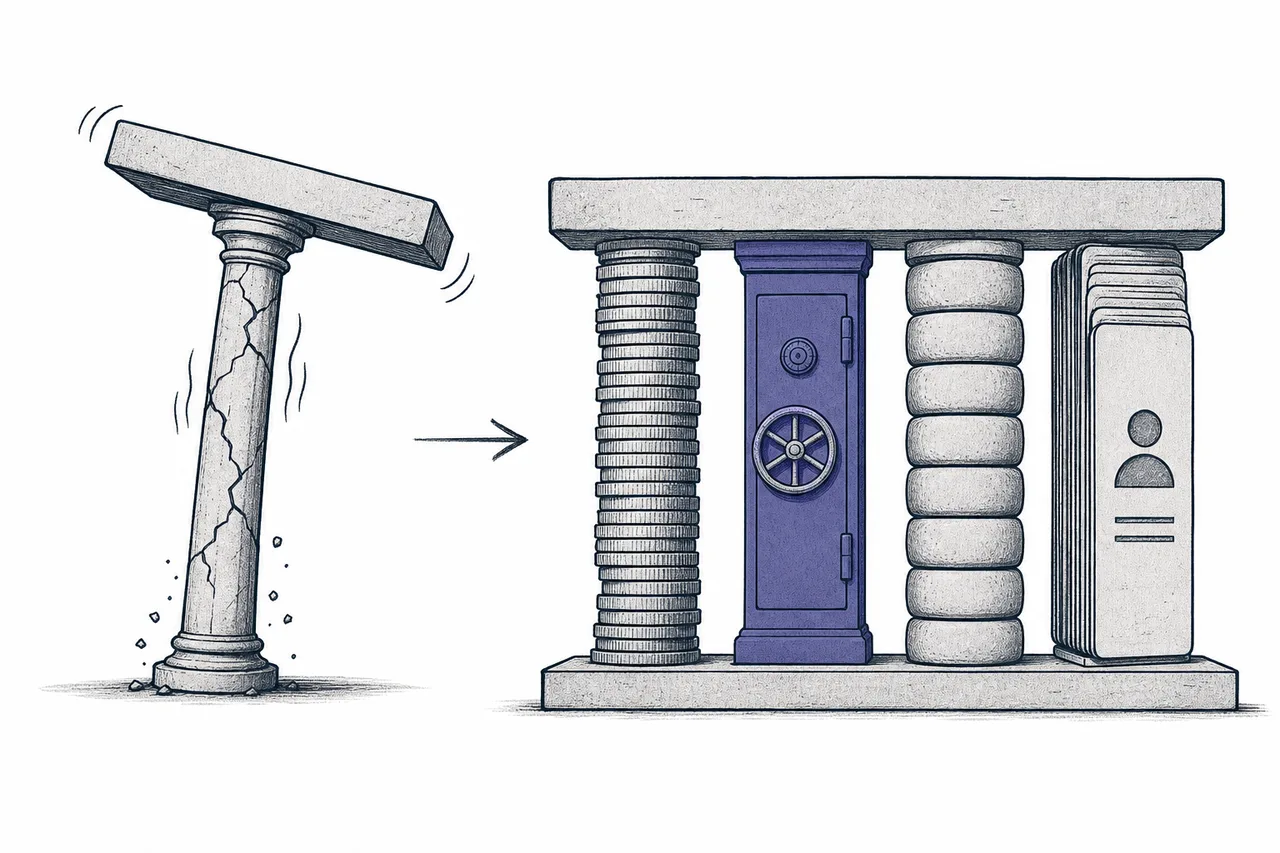
Look at Coinbase's real numbers for Q1 2026 and the picture gets clear: total revenue of $1.4B, with trading revenue at $756M. But what's interesting is that "subscription & services" revenue hit $584M = 44% of net revenue — nearly half the revenue now comes from something that isn't trading fees, with stablecoin revenue alone at $305M.
But the lesson about cycles still holds — in that same quarter, Coinbase posted a net loss of $394M (mostly from marking down a crypto portfolio that fell in value), while spot trading volume dropped to $187B. This is the nature of this business: up hard, down hard — and that's exactly why diversifying revenue into custody/stablecoins matters.
07The road ahead
The first direction is mainstream banks coming in to compete on custody. With SAB 121 repealed, big banks that already have relationships with institutional clients are starting to move in. This is both an opportunity (the market grows a lot) and a threat (specialist players could get squeezed by the banks' brand and cost of capital) — the battlefield of the next decade will be "who earns institutional trust."
The second direction is revenue not tied to the trading cycle. The players who survive long-term are the ones building steady revenue — custody fees charged on asset value, a share of interest from stablecoin reserves, subscriptions, staking. The higher the share of this kind of revenue, the better a business can "withstand the cold" in a bear market (Coinbase already hit 44% in Q1 2026).
The third direction is merging with traditional finance. The line between "crypto company" and "financial institution" is fading — crypto exchanges are starting to offer broker-style products (like RWA and derivatives), while traditional brokers and banks are starting to offer crypto. The endpoint may be a world where "digital assets" are just another asset class in the same account as stocks and bonds.
08Challenges & risks
This node's appeal comes with risks baked deep into its nature.
The first risk is crypto-cyclicality. Trading revenue swings violently with crypto prices — profits flood in when the market's hot, revenue shrinks when it's quiet — as when Coinbase posted a $394M net loss in Q1 2026 despite being the market leader. This is why you should look at how well each company has diversified revenue away from trading fees, not just at how it looks when the market's rising.
The second risk is regulation swings. This cycle, the law was friendly — but the political wind can shift. A rule that opened the gate today could be reinterpreted or reversed tomorrow. A business that depends on "the regulators' mood" carries inherent uncertainty, and the rules differ from country to country.
The third risk is competition that squeezes margins. As big banks and traditional brokers enter custody and crypto trading, fees tend to fall — what used to be a "pricey premium service" can become a commodity. Players without a moat (licenses, trust, scale) get squeezed the hardest.
And the most serious risk is security hacks. The entire business stands on "trust" — a single cold-storage breach or leaked key can lose customers a fortune and destroy a reputation enough to topple the whole company. This industry's history is littered with exchanges that collapsed from a hack or mismanaging customer funds. Security isn't an add-on feature here; it's the line between life and death.
In short: if crypto is a gold rush, this node is the town that springs up around the mine — the gateway people have to pass through, and the vault people have to store their things in. As long as digital assets keep growing, demand for a "trusted way in and out" and a "safe vault" only grows — and that's why a node that looks like mere "infrastructure" is actually where the industry's biggest institutional money gathers.