Megatrend · Digital Finance
When Wall Street moves the real stuff onto a blockchain
Picture a government bond, a fund, or a stock — then turn it into a "token" on a blockchain. Now it can settle instantly, 24 hours a day, be bought in tiny fractions, and even be programmed to pay its own interest. This isn't a crypto dreamer's pitch anymore. The most serious player doing it is BlackRock, the largest asset manager in the world — and the fastest-growing product is the most boring thing imaginable: U.S. Treasuries.
01What it is
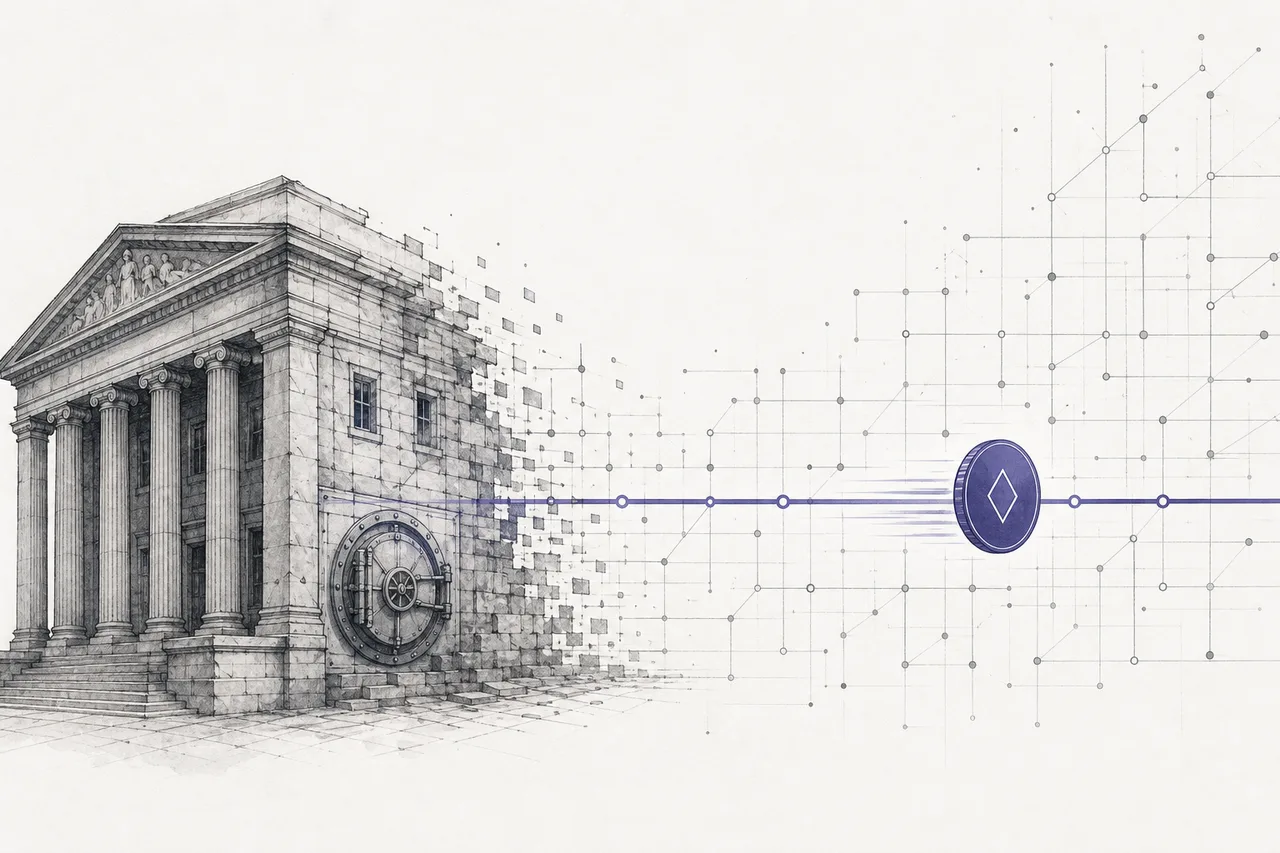
"Real-World Asset Tokenization" — RWA for short — sounds hard, but the idea is simple: take an asset that already exists in traditional finance — a government bond, a money market fund, corporate debt, a stock — and issue a "token" on a blockchain that represents owning it, one for one.
One token is basically a digital certificate of ownership recorded on a blockchain, instead of sitting in the closed ledger of one bank or broker. Here's the difference. A traditional ledger keeps office hours, takes days to clear when you move something across systems, and trades in big chunks. A token on a blockchain moves instantly, 24/7, can be bought in fractions, and can be programmed to act on its own.
An asset that has real value and a real existence in the "physical world" (a bond, a fund, a stock, real estate) that's been issued as a token on a blockchain — unlike something "crypto native" like Bitcoin, which was born on a blockchain and has no real asset behind it. So RWA is the bridge between traditional finance (TradFi) and the blockchain world.
On the megatrend map, this node sits under Digital Finance & Tokenization — the "infrastructure layer" that's about lifting genuinely valuable assets onto a new financial rail. Not just digital money, but assets you can touch and that pay a yield.
02Why it matters — Wall Street actually moved
For years, "tokenization" was just a nice phrase at crypto conferences. The moment everything changed was March 2024, when BlackRock — the largest asset manager in the world (over $10 trillion under management) — launched a tokenized money market fund called BUIDL on the Ethereum blockchain, partnering with a company called Securitize.
That was the signal that Wall Street meant it, and BUIDL grew into one of the largest tokenized Treasury funds, at around $2.5–2.6 billion. Here's the interesting part: the fastest-growing product in this space isn't anything flashy — it's the safest, most boring thing there is, U.S. Treasuries. Because it offers a "safe yield" on a blockchain, which is exactly what the crypto world had been missing for years.
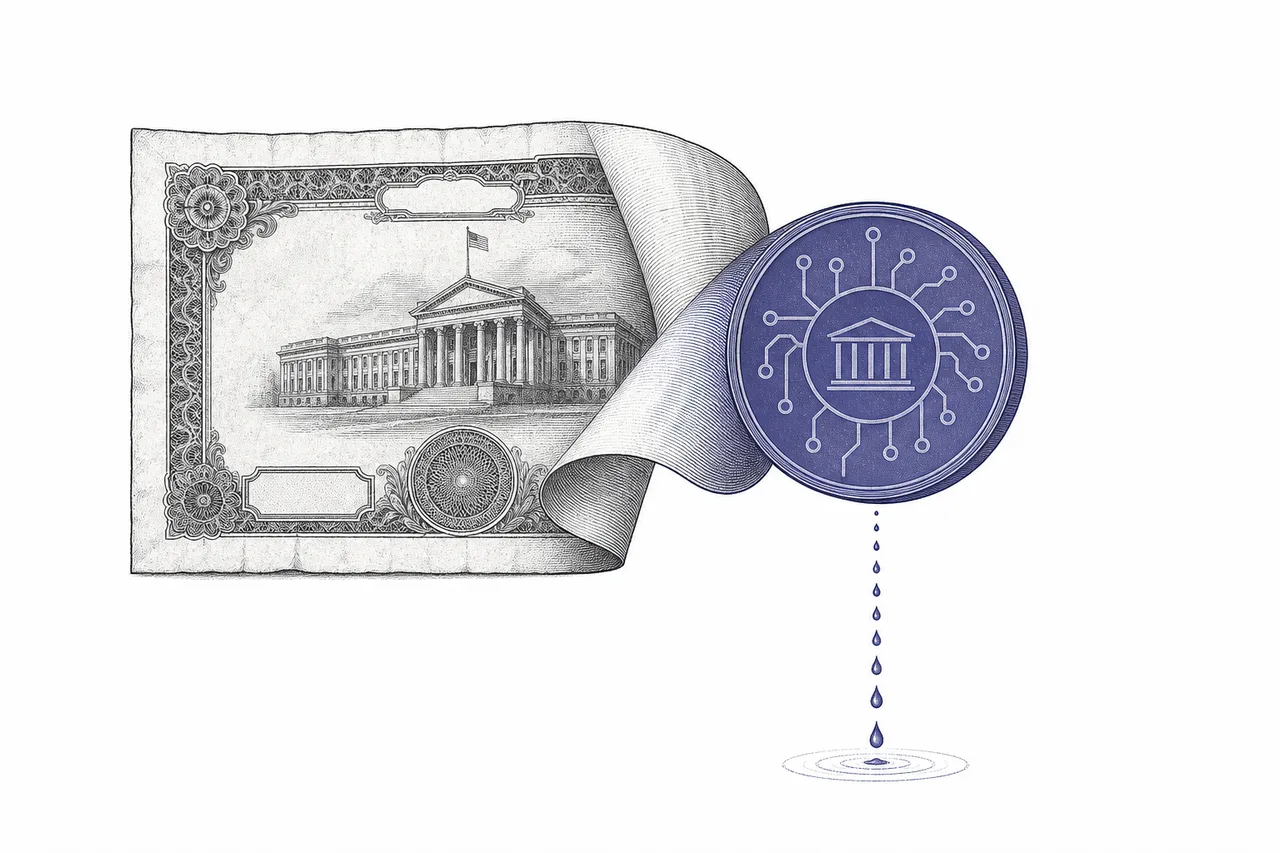
The whole market is still small next to global finance, but it's growing fast. The value of real assets that have been tokenized (excluding stablecoins) sits at around $29–31 billion in early 2026, up more than 263% from 2024 — led by tokenized Treasuries.
03How it works
The heart of this is one question: why is holding a token better than the old system? The answer comes from three properties the old ledger simply can't give you. Let's follow the path of a single asset.
The third power matters in a quiet way. "Programmable" means a bond token can pay interest straight into the holder's wallet on its own, by the conditions in its code, or be posted instantly as "collateral" inside DeFi — in fact, BlackRock's and Apollo's funds are already being used as collateral on-chain. That's something a paper bond in a vault can never do.
In a traditional stock market, when you buy a share, the money and the stock actually "settle" 1–2 business days later (called T+1/T+2). That waiting window carries risk and ties up collateral · On a blockchain, the cash and the asset change hands at the same time, in a single transaction, done in seconds — cutting the risk and the money you'd otherwise have stuck while waiting.
04The two faces of this story
Take RWA apart up close and you'll see it has two faces moving at different speeds — one is already far down the road, the other is just starting and still hitting walls.
Face one — tokenized funds and bonds (issued by asset managers): This is the practical, fastest-growing side. Real asset managers like BlackRock, Franklin Templeton, and Ondo are issuing money market funds and bonds as tokens. This group is "easy" because the underlying asset (government bonds) is already highly liquid with a clear value — tokenizing just makes it move faster and split into fractions. Tokenized bond funds across the whole market broke past ~$15 billion in mid-2026, up from about $100 million when BUIDL launched in 2024.
Face two — the rails for tokenized stocks and securities: This is the bigger dream — turning stocks and ETFs into "digital twins" on-chain, so anyone in the world can buy fractions of U.S. stocks 24 hours a day. Most players here are still new private companies (like Backed, Dinari) and they're up against a big securities-law problem — issuing a "copy of a stock" on-chain counts as offering a security, which falls under strict rules. So this side is more about "the future" than "right now."
05Where it fits in Digital Finance
RWA doesn't float on its own. It's one piece inside Digital Finance & Tokenization, and it has to lean on its siblings in the same family to work:
- It needs Stablecoin as cash on-chain: when you buy a tokenized bond, what do you pay with? The answer is a stablecoin (a digital dollar) — it's the "cash leg" that lets both legs of the delivery settle at once. Without a stablecoin, RWA can't move
- It needs custody and a digital-asset market: tokens worth billions need a safe place to be held (custody) and a market to trade in — this infrastructure is the foundation that supports all of RWA
- It's a relative of Digital Wealth & Robo-Advisory: where tokenized bonds and funds end up is as the "raw material" that digital wealth platforms use to build portfolios for retail investors automatically
Zoom out and the relationship is clear: stablecoins put "money" on-chain — RWA puts "yield-bearing assets" on-chain. Only when both sit on the same rail does finance actually run end-to-end on a blockchain. That's why many people see RWA as the natural "next step" after stablecoins caught on.
06Where it stands now + who's who
Right now the game splits clearly into two layers. The first is the Wall Street giants bringing their own funds to be tokenized. The second is the tech companies building the "rails" everyone uses. The most important one, working quietly behind the scenes, is Securitize — the private company leading real-world asset tokenization globally, handling over $4 billion in assets, issuing BUIDL for BlackRock and working with Apollo, KKR, Hamilton Lane, and VanEck.
What you have to understand is that most of the lead players in this space are still private companies, or just small business units inside the giants — Securitize, Ondo, BlackRock, Franklin Templeton are a picture of the real competition, not a list of stocks you can buy directly. So we rank the players by their role and market share, rather than raw market cap.
The hottest area after Treasuries is private credit — the U.S. private lending market is about $1.5 trillion and is set to grow to ~$2.8 trillion by 2028. Tokenizing opens up access to things that used to have very high minimums. The value of private credit on-chain has already reached around $5 billion, with Apollo and Hamilton Lane starting to issue tokenized credit funds through Securitize.
The other face — tokenized stocks and ETFs — only just crossed the billion-dollar mark on-chain in mid-2026, led by Robinhood, Kraken/xStocks, and Ondo. The deciding factor is the "rails" and whether the U.S. opens the door (Coinbase/SEC) (see the rails for tokenized stocks and securities).
07The road ahead
The first direction is a number that could be enormous — but with a range so wide it's startling. The cautious McKinsey sees the tokenization market at around $2 trillion in 2030, while BCG once went as high as $16 trillion, and Standard Chartered reaches all the way to ~$30 trillion by 2034. That huge gap comes from completely different sets of assumptions — McKinsey counts only the things with a clear benefit (funds, bonds), while the high numbers lump in real estate and private equity that aren't proven yet.
The second direction is big banks going all in. When JPMorgan, BNY, and global banks start issuing tokenized deposits and joining in on tokenizing assets, it pulls in enormous institutional money — and turns RWA from "a crypto experiment" into "the back-end plumbing of mainstream finance."
The third direction is the law getting clearer. RWA's biggest obstacle isn't the technology — it's clarity in securities law. The more regulators in the U.S., Europe, and Asia set out clear frameworks, the more the things that "couldn't be done out of fear of breaking the rules" gradually get unlocked — that's the variable that decides whether the market grows toward $2T or $16T.
08Risks — real vs hyped
RWA is a trend where "the real thing" and "overblown hype" are heavily mixed together. Telling the two apart is the single most important skill for understanding it.
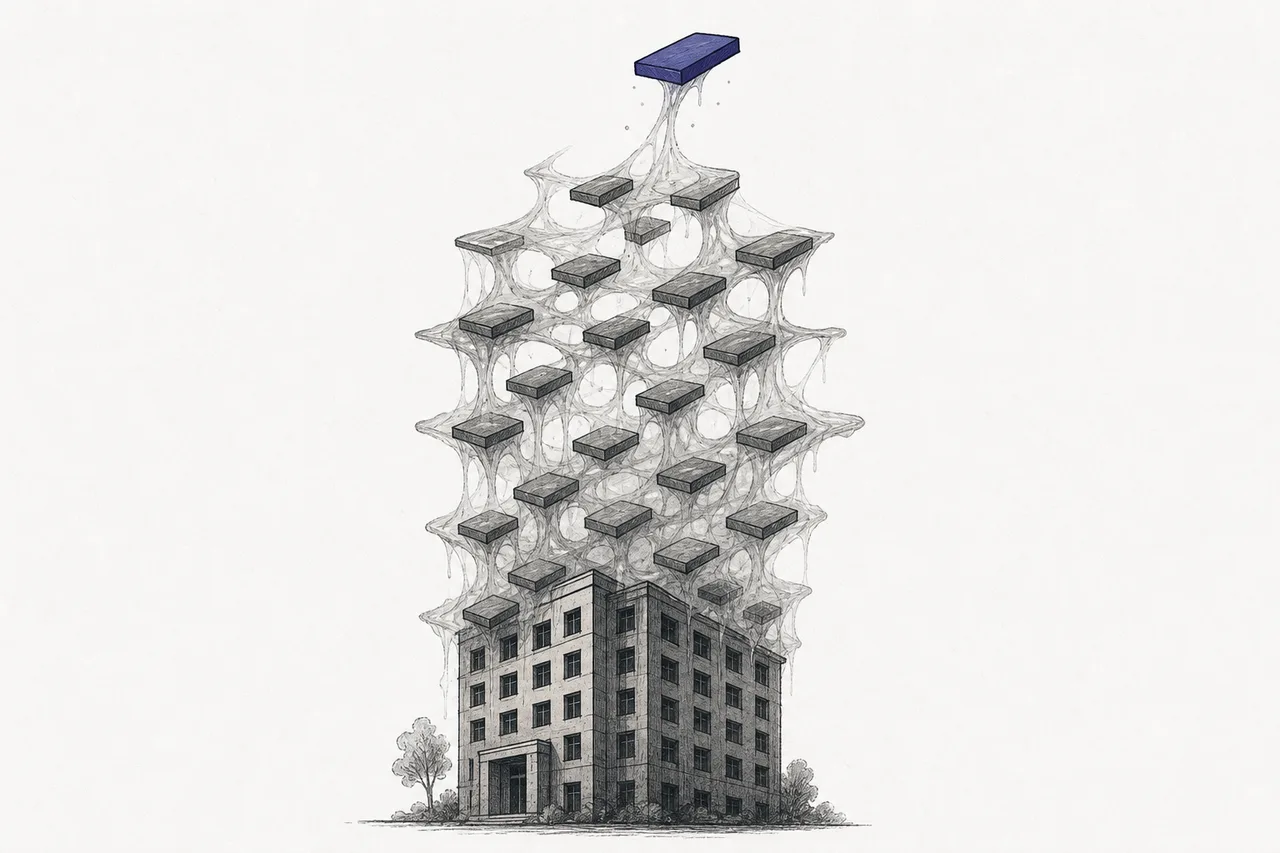
The first risk is that tokens don't conjure liquidity out of thin air. A popular pitch goes: "tokenize real estate and you can trade a building in fractions, easily." But the reality is that slicing a building into tokens doesn't make buyers appear on its own. Real estate still has to be vetted for condition, location, lease terms, and so on, which keeps it slow to trade either way. That's why real estate is still the "hardest" side, and slower than many expect — unlike bonds, which already have people trading them around the clock.
The second risk is law and regulation. A token that represents a stock or a bond is itself a security, subject to strict rules. Issuing a "copy of a stock" across borders is still a gray area in many countries. That uncertainty is exactly what keeps the "stocks and securities rail" side from growing as fast as the bond side.
The third risk is technical and intermediary risk. However good a token is, its value depends on the "real thing" behind it. If the issuer or the asset custodian fails, the token could end up worthless. Add the risk of a smart contract getting hacked, and the risk of value concentrating in just a few issuers — Securitize alone sits behind most of the market's assets.
In short: Real-World Asset Tokenization is the story of traditional finance slowly moving itself onto a digital rail that's faster, always open, and programmable. The turning point was the day the biggest player of all, BlackRock, did it itself — and the funny part is that the fastest-growing product turned out to be the most boring bond, because it's the "safe yield" the blockchain had always lacked. How big the future gets is still a question where the numbers are 15x apart, but the direction is clear: the money is already on-chain through stablecoins — now it's the "yield-bearing assets'" turn to follow.