Megatrend · Cloud & Digital Infrastructure
Why the web loads fast even when the server is on the other side of the planet
Every time you tap play, open a site, or launch a game and it just “appears,” there's a quiet network behind it putting content — and now the computing too — as close to you as possible, instead of sending every request halfway around the world to one central data center. This is the story of CDNs and edge computing — infrastructure that's shifting from a “move bits cheaply” business into a battleground over security and AI.
01What it is
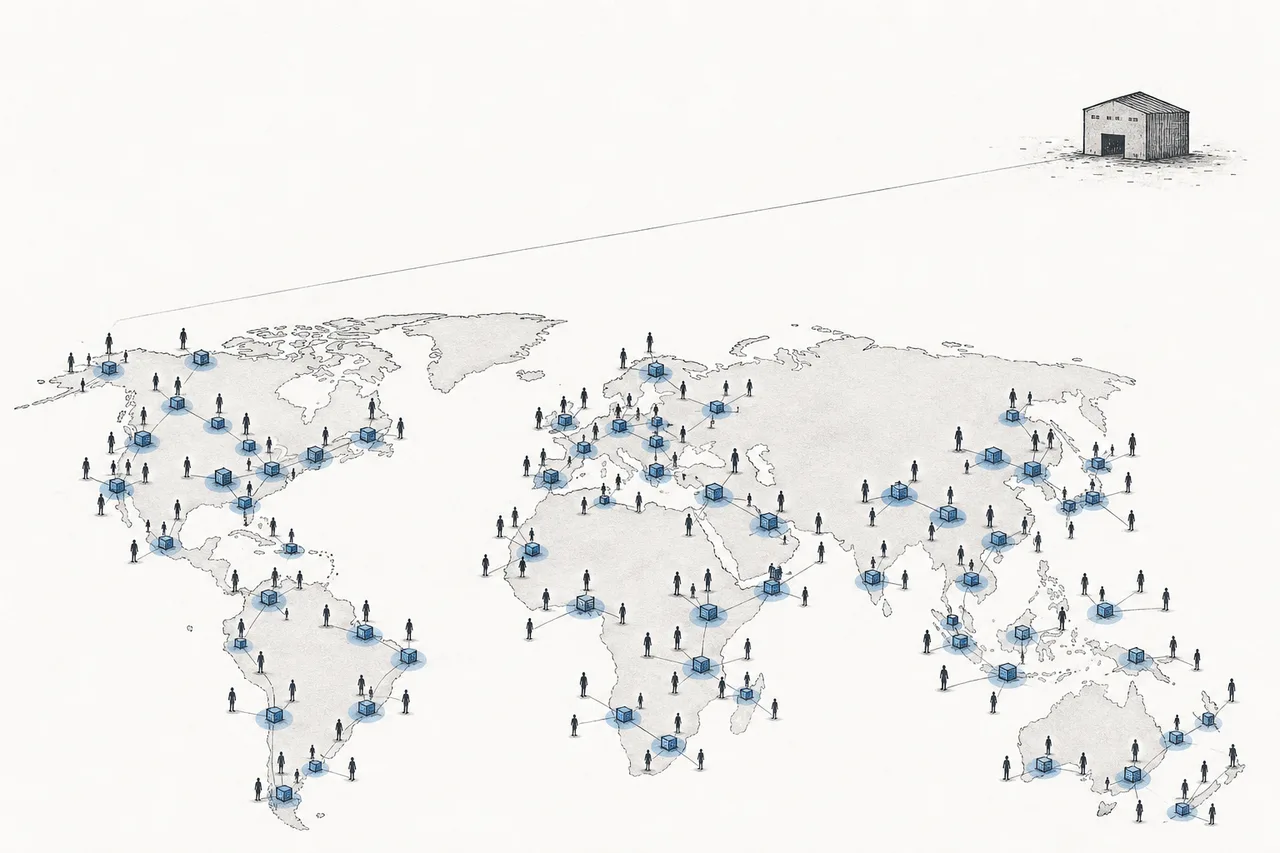
Picture this: you're in Bangkok, and the site you open has its real server in Virginia, USA. If every click had to cross the ocean and back, it'd be annoyingly slow — but in reality it isn't, because a “copy” of that site already sits in a data center near Singapore, or in Thailand itself. So you pull it from somewhere close, never reaching the origin. That's the heart of a CDN.
A CDN (Content Delivery Network) is a network of servers spread across the globe that “caches” (cache — keeps a temporary copy of) a site's content — images, video, files, pages — as close to users as possible. When someone asks for it, it's served from the nearest point instead of running back to the origin. The result is faster, cheaper, and more resilient — because if one point goes down, another takes over.
The word “edge” is the next step. Instead of just “keeping a copy” near users, we can now “run code” and process things right at those points. The edge of the network isn't just a shelf anymore — it's a small computer a few milliseconds from you. Put another way, edge is “stretching the cloud” all the way out to the last stop near the user.
PoP (Point of Presence) = a location where a provider puts servers, in cities around the world. More PoPs = more points close to users · Latency = the time data takes to make a round trip, measured in milliseconds (ms); lower is better · Origin = the site's real source server, the load the CDN keeps shouldering so it isn't hit by every single request.
This node sits under the Cloud & Digital Infrastructure megatrend as the “last-stop” layer of the cloud — the part closest to users. That's the opposite of siblings like Hyperscale Cloud, the giant central data centers. If hyperscale is the “central brain,” edge is the “nerve endings” spread across the whole body.
02Why it matters — cutting the distance to the user
Its importance comes down to one physical law you can't escape: light is the fastest thing in the universe, but over a long enough distance it's still too slow for humans. A signal running through fiber across continents takes hundreds of milliseconds. That sounds tiny, but one page makes dozens of round trips before it finishes loading, so the latency piles up until you can feel it. Research from both Amazon and Google points the same way: every bit of added latency really does cut sales and usage.
That makes a CDN not a luxury but core infrastructure of the modern internet. And it's not small: the global CDN market is around $26B in 2025 and is expected to reach ~$43B in 2030, growing about 9–11% a year — driven by 4K/8K video that eats huge bandwidth, and by every business moving online.
But the number that really brings it home is the “closeness” these networks achieve. Today the market leader, Cloudflare, has points of presence in over 330 cities across 125 countries — enough to say 95% of the world's internet users are within 50 milliseconds of its servers, several times faster than a blink. That's what makes the web “feel fast” even when the origin is on the other side of the world.
03How it works
The heart of the mechanism is a switch from “every request runs to one distant center” to “every request runs to the nearest point that already has a copy.” Compare these two pictures.
The mechanism splits into two layers. The first is “content caching”: the first time someone in a region asks for a file, the edge point fetches it from the origin and stores it. After that, everyone nearby gets it straight from the cache — no need to bother the source again. That slashes both latency and the load on the origin server. For popular content like video, Netflix goes a step further, placing its own “server boxes” (Open Connect) inside ISP networks worldwide at tens of thousands of points — so the movie you watch comes from a machine in your own city.
The second layer is “running code at the edge” (edge compute), which is new and the heart of the future. Instead of just serving static files, an edge point can run small programs right there — checking permissions, personalizing a page per user, blocking bots, even answering an API — without sending anything back to the center. A popular tool like Cloudflare Workers runs this kind of code in a fraction of a second (latency under 100 ms) and is growing about 300% a year.
Cache hit = the copy is already at the edge point and can be served instantly (fast) · Cache miss = it isn't there yet, so it must be fetched from the origin first (slower, but it happens once per region) · Edge compute = running a “program,” not just serving a file, at the edge point so processing happens near the user, cutting both latency and central load.
04Where it sits in the cloud
The easiest way to understand edge is to see it as the “outermost layer” of the cloud. Within the Cloud & Digital Infrastructure megatrend, it ties tightly to several neighbors:
- Builds on Hyperscale Cloud: the giant central data centers are the “origin” that edge distributes and relieves. The two work as a pair — central brain and nerve endings
- Sits on Towers, Fiber & Colocation: every PoP has to sit in a real colocation facility, wired with real fiber — edge is the “software” running on that “digital real estate”
- Merges with Cybersecurity & Digital Trust: this is the most important link right now. Because edge sits on the front line against the user, it's the ideal place to filter dangerous traffic (DDoS, bots) — so delivery and defense fuse into a single service
- Feeds and depends on AI Applications: AI generates enormous traffic (from agents and chatbots) that edge has to absorb, and in turn edge is becoming the place to “run AI” near the user — a two-way relationship
What makes this node interesting as a business is that it's repositioning itself — from being just a cheap “content pipe” into a platform that bundles delivery + security + compute in one place. And that's the story of the next chapter.
05Where it stands now + who the players are
The biggest story in this industry in 2025 is that “pure content delivery has become a commodity”. Once anyone can run a basic CDN, the price per unit of data delivered keeps falling — forcing every player to run upmarket toward “something worth more”: security and compute at the edge. Those who adapt grow; those who cling to the delivery pipe shrink.
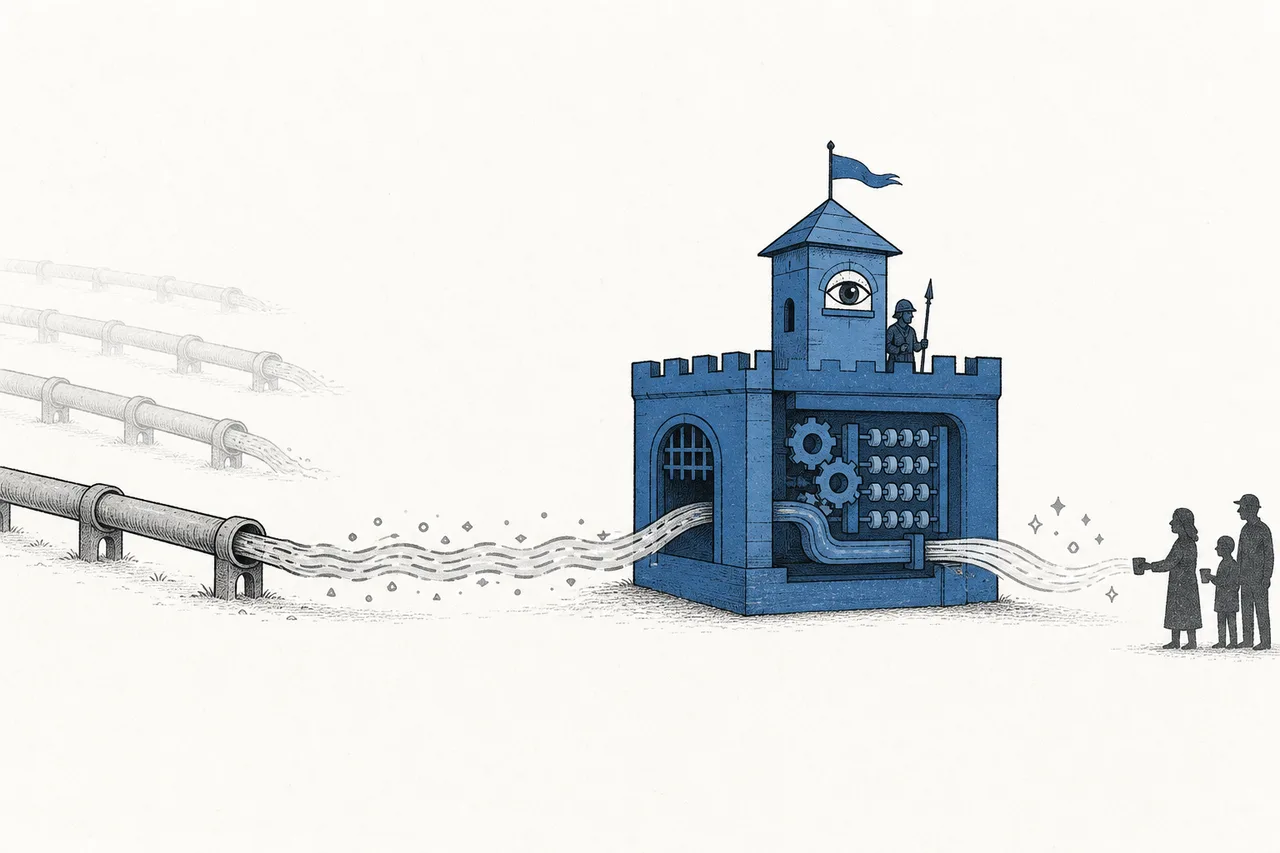
You see this most clearly in Akamai's numbers, the world's first CDN pioneer. Its “delivery” revenue in 2024 was about $1.32B, down 15% and still falling. But over the same period, revenue from security + cloud computing grew into ~67% of the whole company, with the security side already past $2B. It's the entire industry's “pivot” playing out inside one company.
The one born in the new era and running furthest ahead is Cloudflare, which designed itself from the start to be “CDN + security + edge compute in one place.” Its 2025 revenue hit $2.17B, up 30%, accelerating to +34% in Q4, with a new catalyst: AI — companies are moving to build AI apps on the Workers platform, to the point that Cloudflare closed the largest deal in its history, worth over $100M, off this demand.
06The road ahead — when AI moves to the edge
If CDN is the story of “a past that's becoming a commodity,” the new wave that will define the next decade is “AI inference at the edge” — running AI models near the user. The idea is simple: when you talk to an AI or use a smart feature, it has to “think” (inference) before it answers. If that thinking happens at an edge point close to you, instead of being sent to a far-off AI data center, the answer comes back much faster, saves bandwidth, and your private data doesn't have to travel far.

That's why edge players like Cloudflare are racing to build platforms where developers can run AI on their networks, and it's the source of a big new wave of demand. The overall edge AI market is estimated at around $25B in 2025 and growing at high double digits (edge AI software alone is growing ~29% a year) — a growth engine that helps offset the decline of the old content-delivery business.
Three things to watch over the next 3–5 years: (1) who becomes the “platform to run AI at the edge” that developers choose · (2) how far the lines between CDN, security, and cloud blur away (they're fusing into one service) · and (3) how long independent players can compete with hyperscalers that have their own edge — because Amazon, Google, and Microsoft all have CDN/edge tied to their cloud and are ready to cut prices.
07Challenges & risks
The first risk — and the axis of everything — is commoditization. Basic content delivery has almost no barrier left, and the price per unit drops every year. Anyone whose revenue still leans on delivery (as Akamai's once did) has to run upmarket toward higher-value work in time, or revenue shrinks along with the price. This isn't theory — it's already happening in the financials.
The second risk is the hyperscaler shadow. Amazon, Google, and Microsoft are all at once customer, partner, and competitor to the independent edge players. They have their own CDN/edge, bundled and priced down with their cloud. So independents have to win on “neutrality” (not tied to any one cloud), performance, and innovation — not price.
The third risk is betting on edge-AI before it's fully proven. Everyone talks about AI at the edge, but the business model, the real size of demand, and who captures the big profits are still open questions. If this investment doesn't pay back fast enough, the players who bet heavily could get hurt. And one last thing — because edge sits on the front line against the user, it's both shield and target: a single big network outage can take down half the internet at once. Reliability is both the biggest selling point and the most fragile weak spot.
In short: Edge & Content Delivery is the layer of the internet closest to you. It started with a simple job — putting content near users to make the web faster — but it's evolving into infrastructure that bundles data delivery, security, and AI compute at the same edge. Anyone who still sees it as just a “cheap pipe” may miss the real story: the fight to own the “last meter” between the cloud and every user on Earth.