Megatrend · Cloud & Digital Infrastructure
The internet's real landlords — collecting rent on everything you tap on your screen
Every message you send, every video you watch, every prompt you type into an AI — it always runs through one set of physical 'real estate': cell towers, fiber-optic cables, and the data-center buildings that house servers (colocation). The companies that own these things don't sell anything to you directly. They're the 'landlords' — they build a big asset once, then collect rent on it for years. And in 2025–2026, the AI wave is turning part of this business into the hottest it's been in a decade.
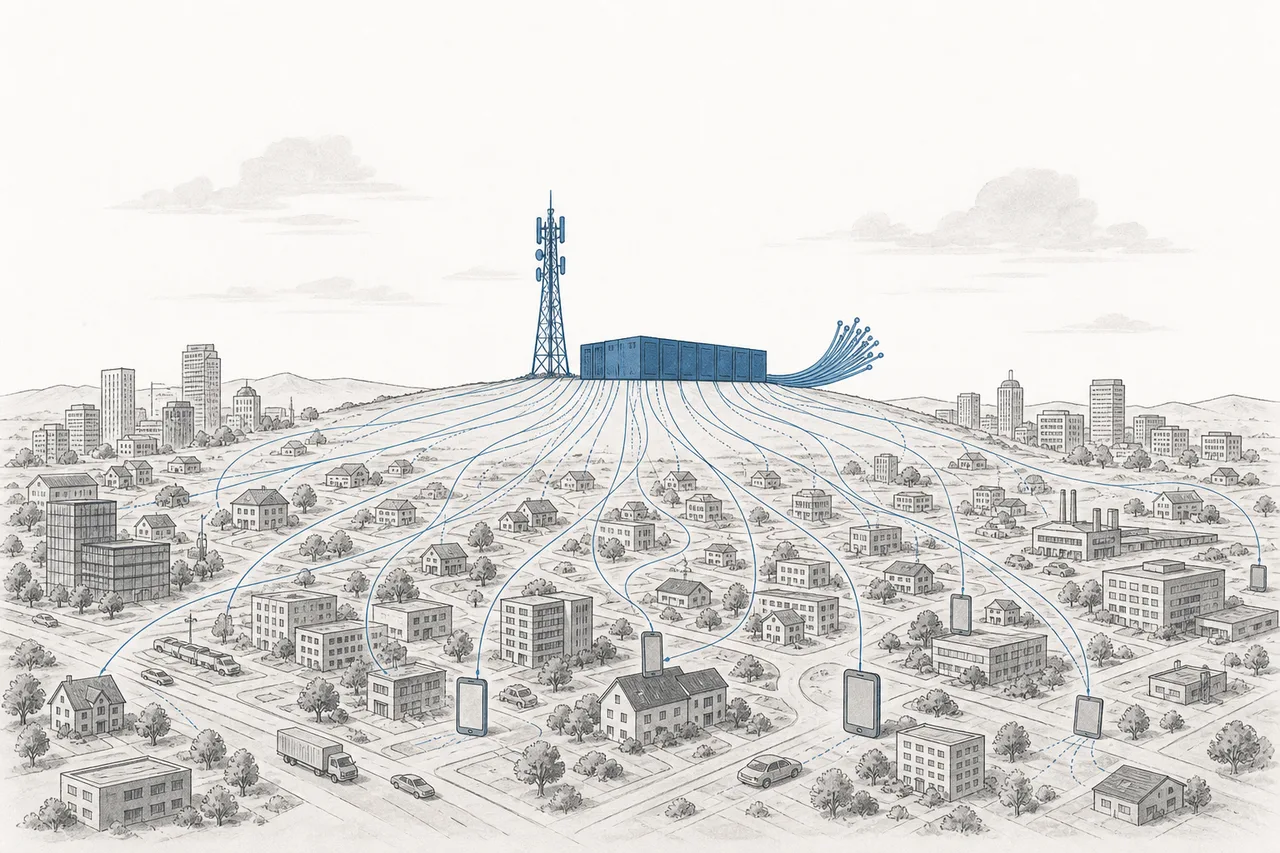
01What it is (the 3 kinds of 'digital land')
When we talk about 'the cloud,' we picture something floating in the sky, untouchable. But the cloud is really heavy stuff sitting on the ground — steel, concrete, wiring, and actual land. This node is about the 'real estate' that supports the entire digital world. It splits into 3 main kinds that do different jobs but link up into one chain.
- Towers: the tall steel structures where mobile carriers rent space to mount their transmitting gear — the 'last stop' before the signal reaches the phone in your pocket
- Fiber: cables that fire light to move data at huge speeds — the 'roads' that connect towers to data centers, and city to city
- Colocation (server-hosting data centers): big windowless buildings that supply power, cooling, and security, then let other companies bring in their servers and 'rent the space' — the 'warehouses' where the world's data goes to sit
This node's definition draws one clear line: this is 'physically connected real estate' — the owners and landlords, not the software companies and not the server makers. And there's another important boundary: the giant data centers built specifically for AI (hyperscale AI data centers) are split off into a separate node, AI Data Center build-out. This lesson is about the 'landlords' of infrastructure — but as you'll see, the AI wave is crashing hard onto this side too.
One company builds a data-center building with power, cooling, and security all in place, then lets other companies bring in 'their own servers' and put them inside, paying monthly rent. The price is set by space and power draw (measured in kilowatts/megawatts, not square meters — because the real constraint is 'power and cooling,' not floor space). The customer doesn't have to build anything; the owner doesn't have to babysit the servers. Each side does what it's good at.
02Why it's such a good business
Think of a landlord with an apartment building: build it once, invest heavily up front, then collect rent every month for decades. The towers/fiber/colocation business works exactly like that — but better, because its 'tenants' are giant mobile carriers, banks, and cloud providers, who are very hard to move out. Hauling all your servers somewhere new is expensive, risky, and disrupts service.
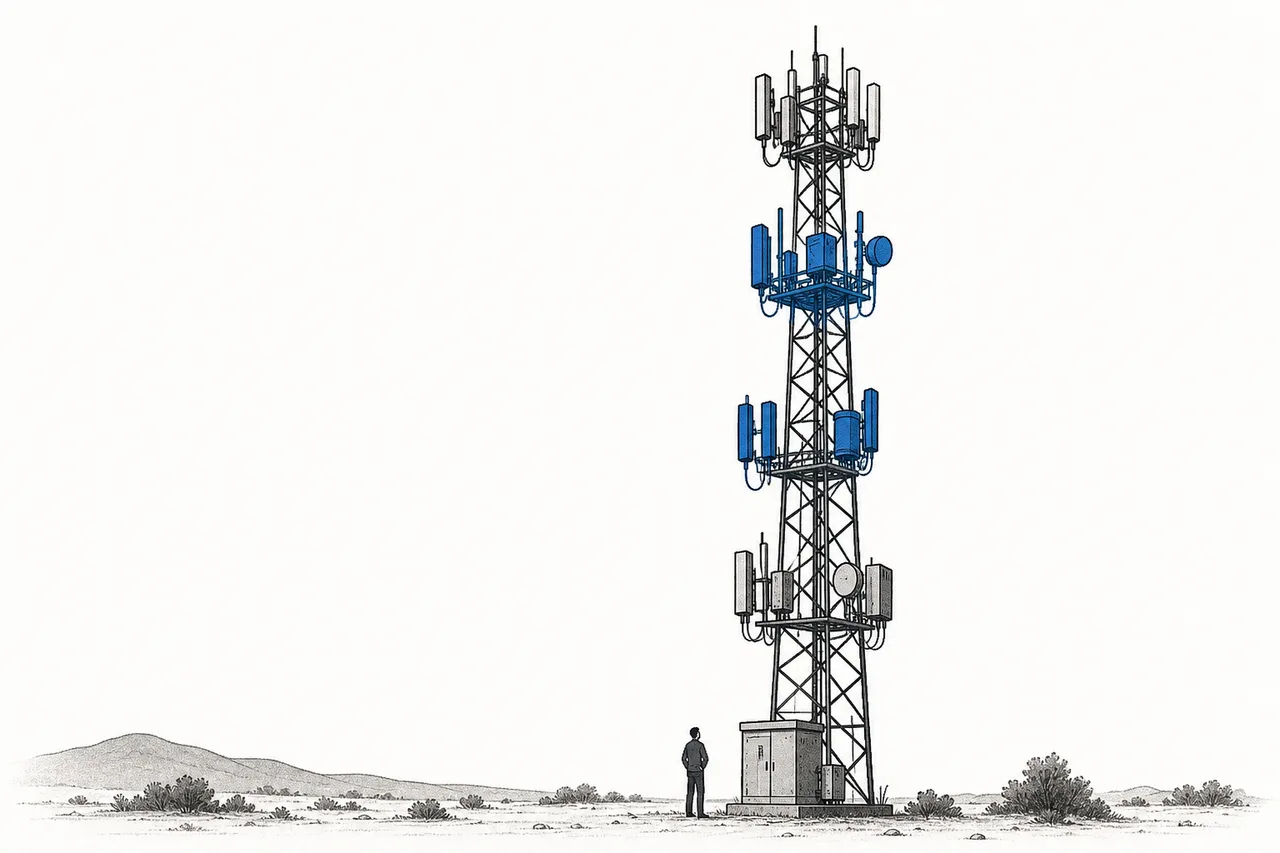
Three things make this business remarkable. (1) One asset, rented to many. A single tower can carry the gear of 3 mobile carriers at once — the 2nd and 3rd tenants add almost no cost, but their rent comes in full. (2) Long leases (often 5–10 years) with an 'automatic escalator' every year — so revenue grows on its own with no extra investment. (3) Customers' switching costs are sky-high, which makes revenue steady and predictable.
The charm of this model shows up in the tenants-per-tower number (tenancy ratio) — in the US market the average has crept from about 2.4 to 2.6 tenants per tower, higher still in big cities. Every extra tenant on an existing tower is profit that's almost 'free.'
That's why the data-center side became one of the hottest real-estate plays in the world in 2025: vacancy in North America's primary markets fell to an all-time low of 1.4% — almost 'every room full.' Which means whoever already owns the space holds full pricing power.
03How it works (the economics of a REIT)
Most of these companies are set up as a REIT (real estate investment trust) — a legal structure designed specifically to 'own assets and collect rent.' The whole mechanism follows the same cycle, whether it's towers, fiber, or data centers.
REIT = a company that holds income-producing real estate and, by rule, must pay most of its profit out as dividends — so it's a stock investors buy for 'cash flow' rather than price appreciation · Escalator = a clause in the lease stating that rent rises automatically every year (e.g. ~3% in the US) — the reason this business's revenue grows on its own even without new customers.
But the REIT structure hides a weakness: because it has to pay out almost all its profit as dividends, the company mostly takes on debt to expand its assets — which makes its share price very 'rate-sensitive.' Rates up = borrowing costs up + dividend investors rotating into bonds instead. This is the double-edged sword that comes back in the final chapter.
04How it connects in the ecosystem
This node is the 'bottom layer' of the Cloud & Digital Infrastructure megatrend — the real ground everything above has to stand on. The most important connections are these:
- Supports Hyperscale Cloud: the giant cloud providers (AWS, Azure, Google) don't build all their data centers themselves — some of it is space rented from colocation providers, to scale fast and reach new markets quickly
- Separate from but tied to AI Data Center build-out: centers built to train giant AI models are a different node, but AI demand is spilling over and packing ordinary colocation until space is tight everywhere — the line blurs more every day
- Connects to Edge & Content Delivery: to get data to users faster, small data centers have to spread out near cities, with towers and fiber as their lifeblood
- Leans heavily on energy and power: data centers are enormous power consumers — in many markets, 'electricity,' not 'land,' has become the No. 1 constraint on expansion
- Feeds AI and Digital Finance: every AI computation and every digital-finance transaction ultimately has to run through this set of infrastructure
Put simply: if the digital megatrends are a 'city,' this node is the city's land, roads, and utilities — unglamorous, but without it, nothing else can happen.
05Where it stands now
2025–2026 is when this business clearly 'split into two worlds.' On one side, colocation is on fire because of AI; on the other, towers are quiet and growing slower, a mature business that's sensitive to interest rates — understand these two pictures and you understand the whole node.
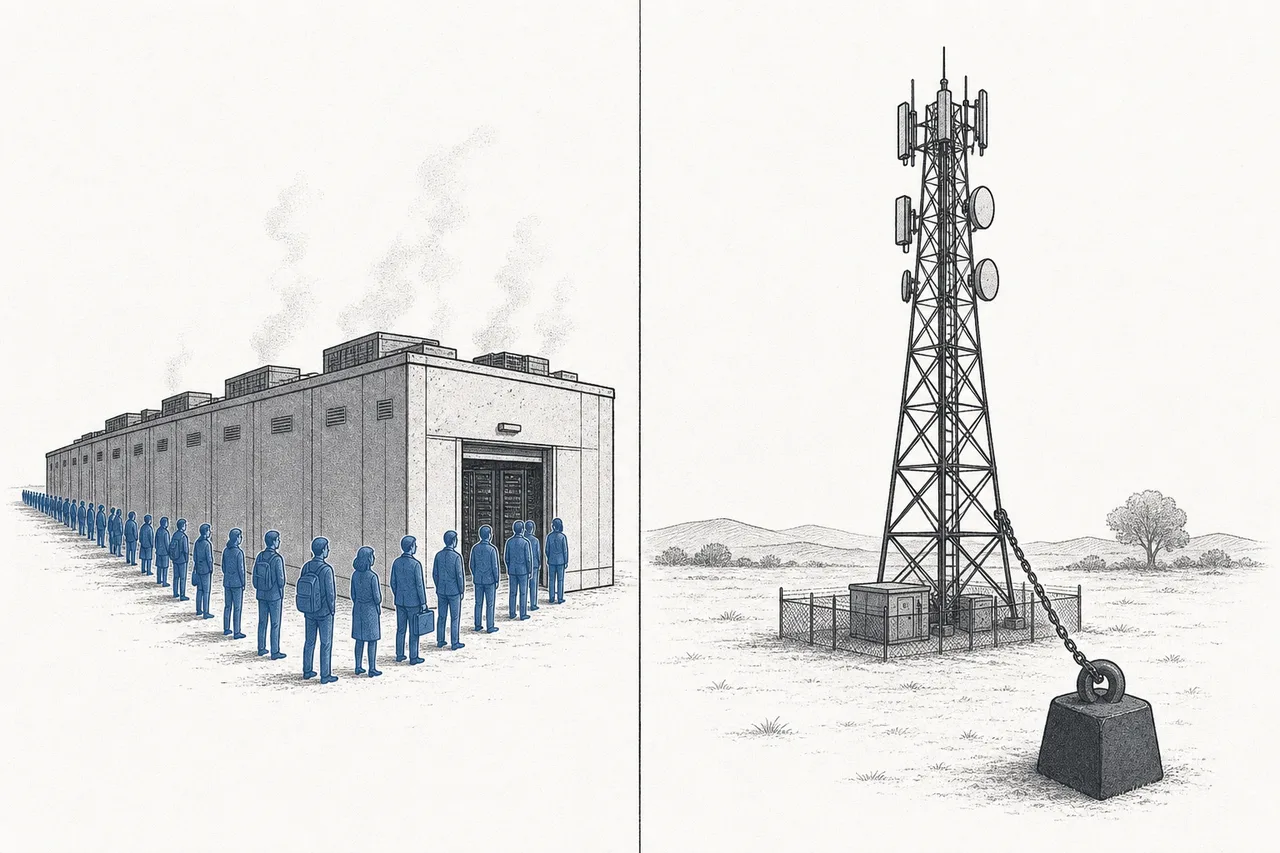
On the colocation side, the numbers tell the story: demand absorbed a record 2,498 megawatts of new space in 2025 (up from the old record of 1,810 megawatts in 2024), vacancy dropped to just 1.4%, and rents surged — the average rent for a 250–500 kilowatt block in primary markets hit a new record of $196.25 per kilowatt per month (+6.6% in a year), while the overall market grew about 14% a year.
The real winners on the colocation side are two American landlords, Equinix and Digital Realty. Equinix booked 2025 revenue of $9,217M (+5%), and in Q4 set a company record for gross bookings at $474M (+42% year over year) while becoming the first in the industry to hit 500,000 interconnections. Digital Realty signed $1,200M in new leases in 2025 and has a record backlog (signed deals waiting to be recognized as revenue) of nearly $1,400M.
The tower side moves to a different beat — a more mature business, with 5G growth slowing and the drag of high interest rates in 2023–2025. The global leader is American Tower, with over 149,000 sites worldwide (about 42,000 towers in the US). SBA Communications closed 2025 with a portfolio of 46,328 towers. The biggest turning point on this side is Crown Castle, which just sold its fiber and small-cell business for $8,500M (deal closing May 2026) to go back to being a 'pure tower company' — a sign that urban fiber turned out to be lower-return than expected.
06The road ahead
The first and strongest direction is that the AI wave will keep pushing demand onto the data-center side. More than 35 gigawatts of data-center capacity is under construction in North America, and ~60% is already pre-booked before it's finished. Equinix aims to double its capacity by 2029 — the job is to 'build fast enough to meet demand,' not 'find customers,' the opposite of an ordinary real-estate business.
The second direction is that power becomes the new battleground. With AI gobbling up enormous amounts of electricity, whoever can find land that 'has enough power' and connect to the grid fast will win — tying this node even more tightly to energy. Some deals now even require building a power plant alongside.
The third direction is the 'split by specialty' that Crown Castle did — companies are starting to choose to be 'pure towers' or 'pure data centers' instead of holding everything, because investors put a higher value on a focused, easy-to-understand business. The towers themselves still have a next wave waiting: the second phase of 5G, and the arrival of low-Earth-orbit satellites that could be both rival and partner.
07Challenges & risks
The appeal of the 'digital landlord' comes with its own specific risks that investors need to understand.
The first risk is rate sensitivity, because this business borrows heavily to expand its assets and is a dividend stock. When rates rise, borrowing costs go up, and dividend investors move their money into bonds that now yield more — this is why tower stocks did poorly during the rate-hike period of 2023–2024 even though the underlying business kept running.
The second risk is customer concentration. On the tower side, revenue depends on just a handful of big mobile carriers — SBA gets about 66% of its US revenue from the top 3, and Crown Castle once leaned about 75% on 3 carriers. When carriers merge (say T-Mobile and Sprint), towers that once had overlapping tenants can get gear stripped out, creating what's called 'churn' that drags on revenue — the fallout from the Sprint deal still runs into 2026.
When two mobile carriers merge, their networks 'overlap' — some towers that once carried both carriers' gear are left with a single tenant. The merged company then cancels some leases to cut costs. That's churn, and it temporarily drags down the tower owner's revenue, even if the long-run tenancy ratio is still trending up.
The third risk is the imbalance between the two sides of the business. The colocation side, hot because of AI, faces the question of whether AI demand is 'real and durable' or a 'one-time investment bubble.' If AI investment slows, the huge amount of space now under construction could end up oversupplied. Meanwhile the tower side risks slow growth and being undercut by new technology (like low-Earth-orbit satellites) — so investing in this node means being clear about whether you're buying the 'fast-growing but volatile side' or the 'quiet but rate-sensitive side.'
In short: behind the airy-sounding word 'cloud' is steel, concrete, and actual land with an owner. They don't sell anything to you — they collect rent on everything you tap on your screen. Understanding this node means understanding why 'the most boring real estate' became one of the arenas global capital is fighting to get into in the AI era.